
Oracle Critical Patch Update October 2022
Released October 2022 · Oracle's advisory ↗ · ← Critical Patch Update, July 2022 · Critical Patch Update, January 2023 →
179 CVEs in this release, one square each
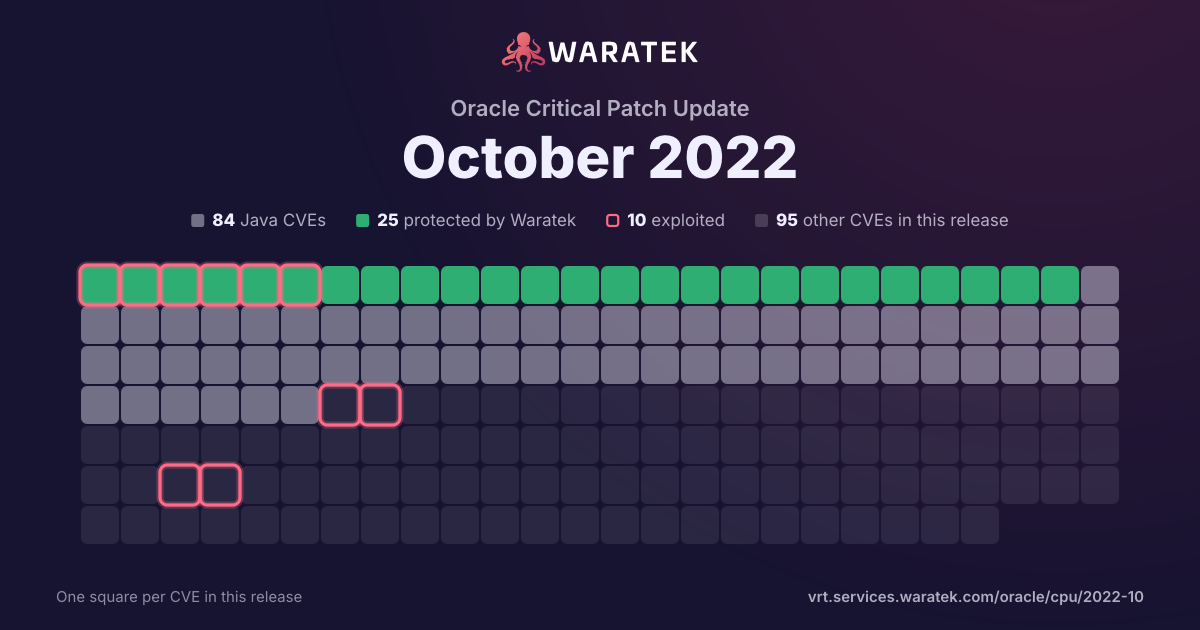
By status
26Protected by Waratek7Mitigation candidate58No exploit published3Outside Waratek scope85Not applicable
10Exploited, marked by the ring
No exploit published. For 34 of them, Oracle's security advisory is the source of public detail.
Protected by Waratek. Waratek RASP can block exploitation of these on systems that have not applied the patch yet.
Overview 130 matches · 58 in Waratek scope · 15 protected · 6 exploited · 2 CISA KEV · 11 public PoC · 10 EPSS ≥ 0.5
130matches
58in Waratek scope44.6%
15protected11.5%
6exploited4.6%
2CISA KEV1.5%
11public PoC8.5%
10EPSS ≥ 0.57.7%
Protected by Waratek
15
11.5%
Rule in development
0
0.0%
Mitigation candidate
4
3.1%
No exploit published
39
30.0%
Outside Waratek scope
3
2.3%
Not applicable
69
53.1%
Withdrawn CVE
0
0.0%
blocked by ARMR today
15
11.5%
partly blocked
0
0.0%
not blocked
115
88.5%
not established
0
0.0%
unrecorded
0
0.0%
split by
peak 79 / month
Jan 226
Protected by Waratek2
No exploit published1
Not applicable3
Critical3
High2
Medium1
blocked by ARMR today2
not blocked4
Exploited1
Proof of concept only3
No public exploit2
Feb 224
No exploit published1
Not applicable3
Critical2
High2
not blocked4
Proof of concept only2
No public exploit2
Mar 226
No exploit published1
Not applicable5
Critical1
High5
not blocked6
Proof of concept only1
Forecast only1
No public exploit4
Apr 225
Protected by Waratek3
No exploit published1
Not applicable1
Critical2
High1
Medium2
blocked by ARMR today3
not blocked2
Exploited2
Proof of concept only1
No public exploit2
May 2211
Protected by Waratek2
Mitigation candidate2
No exploit published3
Not applicable4
Critical4
High2
Medium5
blocked by ARMR today2
not blocked9
Working exploit published1
Proof of concept only3
No public exploit7
Jun 227
Protected by Waratek1
Mitigation candidate1
No exploit published1
Not applicable4
Critical3
High1
Medium2
Low1
blocked by ARMR today1
not blocked6
Exploited1
Proof of concept only3
No public exploit3
Jul 229
Mitigation candidate1
No exploit published2
Not applicable6
Critical3
High3
Medium3
not blocked9
Proof of concept only4
Forecast only1
No public exploit4
Aug 223
Protected by Waratek2
Not applicable1
High2
Medium1
blocked by ARMR today2
not blocked1
Proof of concept only2
No public exploit1
Sep 220
Oct 2279
Protected by Waratek5
No exploit published29
Outside Waratek scope3
Not applicable42
Critical2
High22
Medium49
Low6
blocked by ARMR today5
not blocked74
Exploited2
No public exploit77
Jan 22Feb 22Mar 22Apr 22May 22Jun 22Jul 22Aug 22Sep 22Oct 22
| CVE | Severity | Published▾ | Status | Exploitation | Description |
|---|---|---|---|---|---|
| CVE-2022-30126 | Medium | 2022-05-16 | No exploit published | No public exploit | In Apache Tika, a regular expression in our StandardsText class, used by the StandardsExtractingContentHandler could lead to a denial of service caused by backtracking on a specially crafted file. This only affects users who are running the StandardsExtractingContentHandler, which is a non-standard handler. This is fixed in 1.28.2 and 2.4.0 |
| CVE-2022-1587 | Critical | 2022-05-16 | Not applicable | No public exploit | An out-of-bounds read vulnerability was discovered in the PCRE2 library in the get_recurse_data_length() function of the pcre2_jit_compile.c file. This issue affects recursions in JIT-compiled regular expressions caused by duplicate data transfers. |
| CVE-2022-1586 | Critical | 2022-05-16 | Not applicable | No public exploit | An out-of-bounds read vulnerability was discovered in the PCRE2 library in the compile_xclass_matchingpath() function of the pcre2_jit_compile.c file. This involves a unicode property matching issue in JIT-compiled regular expressions. The issue occurs because the character was not fully read in case-less matching within JIT. |
| CVE-2022-29885 | High | 2022-05-12 | Mitigation candidate | Working exploit published | The documentation of Apache Tomcat 10.1.0-M1 to 10.1.0-M14, 10.0.0-M1 to 10.0.20, 9.0.13 to 9.0.62 and 8.5.38 to 8.5.78 for the EncryptInterceptor incorrectly stated it enabled Tomcat clustering to run over an untrusted network. This was not correct. While the EncryptInterceptor does provide confidentiality and integrity protection, it does not protect against all risks associated with running over any untrusted network, particularly DoS risks. |
| CVE-2022-22971 | Medium | 2022-05-12 | Protected by Waratek | No public exploit | In spring framework versions prior to 5.3.20+ , 5.2.22+ and old unsupported versions, application with a STOMP over WebSocket endpoint is vulnerable to a denial of service attack by an authenticated user. |
| CVE-2022-24823 | Medium | 2022-05-06 | No exploit published | Proof of concept only | Netty is an open-source, asynchronous event-driven network application framework. The package `io.netty:netty-codec-http` prior to version 4.1.77.Final contains an insufficient fix for CVE-2021-21290. When Netty's multipart decoders are used local information disclosure can occur via the local system temporary directory if temporary storing uploads on the disk is enabled. This only impacts applications running on Java version 6 and lower. Additionally, this vulnerability impacts code running on Unix-like systems, and very old versions of Mac OSX and Windows as they all share the system temporary directory between all users. Version 4.1.77.Final contains a patch for this vulnerability. As a workaround, specify one's own `java.io.tmpdir` when starting the JVM or use DefaultHttpDataFactory.setBaseDir(...) to set the directory to something that is only readable by the current user. |
| CVE-2022-29824 | Medium | 2022-05-03 | Not applicable | No public exploit | In libxml2 before 2.9.14, several buffer handling functions in buf.c (xmlBuf*) and tree.c (xmlBuffer*) don't check for integer overflows. This can result in out-of-bounds memory writes. Exploitation requires a victim to open a crafted, multi-gigabyte XML file. Other software using libxml2's buffer functions, for example libxslt through 1.1.35, is affected as well. |
| CVE-2022-1292 | Critical | 2022-05-03 | Not applicable | Proof of concept only | The c_rehash script does not properly sanitise shell metacharacters to prevent command injection. This script is distributed by some operating systems in a manner where it is automatically executed. On such operating systems, an attacker could execute arbitrary commands with the privileges of the script. Use of the c_rehash script is considered obsolete and should be replaced by the OpenSSL rehash command line tool. Fixed in OpenSSL 3.0.3 (Affected 3.0.0,3.0.1,3.0.2). Fixed in OpenSSL 1.1.1o (Affected 1.1.1-1.1.1n). Fixed in OpenSSL 1.0.2ze (Affected 1.0.2-1.0.2zd). |
| CVE-2022-25647 | High | 2022-05-01 | Protected by Waratek | No public exploit | The package com.google.code.gson:gson before 2.8.9 are vulnerable to Deserialization of Untrusted Data via the writeReplace() method in internal classes, which may lead to DoS attacks. |
| CVE-2022-23457 | Critical | 2022-04-25 | Protected by Waratek | Proof of concept only | ESAPI (The OWASP Enterprise Security API) is a free, open source, web application security control library. Prior to version 2.3.0.0, the default implementation of `Validator.getValidDirectoryPath(String, String, File, boolean)` may incorrectly treat the tested input string as a child of the specified parent directory. This potentially could allow control-flow bypass checks to be defeated if an attack can specify the entire string representing the 'input' path. This vulnerability is patched in release 2.3.0.0 of ESAPI. As a workaround, it is possible to write one's own implementation of the Validator interface. However, maintainers do not recommend this. |
| CVE-2022-29577 | Medium | 2022-04-21 | Protected by Waratek | No public exploit | OWASP AntiSamy before 1.6.7 allows XSS via HTML tag smuggling on STYLE content with crafted input. The output serializer does not properly encode the supposed Cascading Style Sheets (CSS) content. NOTE: this issue exists because of an incomplete fix for CVE-2022-28367. |
| CVE-2022-22968 | Medium | 2022-04-14 | No exploit published | No public exploit | In Spring Framework versions 5.3.0 - 5.3.18, 5.2.0 - 5.2.20, and older unsupported versions, the patterns for disallowedFields on a DataBinder are case sensitive which means a field is not effectively protected unless it is listed with both upper and lower case for the first character of the field, including upper and lower case for the first character of all nested fields within the property path. |
| CVE-2021-31805 | Critical | 2022-04-12 | Protected by Waratek | Exploited | The fix issued for CVE-2020-17530 was incomplete. So from Apache Struts 2.0.0 to 2.5.29, still some of the tag’s attributes could perform a double evaluation if a developer applied forced OGNL evaluation by using the %{...} syntax. Using forced OGNL evaluation on untrusted user input can lead to a Remote Code Execution and security degradation. |
| CVE-2022-24785 | High | 2022-04-04 | Not applicable | Exploited | Moment.js is a JavaScript date library for parsing, validating, manipulating, and formatting dates. A path traversal vulnerability impacts npm (server) users of Moment.js between versions 1.0.1 and 2.29.1, especially if a user-provided locale string is directly used to switch moment locale. This problem is patched in 2.29.2, and the patch can be applied to all affected versions. As a workaround, sanitize the user-provided locale name before passing it to Moment.js. |
| CVE-2022-1154 | High | 2022-03-30 | Not applicable | No public exploit | Use after free in utf_ptr2char in GitHub repository vim/vim prior to 8.2.4646. |
| CVE-2018-25032 | High | 2022-03-25 | Not applicable | Proof of concept only | zlib before 1.2.12 allows memory corruption when deflating (i.e., when compressing) if the input has many distant matches. |
| CVE-2022-24761 | High | 2022-03-17 | Not applicable | No public exploit | Waitress is a Web Server Gateway Interface server for Python 2 and 3. When using Waitress versions 2.1.0 and prior behind a proxy that does not properly validate the incoming HTTP request matches the RFC7230 standard, Waitress and the frontend proxy may disagree on where one request starts and where it ends. This would allow requests to be smuggled via the front-end proxy to waitress and later behavior. There are two classes of vulnerability that may lead to request smuggling that are addressed by this advisory: The use of Python's `int()` to parse strings into integers, leading to `+10` to be parsed as `10`, or `0x01` to be parsed as `1`, where as the standard specifies that the string should contain only digits or hex digits; and Waitress does not support chunk extensions, however it was discarding them without validating that they did not contain illegal characters. This vulnerability has been patched in Waitress 2.1.1. A workaround is available. When deploying a proxy in front of waitress, turning on any and all functionality to make sure that the request matches the RFC7230 standard. Certain proxy servers may not have this functionality though and users are encouraged to upgrade to the latest version of waitress instead. |
| CVE-2022-24729 | High | 2022-03-16 | Not applicable | No public exploit | CKEditor4 is an open source what-you-see-is-what-you-get HTML editor. CKEditor4 prior to version 4.18.0 contains a vulnerability in the `dialog` plugin. The vulnerability allows abuse of a dialog input validator regular expression, which can cause a significant performance drop resulting in a browser tab freeze. A patch is available in version 4.18.0. There are currently no known workarounds. |
| CVE-2022-23943 | Critical | 2022-03-14 | Not applicable | Forecast only | Out-of-bounds Write vulnerability in mod_sed of Apache HTTP Server allows an attacker to overwrite heap memory with possibly attacker provided data. This issue affects Apache HTTP Server 2.4 version 2.4.52 and prior versions. |
| CVE-2020-36518 | High | 2022-03-11 | No exploit published | No public exploit | jackson-databind before 2.13.0 allows a Java StackOverflow exception and denial of service via a large depth of nested objects. |
| CVE-2021-21708 | Critical | 2022-02-27 | Not applicable | No public exploit | In PHP versions 7.4.x below 7.4.28, 8.0.x below 8.0.16, and 8.1.x below 8.1.3, when using filter functions with FILTER_VALIDATE_FLOAT filter and min/max limits, if the filter fails, there is a possibility to trigger use of allocated memory after free, which can result it crashes, and potentially in overwrite of other memory chunks and RCE. This issue affects: code that uses FILTER_VALIDATE_FLOAT with min/max limits. |
| CVE-2022-25315 | Critical | 2022-02-18 | Not applicable | Proof of concept only | In Expat (aka libexpat) before 2.4.5, there is an integer overflow in storeRawNames. |
| CVE-2022-23632 | High | 2022-02-17 | Not applicable | No public exploit | Traefik is an HTTP reverse proxy and load balancer. Prior to version 2.6.1, Traefik skips the router transport layer security (TLS) configuration when the host header is a fully qualified domain name (FQDN). For a request, the TLS configuration choice can be different than the router choice, which implies the use of a wrong TLS configuration. When sending a request using FQDN handled by a router configured with a dedicated TLS configuration, the TLS configuration falls back to the default configuration that might not correspond to the configured one. If the CNAME flattening is enabled, the selected TLS configuration is the SNI one and the routing uses the CNAME value, so this can skip the expected TLS configuration. Version 2.6.1 contains a patch for this issue. As a workaround, one may add the FDQN to the host rule. However, there is no workaround if the CNAME flattening is enabled. |
| CVE-2021-43859 | High | 2022-02-01 | No exploit published | Proof of concept only | XStream is an open source java library to serialize objects to XML and back again. Versions prior to 1.4.19 may allow a remote attacker to allocate 100% CPU time on the target system depending on CPU type or parallel execution of such a payload resulting in a denial of service only by manipulating the processed input stream. XStream 1.4.19 monitors and accumulates the time it takes to add elements to collections and throws an exception if a set threshold is exceeded. Users are advised to upgrade as soon as possible. Users unable to upgrade may set the NO_REFERENCE mode to prevent recursion. See GHSA-rmr5-cpv2-vgjf for further details on a workaround if an upgrade is not possible. |
| CVE-2021-4034 | High | 2022-01-28 | Not applicable | Exploited | A local privilege escalation vulnerability was found on polkit's pkexec utility. The pkexec application is a setuid tool designed to allow unprivileged users to run commands as privileged users according predefined policies. The current version of pkexec doesn't handle the calling parameters count correctly and ends trying to execute environment variables as commands. An attacker can leverage this by crafting environment variables in such a way it'll induce pkexec to execute arbitrary code. When successfully executed the attack can cause a local privilege escalation given unprivileged users administrative rights on the target machine. |
| CVE-2022-23181 | High | 2022-01-27 | Protected by Waratek | No public exploit | The fix for bug CVE-2020-9484 introduced a time of check, time of use vulnerability into Apache Tomcat 10.1.0-M1 to 10.1.0-M8, 10.0.0-M5 to 10.0.14, 9.0.35 to 9.0.56 and 8.5.55 to 8.5.73 that allowed a local attacker to perform actions with the privileges of the user that the Tomcat process is using. This issue is only exploitable when Tomcat is configured to persist sessions using the FileStore. |
| CVE-2022-23437 | Medium | 2022-01-24 | No exploit published | No public exploit | There's a vulnerability within the Apache Xerces Java (XercesJ) XML parser when handling specially crafted XML document payloads. This causes, the XercesJ XML parser to wait in an infinite loop, which may sometimes consume system resources for prolonged duration. This vulnerability is present within XercesJ version 2.12.1 and the previous versions. |
| CVE-2022-23305 | Critical | 2022-01-18 | Protected by Waratek | Proof of concept only | By design, the JDBCAppender in Log4j 1.2.x accepts an SQL statement as a configuration parameter where the values to be inserted are converters from PatternLayout. The message converter, %m, is likely to always be included. This allows attackers to manipulate the SQL by entering crafted strings into input fields or headers of an application that are logged allowing unintended SQL queries to be executed. Note this issue only affects Log4j 1.x when specifically configured to use the JDBCAppender, which is not the default. Beginning in version 2.0-beta8, the JDBCAppender was re-introduced with proper support for parameterized SQL queries and further customization over the columns written to in logs. Apache Log4j 1.2 reached end of life in August 2015. Users should upgrade to Log4j 2 as it addresses numerous other issues from the previous versions. |
| CVE-2022-23219 | Critical | 2022-01-14 | Not applicable | Proof of concept only | The deprecated compatibility function clnt_create in the sunrpc module of the GNU C Library (aka glibc) through 2.34 copies its hostname argument on the stack without validating its length, which may result in a buffer overflow, potentially resulting in a denial of service or (if an application is not built with a stack protector enabled) arbitrary code execution. |
| CVE-2022-23218 | Critical | 2022-01-14 | Not applicable | Proof of concept only | The deprecated compatibility function svcunix_create in the sunrpc module of the GNU C Library (aka glibc) through 2.34 copies its path argument on the stack without validating its length, which may result in a buffer overflow, potentially resulting in a denial of service or (if an application is not built with a stack protector enabled) arbitrary code execution. |