
Oracle Critical Patch Update October 2022
Released October 2022 · Oracle's advisory ↗ · ← Critical Patch Update, July 2022 · Critical Patch Update, January 2023 →
179 CVEs in this release, one square each
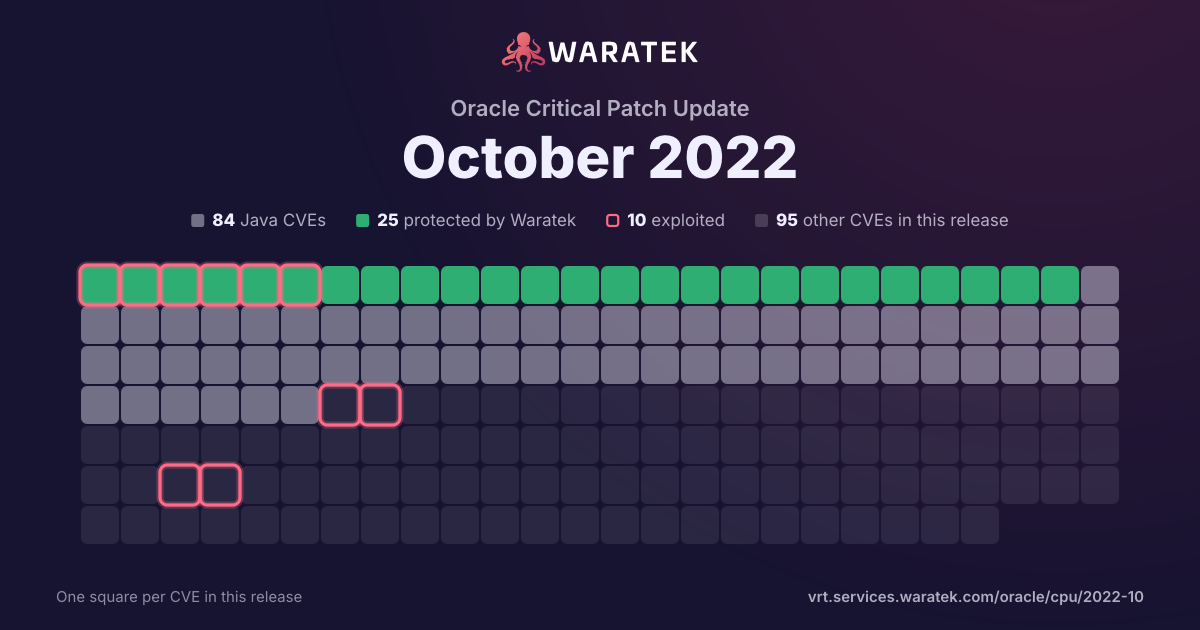
By status
25Protected by Waratek4Mitigation candidate55No exploit published48Outside Waratek scope47Not applicable
10Exploited, marked by the ring
No exploit published. For 33 of them, Oracle's security advisory is the source of public detail.
Protected by Waratek. Waratek RASP can block exploitation of these on systems that have not applied the patch yet.
Overview 24 matches · 0 protected · 0 exploited · 0 CISA KEV · 0 public PoC · 0 EPSS ≥ 0.5
24matches
0protected0.0%
0exploited0.0%
0CISA KEV0.0%
0public PoC0.0%
0EPSS ≥ 0.50.0%
Protected by Waratek
0
0.0%
Rule in development
0
0.0%
Mitigation candidate
0
0.0%
No exploit published
24
100.0%
blocked by ARMR today
0
0.0%
partly blocked
0
0.0%
not blocked
24
100.0%
not established
0
0.0%
unrecorded
0
0.0%
Exploited
0
0.0%
Working exploit published
0
0.0%
Proof of concept only
0
0.0%
Forecast only
0
0.0%
No public exploit
24
100.0%
split by
peak 12 / quarter
Q4 201
No exploit published1
High1
not blocked1
No public exploit1
Q1 213
No exploit published3
High3
not blocked3
No public exploit3
Q2 210
Q3 215
No exploit published5
High5
not blocked5
No public exploit5
Q4 210
Q1 221
No exploit published1
High1
not blocked1
No public exploit1
Q2 220
Q3 222
No exploit published2
High2
not blocked2
No public exploit2
Q4 2212
No exploit published12
High12
not blocked12
No public exploit12
Q4 20Q1 21Q2 21Q3 21Q4 21Q1 22Q2 22Q3 22Q4 22
| CVE | Severity | Published▾ | Status | Exploitation | Description |
|---|---|---|---|---|---|
| CVE-2022-39412 | High | 2022-10-18 | No exploit published | No public exploit | Vulnerability in the Oracle Access Manager product of Oracle Fusion Middleware (component: Admin Console). The supported version that is affected is 12.2.1.4.0. Easily exploitable vulnerability allows unauthenticated attacker with network access via HTTP to compromise Oracle Access Manager. Successful attacks of this vulnerability can result in unauthorized access to critical data or complete access to all Oracle Access Manager accessible data. CVSS 3.1 Base Score 7.5 (Confidentiality impacts). CVSS Vector: (CVSS:3.1/AV:N/AC:L/PR:N/UI:N/S:U/C:H/I:N/A:N). |
| CVE-2022-39406 | High | 2022-10-18 | No exploit published | No public exploit | Vulnerability in the PeopleSoft Enterprise Common Components product of Oracle PeopleSoft (component: Approval Framework). The supported version that is affected is 9.2. Easily exploitable vulnerability allows low privileged attacker with network access via HTTP to compromise PeopleSoft Enterprise Common Components. Successful attacks of this vulnerability can result in unauthorized creation, deletion or modification access to critical data or all PeopleSoft Enterprise Common Components accessible data as well as unauthorized access to critical data or complete access to all PeopleSoft Enterprise Common Components accessible data. CVSS 3.1 Base Score 8.1 (Confidentiality and Integrity impacts). CVSS Vector: (CVSS:3.1/AV:N/AC:L/PR:L/UI:N/S:U/C:H/I:H/A:N). |
| CVE-2022-21634 | High | 2022-10-18 | No exploit published | No public exploit | Vulnerability in the Oracle GraalVM Enterprise Edition product of Oracle Java SE (component: LLVM Interpreter). Supported versions that are affected are Oracle GraalVM Enterprise Edition: 20.3.7, 21.3.3 and 22.2.0. Easily exploitable vulnerability allows unauthenticated attacker with network access via multiple protocols to compromise Oracle GraalVM Enterprise Edition. Successful attacks of this vulnerability can result in unauthorized ability to cause a hang or frequently repeatable crash (complete DOS) of Oracle GraalVM Enterprise Edition. CVSS 3.1 Base Score 7.5 (Availability impacts). CVSS Vector: (CVSS:3.1/AV:N/AC:L/PR:N/UI:N/S:U/C:N/I:N/A:H). |
| CVE-2022-21623 | High | 2022-10-18 | No exploit published | No public exploit | Vulnerability in the Enterprise Manager Base Platform product of Oracle Enterprise Manager (component: Application Config Console). Supported versions that are affected are 13.4.0.0 and 13.5.0.0. Easily exploitable vulnerability allows unauthenticated attacker with network access via HTTP to compromise Enterprise Manager Base Platform. Successful attacks of this vulnerability can result in unauthorized creation, deletion or modification access to critical data or all Enterprise Manager Base Platform accessible data. CVSS 3.1 Base Score 7.5 (Integrity impacts). CVSS Vector: (CVSS:3.1/AV:N/AC:L/PR:N/UI:N/S:U/C:N/I:H/A:N). |
| CVE-2022-21622 | High | 2022-10-18 | No exploit published | No public exploit | Vulnerability in the Oracle SOA Suite product of Oracle Fusion Middleware (component: Adapters). Supported versions that are affected are 12.2.1.3.0 and 12.2.1.4.0. Easily exploitable vulnerability allows unauthenticated attacker with network access via HTTP to compromise Oracle SOA Suite. Successful attacks of this vulnerability can result in unauthorized creation, deletion or modification access to critical data or all Oracle SOA Suite accessible data. CVSS 3.1 Base Score 7.5 (Integrity impacts). CVSS Vector: (CVSS:3.1/AV:N/AC:L/PR:N/UI:N/S:U/C:N/I:H/A:N). |
| CVE-2022-21615 | High | 2022-10-18 | No exploit published | No public exploit | Vulnerability in the Oracle Enterprise Data Quality product of Oracle Fusion Middleware (component: Dashboard). Supported versions that are affected are 12.2.1.3.0 and 12.2.1.4.0. Easily exploitable vulnerability allows unauthenticated attacker with network access via HTTP to compromise Oracle Enterprise Data Quality. Successful attacks require human interaction from a person other than the attacker and while the vulnerability is in Oracle Enterprise Data Quality, attacks may significantly impact additional products (scope change). Successful attacks of this vulnerability can result in unauthorized access to critical data or complete access to all Oracle Enterprise Data Quality accessible data. CVSS 3.1 Base Score 7.4 (Confidentiality impacts). CVSS Vector: (CVSS:3.1/AV:N/AC:L/PR:N/UI:R/S:C/C:H/I:N/A:N). |
| CVE-2022-21614 | High | 2022-10-18 | No exploit published | No public exploit | Vulnerability in the Oracle Enterprise Data Quality product of Oracle Fusion Middleware (component: Dashboard). Supported versions that are affected are 12.2.1.3.0 and 12.2.1.4.0. Easily exploitable vulnerability allows unauthenticated attacker with network access via HTTP to compromise Oracle Enterprise Data Quality. Successful attacks of this vulnerability can result in unauthorized access to critical data or complete access to all Oracle Enterprise Data Quality accessible data. CVSS 3.1 Base Score 7.5 (Confidentiality impacts). CVSS Vector: (CVSS:3.1/AV:N/AC:L/PR:N/UI:N/S:U/C:H/I:N/A:N). |
| CVE-2022-21613 | High | 2022-10-18 | No exploit published | No public exploit | Vulnerability in the Oracle Enterprise Data Quality product of Oracle Fusion Middleware (component: Dashboard). Supported versions that are affected are 12.2.1.3.0 and 12.2.1.4.0. Easily exploitable vulnerability allows unauthenticated attacker with network access via HTTP to compromise Oracle Enterprise Data Quality. Successful attacks require human interaction from a person other than the attacker and while the vulnerability is in Oracle Enterprise Data Quality, attacks may significantly impact additional products (scope change). Successful attacks of this vulnerability can result in unauthorized access to critical data or complete access to all Oracle Enterprise Data Quality accessible data as well as unauthorized update, insert or delete access to some of Oracle Enterprise Data Quality accessible data and unauthorized ability to cause a partial denial of service (partial DOS) of Oracle Enterprise Data Quality. CVSS 3.1 Base Score 8.8 (Confidentiality, Integrity and Availability impacts). CVSS Vector: (CVSS:3.1/AV:N/AC:L/PR:N/UI:R/S:C/C:H/I:L/A:L). |
| CVE-2022-21612 | High | 2022-10-18 | No exploit published | No public exploit | Vulnerability in the Oracle Enterprise Data Quality product of Oracle Fusion Middleware (component: Dashboard). Supported versions that are affected are 12.2.1.3.0 and 12.2.1.4.0. Easily exploitable vulnerability allows low privileged attacker with network access via HTTP to compromise Oracle Enterprise Data Quality. Successful attacks of this vulnerability can result in unauthorized creation, deletion or modification access to critical data or all Oracle Enterprise Data Quality accessible data as well as unauthorized access to critical data or complete access to all Oracle Enterprise Data Quality accessible data. CVSS 3.1 Base Score 8.1 (Confidentiality and Integrity impacts). CVSS Vector: (CVSS:3.1/AV:N/AC:L/PR:L/UI:N/S:U/C:H/I:H/A:N). |
| CVE-2022-21598 | High | 2022-10-18 | No exploit published | No public exploit | Vulnerability in the Siebel Core - DB Deployment and Configuration product of Oracle Siebel CRM (component: Repository Utilities). Supported versions that are affected are 22.8 and prior. Easily exploitable vulnerability allows unauthenticated attacker with network access via HTTP to compromise Siebel Core - DB Deployment and Configuration. Successful attacks of this vulnerability can result in unauthorized creation, deletion or modification access to critical data or all Siebel Core - DB Deployment and Configuration accessible data. CVSS 3.1 Base Score 7.5 (Integrity impacts). CVSS Vector: (CVSS:3.1/AV:N/AC:L/PR:N/UI:N/S:U/C:N/I:H/A:N). |
| CVE-2022-21593 | High | 2022-10-18 | No exploit published | No public exploit | Vulnerability in the Oracle HTTP Server product of Oracle Fusion Middleware (component: OHS Config MBeans). Supported versions that are affected are 12.2.1.3.0 and 12.2.1.4.0. Easily exploitable vulnerability allows unauthenticated attacker with network access via HTTP to compromise Oracle HTTP Server. Successful attacks require human interaction from a person other than the attacker. Successful attacks of this vulnerability can result in unauthorized access to critical data or complete access to all Oracle HTTP Server accessible data as well as unauthorized update, insert or delete access to some of Oracle HTTP Server accessible data. CVSS 3.1 Base Score 7.1 (Confidentiality and Integrity impacts). CVSS Vector: (CVSS:3.1/AV:N/AC:L/PR:N/UI:R/S:U/C:H/I:L/A:N). |
| CVE-2022-21590 | High | 2022-10-18 | No exploit published | No public exploit | Vulnerability in the Oracle BI Publisher product of Oracle Fusion Middleware (component: Core Formatting API). Supported versions that are affected are 5.9.0.0, 6.4.0.0.0, 12.2.1.3.0 and 12.2.1.4.0. Easily exploitable vulnerability allows low privileged attacker with network access via HTTP to compromise Oracle BI Publisher. Successful attacks of this vulnerability can result in unauthorized access to critical data or complete access to all Oracle BI Publisher accessible data as well as unauthorized update, insert or delete access to some of Oracle BI Publisher accessible data and unauthorized ability to cause a partial denial of service (partial DOS) of Oracle BI Publisher. CVSS 3.1 Base Score 7.6 (Confidentiality, Integrity and Availability impacts). CVSS Vector: (CVSS:3.1/AV:N/AC:L/PR:L/UI:N/S:U/C:H/I:L/A:L). |
| CVE-2022-2191 | High | 2022-07-07 | No exploit published | No public exploit | In Eclipse Jetty versions 10.0.0 thru 10.0.9, and 11.0.0 thru 11.0.9 versions, SslConnection does not release ByteBuffers from configured ByteBufferPool in case of error code paths. |
| CVE-2022-2048 | High | 2022-07-07 | No exploit published | No public exploit | In Eclipse Jetty HTTP/2 server implementation, when encountering an invalid HTTP/2 request, the error handling has a bug that can wind up not properly cleaning up the active connections and associated resources. This can lead to a Denial of Service scenario where there are no enough resources left to process good requests. |
| CVE-2020-36518 | High | 2022-03-11 | No exploit published | No public exploit | jackson-databind before 2.13.0 allows a Java StackOverflow exception and denial of service via a large depth of nested objects. |
| CVE-2021-40690 | High | 2021-09-19 | No exploit published | No public exploit | All versions of Apache Santuario - XML Security for Java prior to 2.2.3 and 2.1.7 are vulnerable to an issue where the "secureValidation" property is not passed correctly when creating a KeyInfo from a KeyInfoReference element. This allows an attacker to abuse an XPath Transform to extract any local .xml files in a RetrievalMethod element. |
| CVE-2021-28490 | High | 2021-08-19 | No exploit published | No public exploit | In OWASP CSRFGuard through 3.1.0, CSRF can occur because the CSRF cookie may be retrieved by using only a session token. |
| CVE-2021-2351 | High | 2021-07-21 | No exploit published | No public exploit | Vulnerability in the Advanced Networking Option component of Oracle Database Server. Supported versions that are affected are 12.1.0.2, 12.2.0.1 and 19c. Difficult to exploit vulnerability allows unauthenticated attacker with network access via Oracle Net to compromise Advanced Networking Option. Successful attacks require human interaction from a person other than the attacker and while the vulnerability is in Advanced Networking Option, attacks may significantly impact additional products. Successful attacks of this vulnerability can result in takeover of Advanced Networking Option. Note: The July 2021 Critical Patch Update introduces a number of Native Network Encryption changes to deal with vulnerability CVE-2021-2351 and prevent the use of weaker ciphers. Customers should review: "Changes in Native Network Encryption with the July 2021 Critical Patch Update" (Doc ID 2791571.1). CVSS 3.1 Base Score 8.3 (Confidentiality, Integrity and Availability impacts). CVSS Vector: (CVSS:3.1/AV:N/AC:H/PR:N/UI:R/S:C/C:H/I:H/A:H). |
| CVE-2021-36090 | High | 2021-07-13 | No exploit published | No public exploit | When reading a specially crafted ZIP archive, Compress can be made to allocate large amounts of memory that finally leads to an out of memory error even for very small inputs. This could be used to mount a denial of service attack against services that use Compress' zip package. |
| CVE-2021-30639 | High | 2021-07-12 | No exploit published | No public exploit | A vulnerability in Apache Tomcat allows an attacker to remotely trigger a denial of service. An error introduced as part of a change to improve error handling during non-blocking I/O meant that the error flag associated with the Request object was not reset between requests. This meant that once a non-blocking I/O error occurred, all future requests handled by that request object would fail. Users were able to trigger non-blocking I/O errors, e.g. by dropping a connection, thereby creating the possibility of triggering a DoS. Applications that do not use non-blocking I/O are not exposed to this vulnerability. This issue affects Apache Tomcat 10.0.3 to 10.0.4; 9.0.44; 8.5.64. |
| CVE-2020-13936 | High | 2021-03-10 | No exploit published | No public exploit | An attacker that is able to modify Velocity templates may execute arbitrary Java code or run arbitrary system commands with the same privileges as the account running the Servlet container. This applies to applications that allow untrusted users to upload/modify velocity templates running Apache Velocity Engine versions up to 2.2. |
| CVE-2020-11987 | High | 2021-02-24 | No exploit published | No public exploit | Apache Batik 1.13 is vulnerable to server-side request forgery, caused by improper input validation by the NodePickerPanel. By using a specially-crafted argument, an attacker could exploit this vulnerability to cause the underlying server to make arbitrary GET requests. |
| CVE-2020-9492 | High | 2021-01-26 | No exploit published | No public exploit | In Apache Hadoop 3.2.0 to 3.2.1, 3.0.0-alpha1 to 3.1.3, and 2.0.0-alpha to 2.10.0, WebHDFS client might send SPNEGO authorization header to remote URL without proper verification. |
| CVE-2020-28052 | High | 2020-12-18 | No exploit published | No public exploit | An issue was discovered in Legion of the Bouncy Castle BC Java 1.65 and 1.66. The OpenBSDBCrypt.checkPassword utility method compared incorrect data when checking the password, allowing incorrect passwords to indicate they were matching with previously hashed ones that were different. |