
Oracle Critical Patch Update October 2022
Released October 2022 · Oracle's advisory ↗ · ← Critical Patch Update, July 2022 · Critical Patch Update, January 2023 →
179 CVEs in this release, one square each
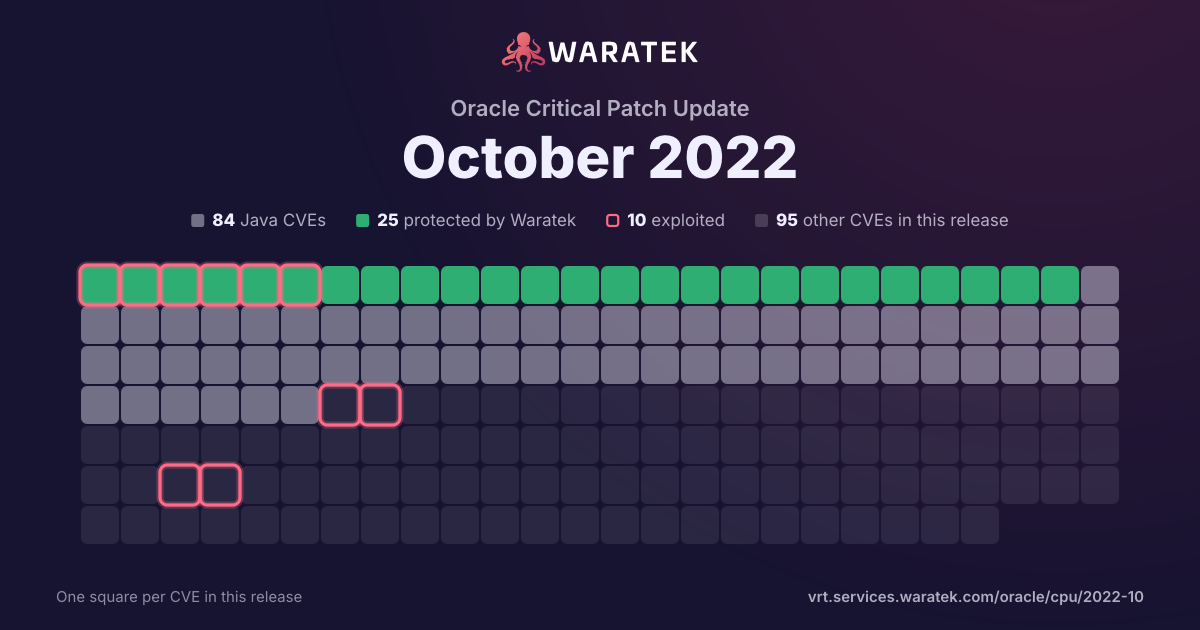
By status
26Protected by Waratek5Mitigation candidate57No exploit published3Outside Waratek scope88Not applicable
10Exploited, marked by the ring
No exploit published. For 33 of them, Oracle's security advisory is the source of public detail.
Protected by Waratek. Waratek RASP can block exploitation of these on systems that have not applied the patch yet.
Overview 10 matches · 4 in Waratek scope · 2 protected · 0 exploited · 0 CISA KEV · 3 public PoC · 2 EPSS ≥ 0.5
10matches
4in Waratek scope40.0%
2protected20.0%
0exploited0.0%
0CISA KEV0.0%
3public PoC30.0%
2EPSS ≥ 0.520.0%
Protected by Waratek
2
20.0%
Rule in development
0
0.0%
Mitigation candidate
1
10.0%
No exploit published
1
10.0%
Outside Waratek scope
0
0.0%
Not applicable
6
60.0%
Withdrawn CVE
0
0.0%
blocked by ARMR today
2
20.0%
partly blocked
0
0.0%
not blocked
8
80.0%
not established
0
0.0%
unrecorded
0
0.0%
Exploited
0
0.0%
Working exploit published
0
0.0%
Proof of concept only
10
100.0%
Forecast only
0
0.0%
No public exploit
0
0.0%
split by
peak 6 / quarter
Q4 191
Mitigation candidate1
Critical1
not blocked1
Proof of concept only1
Q1 200
Q2 200
Q3 200
Q4 200
Q1 210
Q2 210
Q3 211
Not applicable1
High1
not blocked1
Proof of concept only1
Q4 211
Not applicable1
Medium1
not blocked1
Proof of concept only1
Q1 226
Protected by Waratek1
No exploit published1
Not applicable4
Critical4
High2
blocked by ARMR today1
not blocked5
Proof of concept only6
Q2 221
Protected by Waratek1
Critical1
blocked by ARMR today1
Proof of concept only1
Q4 19Q1 20Q2 20Q3 20Q4 20Q1 21Q2 21Q3 21Q4 21Q1 22Q2 22
| CVE | Severity | Published▾ | Status | Exploitation | Description |
|---|---|---|---|---|---|
| CVE-2022-23457 | Critical | 2022-04-25 | Protected by Waratek | Proof of concept only | ESAPI (The OWASP Enterprise Security API) is a free, open source, web application security control library. Prior to version 2.3.0.0, the default implementation of `Validator.getValidDirectoryPath(String, String, File, boolean)` may incorrectly treat the tested input string as a child of the specified parent directory. This potentially could allow control-flow bypass checks to be defeated if an attack can specify the entire string representing the 'input' path. This vulnerability is patched in release 2.3.0.0 of ESAPI. As a workaround, it is possible to write one's own implementation of the Validator interface. However, maintainers do not recommend this. |
| CVE-2018-25032 | High | 2022-03-25 | Not applicable | Proof of concept only | zlib before 1.2.12 allows memory corruption when deflating (i.e., when compressing) if the input has many distant matches. |
| CVE-2022-25315 | Critical | 2022-02-18 | Not applicable | Proof of concept only | In Expat (aka libexpat) before 2.4.5, there is an integer overflow in storeRawNames. |
| CVE-2021-43859 | High | 2022-02-01 | No exploit published | Proof of concept only | XStream is an open source java library to serialize objects to XML and back again. Versions prior to 1.4.19 may allow a remote attacker to allocate 100% CPU time on the target system depending on CPU type or parallel execution of such a payload resulting in a denial of service only by manipulating the processed input stream. XStream 1.4.19 monitors and accumulates the time it takes to add elements to collections and throws an exception if a set threshold is exceeded. Users are advised to upgrade as soon as possible. Users unable to upgrade may set the NO_REFERENCE mode to prevent recursion. See GHSA-rmr5-cpv2-vgjf for further details on a workaround if an upgrade is not possible. |
| CVE-2022-23305 | Critical | 2022-01-18 | Protected by Waratek | Proof of concept only | By design, the JDBCAppender in Log4j 1.2.x accepts an SQL statement as a configuration parameter where the values to be inserted are converters from PatternLayout. The message converter, %m, is likely to always be included. This allows attackers to manipulate the SQL by entering crafted strings into input fields or headers of an application that are logged allowing unintended SQL queries to be executed. Note this issue only affects Log4j 1.x when specifically configured to use the JDBCAppender, which is not the default. Beginning in version 2.0-beta8, the JDBCAppender was re-introduced with proper support for parameterized SQL queries and further customization over the columns written to in logs. Apache Log4j 1.2 reached end of life in August 2015. Users should upgrade to Log4j 2 as it addresses numerous other issues from the previous versions. |
| CVE-2022-23219 | Critical | 2022-01-14 | Not applicable | Proof of concept only | The deprecated compatibility function clnt_create in the sunrpc module of the GNU C Library (aka glibc) through 2.34 copies its hostname argument on the stack without validating its length, which may result in a buffer overflow, potentially resulting in a denial of service or (if an application is not built with a stack protector enabled) arbitrary code execution. |
| CVE-2022-23218 | Critical | 2022-01-14 | Not applicable | Proof of concept only | The deprecated compatibility function svcunix_create in the sunrpc module of the GNU C Library (aka glibc) through 2.34 copies its path argument on the stack without validating its length, which may result in a buffer overflow, potentially resulting in a denial of service or (if an application is not built with a stack protector enabled) arbitrary code execution. |
| CVE-2021-41184 | Medium | 2021-10-26 | Not applicable | Proof of concept only | jQuery-UI is the official jQuery user interface library. Prior to version 1.13.0, accepting the value of the `of` option of the `.position()` util from untrusted sources may execute untrusted code. The issue is fixed in jQuery UI 1.13.0. Any string value passed to the `of` option is now treated as a CSS selector. A workaround is to not accept the value of the `of` option from untrusted sources. |
| CVE-2021-22946 | High | 2021-09-29 | Not applicable | Proof of concept only | A user can tell curl >= 7.20.0 and <= 7.78.0 to require a successful upgrade to TLS when speaking to an IMAP, POP3 or FTP server (`--ssl-reqd` on the command line or`CURLOPT_USE_SSL` set to `CURLUSESSL_CONTROL` or `CURLUSESSL_ALL` withlibcurl). This requirement could be bypassed if the server would return a properly crafted but perfectly legitimate response.This flaw would then make curl silently continue its operations **withoutTLS** contrary to the instructions and expectations, exposing possibly sensitive data in clear text over the network. |
| CVE-2019-17195 | Critical | 2019-10-15 | Mitigation candidate | Proof of concept only | Connect2id Nimbus JOSE+JWT before v7.9 can throw various uncaught exceptions while parsing a JWT, which could result in an application crash (potential information disclosure) or a potential authentication bypass. |