
Oracle Critical Patch Update October 2022
Released October 2022 · Oracle's advisory ↗ · ← Critical Patch Update, July 2022 · Critical Patch Update, January 2023 →
179 CVEs in this release, one square each
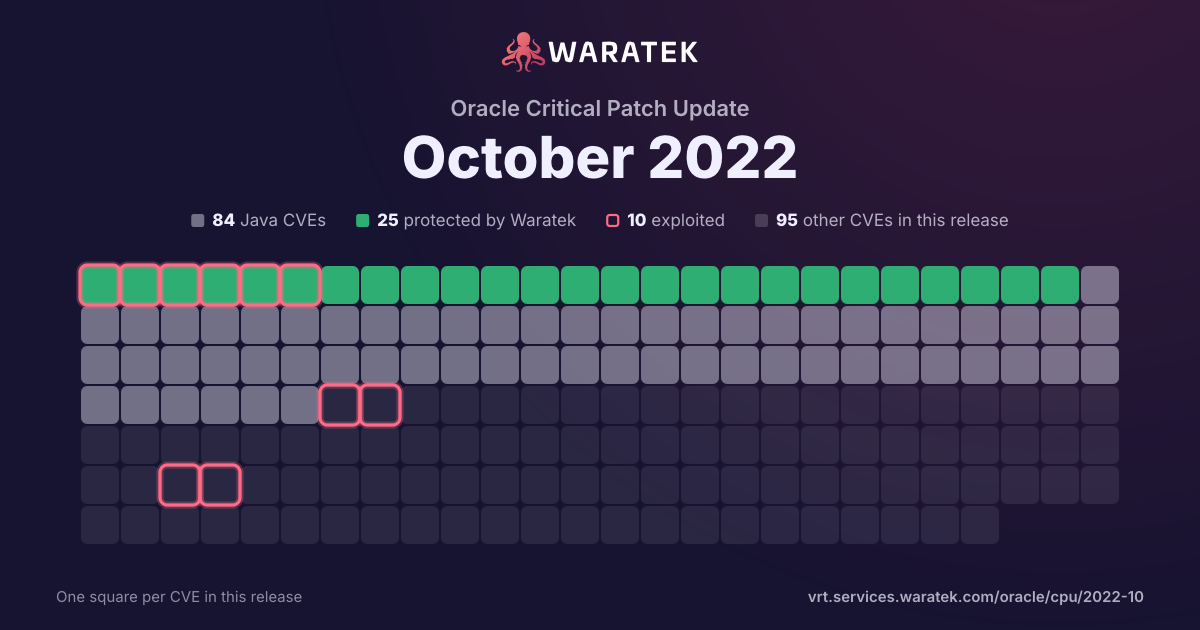
By status
26Protected by Waratek5Mitigation candidate57No exploit published3Outside Waratek scope88Not applicable
10Exploited, marked by the ring
No exploit published. For 33 of them, Oracle's security advisory is the source of public detail.
Protected by Waratek. Waratek RASP can block exploitation of these on systems that have not applied the patch yet.
Overview 12 matches · 0 protected · 0 exploited · 0 CISA KEV · 0 public PoC · 0 EPSS ≥ 0.5
12matches
0protected0.0%
0exploited0.0%
0CISA KEV0.0%
0public PoC0.0%
0EPSS ≥ 0.50.0%
Protected by Waratek
0
0.0%
Rule in development
0
0.0%
Mitigation candidate
0
0.0%
No exploit published
12
100.0%
blocked by ARMR today
0
0.0%
partly blocked
0
0.0%
not blocked
12
100.0%
not established
0
0.0%
unrecorded
0
0.0%
Exploited
0
0.0%
Working exploit published
0
0.0%
Proof of concept only
1
8.3%
Forecast only
0
0.0%
No public exploit
11
91.7%
split by
peak 3 / month
Dec 201
No exploit published1
High1
not blocked1
No public exploit1
Jan 210
Feb 211
No exploit published1
High1
not blocked1
No public exploit1
Mar 212
No exploit published2
High1
Medium1
not blocked2
No public exploit2
Apr 210
May 210
Jun 210
Jul 213
No exploit published3
High2
Medium1
not blocked3
No public exploit3
Aug 210
Sep 211
No exploit published1
High1
not blocked1
No public exploit1
Oct 210
Nov 210
Dec 212
No exploit published2
Critical2
not blocked2
No public exploit2
Jan 220
Feb 221
No exploit published1
High1
not blocked1
Proof of concept only1
Mar 221
No exploit published1
High1
not blocked1
No public exploit1
Jan 21Mar 21May 21Jul 21Sep 21Nov 21Jan 22Mar 22
| CVE | Severity | Published▾ | Status | Exploitation | Description |
|---|---|---|---|---|---|
| CVE-2020-36518 | High | 2022-03-11 | No exploit published | No public exploit | jackson-databind before 2.13.0 allows a Java StackOverflow exception and denial of service via a large depth of nested objects. |
| CVE-2021-43859 | High | 2022-02-01 | No exploit published | Proof of concept only | XStream is an open source java library to serialize objects to XML and back again. Versions prior to 1.4.19 may allow a remote attacker to allocate 100% CPU time on the target system depending on CPU type or parallel execution of such a payload resulting in a denial of service only by manipulating the processed input stream. XStream 1.4.19 monitors and accumulates the time it takes to add elements to collections and throws an exception if a set threshold is exceeded. Users are advised to upgrade as soon as possible. Users unable to upgrade may set the NO_REFERENCE mode to prevent recursion. See GHSA-rmr5-cpv2-vgjf for further details on a workaround if an upgrade is not possible. |
| CVE-2021-23450 | Critical | 2021-12-17 | No exploit published | No public exploit | All versions of package dojo are vulnerable to Prototype Pollution via the setObject function. |
| CVE-2021-43527 | Critical | 2021-12-08 | No exploit published | No public exploit | NSS (Network Security Services) versions prior to 3.73 or 3.68.1 ESR are vulnerable to a heap overflow when handling DER-encoded DSA or RSA-PSS signatures. Applications using NSS for handling signatures encoded within CMS, S/MIME, PKCS \#7, or PKCS \#12 are likely to be impacted. Applications using NSS for certificate validation or other TLS, X.509, OCSP or CRL functionality may be impacted, depending on how they configure NSS. *Note: This vulnerability does NOT impact Mozilla Firefox.* However, email clients and PDF viewers that use NSS for signature verification, such as Thunderbird, LibreOffice, Evolution and Evince are believed to be impacted. This vulnerability affects NSS < 3.73 and NSS < 3.68.1. |
| CVE-2021-40690 | High | 2021-09-19 | No exploit published | No public exploit | All versions of Apache Santuario - XML Security for Java prior to 2.2.3 and 2.1.7 are vulnerable to an issue where the "secureValidation" property is not passed correctly when creating a KeyInfo from a KeyInfoReference element. This allows an attacker to abuse an XPath Transform to extract any local .xml files in a RetrievalMethod element. |
| CVE-2021-2351 | High | 2021-07-21 | No exploit published | No public exploit | Vulnerability in the Advanced Networking Option component of Oracle Database Server. Supported versions that are affected are 12.1.0.2, 12.2.0.1 and 19c. Difficult to exploit vulnerability allows unauthenticated attacker with network access via Oracle Net to compromise Advanced Networking Option. Successful attacks require human interaction from a person other than the attacker and while the vulnerability is in Advanced Networking Option, attacks may significantly impact additional products. Successful attacks of this vulnerability can result in takeover of Advanced Networking Option. Note: The July 2021 Critical Patch Update introduces a number of Native Network Encryption changes to deal with vulnerability CVE-2021-2351 and prevent the use of weaker ciphers. Customers should review: "Changes in Native Network Encryption with the July 2021 Critical Patch Update" (Doc ID 2791571.1). CVSS 3.1 Base Score 8.3 (Confidentiality, Integrity and Availability impacts). CVSS Vector: (CVSS:3.1/AV:N/AC:H/PR:N/UI:R/S:C/C:H/I:H/A:H). |
| CVE-2021-36374 | Medium | 2021-07-14 | No exploit published | No public exploit | When reading a specially crafted ZIP archive, or a derived formats, an Apache Ant build can be made to allocate large amounts of memory that leads to an out of memory error, even for small inputs. This can be used to disrupt builds using Apache Ant. Commonly used derived formats from ZIP archives are for instance JAR files and many office files. Apache Ant prior to 1.9.16 and 1.10.11 were affected. |
| CVE-2021-36090 | High | 2021-07-13 | No exploit published | No public exploit | When reading a specially crafted ZIP archive, Compress can be made to allocate large amounts of memory that finally leads to an out of memory error even for very small inputs. This could be used to mount a denial of service attack against services that use Compress' zip package. |
| CVE-2020-13936 | High | 2021-03-10 | No exploit published | No public exploit | An attacker that is able to modify Velocity templates may execute arbitrary Java code or run arbitrary system commands with the same privileges as the account running the Servlet container. This applies to applications that allow untrusted users to upload/modify velocity templates running Apache Velocity Engine versions up to 2.2. |
| CVE-2021-21295 | Medium | 2021-03-09 | No exploit published | No public exploit | Netty is an open-source, asynchronous event-driven network application framework for rapid development of maintainable high performance protocol servers & clients. In Netty (io.netty:netty-codec-http2) before version 4.1.60.Final there is a vulnerability that enables request smuggling. If a Content-Length header is present in the original HTTP/2 request, the field is not validated by `Http2MultiplexHandler` as it is propagated up. This is fine as long as the request is not proxied through as HTTP/1.1. If the request comes in as an HTTP/2 stream, gets converted into the HTTP/1.1 domain objects (`HttpRequest`, `HttpContent`, etc.) via `Http2StreamFrameToHttpObjectCodec `and then sent up to the child channel's pipeline and proxied through a remote peer as HTTP/1.1 this may result in request smuggling. In a proxy case, users may assume the content-length is validated somehow, which is not the case. If the request is forwarded to a backend channel that is a HTTP/1.1 connection, the Content-Length now has meaning and needs to be checked. An attacker can smuggle requests inside the body as it gets downgraded from HTTP/2 to HTTP/1.1. For an example attack refer to the linked GitHub Advisory. Users are only affected if all of this is true: `HTTP2MultiplexCodec` or `Http2FrameCodec` is used, `Http2StreamFrameToHttpObjectCodec` is used to convert to HTTP/1.1 objects, and these HTTP/1.1 objects are forwarded to another remote peer. This has been patched in 4.1.60.Final As a workaround, the user can do the validation by themselves by implementing a custom `ChannelInboundHandler` that is put in the `ChannelPipeline` behind `Http2StreamFrameToHttpObjectCodec`. |
| CVE-2020-11987 | High | 2021-02-24 | No exploit published | No public exploit | Apache Batik 1.13 is vulnerable to server-side request forgery, caused by improper input validation by the NodePickerPanel. By using a specially-crafted argument, an attacker could exploit this vulnerability to cause the underlying server to make arbitrary GET requests. |
| CVE-2020-28052 | High | 2020-12-18 | No exploit published | No public exploit | An issue was discovered in Legion of the Bouncy Castle BC Java 1.65 and 1.66. The OpenBSDBCrypt.checkPassword utility method compared incorrect data when checking the password, allowing incorrect passwords to indicate they were matching with previously hashed ones that were different. |