
Oracle Critical Patch Update July 2022
Released July 2022 · Oracle's advisory ↗ · ← Critical Patch Update, April 2022 · Critical Patch Update, October 2022 →
188 CVEs in this release, one square each
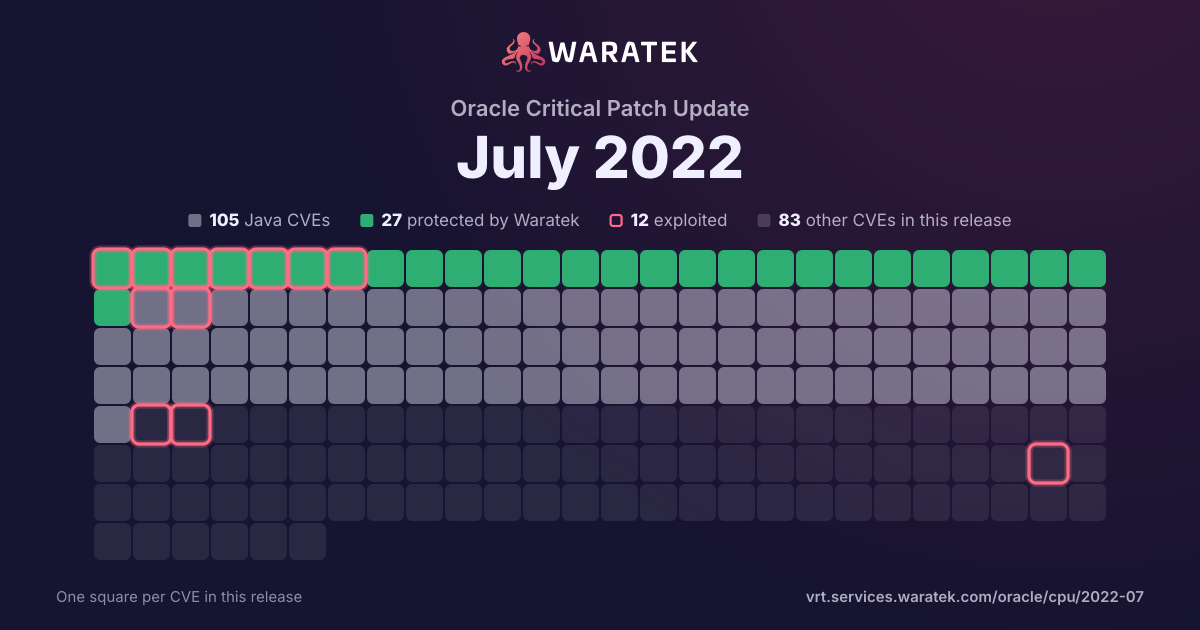
By status
27Protected by Waratek6Mitigation candidate72No exploit published49Outside Waratek scope34Not applicable
12Exploited, marked by the ring
No exploit published. For 47 of them, Oracle's security advisory is the source of public detail.
Protected by Waratek. Waratek RASP can block exploitation of these on systems that have not applied the patch yet.
Overview 13 matches · 5 in Waratek scope · 0 protected · 4 exploited · 2 CISA KEV · 8 EPSS ≥ 0.5
Protected by Waratek
0
0.0%
Rule in development
0
0.0%
Mitigation candidate
5
38.5%
No exploit published
0
0.0%
Outside Waratek scope
6
46.2%
Not applicable
2
15.4%
Withdrawn CVE
0
0.0%
blocked by ARMR today
0
0.0%
partly blocked
0
0.0%
not blocked
13
100.0%
not established
0
0.0%
unrecorded
0
0.0%
Exploited
4
30.8%
Working exploit published
3
23.1%
Proof of concept only
6
46.2%
Forecast only
0
0.0%
No public exploit
0
0.0%
split by
peak 4 / quarter
Q2 191
Outside Waratek scope1
High1
not blocked1
Working exploit published1
Q3 190
Q4 190
Q1 200
Q2 202
Outside Waratek scope2
Medium2
not blocked2
Exploited2
Q3 200
Q4 200
Q1 211
Not applicable1
High1
not blocked1
Exploited1
Q2 211
Mitigation candidate1
High1
not blocked1
Working exploit published1
Q3 210
Q4 211
Outside Waratek scope1
Medium1
not blocked1
Proof of concept only1
Q1 223
Mitigation candidate1
Outside Waratek scope1
Not applicable1
Critical1
High2
not blocked3
Exploited1
Proof of concept only2
Q2 224
Mitigation candidate3
Outside Waratek scope1
Critical3
High1
not blocked4
Working exploit published1
Proof of concept only3
Q2 19Q4 19Q2 20Q4 20Q2 21Q4 21Q2 22
| CVE | Severity | Published▾ | Status | Exploitation | Description |
|---|---|---|---|---|---|
| CVE-2022-25845 | Critical | 2022-06-10 | Mitigation candidate | Proof of concept only | The package com.alibaba:fastjson before 1.2.83 are vulnerable to Deserialization of Untrusted Data by bypassing the default autoType shutdown restrictions, which is possible under certain conditions. Exploiting this vulnerability allows attacking remote servers. Workaround: If upgrading is not possible, you can enable [safeMode](https://github.com/alibaba/fastjson/wiki/fastjson_safemode). |
| CVE-2022-22978 | Critical | 2022-05-19 | Mitigation candidate | Proof of concept only | In spring security versions prior to 5.4.11+, 5.5.7+ , 5.6.4+ and older unsupported versions, RegexRequestMatcher can easily be misconfigured to be bypassed on some servlet containers. Applications using RegexRequestMatcher with `.` in the regular expression are possibly vulnerable to an authorization bypass. |
| CVE-2022-29885 | High | 2022-05-12 | Mitigation candidate | Working exploit published | The documentation of Apache Tomcat 10.1.0-M1 to 10.1.0-M14, 10.0.0-M1 to 10.0.20, 9.0.13 to 9.0.62 and 8.5.38 to 8.5.78 for the EncryptInterceptor incorrectly stated it enabled Tomcat clustering to run over an untrusted network. This was not correct. While the EncryptInterceptor does provide confidentiality and integrity protection, it does not protect against all risks associated with running over any untrusted network, particularly DoS risks. |
| CVE-2022-1292 | Critical | 2022-05-03 | Outside Waratek scope | Proof of concept only | The c_rehash script does not properly sanitise shell metacharacters to prevent command injection. This script is distributed by some operating systems in a manner where it is automatically executed. On such operating systems, an attacker could execute arbitrary commands with the privileges of the script. Use of the c_rehash script is considered obsolete and should be replaced by the OpenSSL rehash command line tool. Fixed in OpenSSL 3.0.3 (Affected 3.0.0,3.0.1,3.0.2). Fixed in OpenSSL 1.1.1o (Affected 1.1.1-1.1.1n). Fixed in OpenSSL 1.0.2ze (Affected 1.0.2-1.0.2zd). |
| CVE-2022-0778 | High | 2022-03-15 | Outside Waratek scope | Proof of concept only | The BN_mod_sqrt() function, which computes a modular square root, contains a bug that can cause it to loop forever for non-prime moduli. Internally this function is used when parsing certificates that contain elliptic curve public keys in compressed form or explicit elliptic curve parameters with a base point encoded in compressed form. It is possible to trigger the infinite loop by crafting a certificate that has invalid explicit curve parameters. Since certificate parsing happens prior to verification of the certificate signature, any process that parses an externally supplied certificate may thus be subject to a denial of service attack. The infinite loop can also be reached when parsing crafted private keys as they can contain explicit elliptic curve parameters. Thus vulnerable situations include: - TLS clients consuming server certificates - TLS servers consuming client certificates - Hosting providers taking certificates or private keys from customers - Certificate authorities parsing certification requests from subscribers - Anything else which parses ASN.1 elliptic curve parameters Also any other applications that use the BN_mod_sqrt() where the attacker can control the parameter values are vulnerable to this DoS issue. In the OpenSSL 1.0.2 version the public key is not parsed during initial parsing of the certificate which makes it slightly harder to trigger the infinite loop. However any operation which requires the public key from the certificate will trigger the infinite loop. In particular the attacker can use a self-signed certificate to trigger the loop during verification of the certificate signature. This issue affects OpenSSL versions 1.0.2, 1.1.1 and 3.0. It was addressed in the releases of 1.1.1n and 3.0.2 on the 15th March 2022. Fixed in OpenSSL 3.0.2 (Affected 3.0.0,3.0.1). Fixed in OpenSSL 1.1.1n (Affected 1.1.1-1.1.1m). Fixed in OpenSSL 1.0.2zd (Affected 1.0.2-1.0.2zc). |
| CVE-2022-22947 | Critical | 2022-03-03 | Mitigation candidate | Exploited | In spring cloud gateway versions prior to 3.1.1+ and 3.0.7+ , applications are vulnerable to a code injection attack when the Gateway Actuator endpoint is enabled, exposed and unsecured. A remote attacker could make a maliciously crafted request that could allow arbitrary remote execution on the remote host. |
| CVE-2022-25636 | High | 2022-02-24 | Not applicable | Proof of concept only | net/netfilter/nf_dup_netdev.c in the Linux kernel 5.4 through 5.6.10 allows local users to gain privileges because of a heap out-of-bounds write. This is related to nf_tables_offload. |
| CVE-2021-41184 | Medium | 2021-10-26 | Outside Waratek scope | Proof of concept only | jQuery-UI is the official jQuery user interface library. Prior to version 1.13.0, accepting the value of the `of` option of the `.position()` util from untrusted sources may execute untrusted code. The issue is fixed in jQuery UI 1.13.0. Any string value passed to the `of` option is now treated as a CSS selector. A workaround is to not accept the value of the `of` option from untrusted sources. |
| CVE-2021-29505 | High | 2021-05-28 | Mitigation candidate | Working exploit published | XStream is software for serializing Java objects to XML and back again. A vulnerability in XStream versions prior to 1.4.17 may allow a remote attacker has sufficient rights to execute commands of the host only by manipulating the processed input stream. No user who followed the recommendation to setup XStream's security framework with a whitelist limited to the minimal required types is affected. The vulnerability is patched in version 1.4.17. |
| CVE-2021-23337 | High | 2021-02-15 | Not applicable | Exploited | Lodash versions prior to 4.17.21 are vulnerable to Command Injection via the template function. |
| CVE-2020-11023 | Medium | 2020-04-29 | Outside Waratek scope | Exploited | In jQuery versions greater than or equal to 1.0.3 and before 3.5.0, passing HTML containing <option> elements from untrusted sources - even after sanitizing it - to one of jQuery's DOM manipulation methods (i.e. .html(), .append(), and others) may execute untrusted code. This problem is patched in jQuery 3.5.0. |
| CVE-2020-11022 | Medium | 2020-04-29 | Outside Waratek scope | Exploited | In jQuery starting with 1.12.0 and before 3.5.0, passing HTML from untrusted sources - even after sanitizing it - to one of jQuery's DOM manipulation methods (i.e. .html(), .append(), and others) may execute untrusted code. This problem is patched in jQuery 3.5.0. |
| CVE-2019-0227 | High | 2019-05-01 | Outside Waratek scope | Working exploit published | A Server Side Request Forgery (SSRF) vulnerability affected the Apache Axis 1.4 distribution that was last released in 2006. Security and bug commits commits continue in the projects Axis 1.x Subversion repository, legacy users are encouraged to build from source. The successor to Axis 1.x is Axis2, the latest version is 1.7.9 and is not vulnerable to this issue. |