
Oracle Critical Patch Update July 2022
Released July 2022 · Oracle's advisory ↗ · ← Critical Patch Update, April 2022 · Critical Patch Update, October 2022 →
188 CVEs in this release, one square each
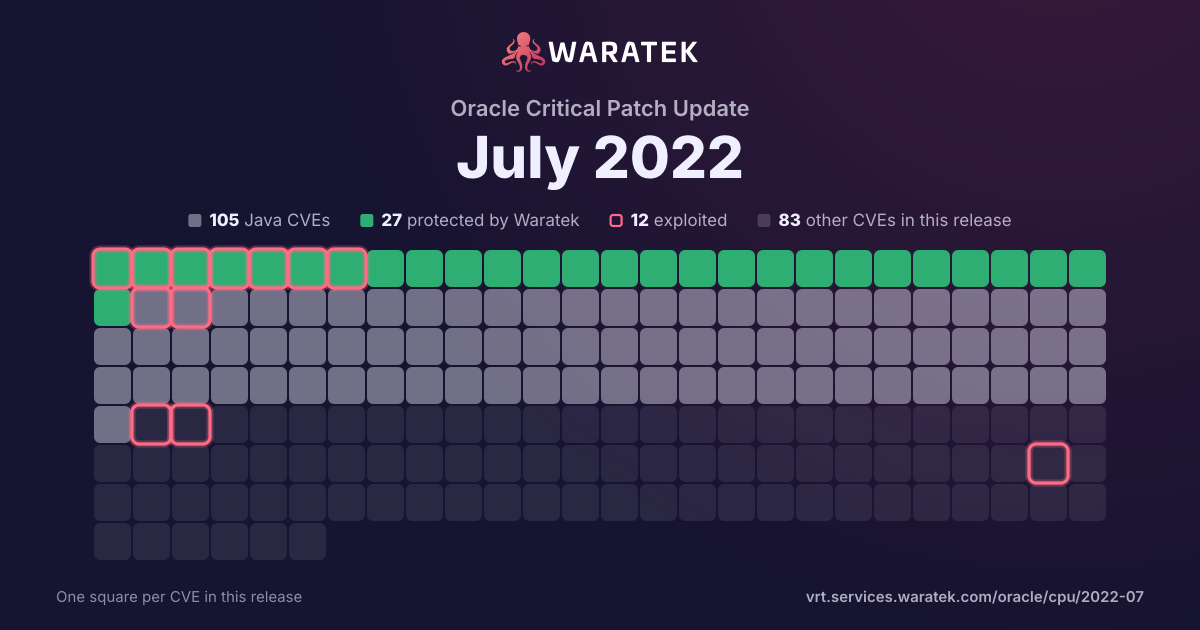
By status
27Protected by Waratek6Mitigation candidate72No exploit published49Outside Waratek scope34Not applicable
12Exploited, marked by the ring
No exploit published. For 47 of them, Oracle's security advisory is the source of public detail.
Protected by Waratek. Waratek RASP can block exploitation of these on systems that have not applied the patch yet.
Overview 16 matches · 7 in Waratek scope · 3 protected · 0 exploited · 0 CISA KEV · 8 public PoC · 5 EPSS ≥ 0.5
16matches
7in Waratek scope43.8%
3protected18.8%
0exploited0.0%
0CISA KEV0.0%
8public PoC50.0%
5EPSS ≥ 0.531.2%
Protected by Waratek
3
18.8%
Rule in development
0
0.0%
Mitigation candidate
2
12.5%
No exploit published
2
12.5%
Outside Waratek scope
7
43.8%
Not applicable
2
12.5%
Withdrawn CVE
0
0.0%
blocked by ARMR today
3
18.8%
partly blocked
0
0.0%
not blocked
13
81.2%
not established
0
0.0%
unrecorded
0
0.0%
Exploited
0
0.0%
Working exploit published
0
0.0%
Proof of concept only
16
100.0%
Forecast only
0
0.0%
No public exploit
0
0.0%
split by
peak 6 / quarter
Q1 211
Outside Waratek scope1
Critical1
not blocked1
Proof of concept only1
Q2 210
Q3 211
Outside Waratek scope1
High1
not blocked1
Proof of concept only1
Q4 211
Outside Waratek scope1
Medium1
not blocked1
Proof of concept only1
Q1 226
Protected by Waratek1
No exploit published1
Outside Waratek scope3
Not applicable1
Critical2
High4
blocked by ARMR today1
not blocked5
Proof of concept only6
Q2 226
Protected by Waratek1
Mitigation candidate2
No exploit published1
Outside Waratek scope1
Not applicable1
Critical4
High1
Medium1
blocked by ARMR today1
not blocked5
Proof of concept only6
Q3 221
Protected by Waratek1
High1
blocked by ARMR today1
Proof of concept only1
Q1 21Q2 21Q3 21Q4 21Q1 22Q2 22Q3 22
| CVE | Severity | Published▾ | Status | Exploitation | Description |
|---|---|---|---|---|---|
| CVE-2022-34169 | High | 2022-07-19 | Protected by Waratek | Proof of concept only | The Apache Xalan Java XSLT library is vulnerable to an integer truncation issue when processing malicious XSLT stylesheets. This can be used to corrupt Java class files generated by the internal XSLTC compiler and execute arbitrary Java bytecode. Users are recommended to update to version 2.7.3 or later. Note: Java runtimes (such as OpenJDK) include repackaged copies of Xalan. |
| CVE-2022-25845 | Critical | 2022-06-10 | Mitigation candidate | Proof of concept only | The package com.alibaba:fastjson before 1.2.83 are vulnerable to Deserialization of Untrusted Data by bypassing the default autoType shutdown restrictions, which is possible under certain conditions. Exploiting this vulnerability allows attacking remote servers. Workaround: If upgrading is not possible, you can enable [safeMode](https://github.com/alibaba/fastjson/wiki/fastjson_safemode). |
| CVE-2022-22978 | Critical | 2022-05-19 | Mitigation candidate | Proof of concept only | In spring security versions prior to 5.4.11+, 5.5.7+ , 5.6.4+ and older unsupported versions, RegexRequestMatcher can easily be misconfigured to be bypassed on some servlet containers. Applications using RegexRequestMatcher with `.` in the regular expression are possibly vulnerable to an authorization bypass. |
| CVE-2022-24823 | Medium | 2022-05-06 | No exploit published | Proof of concept only | Netty is an open-source, asynchronous event-driven network application framework. The package `io.netty:netty-codec-http` prior to version 4.1.77.Final contains an insufficient fix for CVE-2021-21290. When Netty's multipart decoders are used local information disclosure can occur via the local system temporary directory if temporary storing uploads on the disk is enabled. This only impacts applications running on Java version 6 and lower. Additionally, this vulnerability impacts code running on Unix-like systems, and very old versions of Mac OSX and Windows as they all share the system temporary directory between all users. Version 4.1.77.Final contains a patch for this vulnerability. As a workaround, specify one's own `java.io.tmpdir` when starting the JVM or use DefaultHttpDataFactory.setBaseDir(...) to set the directory to something that is only readable by the current user. |
| CVE-2022-1292 | Critical | 2022-05-03 | Outside Waratek scope | Proof of concept only | The c_rehash script does not properly sanitise shell metacharacters to prevent command injection. This script is distributed by some operating systems in a manner where it is automatically executed. On such operating systems, an attacker could execute arbitrary commands with the privileges of the script. Use of the c_rehash script is considered obsolete and should be replaced by the OpenSSL rehash command line tool. Fixed in OpenSSL 3.0.3 (Affected 3.0.0,3.0.1,3.0.2). Fixed in OpenSSL 1.1.1o (Affected 1.1.1-1.1.1n). Fixed in OpenSSL 1.0.2ze (Affected 1.0.2-1.0.2zd). |
| CVE-2022-24735 | High | 2022-04-27 | Not applicable | Proof of concept only | Redis is an in-memory database that persists on disk. By exploiting weaknesses in the Lua script execution environment, an attacker with access to Redis prior to version 7.0.0 or 6.2.7 can inject Lua code that will execute with the (potentially higher) privileges of another Redis user. The Lua script execution environment in Redis provides some measures that prevent a script from creating side effects that persist and can affect the execution of the same, or different script, at a later time. Several weaknesses of these measures have been publicly known for a long time, but they had no security impact as the Redis security model did not endorse the concept of users or privileges. With the introduction of ACLs in Redis 6.0, these weaknesses can be exploited by a less privileged users to inject Lua code that will execute at a later time, when a privileged user executes a Lua script. The problem is fixed in Redis versions 7.0.0 and 6.2.7. An additional workaround to mitigate this problem without patching the redis-server executable, if Lua scripting is not being used, is to block access to `SCRIPT LOAD` and `EVAL` commands using ACL rules. |
| CVE-2022-23457 | Critical | 2022-04-25 | Protected by Waratek | Proof of concept only | ESAPI (The OWASP Enterprise Security API) is a free, open source, web application security control library. Prior to version 2.3.0.0, the default implementation of `Validator.getValidDirectoryPath(String, String, File, boolean)` may incorrectly treat the tested input string as a child of the specified parent directory. This potentially could allow control-flow bypass checks to be defeated if an attack can specify the entire string representing the 'input' path. This vulnerability is patched in release 2.3.0.0 of ESAPI. As a workaround, it is possible to write one's own implementation of the Validator interface. However, maintainers do not recommend this. |
| CVE-2018-25032 | High | 2022-03-25 | Outside Waratek scope | Proof of concept only | zlib before 1.2.12 allows memory corruption when deflating (i.e., when compressing) if the input has many distant matches. |
| CVE-2022-0778 | High | 2022-03-15 | Outside Waratek scope | Proof of concept only | The BN_mod_sqrt() function, which computes a modular square root, contains a bug that can cause it to loop forever for non-prime moduli. Internally this function is used when parsing certificates that contain elliptic curve public keys in compressed form or explicit elliptic curve parameters with a base point encoded in compressed form. It is possible to trigger the infinite loop by crafting a certificate that has invalid explicit curve parameters. Since certificate parsing happens prior to verification of the certificate signature, any process that parses an externally supplied certificate may thus be subject to a denial of service attack. The infinite loop can also be reached when parsing crafted private keys as they can contain explicit elliptic curve parameters. Thus vulnerable situations include: - TLS clients consuming server certificates - TLS servers consuming client certificates - Hosting providers taking certificates or private keys from customers - Certificate authorities parsing certification requests from subscribers - Anything else which parses ASN.1 elliptic curve parameters Also any other applications that use the BN_mod_sqrt() where the attacker can control the parameter values are vulnerable to this DoS issue. In the OpenSSL 1.0.2 version the public key is not parsed during initial parsing of the certificate which makes it slightly harder to trigger the infinite loop. However any operation which requires the public key from the certificate will trigger the infinite loop. In particular the attacker can use a self-signed certificate to trigger the loop during verification of the certificate signature. This issue affects OpenSSL versions 1.0.2, 1.1.1 and 3.0. It was addressed in the releases of 1.1.1n and 3.0.2 on the 15th March 2022. Fixed in OpenSSL 3.0.2 (Affected 3.0.0,3.0.1). Fixed in OpenSSL 1.1.1n (Affected 1.1.1-1.1.1m). Fixed in OpenSSL 1.0.2zd (Affected 1.0.2-1.0.2zc). |
| CVE-2022-25636 | High | 2022-02-24 | Not applicable | Proof of concept only | net/netfilter/nf_dup_netdev.c in the Linux kernel 5.4 through 5.6.10 allows local users to gain privileges because of a heap out-of-bounds write. This is related to nf_tables_offload. |
| CVE-2021-43859 | High | 2022-02-01 | No exploit published | Proof of concept only | XStream is an open source java library to serialize objects to XML and back again. Versions prior to 1.4.19 may allow a remote attacker to allocate 100% CPU time on the target system depending on CPU type or parallel execution of such a payload resulting in a denial of service only by manipulating the processed input stream. XStream 1.4.19 monitors and accumulates the time it takes to add elements to collections and throws an exception if a set threshold is exceeded. Users are advised to upgrade as soon as possible. Users unable to upgrade may set the NO_REFERENCE mode to prevent recursion. See GHSA-rmr5-cpv2-vgjf for further details on a workaround if an upgrade is not possible. |
| CVE-2022-23305 | Critical | 2022-01-18 | Protected by Waratek | Proof of concept only | By design, the JDBCAppender in Log4j 1.2.x accepts an SQL statement as a configuration parameter where the values to be inserted are converters from PatternLayout. The message converter, %m, is likely to always be included. This allows attackers to manipulate the SQL by entering crafted strings into input fields or headers of an application that are logged allowing unintended SQL queries to be executed. Note this issue only affects Log4j 1.x when specifically configured to use the JDBCAppender, which is not the default. Beginning in version 2.0-beta8, the JDBCAppender was re-introduced with proper support for parameterized SQL queries and further customization over the columns written to in logs. Apache Log4j 1.2 reached end of life in August 2015. Users should upgrade to Log4j 2 as it addresses numerous other issues from the previous versions. |
| CVE-2022-23219 | Critical | 2022-01-14 | Outside Waratek scope | Proof of concept only | The deprecated compatibility function clnt_create in the sunrpc module of the GNU C Library (aka glibc) through 2.34 copies its hostname argument on the stack without validating its length, which may result in a buffer overflow, potentially resulting in a denial of service or (if an application is not built with a stack protector enabled) arbitrary code execution. |
| CVE-2021-41184 | Medium | 2021-10-26 | Outside Waratek scope | Proof of concept only | jQuery-UI is the official jQuery user interface library. Prior to version 1.13.0, accepting the value of the `of` option of the `.position()` util from untrusted sources may execute untrusted code. The issue is fixed in jQuery UI 1.13.0. Any string value passed to the `of` option is now treated as a CSS selector. A workaround is to not accept the value of the `of` option from untrusted sources. |
| CVE-2021-22946 | High | 2021-09-29 | Outside Waratek scope | Proof of concept only | A user can tell curl >= 7.20.0 and <= 7.78.0 to require a successful upgrade to TLS when speaking to an IMAP, POP3 or FTP server (`--ssl-reqd` on the command line or`CURLOPT_USE_SSL` set to `CURLUSESSL_CONTROL` or `CURLUSESSL_ALL` withlibcurl). This requirement could be bypassed if the server would return a properly crafted but perfectly legitimate response.This flaw would then make curl silently continue its operations **withoutTLS** contrary to the instructions and expectations, exposing possibly sensitive data in clear text over the network. |
| CVE-2021-3177 | Critical | 2021-01-19 | Outside Waratek scope | Proof of concept only | Python 3.x through 3.9.1 has a buffer overflow in PyCArg_repr in _ctypes/callproc.c, which may lead to remote code execution in certain Python applications that accept floating-point numbers as untrusted input, as demonstrated by a 1e300 argument to c_double.from_param. This occurs because sprintf is used unsafely. |