
Oracle Critical Patch Update July 2022
Released July 2022 · Oracle's advisory ↗ · ← Critical Patch Update, April 2022 · Critical Patch Update, October 2022 →
188 CVEs in this release, one square each
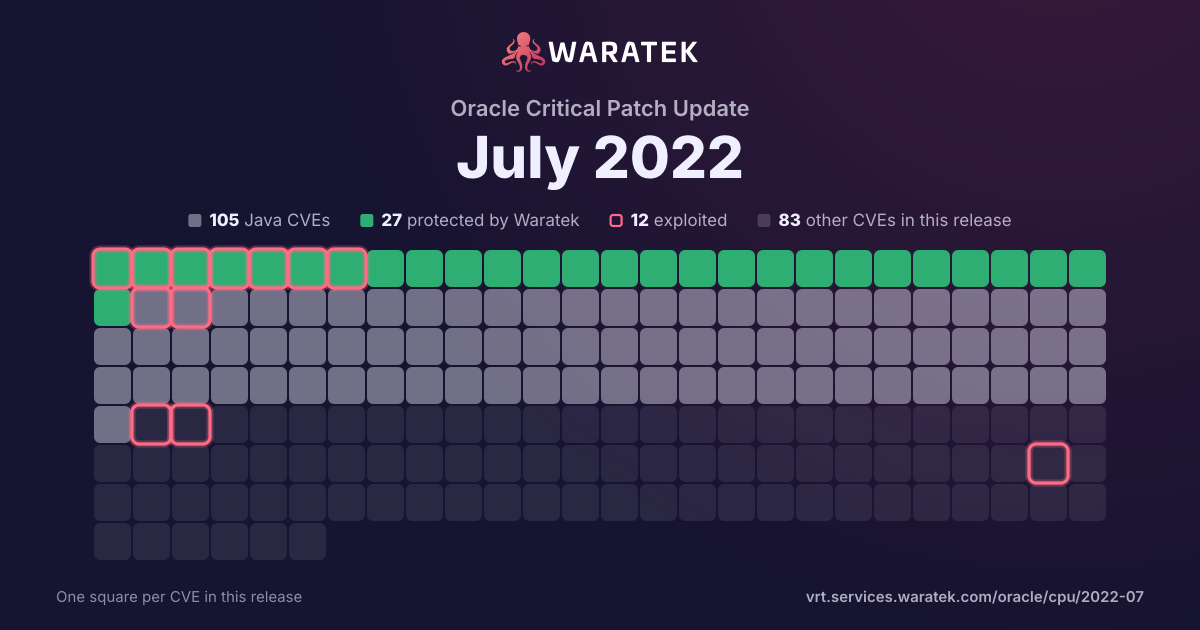
By status
24Protected by Waratek2Rule in development6Mitigation candidate84No exploit published2Outside Waratek scope70Not applicable
12Exploited, marked by the ring
No exploit published. For 47 of them, Oracle's security advisory is the source of public detail.
Protected by Waratek. Waratek RASP can block exploitation of these on systems that have not applied the patch yet.
Overview 16 matches · 0 protected · 0 exploited · 0 CISA KEV · 0 public PoC · 0 EPSS ≥ 0.5
16matches
0protected0.0%
0exploited0.0%
0CISA KEV0.0%
0public PoC0.0%
0EPSS ≥ 0.50.0%
Protected by Waratek
0
0.0%
Rule in development
0
0.0%
Mitigation candidate
0
0.0%
No exploit published
16
100.0%
blocked by ARMR today
0
0.0%
partly blocked
0
0.0%
not blocked
16
100.0%
not established
0
0.0%
unrecorded
0
0.0%
Exploited
0
0.0%
Working exploit published
0
0.0%
Proof of concept only
2
12.5%
Forecast only
0
0.0%
No public exploit
14
87.5%
split by
peak 9 / month
Feb 222
No exploit published2
High1
Medium1
not blocked2
Proof of concept only1
No public exploit1
Mar 221
No exploit published1
High1
not blocked1
No public exploit1
Apr 222
No exploit published2
High1
Medium1
not blocked2
No public exploit2
May 222
No exploit published2
Medium2
not blocked2
Proof of concept only1
No public exploit1
Jun 220
Jul 229
No exploit published9
High3
Medium6
not blocked9
No public exploit9
Feb 22Mar 22Apr 22May 22Jun 22Jul 22
| CVE | Severity | Published▾ | Status | Exploitation | Description |
|---|---|---|---|---|---|
| CVE-2022-21575 | Medium | 2022-07-19 | No exploit published | No public exploit | Vulnerability in the Oracle WebCenter Sites Support Tools product of Oracle Fusion Middleware (component: User Interface). The supported version that is affected is Prior to 4.4.2. Easily exploitable vulnerability allows high privileged attacker with network access via HTTP to compromise Oracle WebCenter Sites Support Tools. Successful attacks of this vulnerability can result in unauthorized access to critical data or complete access to all Oracle WebCenter Sites Support Tools accessible data as well as unauthorized update, insert or delete access to some of Oracle WebCenter Sites Support Tools accessible data and unauthorized ability to cause a partial denial of service (partial DOS) of Oracle WebCenter Sites Support Tools. CVSS 3.1 Base Score 6.0 (Confidentiality, Integrity and Availability impacts). CVSS Vector: (CVSS:3.1/AV:N/AC:L/PR:H/UI:N/S:U/C:H/I:L/A:L). |
| CVE-2022-21570 | High | 2022-07-19 | No exploit published | No public exploit | Vulnerability in the Oracle Coherence product of Oracle Fusion Middleware (component: Core). Supported versions that are affected are 3.7.1.0, 12.2.1.3.0, 12.2.1.4.0 and 14.1.1.0.0. Easily exploitable vulnerability allows unauthenticated attacker with network access via T3, IIOP to compromise Oracle Coherence. Successful attacks of this vulnerability can result in unauthorized ability to cause a hang or frequently repeatable crash (complete DOS) of Oracle Coherence. CVSS 3.1 Base Score 7.5 (Availability impacts). CVSS Vector: (CVSS:3.1/AV:N/AC:L/PR:N/UI:N/S:U/C:N/I:N/A:H). |
| CVE-2022-21564 | Medium | 2022-07-19 | No exploit published | No public exploit | Vulnerability in the Oracle WebLogic Server product of Oracle Fusion Middleware (component: Web Services). Supported versions that are affected are 12.2.1.3.0, 12.2.1.4.0 and 14.1.1.0.0. Easily exploitable vulnerability allows unauthenticated attacker with network access via T3, IIOP to compromise Oracle WebLogic Server. Successful attacks of this vulnerability can result in unauthorized ability to cause a partial denial of service (partial DOS) of Oracle WebLogic Server. CVSS 3.1 Base Score 5.3 (Availability impacts). CVSS Vector: (CVSS:3.1/AV:N/AC:L/PR:N/UI:N/S:U/C:N/I:N/A:L). |
| CVE-2022-21562 | High | 2022-07-19 | No exploit published | No public exploit | Vulnerability in the Oracle SOA Suite product of Oracle Fusion Middleware (component: Fabric Layer). Supported versions that are affected are 12.2.1.3.0 and 12.2.1.4.0. Easily exploitable vulnerability allows unauthenticated attacker with network access via HTTP to compromise Oracle SOA Suite. Successful attacks of this vulnerability can result in unauthorized creation, deletion or modification access to critical data or all Oracle SOA Suite accessible data. CVSS 3.1 Base Score 7.5 (Integrity impacts). CVSS Vector: (CVSS:3.1/AV:N/AC:L/PR:N/UI:N/S:U/C:N/I:H/A:N). |
| CVE-2022-21560 | Medium | 2022-07-19 | No exploit published | No public exploit | Vulnerability in the Oracle WebLogic Server product of Oracle Fusion Middleware (component: Core). Supported versions that are affected are 12.2.1.3.0, 12.2.1.4.0 and 14.1.1.0.0. Easily exploitable vulnerability allows unauthenticated attacker with network access via T3, IIOP to compromise Oracle WebLogic Server. Successful attacks of this vulnerability can result in unauthorized ability to cause a partial denial of service (partial DOS) of Oracle WebLogic Server. CVSS 3.1 Base Score 5.3 (Availability impacts). CVSS Vector: (CVSS:3.1/AV:N/AC:L/PR:N/UI:N/S:U/C:N/I:N/A:L). |
| CVE-2022-21557 | Medium | 2022-07-19 | No exploit published | No public exploit | Vulnerability in the Oracle WebLogic Server product of Oracle Fusion Middleware (component: Web Container). Supported versions that are affected are 12.2.1.3.0, 12.2.1.4.0 and 14.1.1.0.0. Difficult to exploit vulnerability allows high privileged attacker with logon to the infrastructure where Oracle WebLogic Server executes to compromise Oracle WebLogic Server. Successful attacks of this vulnerability can result in unauthorized creation, deletion or modification access to critical data or all Oracle WebLogic Server accessible data as well as unauthorized access to critical data or complete access to all Oracle WebLogic Server accessible data. CVSS 3.1 Base Score 5.7 (Confidentiality and Integrity impacts). CVSS Vector: (CVSS:3.1/AV:L/AC:H/PR:H/UI:N/S:U/C:H/I:H/A:N). |
| CVE-2022-21552 | High | 2022-07-19 | No exploit published | No public exploit | Vulnerability in the Oracle WebCenter Content product of Oracle Fusion Middleware (component: Search). Supported versions that are affected are 12.2.1.3.0 and 12.2.1.4.0. Easily exploitable vulnerability allows unauthenticated attacker with network access via HTTP to compromise Oracle WebCenter Content. While the vulnerability is in Oracle WebCenter Content, attacks may significantly impact additional products (scope change). Successful attacks of this vulnerability can result in unauthorized update, insert or delete access to some of Oracle WebCenter Content accessible data as well as unauthorized read access to a subset of Oracle WebCenter Content accessible data. CVSS 3.1 Base Score 7.2 (Confidentiality and Integrity impacts). CVSS Vector: (CVSS:3.1/AV:N/AC:L/PR:N/UI:N/S:C/C:L/I:L/A:N). |
| CVE-2022-21548 | Medium | 2022-07-19 | No exploit published | No public exploit | Vulnerability in the Oracle WebLogic Server product of Oracle Fusion Middleware (component: Core). Supported versions that are affected are 12.2.1.3.0, 12.2.1.4.0 and 14.1.1.0.0. Easily exploitable vulnerability allows unauthenticated attacker with network access via T3, IIOP to compromise Oracle WebLogic Server. Successful attacks of this vulnerability can result in unauthorized update, insert or delete access to some of Oracle WebLogic Server accessible data and unauthorized ability to cause a partial denial of service (partial DOS) of Oracle WebLogic Server. CVSS 3.1 Base Score 6.5 (Integrity and Availability impacts). CVSS Vector: (CVSS:3.1/AV:N/AC:L/PR:N/UI:N/S:U/C:N/I:L/A:L). |
| CVE-2022-21523 | Medium | 2022-07-19 | No exploit published | No public exploit | Vulnerability in the Oracle BI Publisher product of Oracle Fusion Middleware (component: BI Publisher Security). Supported versions that are affected are 12.2.1.3.0 and 12.2.1.4.0. Easily exploitable vulnerability allows low privileged attacker with network access via HTTP to compromise Oracle BI Publisher. Successful attacks of this vulnerability can result in unauthorized read access to a subset of Oracle BI Publisher accessible data. CVSS 3.1 Base Score 4.3 (Confidentiality impacts). CVSS Vector: (CVSS:3.1/AV:N/AC:L/PR:L/UI:N/S:U/C:L/I:N/A:N). |
| CVE-2022-30126 | Medium | 2022-05-16 | No exploit published | No public exploit | In Apache Tika, a regular expression in our StandardsText class, used by the StandardsExtractingContentHandler could lead to a denial of service caused by backtracking on a specially crafted file. This only affects users who are running the StandardsExtractingContentHandler, which is a non-standard handler. This is fixed in 1.28.2 and 2.4.0 |
| CVE-2022-24823 | Medium | 2022-05-06 | No exploit published | Proof of concept only | Netty is an open-source, asynchronous event-driven network application framework. The package `io.netty:netty-codec-http` prior to version 4.1.77.Final contains an insufficient fix for CVE-2021-21290. When Netty's multipart decoders are used local information disclosure can occur via the local system temporary directory if temporary storing uploads on the disk is enabled. This only impacts applications running on Java version 6 and lower. Additionally, this vulnerability impacts code running on Unix-like systems, and very old versions of Mac OSX and Windows as they all share the system temporary directory between all users. Version 4.1.77.Final contains a patch for this vulnerability. As a workaround, specify one's own `java.io.tmpdir` when starting the JVM or use DefaultHttpDataFactory.setBaseDir(...) to set the directory to something that is only readable by the current user. |
| CVE-2022-22968 | Medium | 2022-04-14 | No exploit published | No public exploit | In Spring Framework versions 5.3.0 - 5.3.18, 5.2.0 - 5.2.20, and older unsupported versions, the patterns for disallowedFields on a DataBinder are case sensitive which means a field is not effectively protected unless it is listed with both upper and lower case for the first character of the field, including upper and lower case for the first character of all nested fields within the property path. |
| CVE-2022-24839 | High | 2022-04-11 | No exploit published | No public exploit | org.cyberneko.html is an html parser written in Java. The fork of `org.cyberneko.html` used by Nokogiri (Rubygem) raises a `java.lang.OutOfMemoryError` exception when parsing ill-formed HTML markup. Users are advised to upgrade to `>= 1.9.22.noko2`. Note: The upstream library `org.cyberneko.html` is no longer maintained. Nokogiri uses its own fork of this library located at https://github.com/sparklemotion/nekohtml and this CVE applies only to that fork. Other forks of nekohtml may have a similar vulnerability. |
| CVE-2020-36518 | High | 2022-03-11 | No exploit published | No public exploit | jackson-databind before 2.13.0 allows a Java StackOverflow exception and denial of service via a large depth of nested objects. |
| CVE-2022-24329 | Medium | 2022-02-25 | No exploit published | No public exploit | In JetBrains Kotlin before 1.6.0, it was not possible to lock dependencies for Multiplatform Gradle Projects. |
| CVE-2021-43859 | High | 2022-02-01 | No exploit published | Proof of concept only | XStream is an open source java library to serialize objects to XML and back again. Versions prior to 1.4.19 may allow a remote attacker to allocate 100% CPU time on the target system depending on CPU type or parallel execution of such a payload resulting in a denial of service only by manipulating the processed input stream. XStream 1.4.19 monitors and accumulates the time it takes to add elements to collections and throws an exception if a set threshold is exceeded. Users are advised to upgrade as soon as possible. Users unable to upgrade may set the NO_REFERENCE mode to prevent recursion. See GHSA-rmr5-cpv2-vgjf for further details on a workaround if an upgrade is not possible. |