
Oracle Critical Patch Update July 2022
Released July 2022 · Oracle's advisory ↗ · ← Critical Patch Update, April 2022 · Critical Patch Update, October 2022 →
188 CVEs in this release, one square each
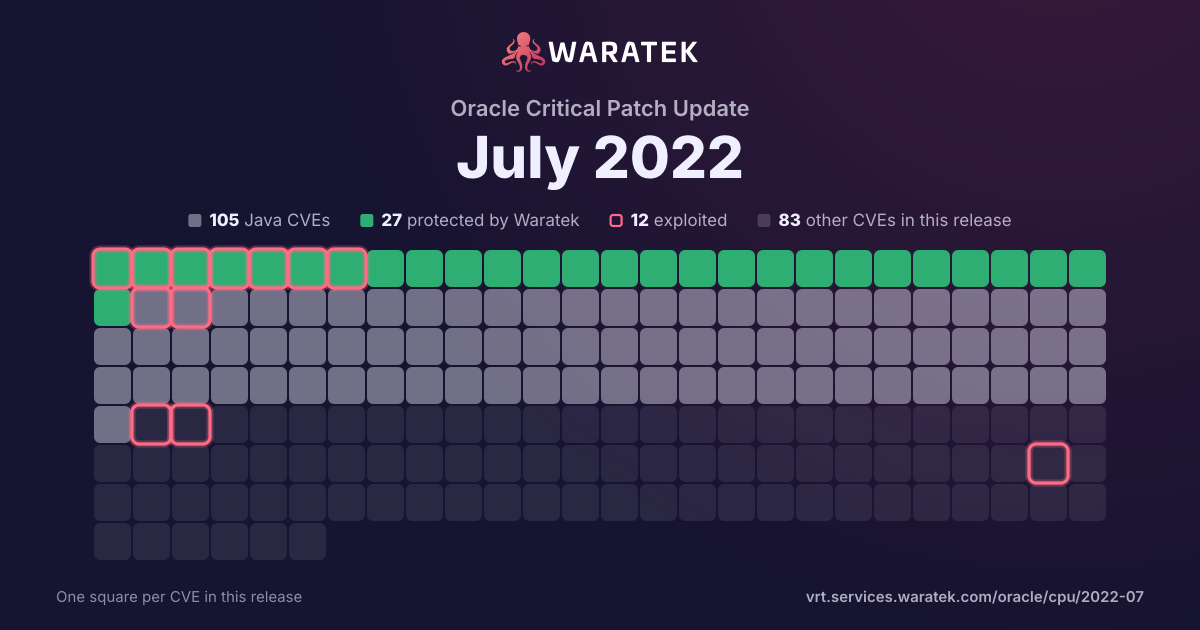
By status
24Protected by Waratek2Rule in development6Mitigation candidate83No exploit published2Outside Waratek scope71Not applicable
12Exploited, marked by the ring
No exploit published. For 46 of them, Oracle's security advisory is the source of public detail.
Protected by Waratek. Waratek RASP can block exploitation of these on systems that have not applied the patch yet.
Overview 13 matches · 0 protected · 0 exploited · 0 CISA KEV · 2 public PoC · 2 EPSS ≥ 0.5
Protected by Waratek
0
0.0%
Rule in development
0
0.0%
Mitigation candidate
2
15.4%
No exploit published
11
84.6%
blocked by ARMR today
0
0.0%
partly blocked
0
0.0%
not blocked
13
100.0%
not established
0
0.0%
unrecorded
0
0.0%
Exploited
0
0.0%
Working exploit published
2
15.4%
Proof of concept only
0
0.0%
Forecast only
0
0.0%
No public exploit
11
84.6%
split by
peak 5 / quarter
Q2 191
Mitigation candidate1
High1
not blocked1
Working exploit published1
Q3 190
Q4 191
No exploit published1
Critical1
not blocked1
No public exploit1
Q1 200
Q2 200
Q3 200
Q4 201
No exploit published1
High1
not blocked1
No public exploit1
Q1 212
No exploit published2
High2
not blocked2
No public exploit2
Q2 213
Mitigation candidate1
No exploit published2
High2
Medium1
not blocked3
Working exploit published1
No public exploit2
Q3 215
No exploit published5
High3
Medium2
not blocked5
No public exploit5
Q2 19Q3 19Q4 19Q1 20Q2 20Q3 20Q4 20Q1 21Q2 21Q3 21
| CVE | Severity | Published▾ | Status | Exploitation | Description |
|---|---|---|---|---|---|
| CVE-2021-37714 | High | 2021-08-18 | No exploit published | No public exploit | jsoup is a Java library for working with HTML. Those using jsoup versions prior to 1.14.2 to parse untrusted HTML or XML may be vulnerable to DOS attacks. If the parser is run on user supplied input, an attacker may supply content that causes the parser to get stuck (loop indefinitely until cancelled), to complete more slowly than usual, or to throw an unexpected exception. This effect may support a denial of service attack. The issue is patched in version 1.14.2. There are a few available workarounds. Users may rate limit input parsing, limit the size of inputs based on system resources, and/or implement thread watchdogs to cap and timeout parse runtimes. |
| CVE-2021-2351 | High | 2021-07-21 | No exploit published | No public exploit | Vulnerability in the Advanced Networking Option component of Oracle Database Server. Supported versions that are affected are 12.1.0.2, 12.2.0.1 and 19c. Difficult to exploit vulnerability allows unauthenticated attacker with network access via Oracle Net to compromise Advanced Networking Option. Successful attacks require human interaction from a person other than the attacker and while the vulnerability is in Advanced Networking Option, attacks may significantly impact additional products. Successful attacks of this vulnerability can result in takeover of Advanced Networking Option. Note: The July 2021 Critical Patch Update introduces a number of Native Network Encryption changes to deal with vulnerability CVE-2021-2351 and prevent the use of weaker ciphers. Customers should review: "Changes in Native Network Encryption with the July 2021 Critical Patch Update" (Doc ID 2791571.1). CVSS 3.1 Base Score 8.3 (Confidentiality, Integrity and Availability impacts). CVSS Vector: (CVSS:3.1/AV:N/AC:H/PR:N/UI:R/S:C/C:H/I:H/A:H). |
| CVE-2021-36374 | Medium | 2021-07-14 | No exploit published | No public exploit | When reading a specially crafted ZIP archive, or a derived formats, an Apache Ant build can be made to allocate large amounts of memory that leads to an out of memory error, even for small inputs. This can be used to disrupt builds using Apache Ant. Commonly used derived formats from ZIP archives are for instance JAR files and many office files. Apache Ant prior to 1.9.16 and 1.10.11 were affected. |
| CVE-2021-36090 | High | 2021-07-13 | No exploit published | No public exploit | When reading a specially crafted ZIP archive, Compress can be made to allocate large amounts of memory that finally leads to an out of memory error even for very small inputs. This could be used to mount a denial of service attack against services that use Compress' zip package. |
| CVE-2021-30129 | Medium | 2021-07-12 | No exploit published | No public exploit | A vulnerability in sshd-core of Apache Mina SSHD allows an attacker to overflow the server causing an OutOfMemory error. This issue affects the SFTP and port forwarding features of Apache Mina SSHD version 2.0.0 and later versions. It was addressed in Apache Mina SSHD 2.7.0 |
| CVE-2021-31812 | Medium | 2021-06-12 | No exploit published | No public exploit | In Apache PDFBox, a carefully crafted PDF file can trigger an infinite loop while loading the file. This issue affects Apache PDFBox version 2.0.23 and prior 2.0.x versions. |
| CVE-2021-29505 | High | 2021-05-28 | Mitigation candidate | Working exploit published | XStream is software for serializing Java objects to XML and back again. A vulnerability in XStream versions prior to 1.4.17 may allow a remote attacker has sufficient rights to execute commands of the host only by manipulating the processed input stream. No user who followed the recommendation to setup XStream's security framework with a whitelist limited to the minimal required types is affected. The vulnerability is patched in version 1.4.17. |
| CVE-2021-22118 | High | 2021-05-27 | No exploit published | No public exploit | In Spring Framework, versions 5.2.x prior to 5.2.15 and versions 5.3.x prior to 5.3.7, a WebFlux application is vulnerable to a privilege escalation: by (re)creating the temporary storage directory, a locally authenticated malicious user can read or modify files that have been uploaded to the WebFlux application, or overwrite arbitrary files with multipart request data. |
| CVE-2020-11987 | High | 2021-02-24 | No exploit published | No public exploit | Apache Batik 1.13 is vulnerable to server-side request forgery, caused by improper input validation by the NodePickerPanel. By using a specially-crafted argument, an attacker could exploit this vulnerability to cause the underlying server to make arbitrary GET requests. |
| CVE-2020-9492 | High | 2021-01-26 | No exploit published | No public exploit | In Apache Hadoop 3.2.0 to 3.2.1, 3.0.0-alpha1 to 3.1.3, and 2.0.0-alpha to 2.10.0, WebHDFS client might send SPNEGO authorization header to remote URL without proper verification. |
| CVE-2020-28052 | High | 2020-12-18 | No exploit published | No public exploit | An issue was discovered in Legion of the Bouncy Castle BC Java 1.65 and 1.66. The OpenBSDBCrypt.checkPassword utility method compared incorrect data when checking the password, allowing incorrect passwords to indicate they were matching with previously hashed ones that were different. |
| CVE-2019-17495 | Critical | 2019-10-10 | No exploit published | No public exploit | A Cascading Style Sheets (CSS) injection vulnerability in Swagger UI before 3.23.11 allows attackers to use the Relative Path Overwrite (RPO) technique to perform CSS-based input field value exfiltration, such as exfiltration of a CSRF token value. In other words, this product intentionally allows the embedding of untrusted JSON data from remote servers, but it was not previously known that <style>@import within the JSON data was a functional attack method. |
| CVE-2019-0227 | High | 2019-05-01 | Mitigation candidate | Working exploit published | A Server Side Request Forgery (SSRF) vulnerability affected the Apache Axis 1.4 distribution that was last released in 2006. Security and bug commits commits continue in the projects Axis 1.x Subversion repository, legacy users are encouraged to build from source. The successor to Axis 1.x is Axis2, the latest version is 1.7.9 and is not vulnerable to this issue. |