
Oracle Critical Patch Update July 2022
Released July 2022 · Oracle's advisory ↗ · ← Critical Patch Update, April 2022 · Critical Patch Update, October 2022 →
188 CVEs in this release, one square each
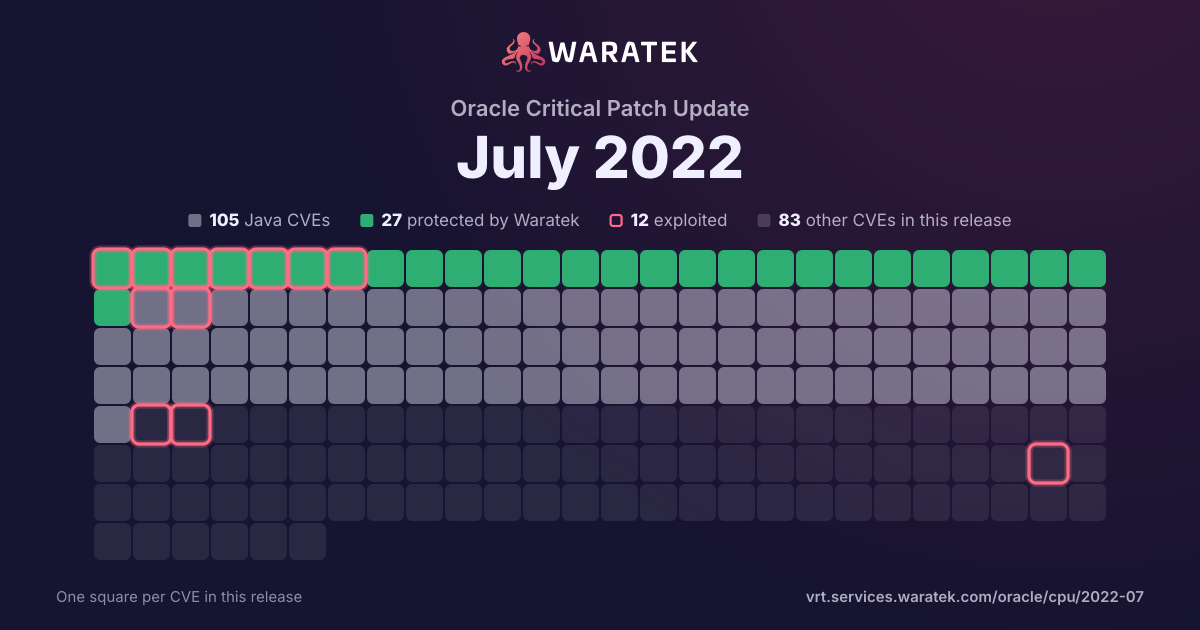
By status
24Protected by Waratek2Rule in development6Mitigation candidate83No exploit published2Outside Waratek scope71Not applicable
12Exploited, marked by the ring
No exploit published. For 46 of them, Oracle's security advisory is the source of public detail.
Protected by Waratek. Waratek RASP can block exploitation of these on systems that have not applied the patch yet.
Overview 17 matches · 4 protected · 0 exploited · 0 CISA KEV · 2 public PoC · 1 EPSS ≥ 0.5
Protected by Waratek
4
23.5%
Rule in development
0
0.0%
Mitigation candidate
1
5.9%
No exploit published
12
70.6%
blocked by ARMR today
4
23.5%
partly blocked
0
0.0%
not blocked
13
76.5%
not established
0
0.0%
unrecorded
0
0.0%
Exploited
0
0.0%
Working exploit published
1
5.9%
Proof of concept only
2
11.8%
Forecast only
0
0.0%
No public exploit
14
82.4%
split by
peak 2 / month
Feb 211
No exploit published1
High1
not blocked1
No public exploit1
Mar 210
Apr 210
May 212
Mitigation candidate1
No exploit published1
High2
not blocked2
Working exploit published1
No public exploit1
Jun 211
Protected by Waratek1
High1
blocked by ARMR today1
No public exploit1
Jul 212
No exploit published2
High2
not blocked2
No public exploit2
Aug 212
No exploit published2
High2
not blocked2
No public exploit2
Sep 211
No exploit published1
High1
not blocked1
No public exploit1
Oct 212
No exploit published2
High2
not blocked2
No public exploit2
Nov 210
Dec 210
Jan 221
Protected by Waratek1
High1
blocked by ARMR today1
No public exploit1
Feb 221
No exploit published1
High1
not blocked1
Proof of concept only1
Mar 221
No exploit published1
High1
not blocked1
No public exploit1
Apr 220
May 221
Protected by Waratek1
High1
blocked by ARMR today1
No public exploit1
Jun 220
Jul 222
Protected by Waratek1
No exploit published1
High2
blocked by ARMR today1
not blocked1
Proof of concept only1
No public exploit1
Mar 21May 21Jul 21Sep 21Nov 21Jan 22Mar 22May 22Jul 22
| CVE | Severity | Published▾ | Status | Exploitation | Description |
|---|---|---|---|---|---|
| CVE-2022-34169 | High | 2022-07-19 | Protected by Waratek | Proof of concept only | The Apache Xalan Java XSLT library is vulnerable to an integer truncation issue when processing malicious XSLT stylesheets. This can be used to corrupt Java class files generated by the internal XSLTC compiler and execute arbitrary Java bytecode. Users are recommended to update to version 2.7.3 or later. Note: Java runtimes (such as OpenJDK) include repackaged copies of Xalan. |
| CVE-2022-21429 | High | 2022-07-19 | No exploit published | No public exploit | Vulnerability in the Oracle Communications Billing and Revenue Management product of Oracle Communications Applications (component: Billing Care). Supported versions that are affected are 12.0.0.4.0-12.0.0.6.0. Difficult to exploit vulnerability allows unauthenticated attacker with network access via HTTP to compromise Oracle Communications Billing and Revenue Management. Successful attacks of this vulnerability can result in takeover of Oracle Communications Billing and Revenue Management. CVSS 3.1 Base Score 8.1 (Confidentiality, Integrity and Availability impacts). CVSS Vector: (CVSS:3.1/AV:N/AC:H/PR:N/UI:N/S:U/C:H/I:H/A:H). |
| CVE-2022-25647 | High | 2022-05-01 | Protected by Waratek | No public exploit | The package com.google.code.gson:gson before 2.8.9 are vulnerable to Deserialization of Untrusted Data via the writeReplace() method in internal classes, which may lead to DoS attacks. |
| CVE-2020-36518 | High | 2022-03-11 | No exploit published | No public exploit | jackson-databind before 2.13.0 allows a Java StackOverflow exception and denial of service via a large depth of nested objects. |
| CVE-2021-43859 | High | 2022-02-01 | No exploit published | Proof of concept only | XStream is an open source java library to serialize objects to XML and back again. Versions prior to 1.4.19 may allow a remote attacker to allocate 100% CPU time on the target system depending on CPU type or parallel execution of such a payload resulting in a denial of service only by manipulating the processed input stream. XStream 1.4.19 monitors and accumulates the time it takes to add elements to collections and throws an exception if a set threshold is exceeded. Users are advised to upgrade as soon as possible. Users unable to upgrade may set the NO_REFERENCE mode to prevent recursion. See GHSA-rmr5-cpv2-vgjf for further details on a workaround if an upgrade is not possible. |
| CVE-2022-23181 | High | 2022-01-27 | Protected by Waratek | No public exploit | The fix for bug CVE-2020-9484 introduced a time of check, time of use vulnerability into Apache Tomcat 10.1.0-M1 to 10.1.0-M8, 10.0.0-M5 to 10.0.14, 9.0.35 to 9.0.56 and 8.5.55 to 8.5.73 that allowed a local attacker to perform actions with the privileges of the user that the Tomcat process is using. This issue is only exploitable when Tomcat is configured to persist sessions using the FileStore. |
| CVE-2021-37137 | High | 2021-10-19 | No exploit published | No public exploit | The Snappy frame decoder function doesn't restrict the chunk length which may lead to excessive memory usage. Beside this it also may buffer reserved skippable chunks until the whole chunk was received which may lead to excessive memory usage as well. This vulnerability can be triggered by supplying malicious input that decompresses to a very big size (via a network stream or a file) or by sending a huge skippable chunk. |
| CVE-2021-42340 | High | 2021-10-14 | No exploit published | No public exploit | The fix for bug 63362 present in Apache Tomcat 10.1.0-M1 to 10.1.0-M5, 10.0.0-M1 to 10.0.11, 9.0.40 to 9.0.53 and 8.5.60 to 8.5.71 introduced a memory leak. The object introduced to collect metrics for HTTP upgrade connections was not released for WebSocket connections once the connection was closed. This created a memory leak that, over time, could lead to a denial of service via an OutOfMemoryError. |
| CVE-2021-40690 | High | 2021-09-19 | No exploit published | No public exploit | All versions of Apache Santuario - XML Security for Java prior to 2.2.3 and 2.1.7 are vulnerable to an issue where the "secureValidation" property is not passed correctly when creating a KeyInfo from a KeyInfoReference element. This allows an attacker to abuse an XPath Transform to extract any local .xml files in a RetrievalMethod element. |
| CVE-2021-39139 | High | 2021-08-23 | No exploit published | No public exploit | XStream is a simple library to serialize objects to XML and back again. In affected versions this vulnerability may allow a remote attacker to load and execute arbitrary code from a remote host only by manipulating the processed input stream. A user is only affected if using the version out of the box with JDK 1.7u21 or below. However, this scenario can be adjusted easily to an external Xalan that works regardless of the version of the Java runtime. No user is affected, who followed the recommendation to setup XStream's security framework with a whitelist limited to the minimal required types. XStream 1.4.18 uses no longer a blacklist by default, since it cannot be secured for general purpose. |
| CVE-2021-37714 | High | 2021-08-18 | No exploit published | No public exploit | jsoup is a Java library for working with HTML. Those using jsoup versions prior to 1.14.2 to parse untrusted HTML or XML may be vulnerable to DOS attacks. If the parser is run on user supplied input, an attacker may supply content that causes the parser to get stuck (loop indefinitely until cancelled), to complete more slowly than usual, or to throw an unexpected exception. This effect may support a denial of service attack. The issue is patched in version 1.14.2. There are a few available workarounds. Users may rate limit input parsing, limit the size of inputs based on system resources, and/or implement thread watchdogs to cap and timeout parse runtimes. |
| CVE-2021-2351 | High | 2021-07-21 | No exploit published | No public exploit | Vulnerability in the Advanced Networking Option component of Oracle Database Server. Supported versions that are affected are 12.1.0.2, 12.2.0.1 and 19c. Difficult to exploit vulnerability allows unauthenticated attacker with network access via Oracle Net to compromise Advanced Networking Option. Successful attacks require human interaction from a person other than the attacker and while the vulnerability is in Advanced Networking Option, attacks may significantly impact additional products. Successful attacks of this vulnerability can result in takeover of Advanced Networking Option. Note: The July 2021 Critical Patch Update introduces a number of Native Network Encryption changes to deal with vulnerability CVE-2021-2351 and prevent the use of weaker ciphers. Customers should review: "Changes in Native Network Encryption with the July 2021 Critical Patch Update" (Doc ID 2791571.1). CVSS 3.1 Base Score 8.3 (Confidentiality, Integrity and Availability impacts). CVSS Vector: (CVSS:3.1/AV:N/AC:H/PR:N/UI:R/S:C/C:H/I:H/A:H). |
| CVE-2021-36090 | High | 2021-07-13 | No exploit published | No public exploit | When reading a specially crafted ZIP archive, Compress can be made to allocate large amounts of memory that finally leads to an out of memory error even for very small inputs. This could be used to mount a denial of service attack against services that use Compress' zip package. |
| CVE-2021-33813 | High | 2021-06-16 | Protected by Waratek | No public exploit | An XXE issue in SAXBuilder in JDOM through 2.0.6 allows attackers to cause a denial of service via a crafted HTTP request. |
| CVE-2021-29505 | High | 2021-05-28 | Mitigation candidate | Working exploit published | XStream is software for serializing Java objects to XML and back again. A vulnerability in XStream versions prior to 1.4.17 may allow a remote attacker has sufficient rights to execute commands of the host only by manipulating the processed input stream. No user who followed the recommendation to setup XStream's security framework with a whitelist limited to the minimal required types is affected. The vulnerability is patched in version 1.4.17. |
| CVE-2021-22118 | High | 2021-05-27 | No exploit published | No public exploit | In Spring Framework, versions 5.2.x prior to 5.2.15 and versions 5.3.x prior to 5.3.7, a WebFlux application is vulnerable to a privilege escalation: by (re)creating the temporary storage directory, a locally authenticated malicious user can read or modify files that have been uploaded to the WebFlux application, or overwrite arbitrary files with multipart request data. |
| CVE-2020-11987 | High | 2021-02-24 | No exploit published | No public exploit | Apache Batik 1.13 is vulnerable to server-side request forgery, caused by improper input validation by the NodePickerPanel. By using a specially-crafted argument, an attacker could exploit this vulnerability to cause the underlying server to make arbitrary GET requests. |