
Oracle Critical Patch Update July 2022
Released July 2022 · Oracle's advisory ↗ · ← Critical Patch Update, April 2022 · Critical Patch Update, October 2022 →
188 CVEs in this release, one square each
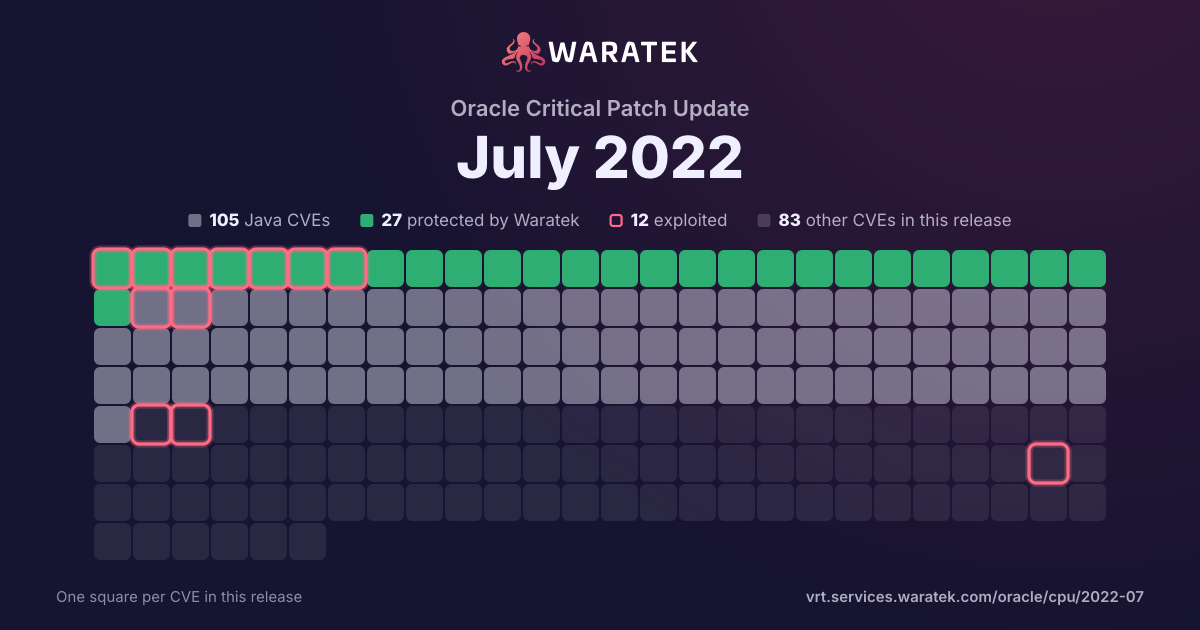
By status
24Protected by Waratek2Rule in development6Mitigation candidate83No exploit published2Outside Waratek scope71Not applicable
12Exploited, marked by the ring
No exploit published. For 46 of them, Oracle's security advisory is the source of public detail.
Protected by Waratek. Waratek RASP can block exploitation of these on systems that have not applied the patch yet.
Overview 28 matches · 8 protected · 1 exploited · 0 CISA KEV · 3 public PoC · 4 EPSS ≥ 0.5
Protected by Waratek
8
28.6%
Rule in development
0
0.0%
Mitigation candidate
2
7.1%
No exploit published
18
64.3%
blocked by ARMR today
8
28.6%
partly blocked
0
0.0%
not blocked
20
71.4%
not established
0
0.0%
unrecorded
0
0.0%
Exploited
1
3.6%
Working exploit published
2
7.1%
Proof of concept only
0
0.0%
Forecast only
1
3.6%
No public exploit
24
85.7%
split by
peak 8 / quarter
Q2 191
Mitigation candidate1
High1
not blocked1
Working exploit published1
Q3 191
Protected by Waratek1
High1
blocked by ARMR today1
No public exploit1
Q4 190
Q1 201
No exploit published1
High1
not blocked1
No public exploit1
Q2 202
Protected by Waratek1
No exploit published1
Critical1
Medium1
blocked by ARMR today1
not blocked1
Forecast only1
No public exploit1
Q3 200
Q4 203
Protected by Waratek2
No exploit published1
High2
Medium1
blocked by ARMR today2
not blocked1
No public exploit3
Q1 213
Protected by Waratek1
No exploit published2
Critical1
High2
blocked by ARMR today1
not blocked2
No public exploit3
Q2 216
Protected by Waratek2
Mitigation candidate1
No exploit published3
Critical1
High3
Medium2
blocked by ARMR today2
not blocked4
Working exploit published1
No public exploit5
Q3 218
Protected by Waratek1
No exploit published7
High5
Medium3
blocked by ARMR today1
not blocked7
Exploited1
No public exploit7
Q4 213
No exploit published3
Critical1
High2
not blocked3
No public exploit3
Q2 19Q3 19Q4 19Q1 20Q2 20Q3 20Q4 20Q1 21Q2 21Q3 21Q4 21
| CVE | Severity | Published▾ | Status | Exploitation | Description |
|---|---|---|---|---|---|
| CVE-2021-37137 | High | 2021-10-19 | No exploit published | No public exploit | The Snappy frame decoder function doesn't restrict the chunk length which may lead to excessive memory usage. Beside this it also may buffer reserved skippable chunks until the whole chunk was received which may lead to excessive memory usage as well. This vulnerability can be triggered by supplying malicious input that decompresses to a very big size (via a network stream or a file) or by sending a huge skippable chunk. |
| CVE-2021-42575 | Critical | 2021-10-18 | No exploit published | No public exploit | The OWASP Java HTML Sanitizer before 20211018.1 does not properly enforce policies associated with the SELECT, STYLE, and OPTION elements. |
| CVE-2021-42340 | High | 2021-10-14 | No exploit published | No public exploit | The fix for bug 63362 present in Apache Tomcat 10.1.0-M1 to 10.1.0-M5, 10.0.0-M1 to 10.0.11, 9.0.40 to 9.0.53 and 8.5.60 to 8.5.71 introduced a memory leak. The object introduced to collect metrics for HTTP upgrade connections was not released for WebSocket connections once the connection was closed. This created a memory leak that, over time, could lead to a denial of service via an OutOfMemoryError. |
| CVE-2021-40690 | High | 2021-09-19 | No exploit published | No public exploit | All versions of Apache Santuario - XML Security for Java prior to 2.2.3 and 2.1.7 are vulnerable to an issue where the "secureValidation" property is not passed correctly when creating a KeyInfo from a KeyInfoReference element. This allows an attacker to abuse an XPath Transform to extract any local .xml files in a RetrievalMethod element. |
| CVE-2021-39139 | High | 2021-08-23 | No exploit published | No public exploit | XStream is a simple library to serialize objects to XML and back again. In affected versions this vulnerability may allow a remote attacker to load and execute arbitrary code from a remote host only by manipulating the processed input stream. A user is only affected if using the version out of the box with JDK 1.7u21 or below. However, this scenario can be adjusted easily to an external Xalan that works regardless of the version of the Java runtime. No user is affected, who followed the recommendation to setup XStream's security framework with a whitelist limited to the minimal required types. XStream 1.4.18 uses no longer a blacklist by default, since it cannot be secured for general purpose. |
| CVE-2021-37714 | High | 2021-08-18 | No exploit published | No public exploit | jsoup is a Java library for working with HTML. Those using jsoup versions prior to 1.14.2 to parse untrusted HTML or XML may be vulnerable to DOS attacks. If the parser is run on user supplied input, an attacker may supply content that causes the parser to get stuck (loop indefinitely until cancelled), to complete more slowly than usual, or to throw an unexpected exception. This effect may support a denial of service attack. The issue is patched in version 1.14.2. There are a few available workarounds. Users may rate limit input parsing, limit the size of inputs based on system resources, and/or implement thread watchdogs to cap and timeout parse runtimes. |
| CVE-2021-2351 | High | 2021-07-21 | No exploit published | No public exploit | Vulnerability in the Advanced Networking Option component of Oracle Database Server. Supported versions that are affected are 12.1.0.2, 12.2.0.1 and 19c. Difficult to exploit vulnerability allows unauthenticated attacker with network access via Oracle Net to compromise Advanced Networking Option. Successful attacks require human interaction from a person other than the attacker and while the vulnerability is in Advanced Networking Option, attacks may significantly impact additional products. Successful attacks of this vulnerability can result in takeover of Advanced Networking Option. Note: The July 2021 Critical Patch Update introduces a number of Native Network Encryption changes to deal with vulnerability CVE-2021-2351 and prevent the use of weaker ciphers. Customers should review: "Changes in Native Network Encryption with the July 2021 Critical Patch Update" (Doc ID 2791571.1). CVSS 3.1 Base Score 8.3 (Confidentiality, Integrity and Availability impacts). CVSS Vector: (CVSS:3.1/AV:N/AC:H/PR:N/UI:R/S:C/C:H/I:H/A:H). |
| CVE-2021-34429 | Medium | 2021-07-15 | Protected by Waratek | Exploited | For Eclipse Jetty versions 9.4.37-9.4.42, 10.0.1-10.0.5 & 11.0.1-11.0.5, URIs can be crafted using some encoded characters to access the content of the WEB-INF directory and/or bypass some security constraints. This is a variation of the vulnerability reported in CVE-2021-28164/GHSA-v7ff-8wcx-gmc5. |
| CVE-2021-36374 | Medium | 2021-07-14 | No exploit published | No public exploit | When reading a specially crafted ZIP archive, or a derived formats, an Apache Ant build can be made to allocate large amounts of memory that leads to an out of memory error, even for small inputs. This can be used to disrupt builds using Apache Ant. Commonly used derived formats from ZIP archives are for instance JAR files and many office files. Apache Ant prior to 1.9.16 and 1.10.11 were affected. |
| CVE-2021-36090 | High | 2021-07-13 | No exploit published | No public exploit | When reading a specially crafted ZIP archive, Compress can be made to allocate large amounts of memory that finally leads to an out of memory error even for very small inputs. This could be used to mount a denial of service attack against services that use Compress' zip package. |
| CVE-2021-30129 | Medium | 2021-07-12 | No exploit published | No public exploit | A vulnerability in sshd-core of Apache Mina SSHD allows an attacker to overflow the server causing an OutOfMemory error. This issue affects the SFTP and port forwarding features of Apache Mina SSHD version 2.0.0 and later versions. It was addressed in Apache Mina SSHD 2.7.0 |
| CVE-2021-33813 | High | 2021-06-16 | Protected by Waratek | No public exploit | An XXE issue in SAXBuilder in JDOM through 2.0.6 allows attackers to cause a denial of service via a crafted HTTP request. |
| CVE-2021-31812 | Medium | 2021-06-12 | No exploit published | No public exploit | In Apache PDFBox, a carefully crafted PDF file can trigger an infinite loop while loading the file. This issue affects Apache PDFBox version 2.0.23 and prior 2.0.x versions. |
| CVE-2021-31684 | High | 2021-06-01 | No exploit published | No public exploit | A vulnerability was discovered in the indexOf function of JSONParserByteArray in JSON Smart versions 1.3 and 2.4 which causes a denial of service (DOS) via a crafted web request. |
| CVE-2021-29505 | High | 2021-05-28 | Mitigation candidate | Working exploit published | XStream is software for serializing Java objects to XML and back again. A vulnerability in XStream versions prior to 1.4.17 may allow a remote attacker has sufficient rights to execute commands of the host only by manipulating the processed input stream. No user who followed the recommendation to setup XStream's security framework with a whitelist limited to the minimal required types is affected. The vulnerability is patched in version 1.4.17. |
| CVE-2021-26291 | Critical | 2021-04-23 | No exploit published | No public exploit | Apache Maven will follow repositories that are defined in a dependency’s Project Object Model (pom) which may be surprising to some users, resulting in potential risk if a malicious actor takes over that repository or is able to insert themselves into a position to pretend to be that repository. Maven is changing the default behavior in 3.8.1+ to no longer follow http (non-SSL) repository references by default. More details available in the referenced urls. If you are currently using a repository manager to govern the repositories used by your builds, you are unaffected by the risks present in the legacy behavior, and are unaffected by this vulnerability and change to default behavior. See this link for more information about repository management: https://maven.apache.org/repository-management.html |
| CVE-2021-29425 | Medium | 2021-04-13 | Protected by Waratek | No public exploit | In Apache Commons IO before 2.7, When invoking the method FileNameUtils.normalize with an improper input string, like "//../foo", or "\\..\foo", the result would be the same value, thus possibly providing access to files in the parent directory, but not further above (thus "limited" path traversal), if the calling code would use the result to construct a path value. |
| CVE-2020-11987 | High | 2021-02-24 | No exploit published | No public exploit | Apache Batik 1.13 is vulnerable to server-side request forgery, caused by improper input validation by the NodePickerPanel. By using a specially-crafted argument, an attacker could exploit this vulnerability to cause the underlying server to make arbitrary GET requests. |
| CVE-2020-28491 | High | 2021-02-18 | No exploit published | No public exploit | This affects the package com.fasterxml.jackson.dataformat:jackson-dataformat-cbor from 0 and before 2.11.4, from 2.12.0-rc1 and before 2.12.1. Unchecked allocation of byte buffer can cause a java.lang.OutOfMemoryError exception. |
| CVE-2021-23926 | Critical | 2021-01-14 | Protected by Waratek | No public exploit | The XML parsers used by XMLBeans up to version 2.6.0 did not set the properties needed to protect the user from malicious XML input. Vulnerabilities include possibilities for XML Entity Expansion attacks. Affects XMLBeans up to and including v2.6.0. |
| CVE-2020-28052 | High | 2020-12-18 | No exploit published | No public exploit | An issue was discovered in Legion of the Bouncy Castle BC Java 1.65 and 1.66. The OpenBSDBCrypt.checkPassword utility method compared incorrect data when checking the password, allowing incorrect passwords to indicate they were matching with previously hashed ones that were different. |
| CVE-2020-17521 | Medium | 2020-12-07 | Protected by Waratek | No public exploit | Apache Groovy provides extension methods to aid with creating temporary directories. Prior to this fix, Groovy's implementation of those extension methods was using a now superseded Java JDK method call that is potentially not secure on some operating systems in some contexts. Users not using the extension methods mentioned in the advisory are not affected, but may wish to read the advisory for further details. Versions Affected: 2.0 to 2.4.20, 2.5.0 to 2.5.13, 3.0.0 to 3.0.6, and 4.0.0-alpha-1. Fixed in versions 2.4.21, 2.5.14, 3.0.7, 4.0.0-alpha-2. |
| CVE-2020-25649 | High | 2020-12-03 | Protected by Waratek | No public exploit | A flaw was found in FasterXML Jackson Databind, where it did not have entity expansion secured properly. This flaw allows vulnerability to XML external entity (XXE) attacks. The highest threat from this vulnerability is data integrity. |
| CVE-2020-10683 | Critical | 2020-05-01 | Protected by Waratek | No public exploit | dom4j before 2.0.3 and 2.1.x before 2.1.3 allows external DTDs and External Entities by default, which might enable XXE attacks. However, there is popular external documentation from OWASP showing how to enable the safe, non-default behavior in any application that uses dom4j. |
| CVE-2020-1927 | Medium | 2020-04-02 | No exploit published | Forecast only | In Apache HTTP Server 2.4.0 to 2.4.41, redirects configured with mod_rewrite that were intended to be self-referential might be fooled by encoded newlines and redirect instead to an an unexpected URL within the request URL. |
| CVE-2020-5258 | High | 2020-03-10 | No exploit published | No public exploit | In affected versions of dojo (NPM package), the deepCopy method is vulnerable to Prototype Pollution. Prototype Pollution refers to the ability to inject properties into existing JavaScript language construct prototypes, such as objects. An attacker manipulates these attributes to overwrite, or pollute, a JavaScript application object prototype of the base object by injecting other values. This has been patched in versions 1.12.8, 1.13.7, 1.14.6, 1.15.3 and 1.16.2 |
| CVE-2019-10086 | High | 2019-08-20 | Protected by Waratek | No public exploit | In Apache Commons Beanutils 1.9.2, a special BeanIntrospector class was added which allows suppressing the ability for an attacker to access the classloader via the class property available on all Java objects. We, however were not using this by default characteristic of the PropertyUtilsBean. |
| CVE-2019-0227 | High | 2019-05-01 | Mitigation candidate | Working exploit published | A Server Side Request Forgery (SSRF) vulnerability affected the Apache Axis 1.4 distribution that was last released in 2006. Security and bug commits commits continue in the projects Axis 1.x Subversion repository, legacy users are encouraged to build from source. The successor to Axis 1.x is Axis2, the latest version is 1.7.9 and is not vulnerable to this issue. |