
Oracle Critical Patch Update July 2022
Released July 2022 · Oracle's advisory ↗ · ← Critical Patch Update, April 2022 · Critical Patch Update, October 2022 →
188 CVEs in this release, one square each
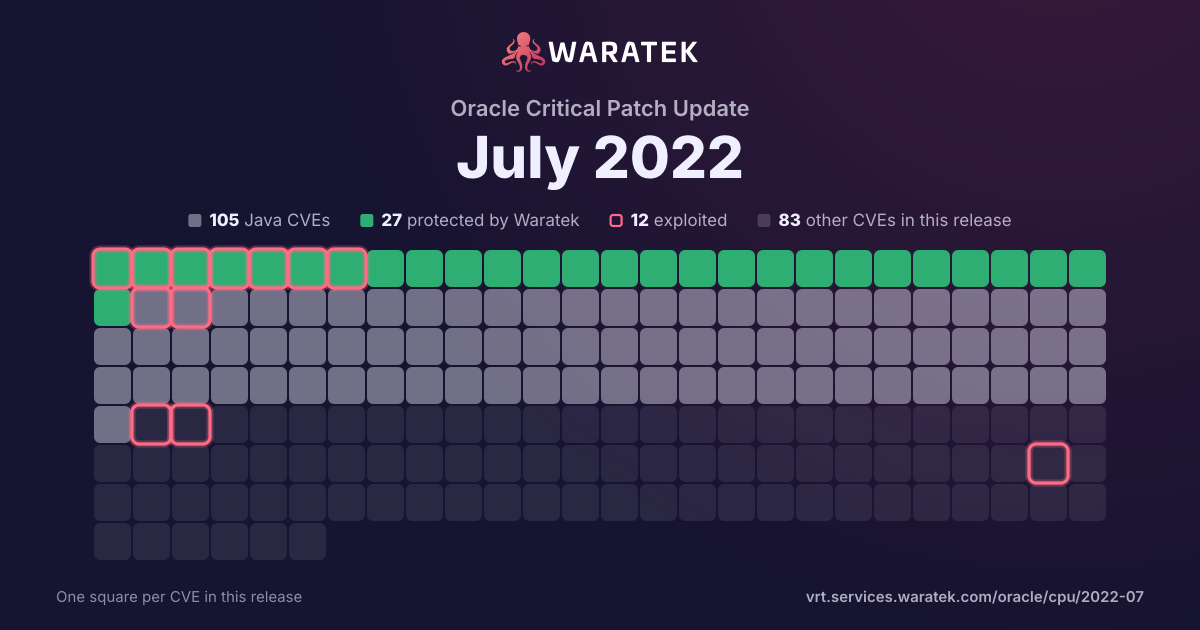
By status
24Protected by Waratek2Rule in development6Mitigation candidate83No exploit published2Outside Waratek scope71Not applicable
12Exploited, marked by the ring
No exploit published. For 46 of them, Oracle's security advisory is the source of public detail.
Protected by Waratek. Waratek RASP can block exploitation of these on systems that have not applied the patch yet.
Overview 30 matches · 9 protected · 2 exploited · 2 CISA KEV · 5 public PoC · 3 EPSS ≥ 0.5
Protected by Waratek
9
30.0%
Rule in development
1
3.3%
Mitigation candidate
1
3.3%
No exploit published
19
63.3%
blocked by ARMR today
9
30.0%
partly blocked
0
0.0%
not blocked
21
70.0%
not established
0
0.0%
unrecorded
0
0.0%
Exploited
2
6.7%
Working exploit published
0
0.0%
Proof of concept only
6
20.0%
Forecast only
0
0.0%
No public exploit
22
73.3%
split by
peak 14 / month
Jan 223
Protected by Waratek3
Critical1
High1
Medium1
blocked by ARMR today3
Proof of concept only1
No public exploit2
Feb 221
No exploit published1
High1
not blocked1
Proof of concept only1
Mar 222
No exploit published2
High2
not blocked2
No public exploit2
Apr 226
Protected by Waratek3
Rule in development1
No exploit published2
Critical3
High1
Medium2
blocked by ARMR today3
not blocked3
Exploited2
Proof of concept only1
No public exploit3
May 224
Protected by Waratek2
Mitigation candidate1
No exploit published1
Critical1
High1
Medium2
blocked by ARMR today2
not blocked2
Proof of concept only2
No public exploit2
Jun 220
Jul 2214
Protected by Waratek1
No exploit published13
High2
Medium12
blocked by ARMR today1
not blocked13
Proof of concept only1
No public exploit13
Jan 22Feb 22Mar 22Apr 22May 22Jun 22Jul 22
| CVE | Severity | Published▾ | Status | Exploitation | Description |
|---|---|---|---|---|---|
| CVE-2022-34169 | High | 2022-07-19 | Protected by Waratek | Proof of concept only | The Apache Xalan Java XSLT library is vulnerable to an integer truncation issue when processing malicious XSLT stylesheets. This can be used to corrupt Java class files generated by the internal XSLTC compiler and execute arbitrary Java bytecode. Users are recommended to update to version 2.7.3 or later. Note: Java runtimes (such as OpenJDK) include repackaged copies of Xalan. |
| CVE-2022-21586 | Medium | 2022-07-19 | No exploit published | No public exploit | Vulnerability in the Oracle Banking Trade Finance product of Oracle Financial Services Applications (component: Infrastructure). The supported version that is affected is 14.5. Difficult to exploit vulnerability allows low privileged attacker with network access via HTTP to compromise Oracle Banking Trade Finance. Successful attacks require human interaction from a person other than the attacker. Successful attacks of this vulnerability can result in unauthorized creation, deletion or modification access to critical data or all Oracle Banking Trade Finance accessible data as well as unauthorized access to critical data or complete access to all Oracle Banking Trade Finance accessible data. CVSS 3.1 Base Score 6.4 (Confidentiality and Integrity impacts). CVSS Vector: (CVSS:3.1/AV:N/AC:H/PR:L/UI:R/S:U/C:H/I:H/A:N). |
| CVE-2022-21585 | Medium | 2022-07-19 | No exploit published | No public exploit | Vulnerability in the Oracle Banking Trade Finance product of Oracle Financial Services Applications (component: Infrastructure). The supported version that is affected is 14.5. Difficult to exploit vulnerability allows low privileged attacker with network access via HTTP to compromise Oracle Banking Trade Finance. Successful attacks require human interaction from a person other than the attacker. Successful attacks of this vulnerability can result in unauthorized creation, deletion or modification access to critical data or all Oracle Banking Trade Finance accessible data as well as unauthorized access to critical data or complete access to all Oracle Banking Trade Finance accessible data and unauthorized ability to cause a partial denial of service (partial DOS) of Oracle Banking Trade Finance. CVSS 3.1 Base Score 6.7 (Confidentiality, Integrity and Availability impacts). CVSS Vector: (CVSS:3.1/AV:N/AC:H/PR:L/UI:R/S:U/C:H/I:H/A:L). |
| CVE-2022-21584 | Medium | 2022-07-19 | No exploit published | No public exploit | Vulnerability in the Oracle Banking Trade Finance product of Oracle Financial Services Applications (component: Infrastructure). The supported version that is affected is 14.5. Difficult to exploit vulnerability allows low privileged attacker with network access via HTTP to compromise Oracle Banking Trade Finance. Successful attacks require human interaction from a person other than the attacker. Successful attacks of this vulnerability can result in unauthorized creation, deletion or modification access to critical data or all Oracle Banking Trade Finance accessible data as well as unauthorized access to critical data or complete access to all Oracle Banking Trade Finance accessible data. CVSS 3.1 Base Score 6.4 (Confidentiality and Integrity impacts). CVSS Vector: (CVSS:3.1/AV:N/AC:H/PR:L/UI:R/S:U/C:H/I:H/A:N). |
| CVE-2022-21583 | Medium | 2022-07-19 | No exploit published | No public exploit | Vulnerability in the Oracle Banking Trade Finance product of Oracle Financial Services Applications (component: Infrastructure). The supported version that is affected is 14.5. Difficult to exploit vulnerability allows low privileged attacker with network access via HTTP to compromise Oracle Banking Trade Finance. Successful attacks of this vulnerability can result in unauthorized access to critical data or complete access to all Oracle Banking Trade Finance accessible data as well as unauthorized update, insert or delete access to some of Oracle Banking Trade Finance accessible data and unauthorized ability to cause a partial denial of service (partial DOS) of Oracle Banking Trade Finance. CVSS 3.1 Base Score 6.4 (Confidentiality, Integrity and Availability impacts). CVSS Vector: (CVSS:3.1/AV:N/AC:H/PR:L/UI:N/S:U/C:H/I:L/A:L). |
| CVE-2022-21582 | Medium | 2022-07-19 | No exploit published | No public exploit | Vulnerability in the Oracle Banking Trade Finance product of Oracle Financial Services Applications (component: Infrastructure). The supported version that is affected is 14.5. Difficult to exploit vulnerability allows low privileged attacker with network access via HTTP to compromise Oracle Banking Trade Finance. Successful attacks require human interaction from a person other than the attacker. Successful attacks of this vulnerability can result in unauthorized creation, deletion or modification access to critical data or all Oracle Banking Trade Finance accessible data as well as unauthorized access to critical data or complete access to all Oracle Banking Trade Finance accessible data and unauthorized ability to cause a partial denial of service (partial DOS) of Oracle Banking Trade Finance. CVSS 3.1 Base Score 6.7 (Confidentiality, Integrity and Availability impacts). CVSS Vector: (CVSS:3.1/AV:N/AC:H/PR:L/UI:R/S:U/C:H/I:H/A:L). |
| CVE-2022-21581 | Medium | 2022-07-19 | No exploit published | No public exploit | Vulnerability in the Oracle Banking Trade Finance product of Oracle Financial Services Applications (component: Infrastructure). The supported version that is affected is 14.5. Difficult to exploit vulnerability allows low privileged attacker with network access via HTTP to compromise Oracle Banking Trade Finance. Successful attacks require human interaction from a person other than the attacker. Successful attacks of this vulnerability can result in unauthorized creation, deletion or modification access to critical data or all Oracle Banking Trade Finance accessible data as well as unauthorized read access to a subset of Oracle Banking Trade Finance accessible data and unauthorized ability to cause a partial denial of service (partial DOS) of Oracle Banking Trade Finance. CVSS 3.1 Base Score 5.9 (Confidentiality, Integrity and Availability impacts). CVSS Vector: (CVSS:3.1/AV:N/AC:H/PR:L/UI:R/S:U/C:L/I:H/A:L). |
| CVE-2022-21580 | Medium | 2022-07-19 | No exploit published | No public exploit | Vulnerability in the Oracle Financial Services Revenue Management and Billing product of Oracle Financial Services Applications (component: Infrastructure). Supported versions that are affected are 2.9.0.0.0, 2.9.0.1.0, 3.0.0.0.0-3.2.0.0.0 and 4.0.0.0.0. Difficult to exploit vulnerability allows low privileged attacker with network access via HTTP to compromise Oracle Financial Services Revenue Management and Billing. Successful attacks require human interaction from a person other than the attacker. Successful attacks of this vulnerability can result in unauthorized access to critical data or complete access to all Oracle Financial Services Revenue Management and Billing accessible data as well as unauthorized update, insert or delete access to some of Oracle Financial Services Revenue Management and Billing accessible data and unauthorized ability to cause a partial denial of service (partial DOS) of Oracle Financial Services Revenue Management and Billing. CVSS 3.1 Base Score 5.9 (Confidentiality, Integrity and Availability impacts). CVSS Vector: (CVSS:3.1/AV:N/AC:H/PR:L/UI:R/S:U/C:H/I:L/A:L). |
| CVE-2022-21579 | Medium | 2022-07-19 | No exploit published | No public exploit | Vulnerability in the Oracle FLEXCUBE Universal Banking product of Oracle Financial Services Applications (component: Infrastructure). Supported versions that are affected are 12.1-12.4, 14.0-14.3 and 14.5. Difficult to exploit vulnerability allows low privileged attacker with network access via HTTP to compromise Oracle FLEXCUBE Universal Banking. Successful attacks require human interaction from a person other than the attacker. Successful attacks of this vulnerability can result in unauthorized creation, deletion or modification access to critical data or all Oracle FLEXCUBE Universal Banking accessible data as well as unauthorized access to critical data or complete access to all Oracle FLEXCUBE Universal Banking accessible data. CVSS 3.1 Base Score 6.4 (Confidentiality and Integrity impacts). CVSS Vector: (CVSS:3.1/AV:N/AC:H/PR:L/UI:R/S:U/C:H/I:H/A:N). |
| CVE-2022-21578 | Medium | 2022-07-19 | No exploit published | No public exploit | Vulnerability in the Oracle FLEXCUBE Universal Banking product of Oracle Financial Services Applications (component: Infrastructure). Supported versions that are affected are 12.1-12.4, 14.0-14.3 and 14.5. Difficult to exploit vulnerability allows low privileged attacker with network access via HTTP to compromise Oracle FLEXCUBE Universal Banking. Successful attacks require human interaction from a person other than the attacker. Successful attacks of this vulnerability can result in unauthorized creation, deletion or modification access to critical data or all Oracle FLEXCUBE Universal Banking accessible data as well as unauthorized access to critical data or complete access to all Oracle FLEXCUBE Universal Banking accessible data and unauthorized ability to cause a partial denial of service (partial DOS) of Oracle FLEXCUBE Universal Banking. CVSS 3.1 Base Score 6.7 (Confidentiality, Integrity and Availability impacts). CVSS Vector: (CVSS:3.1/AV:N/AC:H/PR:L/UI:R/S:U/C:H/I:H/A:L). |
| CVE-2022-21577 | Medium | 2022-07-19 | No exploit published | No public exploit | Vulnerability in the Oracle FLEXCUBE Universal Banking product of Oracle Financial Services Applications (component: Infrastructure). Supported versions that are affected are 12.1-12.4, 14.0-14.3 and 14.5. Difficult to exploit vulnerability allows low privileged attacker with network access via HTTP to compromise Oracle FLEXCUBE Universal Banking. Successful attacks require human interaction from a person other than the attacker. Successful attacks of this vulnerability can result in unauthorized creation, deletion or modification access to critical data or all Oracle FLEXCUBE Universal Banking accessible data as well as unauthorized access to critical data or complete access to all Oracle FLEXCUBE Universal Banking accessible data. CVSS 3.1 Base Score 6.4 (Confidentiality and Integrity impacts). CVSS Vector: (CVSS:3.1/AV:N/AC:H/PR:L/UI:R/S:U/C:H/I:H/A:N). |
| CVE-2022-21576 | Medium | 2022-07-19 | No exploit published | No public exploit | Vulnerability in the Oracle FLEXCUBE Universal Banking product of Oracle Financial Services Applications (component: Infrastructure). Supported versions that are affected are 12.3, 12.4, 14.0-14.3 and 14.5. Difficult to exploit vulnerability allows low privileged attacker with network access via HTTP to compromise Oracle FLEXCUBE Universal Banking. Successful attacks of this vulnerability can result in unauthorized access to critical data or complete access to all Oracle FLEXCUBE Universal Banking accessible data as well as unauthorized update, insert or delete access to some of Oracle FLEXCUBE Universal Banking accessible data and unauthorized ability to cause a partial denial of service (partial DOS) of Oracle FLEXCUBE Universal Banking. CVSS 3.1 Base Score 6.4 (Confidentiality, Integrity and Availability impacts). CVSS Vector: (CVSS:3.1/AV:N/AC:H/PR:L/UI:N/S:U/C:H/I:L/A:L). |
| CVE-2022-21544 | High | 2022-07-19 | No exploit published | No public exploit | Vulnerability in the Oracle FLEXCUBE Universal Banking product of Oracle Financial Services Applications (component: Infrastructure). Supported versions that are affected are 12.1-12.4, 14.0-14.3 and 14.5. Difficult to exploit vulnerability allows low privileged attacker with network access via HTTP to compromise Oracle FLEXCUBE Universal Banking. Successful attacks require human interaction from a person other than the attacker. Successful attacks of this vulnerability can result in takeover of Oracle FLEXCUBE Universal Banking. CVSS 3.1 Base Score 7.1 (Confidentiality, Integrity and Availability impacts). CVSS Vector: (CVSS:3.1/AV:N/AC:H/PR:L/UI:R/S:U/C:H/I:H/A:H). |
| CVE-2022-21428 | Medium | 2022-07-19 | No exploit published | No public exploit | Vulnerability in the Oracle FLEXCUBE Universal Banking product of Oracle Financial Services Applications (component: Infrastructure). Supported versions that are affected are 12.1-12.4, 14.0-14.3 and 14.5. Difficult to exploit vulnerability allows low privileged attacker with network access via HTTP to compromise Oracle FLEXCUBE Universal Banking. Successful attacks require human interaction from a person other than the attacker. Successful attacks of this vulnerability can result in unauthorized creation, deletion or modification access to critical data or all Oracle FLEXCUBE Universal Banking accessible data as well as unauthorized access to critical data or complete access to all Oracle FLEXCUBE Universal Banking accessible data and unauthorized ability to cause a partial denial of service (partial DOS) of Oracle FLEXCUBE Universal Banking. CVSS 3.1 Base Score 6.7 (Confidentiality, Integrity and Availability impacts). CVSS Vector: (CVSS:3.1/AV:N/AC:H/PR:L/UI:R/S:U/C:H/I:H/A:L). |
| CVE-2022-22978 | Critical | 2022-05-19 | Mitigation candidate | Proof of concept only | In spring security versions prior to 5.4.11+, 5.5.7+ , 5.6.4+ and older unsupported versions, RegexRequestMatcher can easily be misconfigured to be bypassed on some servlet containers. Applications using RegexRequestMatcher with `.` in the regular expression are possibly vulnerable to an authorization bypass. |
| CVE-2022-22971 | Medium | 2022-05-12 | Protected by Waratek | No public exploit | In spring framework versions prior to 5.3.20+ , 5.2.22+ and old unsupported versions, application with a STOMP over WebSocket endpoint is vulnerable to a denial of service attack by an authenticated user. |
| CVE-2022-24823 | Medium | 2022-05-06 | No exploit published | Proof of concept only | Netty is an open-source, asynchronous event-driven network application framework. The package `io.netty:netty-codec-http` prior to version 4.1.77.Final contains an insufficient fix for CVE-2021-21290. When Netty's multipart decoders are used local information disclosure can occur via the local system temporary directory if temporary storing uploads on the disk is enabled. This only impacts applications running on Java version 6 and lower. Additionally, this vulnerability impacts code running on Unix-like systems, and very old versions of Mac OSX and Windows as they all share the system temporary directory between all users. Version 4.1.77.Final contains a patch for this vulnerability. As a workaround, specify one's own `java.io.tmpdir` when starting the JVM or use DefaultHttpDataFactory.setBaseDir(...) to set the directory to something that is only readable by the current user. |
| CVE-2022-25647 | High | 2022-05-01 | Protected by Waratek | No public exploit | The package com.google.code.gson:gson before 2.8.9 are vulnerable to Deserialization of Untrusted Data via the writeReplace() method in internal classes, which may lead to DoS attacks. |
| CVE-2022-23457 | Critical | 2022-04-25 | Protected by Waratek | Proof of concept only | ESAPI (The OWASP Enterprise Security API) is a free, open source, web application security control library. Prior to version 2.3.0.0, the default implementation of `Validator.getValidDirectoryPath(String, String, File, boolean)` may incorrectly treat the tested input string as a child of the specified parent directory. This potentially could allow control-flow bypass checks to be defeated if an attack can specify the entire string representing the 'input' path. This vulnerability is patched in release 2.3.0.0 of ESAPI. As a workaround, it is possible to write one's own implementation of the Validator interface. However, maintainers do not recommend this. |
| CVE-2022-29577 | Medium | 2022-04-21 | Protected by Waratek | No public exploit | OWASP AntiSamy before 1.6.7 allows XSS via HTML tag smuggling on STYLE content with crafted input. The output serializer does not properly encode the supposed Cascading Style Sheets (CSS) content. NOTE: this issue exists because of an incomplete fix for CVE-2022-28367. |
| CVE-2022-22969 | Medium | 2022-04-21 | No exploit published | No public exploit | <Issue Description> Spring Security OAuth versions 2.5.x prior to 2.5.2 and older unsupported versions are susceptible to a Denial-of-Service (DoS) attack via the initiation of the Authorization Request in an OAuth 2.0 Client application. A malicious user or attacker can send multiple requests initiating the Authorization Request for the Authorization Code Grant, which has the potential of exhausting system resources using a single session. This vulnerability exposes OAuth 2.0 Client applications only. |
| CVE-2022-24839 | High | 2022-04-11 | No exploit published | No public exploit | org.cyberneko.html is an html parser written in Java. The fork of `org.cyberneko.html` used by Nokogiri (Rubygem) raises a `java.lang.OutOfMemoryError` exception when parsing ill-formed HTML markup. Users are advised to upgrade to `>= 1.9.22.noko2`. Note: The upstream library `org.cyberneko.html` is no longer maintained. Nokogiri uses its own fork of this library located at https://github.com/sparklemotion/nekohtml and this CVE applies only to that fork. Other forks of nekohtml may have a similar vulnerability. |
| CVE-2022-22965 | Critical | 2022-04-01 | Protected by Waratek | Exploited | A Spring MVC or Spring WebFlux application running on JDK 9+ may be vulnerable to remote code execution (RCE) via data binding. The specific exploit requires the application to run on Tomcat as a WAR deployment. If the application is deployed as a Spring Boot executable jar, i.e. the default, it is not vulnerable to the exploit. However, the nature of the vulnerability is more general, and there may be other ways to exploit it. |
| CVE-2022-22963 | Critical | 2022-04-01 | Rule in development | Exploited | In Spring Cloud Function versions 3.1.6, 3.2.2 and older unsupported versions, when using routing functionality it is possible for a user to provide a specially crafted SpEL as a routing-expression that may result in remote code execution and access to local resources. |
| CVE-2020-36518 | High | 2022-03-11 | No exploit published | No public exploit | jackson-databind before 2.13.0 allows a Java StackOverflow exception and denial of service via a large depth of nested objects. |
| CVE-2021-38296 | High | 2022-03-10 | No exploit published | No public exploit | Apache Spark supports end-to-end encryption of RPC connections via "spark.authenticate" and "spark.network.crypto.enabled". In versions 3.1.2 and earlier, it uses a bespoke mutual authentication protocol that allows for full encryption key recovery. After an initial interactive attack, this would allow someone to decrypt plaintext traffic offline. Note that this does not affect security mechanisms controlled by "spark.authenticate.enableSaslEncryption", "spark.io.encryption.enabled", "spark.ssl", "spark.ui.strictTransportSecurity". Update to Apache Spark 3.1.3 or later |
| CVE-2021-43859 | High | 2022-02-01 | No exploit published | Proof of concept only | XStream is an open source java library to serialize objects to XML and back again. Versions prior to 1.4.19 may allow a remote attacker to allocate 100% CPU time on the target system depending on CPU type or parallel execution of such a payload resulting in a denial of service only by manipulating the processed input stream. XStream 1.4.19 monitors and accumulates the time it takes to add elements to collections and throws an exception if a set threshold is exceeded. Users are advised to upgrade as soon as possible. Users unable to upgrade may set the NO_REFERENCE mode to prevent recursion. See GHSA-rmr5-cpv2-vgjf for further details on a workaround if an upgrade is not possible. |
| CVE-2022-23181 | High | 2022-01-27 | Protected by Waratek | No public exploit | The fix for bug CVE-2020-9484 introduced a time of check, time of use vulnerability into Apache Tomcat 10.1.0-M1 to 10.1.0-M8, 10.0.0-M5 to 10.0.14, 9.0.35 to 9.0.56 and 8.5.55 to 8.5.73 that allowed a local attacker to perform actions with the privileges of the user that the Tomcat process is using. This issue is only exploitable when Tomcat is configured to persist sessions using the FileStore. |
| CVE-2022-23437 | Medium | 2022-01-24 | Protected by Waratek | No public exploit | There's a vulnerability within the Apache Xerces Java (XercesJ) XML parser when handling specially crafted XML document payloads. This causes, the XercesJ XML parser to wait in an infinite loop, which may sometimes consume system resources for prolonged duration. This vulnerability is present within XercesJ version 2.12.1 and the previous versions. |
| CVE-2022-23305 | Critical | 2022-01-18 | Protected by Waratek | Proof of concept only | By design, the JDBCAppender in Log4j 1.2.x accepts an SQL statement as a configuration parameter where the values to be inserted are converters from PatternLayout. The message converter, %m, is likely to always be included. This allows attackers to manipulate the SQL by entering crafted strings into input fields or headers of an application that are logged allowing unintended SQL queries to be executed. Note this issue only affects Log4j 1.x when specifically configured to use the JDBCAppender, which is not the default. Beginning in version 2.0-beta8, the JDBCAppender was re-introduced with proper support for parameterized SQL queries and further customization over the columns written to in logs. Apache Log4j 1.2 reached end of life in August 2015. Users should upgrade to Log4j 2 as it addresses numerous other issues from the previous versions. |