
Oracle Critical Patch Update April 2022
Released April 2022 · Oracle's advisory ↗ · ← Critical Patch Update, January 2022 · Critical Patch Update, July 2022 →
222 CVEs in this release, one square each
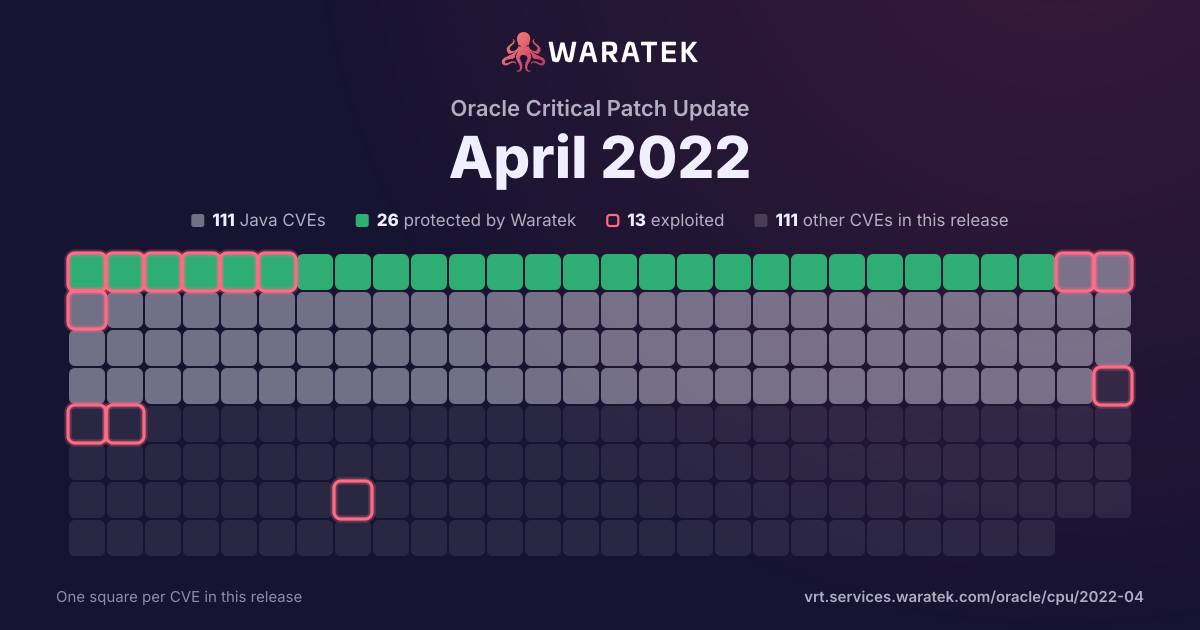
By status
29Protected by Waratek9Mitigation candidate96No exploit published88Not applicable
13Exploited, marked by the ring
No exploit published. For 46 of them, Oracle's security advisory is the source of public detail.
Protected by Waratek. Waratek RASP can block exploitation of these on systems that have not applied the patch yet.
Overview 3 matches · 2 in Waratek scope · 1 protected · 0 exploited · 0 CISA KEV · 2 EPSS ≥ 0.5
Protected by Waratek
1
33.3%
Rule in development
0
0.0%
Mitigation candidate
1
33.3%
No exploit published
0
0.0%
Outside Waratek scope
0
0.0%
Not applicable
1
33.3%
Withdrawn CVE
0
0.0%
blocked by ARMR today
1
33.3%
partly blocked
0
0.0%
not blocked
2
66.7%
not established
0
0.0%
unrecorded
0
0.0%
Exploited
0
0.0%
Working exploit published
3
100.0%
Proof of concept only
0
0.0%
Forecast only
0
0.0%
No public exploit
0
0.0%
split by
peak 2 / month
May 19Jun 19Jul 19Aug 19Sep 19Oct 19Nov 19
| CVE | Severity | Published▾ | Status | Exploitation | Description |
|---|---|---|---|---|---|
| CVE-2019-18276 | High | 2019-11-28 | Not applicable | Working exploit published | An issue was discovered in disable_priv_mode in shell.c in GNU Bash through 5.0 patch 11. By default, if Bash is run with its effective UID not equal to its real UID, it will drop privileges by setting its effective UID to its real UID. However, it does so incorrectly. On Linux and other systems that support "saved UID" functionality, the saved UID is not dropped. An attacker with command execution in the shell can use "enable -f" for runtime loading of a new builtin, which can be a shared object that calls setuid() and therefore regains privileges. However, binaries running with an effective UID of 0 are unaffected. |
| CVE-2019-3799 | Medium | 2019-05-06 | Protected by Waratek | Working exploit published | Spring Cloud Config, versions 2.1.x prior to 2.1.2, versions 2.0.x prior to 2.0.4, and versions 1.4.x prior to 1.4.6, and older unsupported versions allow applications to serve arbitrary configuration files through the spring-cloud-config-server module. A malicious user, or attacker, can send a request using a specially crafted URL that can lead a directory traversal attack. |
| CVE-2019-0227 | High | 2019-05-01 | Mitigation candidate | Working exploit published | A Server Side Request Forgery (SSRF) vulnerability affected the Apache Axis 1.4 distribution that was last released in 2006. Security and bug commits commits continue in the projects Axis 1.x Subversion repository, legacy users are encouraged to build from source. The successor to Axis 1.x is Axis2, the latest version is 1.7.9 and is not vulnerable to this issue. |