
Oracle Critical Patch Update April 2022
Released April 2022 · Oracle's advisory ↗ · ← Critical Patch Update, January 2022 · Critical Patch Update, July 2022 →
222 CVEs in this release, one square each
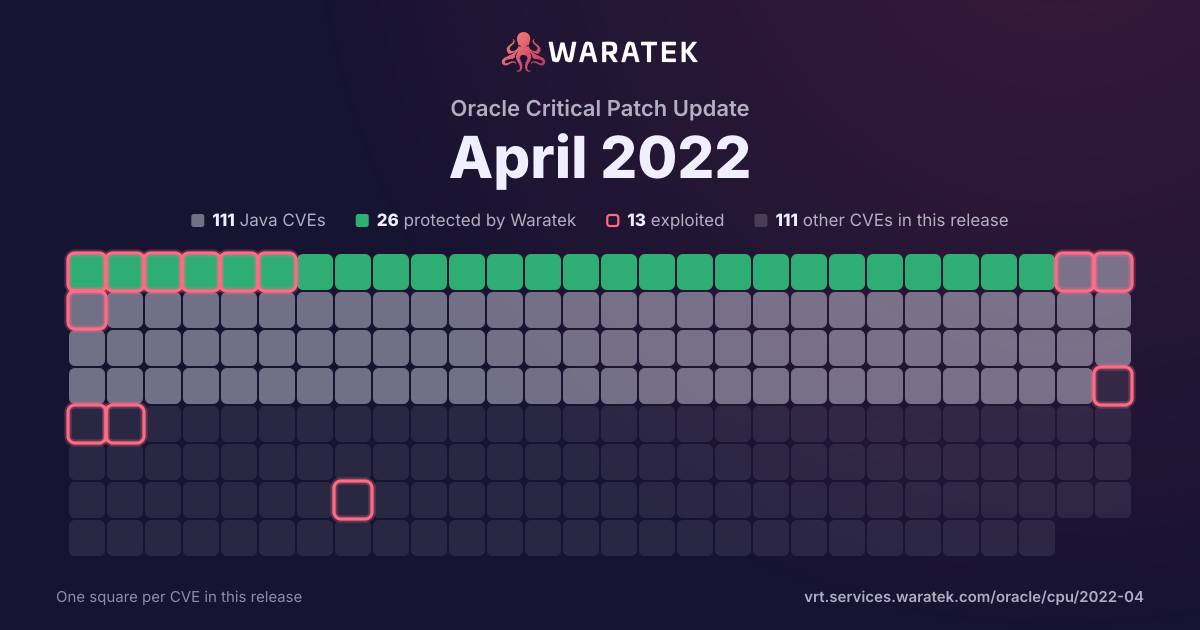
By status
29Protected by Waratek9Mitigation candidate96No exploit published88Not applicable
13Exploited, marked by the ring
No exploit published. For 46 of them, Oracle's security advisory is the source of public detail.
Protected by Waratek. Waratek RASP can block exploitation of these on systems that have not applied the patch yet.
Overview 5 matches · 4 in Waratek scope · 2 protected · 0 exploited · 0 CISA KEV · 3 public PoC · 3 EPSS ≥ 0.5
5matches
4in Waratek scope80.0%
2protected40.0%
0exploited0.0%
0CISA KEV0.0%
3public PoC60.0%
3EPSS ≥ 0.560.0%
Protected by Waratek
2
40.0%
Rule in development
0
0.0%
Mitigation candidate
0
0.0%
No exploit published
2
40.0%
Outside Waratek scope
0
0.0%
Not applicable
1
20.0%
Withdrawn CVE
0
0.0%
blocked by ARMR today
2
40.0%
partly blocked
0
0.0%
not blocked
3
60.0%
not established
0
0.0%
unrecorded
0
0.0%
Exploited
0
0.0%
Working exploit published
0
0.0%
Proof of concept only
5
100.0%
Forecast only
0
0.0%
No public exploit
0
0.0%
split by
peak 2 / month
Jan 222
Protected by Waratek1
No exploit published1
Critical1
High1
blocked by ARMR today1
not blocked1
Proof of concept only2
Feb 221
No exploit published1
High1
not blocked1
Proof of concept only1
Mar 221
Not applicable1
High1
not blocked1
Proof of concept only1
Apr 221
Protected by Waratek1
High1
blocked by ARMR today1
Proof of concept only1
Jan 22Feb 22Mar 22Apr 22
| CVE | Severity | Published▾ | Status | Exploitation | Description |
|---|---|---|---|---|---|
| CVE-2022-21449 | High | 2022-04-19 | Protected by Waratek | Proof of concept only | Vulnerability in the Oracle Java SE, Oracle GraalVM Enterprise Edition product of Oracle Java SE (component: Libraries). Supported versions that are affected are Oracle Java SE: 17.0.2 and 18; Oracle GraalVM Enterprise Edition: 21.3.1 and 22.0.0.2. Easily exploitable vulnerability allows unauthenticated attacker with network access via multiple protocols to compromise Oracle Java SE, Oracle GraalVM Enterprise Edition. Successful attacks of this vulnerability can result in unauthorized creation, deletion or modification access to critical data or all Oracle Java SE, Oracle GraalVM Enterprise Edition accessible data. Note: This vulnerability applies to Java deployments, typically in clients running sandboxed Java Web Start applications or sandboxed Java applets, that load and run untrusted code (e.g., code that comes from the internet) and rely on the Java sandbox for security. This vulnerability can also be exploited by using APIs in the specified Component, e.g., through a web service which supplies data to the APIs. CVSS 3.1 Base Score 7.5 (Integrity impacts). CVSS Vector: (CVSS:3.1/AV:N/AC:L/PR:N/UI:N/S:U/C:N/I:H/A:N). |
| CVE-2022-0778 | High | 2022-03-15 | Not applicable | Proof of concept only | The BN_mod_sqrt() function, which computes a modular square root, contains a bug that can cause it to loop forever for non-prime moduli. Internally this function is used when parsing certificates that contain elliptic curve public keys in compressed form or explicit elliptic curve parameters with a base point encoded in compressed form. It is possible to trigger the infinite loop by crafting a certificate that has invalid explicit curve parameters. Since certificate parsing happens prior to verification of the certificate signature, any process that parses an externally supplied certificate may thus be subject to a denial of service attack. The infinite loop can also be reached when parsing crafted private keys as they can contain explicit elliptic curve parameters. Thus vulnerable situations include: - TLS clients consuming server certificates - TLS servers consuming client certificates - Hosting providers taking certificates or private keys from customers - Certificate authorities parsing certification requests from subscribers - Anything else which parses ASN.1 elliptic curve parameters Also any other applications that use the BN_mod_sqrt() where the attacker can control the parameter values are vulnerable to this DoS issue. In the OpenSSL 1.0.2 version the public key is not parsed during initial parsing of the certificate which makes it slightly harder to trigger the infinite loop. However any operation which requires the public key from the certificate will trigger the infinite loop. In particular the attacker can use a self-signed certificate to trigger the loop during verification of the certificate signature. This issue affects OpenSSL versions 1.0.2, 1.1.1 and 3.0. It was addressed in the releases of 1.1.1n and 3.0.2 on the 15th March 2022. Fixed in OpenSSL 3.0.2 (Affected 3.0.0,3.0.1). Fixed in OpenSSL 1.1.1n (Affected 1.1.1-1.1.1m). Fixed in OpenSSL 1.0.2zd (Affected 1.0.2-1.0.2zc). |
| CVE-2021-43859 | High | 2022-02-01 | No exploit published | Proof of concept only | XStream is an open source java library to serialize objects to XML and back again. Versions prior to 1.4.19 may allow a remote attacker to allocate 100% CPU time on the target system depending on CPU type or parallel execution of such a payload resulting in a denial of service only by manipulating the processed input stream. XStream 1.4.19 monitors and accumulates the time it takes to add elements to collections and throws an exception if a set threshold is exceeded. Users are advised to upgrade as soon as possible. Users unable to upgrade may set the NO_REFERENCE mode to prevent recursion. See GHSA-rmr5-cpv2-vgjf for further details on a workaround if an upgrade is not possible. |
| CVE-2022-23305 | Critical | 2022-01-18 | Protected by Waratek | Proof of concept only | By design, the JDBCAppender in Log4j 1.2.x accepts an SQL statement as a configuration parameter where the values to be inserted are converters from PatternLayout. The message converter, %m, is likely to always be included. This allows attackers to manipulate the SQL by entering crafted strings into input fields or headers of an application that are logged allowing unintended SQL queries to be executed. Note this issue only affects Log4j 1.x when specifically configured to use the JDBCAppender, which is not the default. Beginning in version 2.0-beta8, the JDBCAppender was re-introduced with proper support for parameterized SQL queries and further customization over the columns written to in logs. Apache Log4j 1.2 reached end of life in August 2015. Users should upgrade to Log4j 2 as it addresses numerous other issues from the previous versions. |
| CVE-2021-22569 | High | 2022-01-10 | No exploit published | Proof of concept only | An issue in protobuf-java allowed the interleaving of com.google.protobuf.UnknownFieldSet fields in such a way that would be processed out of order. A small malicious payload can occupy the parser for several minutes by creating large numbers of short-lived objects that cause frequent, repeated pauses. We recommend upgrading libraries beyond the vulnerable versions. |