
Oracle Critical Patch Update April 2022
Released April 2022 · Oracle's advisory ↗ · ← Critical Patch Update, January 2022 · Critical Patch Update, July 2022 →
222 CVEs in this release, one square each
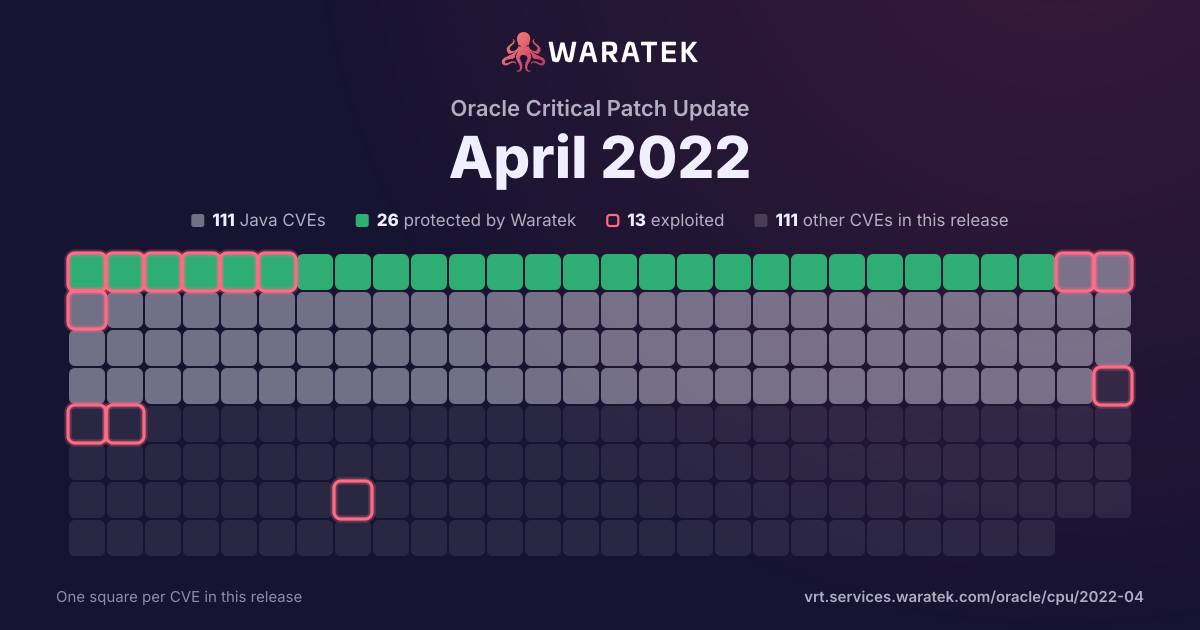
By status
25Protected by Waratek1Rule in development7Mitigation candidate98No exploit published91Not applicable
13Exploited, marked by the ring
No exploit published. For 40 of them, Oracle's security advisory is the source of public detail.
Protected by Waratek. Waratek RASP can block exploitation of these on systems that have not applied the patch yet.
Overview 23 matches · 7 protected · 0 exploited · 0 CISA KEV · 0 public PoC · 0 EPSS ≥ 0.5
Protected by Waratek
7
30.4%
Rule in development
0
0.0%
Mitigation candidate
0
0.0%
No exploit published
16
69.6%
blocked by ARMR today
7
30.4%
partly blocked
0
0.0%
not blocked
16
69.6%
not established
0
0.0%
unrecorded
0
0.0%
Exploited
0
0.0%
Working exploit published
0
0.0%
Proof of concept only
0
0.0%
Forecast only
0
0.0%
No public exploit
23
100.0%
split by
peak 8 / quarter
Q2 191
Protected by Waratek1
High1
blocked by ARMR today1
No public exploit1
Q3 192
Protected by Waratek1
No exploit published1
High1
Medium1
blocked by ARMR today1
not blocked1
No public exploit2
Q4 190
Q1 202
No exploit published2
High1
Medium1
not blocked2
No public exploit2
Q2 202
No exploit published2
High1
Low1
not blocked2
No public exploit2
Q3 202
No exploit published2
High1
Medium1
not blocked2
No public exploit2
Q4 208
Protected by Waratek4
No exploit published4
High4
Medium3
Low1
blocked by ARMR today4
not blocked4
No public exploit8
Q1 212
No exploit published2
High1
Medium1
not blocked2
No public exploit2
Q2 214
Protected by Waratek1
No exploit published3
Critical1
Medium3
blocked by ARMR today1
not blocked3
No public exploit4
Q2 19Q3 19Q4 19Q1 20Q2 20Q3 20Q4 20Q1 21Q2 21
| CVE | Severity | Published▾ | Status | Exploitation | Description |
|---|---|---|---|---|---|
| CVE-2021-28170 | Medium | 2021-05-26 | No exploit published | No public exploit | In the Jakarta Expression Language implementation 3.0.3 and earlier, a bug in the ELParserTokenManager enables invalid EL expressions to be evaluated as if they were valid. |
| CVE-2021-26291 | Critical | 2021-04-23 | No exploit published | No public exploit | Apache Maven will follow repositories that are defined in a dependency’s Project Object Model (pom) which may be surprising to some users, resulting in potential risk if a malicious actor takes over that repository or is able to insert themselves into a position to pretend to be that repository. Maven is changing the default behavior in 3.8.1+ to no longer follow http (non-SSL) repository references by default. More details available in the referenced urls. If you are currently using a repository manager to govern the repositories used by your builds, you are unaffected by the risks present in the legacy behavior, and are unaffected by this vulnerability and change to default behavior. See this link for more information about repository management: https://maven.apache.org/repository-management.html |
| CVE-2021-28168 | Medium | 2021-04-22 | No exploit published | No public exploit | Eclipse Jersey 2.28 to 2.33 and Eclipse Jersey 3.0.0 to 3.0.1 contains a local information disclosure vulnerability. This is due to the use of the File.createTempFile which creates a file inside of the system temporary directory with the permissions: -rw-r--r--. Thus the contents of this file are viewable by all other users locally on the system. As such, if the contents written is security sensitive, it can be disclosed to other local users. |
| CVE-2021-29425 | Medium | 2021-04-13 | Protected by Waratek | No public exploit | In Apache Commons IO before 2.7, When invoking the method FileNameUtils.normalize with an improper input string, like "//../foo", or "\\..\foo", the result would be the same value, thus possibly providing access to files in the parent directory, but not further above (thus "limited" path traversal), if the calling code would use the result to construct a path value. |
| CVE-2021-28657 | Medium | 2021-03-31 | No exploit published | No public exploit | A carefully crafted or corrupt file may trigger an infinite loop in Tika's MP3Parser up to and including Tika 1.25. Apache Tika users should upgrade to 1.26 or later. |
| CVE-2020-13936 | High | 2021-03-10 | No exploit published | No public exploit | An attacker that is able to modify Velocity templates may execute arbitrary Java code or run arbitrary system commands with the same privileges as the account running the Servlet container. This applies to applications that allow untrusted users to upload/modify velocity templates running Apache Velocity Engine versions up to 2.2. |
| CVE-2020-28052 | High | 2020-12-18 | No exploit published | No public exploit | An issue was discovered in Legion of the Bouncy Castle BC Java 1.65 and 1.66. The OpenBSDBCrypt.checkPassword utility method compared incorrect data when checking the password, allowing incorrect passwords to indicate they were matching with previously hashed ones that were different. |
| CVE-2020-8908 | Low | 2020-12-10 | No exploit published | No public exploit | A temp directory creation vulnerability exists in all versions of Guava, allowing an attacker with access to the machine to potentially access data in a temporary directory created by the Guava API com.google.common.io.Files.createTempDir(). By default, on unix-like systems, the created directory is world-readable (readable by an attacker with access to the system). The method in question has been marked @Deprecated in versions 30.0 and later and should not be used. For Android developers, we recommend choosing a temporary directory API provided by Android, such as context.getCacheDir(). For other Java developers, we recommend migrating to the Java 7 API java.nio.file.Files.createTempDirectory() which explicitly configures permissions of 700, or configuring the Java runtime's java.io.tmpdir system property to point to a location whose permissions are appropriately configured. |
| CVE-2020-17521 | Medium | 2020-12-07 | Protected by Waratek | No public exploit | Apache Groovy provides extension methods to aid with creating temporary directories. Prior to this fix, Groovy's implementation of those extension methods was using a now superseded Java JDK method call that is potentially not secure on some operating systems in some contexts. Users not using the extension methods mentioned in the advisory are not affected, but may wish to read the advisory for further details. Versions Affected: 2.0 to 2.4.20, 2.5.0 to 2.5.13, 3.0.0 to 3.0.6, and 4.0.0-alpha-1. Fixed in versions 2.4.21, 2.5.14, 3.0.7, 4.0.0-alpha-2. |
| CVE-2020-25649 | High | 2020-12-03 | Protected by Waratek | No public exploit | A flaw was found in FasterXML Jackson Databind, where it did not have entity expansion secured properly. This flaw allows vulnerability to XML external entity (XXE) attacks. The highest threat from this vulnerability is data integrity. |
| CVE-2020-25638 | High | 2020-12-02 | Protected by Waratek | No public exploit | A flaw was found in hibernate-core in versions prior to and including 5.4.23.Final. A SQL injection in the implementation of the JPA Criteria API can permit unsanitized literals when a literal is used in the SQL comments of the query. This flaw could allow an attacker to access unauthorized information or possibly conduct further attacks. The highest threat from this vulnerability is to data confidentiality and integrity. |
| CVE-2020-13956 | Medium | 2020-12-02 | No exploit published | No public exploit | Apache HttpClient versions prior to version 4.5.13 and 5.0.3 can misinterpret malformed authority component in request URIs passed to the library as java.net.URI object and pick the wrong target host for request execution. |
| CVE-2020-15250 | Medium | 2020-10-12 | Protected by Waratek | No public exploit | In JUnit4 from version 4.7 and before 4.13.1, the test rule TemporaryFolder contains a local information disclosure vulnerability. On Unix like systems, the system's temporary directory is shared between all users on that system. Because of this, when files and directories are written into this directory they are, by default, readable by other users on that same system. This vulnerability does not allow other users to overwrite the contents of these directories or files. This is purely an information disclosure vulnerability. This vulnerability impacts you if the JUnit tests write sensitive information, like API keys or passwords, into the temporary folder, and the JUnit tests execute in an environment where the OS has other untrusted users. Because certain JDK file system APIs were only added in JDK 1.7, this this fix is dependent upon the version of the JDK you are using. For Java 1.7 and higher users: this vulnerability is fixed in 4.13.1. For Java 1.6 and lower users: no patch is available, you must use the workaround below. If you are unable to patch, or are stuck running on Java 1.6, specifying the `java.io.tmpdir` system environment variable to a directory that is exclusively owned by the executing user will fix this vulnerability. For more information, including an example of vulnerable code, see the referenced GitHub Security Advisory. |
| CVE-2020-11979 | High | 2020-10-01 | No exploit published | No public exploit | As mitigation for CVE-2020-1945 Apache Ant 1.10.8 changed the permissions of temporary files it created so that only the current user was allowed to access them. Unfortunately the fixcrlf task deleted the temporary file and created a new one without said protection, effectively nullifying the effort. This would still allow an attacker to inject modified source files into the build process. |
| CVE-2020-5421 | Medium | 2020-09-19 | No exploit published | No public exploit | In Spring Framework versions 5.2.0 - 5.2.8, 5.1.0 - 5.1.17, 5.0.0 - 5.0.18, 4.3.0 - 4.3.28, and older unsupported versions, the protections against RFD attacks from CVE-2015-5211 may be bypassed depending on the browser used through the use of a jsessionid path parameter. |
| CVE-2020-24750 | High | 2020-09-17 | No exploit published | No public exploit | FasterXML jackson-databind 2.x before 2.9.10.6 mishandles the interaction between serialization gadgets and typing, related to com.pastdev.httpcomponents.configuration.JndiConfiguration. |
| CVE-2020-9488 | Low | 2020-04-27 | No exploit published | No public exploit | Improper validation of certificate with host mismatch in Apache Log4j SMTP appender. This could allow an SMTPS connection to be intercepted by a man-in-the-middle attack which could leak any log messages sent through that appender. Fixed in Apache Log4j 2.12.3 and 2.13.1 |
| CVE-2020-11612 | High | 2020-04-07 | No exploit published | No public exploit | The ZlibDecoders in Netty 4.1.x before 4.1.46 allow for unbounded memory allocation while decoding a ZlibEncoded byte stream. An attacker could send a large ZlibEncoded byte stream to the Netty server, forcing the server to allocate all of its free memory to a single decoder. |
| CVE-2020-7226 | High | 2020-01-24 | No exploit published | No public exploit | CiphertextHeader.java in Cryptacular 1.2.3, as used in Apereo CAS and other products, allows attackers to trigger excessive memory allocation during a decode operation, because the nonce array length associated with "new byte" may depend on untrusted input within the header of encoded data. |
| CVE-2019-14862 | Medium | 2020-01-02 | No exploit published | No public exploit | There is a vulnerability in knockout before version 3.5.0-beta, where after escaping the context of the web application, the web application delivers data to its users along with other trusted dynamic content, without validating it. |
| CVE-2019-3740 | Medium | 2019-09-18 | No exploit published | No public exploit | RSA BSAFE Crypto-J versions prior to 6.2.5 are vulnerable to an Information Exposure Through Timing Discrepancy vulnerabilities during DSA key generation. A malicious remote attacker could potentially exploit those vulnerabilities to recover DSA keys. |
| CVE-2019-10086 | High | 2019-08-20 | Protected by Waratek | No public exploit | In Apache Commons Beanutils 1.9.2, a special BeanIntrospector class was added which allows suppressing the ability for an attacker to access the classloader via the class property available on all Java objects. We, however were not using this by default characteristic of the PropertyUtilsBean. |
| CVE-2019-12086 | High | 2019-05-17 | Protected by Waratek | No public exploit | A Polymorphic Typing issue was discovered in FasterXML jackson-databind 2.x before 2.9.9. When Default Typing is enabled (either globally or for a specific property) for an externally exposed JSON endpoint, the service has the mysql-connector-java jar (8.0.14 or earlier) in the classpath, and an attacker can host a crafted MySQL server reachable by the victim, an attacker can send a crafted JSON message that allows them to read arbitrary local files on the server. This occurs because of missing com.mysql.cj.jdbc.admin.MiniAdmin validation. |