
Oracle Critical Patch Update April 2022
Released April 2022 · Oracle's advisory ↗ · ← Critical Patch Update, January 2022 · Critical Patch Update, July 2022 →
222 CVEs in this release, one square each
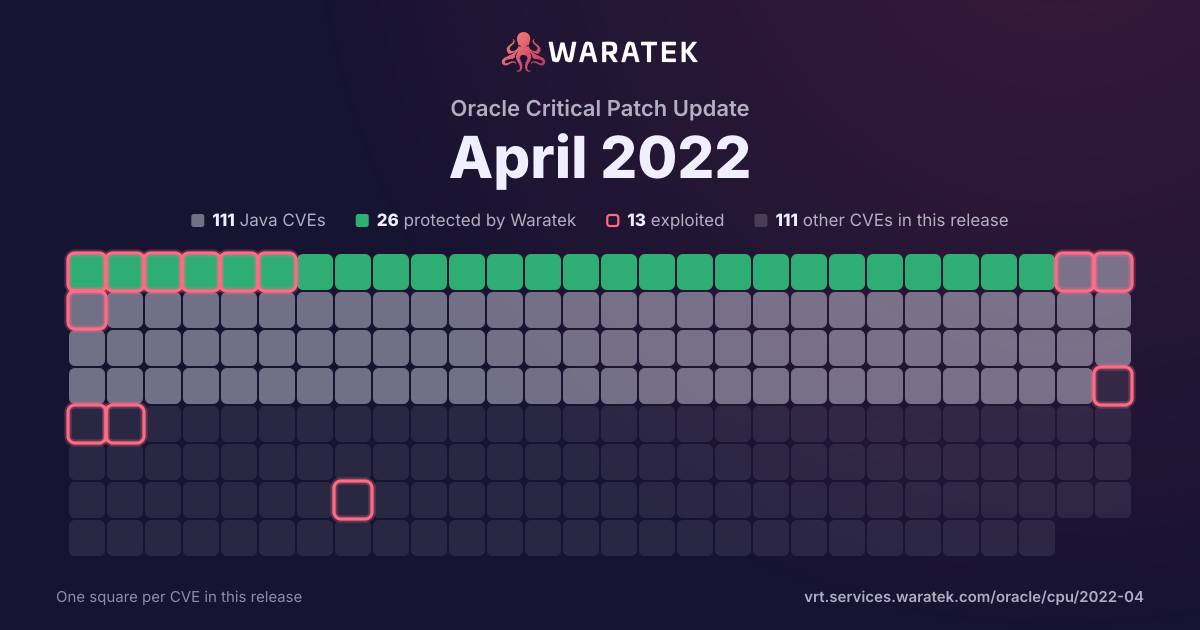
By status
25Protected by Waratek1Rule in development7Mitigation candidate98No exploit published91Not applicable
13Exploited, marked by the ring
No exploit published. For 40 of them, Oracle's security advisory is the source of public detail.
Protected by Waratek. Waratek RASP can block exploitation of these on systems that have not applied the patch yet.
Overview 22 matches · 5 protected · 3 exploited · 1 CISA KEV · 2 public PoC · 3 EPSS ≥ 0.5
Protected by Waratek
5
22.7%
Rule in development
0
0.0%
Mitigation candidate
1
4.5%
No exploit published
16
72.7%
blocked by ARMR today
5
22.7%
partly blocked
0
0.0%
not blocked
17
77.3%
not established
0
0.0%
unrecorded
0
0.0%
Exploited
3
13.6%
Working exploit published
0
0.0%
Proof of concept only
3
13.6%
Forecast only
0
0.0%
No public exploit
16
72.7%
split by
peak 5 / month
Aug 212
No exploit published2
High2
not blocked2
No public exploit2
Sep 212
Mitigation candidate1
No exploit published1
High1
Medium1
not blocked2
Exploited1
No public exploit1
Oct 212
No exploit published2
High2
not blocked2
No public exploit2
Nov 210
Dec 214
Protected by Waratek1
No exploit published3
Critical2
Medium2
blocked by ARMR today1
not blocked3
Exploited1
No public exploit3
Jan 224
Protected by Waratek3
No exploit published1
Critical1
High2
Medium1
blocked by ARMR today3
not blocked1
Proof of concept only2
No public exploit2
Feb 222
No exploit published2
High1
Medium1
not blocked2
Proof of concept only1
No public exploit1
Mar 221
No exploit published1
High1
not blocked1
No public exploit1
Apr 225
Protected by Waratek1
No exploit published4
Critical2
High3
blocked by ARMR today1
not blocked4
Exploited1
No public exploit4
Aug 21Sep 21Oct 21Nov 21Dec 21Jan 22Feb 22Mar 22Apr 22
| CVE | Severity | Published▾ | Status | Exploitation | Description |
|---|---|---|---|---|---|
| CVE-2022-21431 | Critical | 2022-04-19 | No exploit published | No public exploit | Vulnerability in the Oracle Communications Billing and Revenue Management product of Oracle Communications Applications (component: Connection Manager). Supported versions that are affected are 12.0.0.4 and 12.0.0.5. Easily exploitable vulnerability allows unauthenticated attacker with network access via TCP to compromise Oracle Communications Billing and Revenue Management. While the vulnerability is in Oracle Communications Billing and Revenue Management, attacks may significantly impact additional products (scope change). Successful attacks of this vulnerability can result in takeover of Oracle Communications Billing and Revenue Management. CVSS 3.1 Base Score 10.0 (Confidentiality, Integrity and Availability impacts). CVSS Vector: (CVSS:3.1/AV:N/AC:L/PR:N/UI:N/S:C/C:H/I:H/A:H). |
| CVE-2022-21430 | High | 2022-04-19 | No exploit published | No public exploit | Vulnerability in the Oracle Communications Billing and Revenue Management product of Oracle Communications Applications (component: Connection Manager). Supported versions that are affected are 12.0.0.4 and 12.0.0.5. Difficult to exploit vulnerability allows low privileged attacker with network access via TCP to compromise Oracle Communications Billing and Revenue Management. While the vulnerability is in Oracle Communications Billing and Revenue Management, attacks may significantly impact additional products (scope change). Successful attacks of this vulnerability can result in takeover of Oracle Communications Billing and Revenue Management. CVSS 3.1 Base Score 8.5 (Confidentiality, Integrity and Availability impacts). CVSS Vector: (CVSS:3.1/AV:N/AC:H/PR:L/UI:N/S:C/C:H/I:H/A:H). |
| CVE-2022-21424 | High | 2022-04-19 | No exploit published | No public exploit | Vulnerability in the Oracle Communications Billing and Revenue Management product of Oracle Communications Applications (component: Connection Manager). The supported version that is affected is 12.0.0.4. Easily exploitable vulnerability allows low privileged attacker with network access via TCP to compromise Oracle Communications Billing and Revenue Management. Successful attacks of this vulnerability can result in unauthorized creation, deletion or modification access to critical data or all Oracle Communications Billing and Revenue Management accessible data as well as unauthorized access to critical data or complete access to all Oracle Communications Billing and Revenue Management accessible data and unauthorized ability to cause a partial denial of service (partial DOS) of Oracle Communications Billing and Revenue Management. CVSS 3.1 Base Score 8.3 (Confidentiality, Integrity and Availability impacts). CVSS Vector: (CVSS:3.1/AV:N/AC:L/PR:L/UI:N/S:U/C:H/I:H/A:L). |
| CVE-2022-21422 | High | 2022-04-19 | No exploit published | No public exploit | Vulnerability in the Oracle Communications Billing and Revenue Management product of Oracle Communications Applications (component: Connection Manager). Supported versions that are affected are 12.0.0.4 and 12.0.0.5. Difficult to exploit vulnerability allows low privileged attacker with network access via TCP to compromise Oracle Communications Billing and Revenue Management. Successful attacks of this vulnerability can result in takeover of Oracle Communications Billing and Revenue Management. CVSS 3.1 Base Score 7.5 (Confidentiality, Integrity and Availability impacts). CVSS Vector: (CVSS:3.1/AV:N/AC:H/PR:L/UI:N/S:U/C:H/I:H/A:H). |
| CVE-2022-22965 | Critical | 2022-04-01 | Protected by Waratek | Exploited | A Spring MVC or Spring WebFlux application running on JDK 9+ may be vulnerable to remote code execution (RCE) via data binding. The specific exploit requires the application to run on Tomcat as a WAR deployment. If the application is deployed as a Spring Boot executable jar, i.e. the default, it is not vulnerable to the exploit. However, the nature of the vulnerability is more general, and there may be other ways to exploit it. |
| CVE-2020-36518 | High | 2022-03-11 | No exploit published | No public exploit | jackson-databind before 2.13.0 allows a Java StackOverflow exception and denial of service via a large depth of nested objects. |
| CVE-2022-24329 | Medium | 2022-02-25 | No exploit published | No public exploit | In JetBrains Kotlin before 1.6.0, it was not possible to lock dependencies for Multiplatform Gradle Projects. |
| CVE-2021-43859 | High | 2022-02-01 | No exploit published | Proof of concept only | XStream is an open source java library to serialize objects to XML and back again. Versions prior to 1.4.19 may allow a remote attacker to allocate 100% CPU time on the target system depending on CPU type or parallel execution of such a payload resulting in a denial of service only by manipulating the processed input stream. XStream 1.4.19 monitors and accumulates the time it takes to add elements to collections and throws an exception if a set threshold is exceeded. Users are advised to upgrade as soon as possible. Users unable to upgrade may set the NO_REFERENCE mode to prevent recursion. See GHSA-rmr5-cpv2-vgjf for further details on a workaround if an upgrade is not possible. |
| CVE-2022-23181 | High | 2022-01-27 | Protected by Waratek | No public exploit | The fix for bug CVE-2020-9484 introduced a time of check, time of use vulnerability into Apache Tomcat 10.1.0-M1 to 10.1.0-M8, 10.0.0-M5 to 10.0.14, 9.0.35 to 9.0.56 and 8.5.55 to 8.5.73 that allowed a local attacker to perform actions with the privileges of the user that the Tomcat process is using. This issue is only exploitable when Tomcat is configured to persist sessions using the FileStore. |
| CVE-2022-23437 | Medium | 2022-01-24 | Protected by Waratek | No public exploit | There's a vulnerability within the Apache Xerces Java (XercesJ) XML parser when handling specially crafted XML document payloads. This causes, the XercesJ XML parser to wait in an infinite loop, which may sometimes consume system resources for prolonged duration. This vulnerability is present within XercesJ version 2.12.1 and the previous versions. |
| CVE-2022-23305 | Critical | 2022-01-18 | Protected by Waratek | Proof of concept only | By design, the JDBCAppender in Log4j 1.2.x accepts an SQL statement as a configuration parameter where the values to be inserted are converters from PatternLayout. The message converter, %m, is likely to always be included. This allows attackers to manipulate the SQL by entering crafted strings into input fields or headers of an application that are logged allowing unintended SQL queries to be executed. Note this issue only affects Log4j 1.x when specifically configured to use the JDBCAppender, which is not the default. Beginning in version 2.0-beta8, the JDBCAppender was re-introduced with proper support for parameterized SQL queries and further customization over the columns written to in logs. Apache Log4j 1.2 reached end of life in August 2015. Users should upgrade to Log4j 2 as it addresses numerous other issues from the previous versions. |
| CVE-2021-22569 | High | 2022-01-10 | No exploit published | Proof of concept only | An issue in protobuf-java allowed the interleaving of com.google.protobuf.UnknownFieldSet fields in such a way that would be processed out of order. A small malicious payload can occupy the parser for several minutes by creating large numbers of short-lived objects that cause frequent, repeated pauses. We recommend upgrading libraries beyond the vulnerable versions. |
| CVE-2021-44832 | Medium | 2021-12-28 | Protected by Waratek | Exploited | Apache Log4j2 versions 2.0-beta7 through 2.17.0 (excluding security fix releases 2.3.2 and 2.12.4) are vulnerable to a remote code execution (RCE) attack when a configuration uses a JDBC Appender with a JNDI LDAP data source URI when an attacker has control of the target LDAP server. This issue is fixed by limiting JNDI data source names to the java protocol in Log4j2 versions 2.17.1, 2.12.4, and 2.3.2. |
| CVE-2021-23450 | Critical | 2021-12-17 | No exploit published | No public exploit | All versions of package dojo are vulnerable to Prototype Pollution via the setObject function. |
| CVE-2021-43797 | Medium | 2021-12-09 | No exploit published | No public exploit | Netty is an asynchronous event-driven network application framework for rapid development of maintainable high performance protocol servers & clients. Netty prior to version 4.1.71.Final skips control chars when they are present at the beginning / end of the header name. It should instead fail fast as these are not allowed by the spec and could lead to HTTP request smuggling. Failing to do the validation might cause netty to "sanitize" header names before it forward these to another remote system when used as proxy. This remote system can't see the invalid usage anymore, and therefore does not do the validation itself. Users should upgrade to version 4.1.71.Final. |
| CVE-2021-43527 | Critical | 2021-12-08 | No exploit published | No public exploit | NSS (Network Security Services) versions prior to 3.73 or 3.68.1 ESR are vulnerable to a heap overflow when handling DER-encoded DSA or RSA-PSS signatures. Applications using NSS for handling signatures encoded within CMS, S/MIME, PKCS \#7, or PKCS \#12 are likely to be impacted. Applications using NSS for certificate validation or other TLS, X.509, OCSP or CRL functionality may be impacted, depending on how they configure NSS. *Note: This vulnerability does NOT impact Mozilla Firefox.* However, email clients and PDF viewers that use NSS for signature verification, such as Thunderbird, LibreOffice, Evolution and Evince are believed to be impacted. This vulnerability affects NSS < 3.73 and NSS < 3.68.1. |
| CVE-2021-37137 | High | 2021-10-19 | No exploit published | No public exploit | The Snappy frame decoder function doesn't restrict the chunk length which may lead to excessive memory usage. Beside this it also may buffer reserved skippable chunks until the whole chunk was received which may lead to excessive memory usage as well. This vulnerability can be triggered by supplying malicious input that decompresses to a very big size (via a network stream or a file) or by sending a huge skippable chunk. |
| CVE-2021-42340 | High | 2021-10-14 | No exploit published | No public exploit | The fix for bug 63362 present in Apache Tomcat 10.1.0-M1 to 10.1.0-M5, 10.0.0-M1 to 10.0.11, 9.0.40 to 9.0.53 and 8.5.60 to 8.5.71 introduced a memory leak. The object introduced to collect metrics for HTTP upgrade connections was not released for WebSocket connections once the connection was closed. This created a memory leak that, over time, could lead to a denial of service via an OutOfMemoryError. |
| CVE-2021-38153 | Medium | 2021-09-22 | Mitigation candidate | Exploited | Some components in Apache Kafka use `Arrays.equals` to validate a password or key, which is vulnerable to timing attacks that make brute force attacks for such credentials more likely to be successful. Users should upgrade to 2.8.1 or higher, or 3.0.0 or higher where this vulnerability has been fixed. The affected versions include Apache Kafka 2.0.0, 2.0.1, 2.1.0, 2.1.1, 2.2.0, 2.2.1, 2.2.2, 2.3.0, 2.3.1, 2.4.0, 2.4.1, 2.5.0, 2.5.1, 2.6.0, 2.6.1, 2.6.2, 2.7.0, 2.7.1, and 2.8.0. |
| CVE-2021-40690 | High | 2021-09-19 | No exploit published | No public exploit | All versions of Apache Santuario - XML Security for Java prior to 2.2.3 and 2.1.7 are vulnerable to an issue where the "secureValidation" property is not passed correctly when creating a KeyInfo from a KeyInfoReference element. This allows an attacker to abuse an XPath Transform to extract any local .xml files in a RetrievalMethod element. |
| CVE-2021-39139 | High | 2021-08-23 | No exploit published | No public exploit | XStream is a simple library to serialize objects to XML and back again. In affected versions this vulnerability may allow a remote attacker to load and execute arbitrary code from a remote host only by manipulating the processed input stream. A user is only affected if using the version out of the box with JDK 1.7u21 or below. However, this scenario can be adjusted easily to an external Xalan that works regardless of the version of the Java runtime. No user is affected, who followed the recommendation to setup XStream's security framework with a whitelist limited to the minimal required types. XStream 1.4.18 uses no longer a blacklist by default, since it cannot be secured for general purpose. |
| CVE-2021-37714 | High | 2021-08-18 | No exploit published | No public exploit | jsoup is a Java library for working with HTML. Those using jsoup versions prior to 1.14.2 to parse untrusted HTML or XML may be vulnerable to DOS attacks. If the parser is run on user supplied input, an attacker may supply content that causes the parser to get stuck (loop indefinitely until cancelled), to complete more slowly than usual, or to throw an unexpected exception. This effect may support a denial of service attack. The issue is patched in version 1.14.2. There are a few available workarounds. Users may rate limit input parsing, limit the size of inputs based on system resources, and/or implement thread watchdogs to cap and timeout parse runtimes. |