
Oracle Critical Patch Update April 2022
Released April 2022 · Oracle's advisory ↗ · ← Critical Patch Update, January 2022 · Critical Patch Update, July 2022 →
222 CVEs in this release, one square each
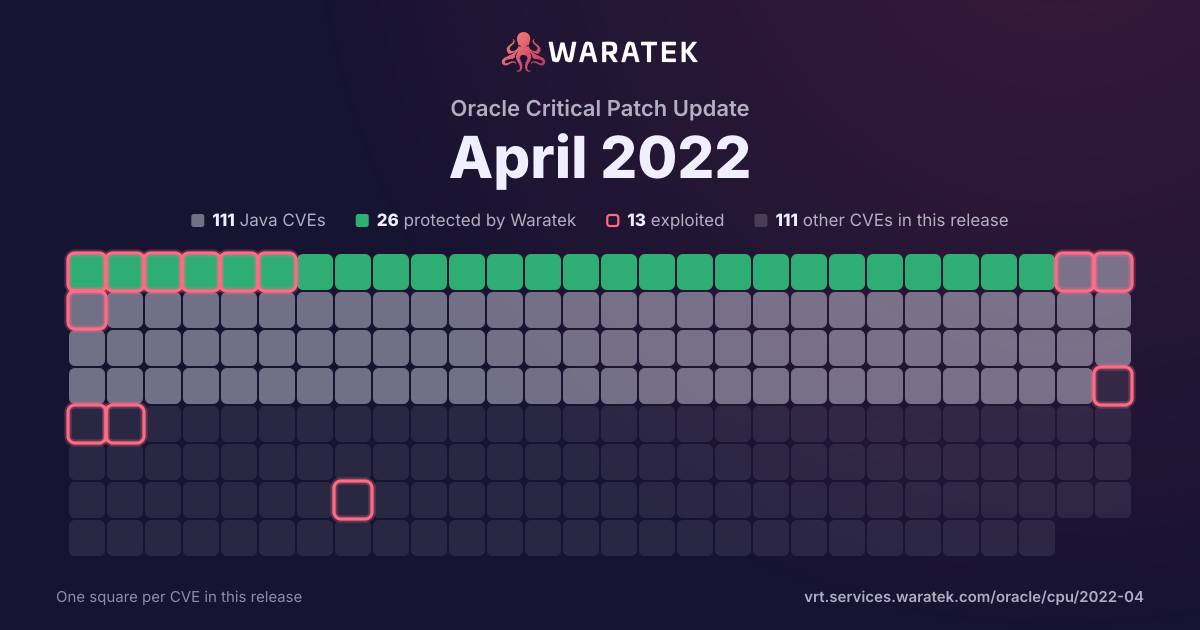
By status
26Protected by Waratek5Mitigation candidate80No exploit published64Outside Waratek scope47Not applicable
13Exploited, marked by the ring
No exploit published. For 40 of them, Oracle's security advisory is the source of public detail.
Protected by Waratek. Waratek RASP can block exploitation of these on systems that have not applied the patch yet.
Overview 7 matches · 1 in Waratek scope · 0 protected · 1 exploited · 1 CISA KEV · 5 public PoC
Protected by Waratek
0
0.0%
Rule in development
0
0.0%
Mitigation candidate
1
14.3%
No exploit published
0
0.0%
Outside Waratek scope
5
71.4%
Not applicable
1
14.3%
Withdrawn CVE
0
0.0%
blocked by ARMR today
0
0.0%
partly blocked
0
0.0%
not blocked
7
100.0%
not established
0
0.0%
unrecorded
0
0.0%
Exploited
1
14.3%
Working exploit published
2
28.6%
Proof of concept only
2
28.6%
Forecast only
2
28.6%
No public exploit
0
0.0%
split by
peak 2 / quarter
Q2 191
Outside Waratek scope1
High1
not blocked1
Working exploit published1
Q3 190
Q4 190
Q1 200
Q2 200
Q3 200
Q4 200
Q1 211
Outside Waratek scope1
High1
not blocked1
Exploited1
Q2 212
Outside Waratek scope1
Not applicable1
High2
not blocked2
Working exploit published1
Forecast only1
Q3 210
Q4 211
Outside Waratek scope1
High1
not blocked1
Forecast only1
Q1 221
Outside Waratek scope1
High1
not blocked1
Proof of concept only1
Q2 221
Mitigation candidate1
High1
not blocked1
Proof of concept only1
Q2 19Q4 19Q2 20Q4 20Q2 21Q4 21Q2 22
| CVE | Severity | Published▾ | Status | Exploitation | Description |
|---|---|---|---|---|---|
| CVE-2022-21449 | High | 2022-04-19 | Mitigation candidate | Proof of concept only | Vulnerability in the Oracle Java SE, Oracle GraalVM Enterprise Edition product of Oracle Java SE (component: Libraries). Supported versions that are affected are Oracle Java SE: 17.0.2 and 18; Oracle GraalVM Enterprise Edition: 21.3.1 and 22.0.0.2. Easily exploitable vulnerability allows unauthenticated attacker with network access via multiple protocols to compromise Oracle Java SE, Oracle GraalVM Enterprise Edition. Successful attacks of this vulnerability can result in unauthorized creation, deletion or modification access to critical data or all Oracle Java SE, Oracle GraalVM Enterprise Edition accessible data. Note: This vulnerability applies to Java deployments, typically in clients running sandboxed Java Web Start applications or sandboxed Java applets, that load and run untrusted code (e.g., code that comes from the internet) and rely on the Java sandbox for security. This vulnerability can also be exploited by using APIs in the specified Component, e.g., through a web service which supplies data to the APIs. CVSS 3.1 Base Score 7.5 (Integrity impacts). CVSS Vector: (CVSS:3.1/AV:N/AC:L/PR:N/UI:N/S:U/C:N/I:H/A:N). |
| CVE-2022-0778 | High | 2022-03-15 | Outside Waratek scope | Proof of concept only | The BN_mod_sqrt() function, which computes a modular square root, contains a bug that can cause it to loop forever for non-prime moduli. Internally this function is used when parsing certificates that contain elliptic curve public keys in compressed form or explicit elliptic curve parameters with a base point encoded in compressed form. It is possible to trigger the infinite loop by crafting a certificate that has invalid explicit curve parameters. Since certificate parsing happens prior to verification of the certificate signature, any process that parses an externally supplied certificate may thus be subject to a denial of service attack. The infinite loop can also be reached when parsing crafted private keys as they can contain explicit elliptic curve parameters. Thus vulnerable situations include: - TLS clients consuming server certificates - TLS servers consuming client certificates - Hosting providers taking certificates or private keys from customers - Certificate authorities parsing certification requests from subscribers - Anything else which parses ASN.1 elliptic curve parameters Also any other applications that use the BN_mod_sqrt() where the attacker can control the parameter values are vulnerable to this DoS issue. In the OpenSSL 1.0.2 version the public key is not parsed during initial parsing of the certificate which makes it slightly harder to trigger the infinite loop. However any operation which requires the public key from the certificate will trigger the infinite loop. In particular the attacker can use a self-signed certificate to trigger the loop during verification of the certificate signature. This issue affects OpenSSL versions 1.0.2, 1.1.1 and 3.0. It was addressed in the releases of 1.1.1n and 3.0.2 on the 15th March 2022. Fixed in OpenSSL 3.0.2 (Affected 3.0.0,3.0.1). Fixed in OpenSSL 1.1.1n (Affected 1.1.1-1.1.1m). Fixed in OpenSSL 1.0.2zd (Affected 1.0.2-1.0.2zc). |
| CVE-2021-44224 | High | 2021-12-20 | Outside Waratek scope | Forecast only | A crafted URI sent to httpd configured as a forward proxy (ProxyRequests on) can cause a crash (NULL pointer dereference) or, for configurations mixing forward and reverse proxy declarations, can allow for requests to be directed to a declared Unix Domain Socket endpoint (Server Side Request Forgery). This issue affects Apache HTTP Server 2.4.7 up to 2.4.51 (included). |
| CVE-2021-22901 | High | 2021-06-11 | Outside Waratek scope | Forecast only | curl 7.75.0 through 7.76.1 suffers from a use-after-free vulnerability resulting in already freed memory being used when a TLS 1.3 session ticket arrives over a connection. A malicious server can use this in rare unfortunate circumstances to potentially reach remote code execution in the client. When libcurl at run-time sets up support for TLS 1.3 session tickets on a connection using OpenSSL, it stores pointers to the transfer in-memory object for later retrieval when a session ticket arrives. If the connection is used by multiple transfers (like with a reused HTTP/1.1 connection or multiplexed HTTP/2 connection) that first transfer object might be freed before the new session is established on that connection and then the function will access a memory buffer that might be freed. When using that memory, libcurl might even call a function pointer in the object, making it possible for a remote code execution if the server could somehow manage to get crafted memory content into the correct place in memory. |
| CVE-2021-23017 | High | 2021-06-01 | Not applicable | Working exploit published | A security issue in nginx resolver was identified, which might allow an attacker who is able to forge UDP packets from the DNS server to cause 1-byte memory overwrite, resulting in worker process crash or potential other impact. |
| CVE-2021-3156 | High | 2021-01-26 | Outside Waratek scope | Exploited | Sudo before 1.9.5p2 contains an off-by-one error that can result in a heap-based buffer overflow, which allows privilege escalation to root via "sudoedit -s" and a command-line argument that ends with a single backslash character. |
| CVE-2019-0227 | High | 2019-05-01 | Outside Waratek scope | Working exploit published | A Server Side Request Forgery (SSRF) vulnerability affected the Apache Axis 1.4 distribution that was last released in 2006. Security and bug commits commits continue in the projects Axis 1.x Subversion repository, legacy users are encouraged to build from source. The successor to Axis 1.x is Axis2, the latest version is 1.7.9 and is not vulnerable to this issue. |