
Oracle Critical Patch Update April 2022
Released April 2022 · Oracle's advisory ↗ · ← Critical Patch Update, January 2022 · Critical Patch Update, July 2022 →
222 CVEs in this release, one square each
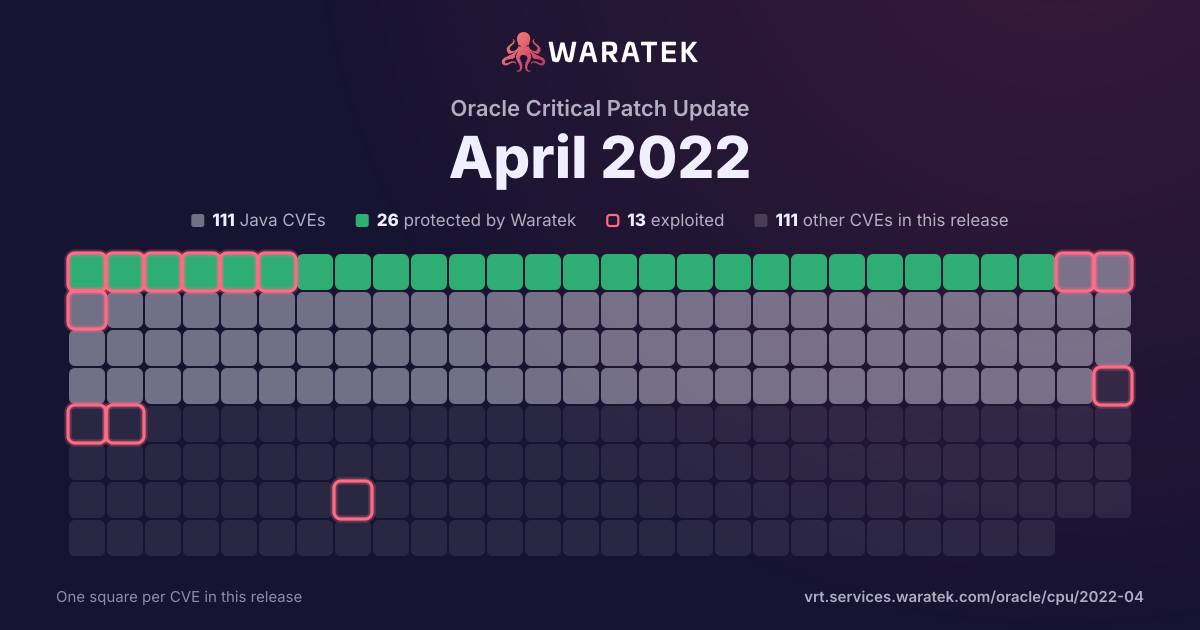
By status
26Protected by Waratek5Mitigation candidate80No exploit published64Outside Waratek scope47Not applicable
13Exploited, marked by the ring
No exploit published. For 40 of them, Oracle's security advisory is the source of public detail.
Protected by Waratek. Waratek RASP can block exploitation of these on systems that have not applied the patch yet.
Overview 25 matches · 10 in Waratek scope · 7 protected · 7 exploited · 7 CISA KEV · 11 public PoC · 12 EPSS ≥ 0.5
25matches
10in Waratek scope40.0%
7protected28.0%
7exploited28.0%
7CISA KEV28.0%
11public PoC44.0%
12EPSS ≥ 0.548.0%
Protected by Waratek
7
28.0%
Rule in development
0
0.0%
Mitigation candidate
1
4.0%
No exploit published
2
8.0%
Outside Waratek scope
12
48.0%
Not applicable
3
12.0%
Withdrawn CVE
0
0.0%
blocked by ARMR today
7
28.0%
partly blocked
0
0.0%
not blocked
18
72.0%
not established
0
0.0%
unrecorded
0
0.0%
split by
peak 4 / quarter
Q1 181
Protected by Waratek1
Critical1
blocked by ARMR today1
Exploited1
Q2 180
Q3 180
Q4 180
Q1 190
Q2 190
Q3 190
Q4 191
Outside Waratek scope1
Critical1
not blocked1
Proof of concept only1
Q1 200
Q2 201
Outside Waratek scope1
Critical1
not blocked1
No public exploit1
Q3 200
Q4 201
Protected by Waratek1
Critical1
blocked by ARMR today1
Exploited1
Q1 212
Outside Waratek scope2
Critical2
not blocked2
No public exploit2
Q2 214
Outside Waratek scope2
Not applicable2
Critical4
not blocked4
No public exploit4
Q3 213
Outside Waratek scope3
Critical3
not blocked3
Exploited1
Forecast only1
No public exploit1
Q4 214
Outside Waratek scope3
Not applicable1
Critical4
not blocked4
Exploited1
Working exploit published1
No public exploit2
Q1 224
Protected by Waratek3
Mitigation candidate1
Critical4
blocked by ARMR today3
not blocked1
Exploited1
Working exploit published1
Proof of concept only2
Q2 224
Protected by Waratek2
No exploit published2
Critical4
blocked by ARMR today2
not blocked2
Exploited2
No public exploit2
Q2 18Q4 18Q2 19Q4 19Q2 20Q4 20Q2 21Q4 21Q2 22
| CVE | Severity | Published▾ | Status | Exploitation | Description |
|---|---|---|---|---|---|
| CVE-2022-21445 | Critical | 2022-04-19 | Protected by Waratek | Exploited | Vulnerability in the Oracle Application Development Framework (ADF) product of Oracle Fusion Middleware (component: ADF Faces). Supported versions that are affected are 12.2.1.3.0 and 12.2.1.4.0. Easily exploitable vulnerability allows unauthenticated attacker with network access via HTTP to compromise Oracle Application Development Framework (ADF). Successful attacks of this vulnerability can result in takeover of Oracle Application Development Framework (ADF). Note: Oracle Application Development Framework (ADF) is downloaded via Oracle JDeveloper Product. Please refer to Fusion Middleware Patch Advisor for more details. CVSS 3.1 Base Score 9.8 (Confidentiality, Integrity and Availability impacts). CVSS Vector: (CVSS:3.1/AV:N/AC:L/PR:N/UI:N/S:U/C:H/I:H/A:H). |
| CVE-2022-21431 | Critical | 2022-04-19 | No exploit published | No public exploit | Vulnerability in the Oracle Communications Billing and Revenue Management product of Oracle Communications Applications (component: Connection Manager). Supported versions that are affected are 12.0.0.4 and 12.0.0.5. Easily exploitable vulnerability allows unauthenticated attacker with network access via TCP to compromise Oracle Communications Billing and Revenue Management. While the vulnerability is in Oracle Communications Billing and Revenue Management, attacks may significantly impact additional products (scope change). Successful attacks of this vulnerability can result in takeover of Oracle Communications Billing and Revenue Management. CVSS 3.1 Base Score 10.0 (Confidentiality, Integrity and Availability impacts). CVSS Vector: (CVSS:3.1/AV:N/AC:L/PR:N/UI:N/S:C/C:H/I:H/A:H). |
| CVE-2022-21420 | Critical | 2022-04-19 | No exploit published | No public exploit | Vulnerability in the Oracle Coherence product of Oracle Fusion Middleware (component: Core). Supported versions that are affected are 12.2.1.3.0, 12.2.1.4.0 and 14.1.1.0.0. Easily exploitable vulnerability allows unauthenticated attacker with network access via T3 to compromise Oracle Coherence. Successful attacks of this vulnerability can result in takeover of Oracle Coherence. CVSS 3.1 Base Score 9.8 (Confidentiality, Integrity and Availability impacts). CVSS Vector: (CVSS:3.1/AV:N/AC:L/PR:N/UI:N/S:U/C:H/I:H/A:H). |
| CVE-2022-22965 | Critical | 2022-04-01 | Protected by Waratek | Exploited | A Spring MVC or Spring WebFlux application running on JDK 9+ may be vulnerable to remote code execution (RCE) via data binding. The specific exploit requires the application to run on Tomcat as a WAR deployment. If the application is deployed as a Spring Boot executable jar, i.e. the default, it is not vulnerable to the exploit. However, the nature of the vulnerability is more general, and there may be other ways to exploit it. |
| CVE-2022-22947 | Critical | 2022-03-03 | Mitigation candidate | Exploited | In spring cloud gateway versions prior to 3.1.1+ and 3.0.7+ , applications are vulnerable to a code injection attack when the Gateway Actuator endpoint is enabled, exposed and unsecured. A remote attacker could make a maliciously crafted request that could allow arbitrary remote execution on the remote host. |
| CVE-2022-23221 | Critical | 2022-01-19 | Protected by Waratek | Proof of concept only | H2 Console before 2.1.210 allows remote attackers to execute arbitrary code via a jdbc:h2:mem JDBC URL containing the IGNORE_UNKNOWN_SETTINGS=TRUE;FORBID_CREATION=FALSE;INIT=RUNSCRIPT substring, a different vulnerability than CVE-2021-42392. |
| CVE-2022-23305 | Critical | 2022-01-18 | Protected by Waratek | Proof of concept only | By design, the JDBCAppender in Log4j 1.2.x accepts an SQL statement as a configuration parameter where the values to be inserted are converters from PatternLayout. The message converter, %m, is likely to always be included. This allows attackers to manipulate the SQL by entering crafted strings into input fields or headers of an application that are logged allowing unintended SQL queries to be executed. Note this issue only affects Log4j 1.x when specifically configured to use the JDBCAppender, which is not the default. Beginning in version 2.0-beta8, the JDBCAppender was re-introduced with proper support for parameterized SQL queries and further customization over the columns written to in logs. Apache Log4j 1.2 reached end of life in August 2015. Users should upgrade to Log4j 2 as it addresses numerous other issues from the previous versions. |
| CVE-2021-42392 | Critical | 2022-01-10 | Protected by Waratek | Working exploit published | The org.h2.util.JdbcUtils.getConnection method of the H2 database takes as parameters the class name of the driver and URL of the database. An attacker may pass a JNDI driver name and a URL leading to a LDAP or RMI servers, causing remote code execution. This can be exploited through various attack vectors, most notably through the H2 Console which leads to unauthenticated remote code execution. |
| CVE-2021-44790 | Critical | 2021-12-20 | Outside Waratek scope | Working exploit published | A carefully crafted request body can cause a buffer overflow in the mod_lua multipart parser (r:parsebody() called from Lua scripts). The Apache httpd team is not aware of an exploit for the vulnerabilty though it might be possible to craft one. This issue affects Apache HTTP Server 2.4.51 and earlier. |
| CVE-2021-23450 | Critical | 2021-12-17 | Outside Waratek scope | No public exploit | All versions of package dojo are vulnerable to Prototype Pollution via the setObject function. |
| CVE-2021-43527 | Critical | 2021-12-08 | Outside Waratek scope | No public exploit | NSS (Network Security Services) versions prior to 3.73 or 3.68.1 ESR are vulnerable to a heap overflow when handling DER-encoded DSA or RSA-PSS signatures. Applications using NSS for handling signatures encoded within CMS, S/MIME, PKCS \#7, or PKCS \#12 are likely to be impacted. Applications using NSS for certificate validation or other TLS, X.509, OCSP or CRL functionality may be impacted, depending on how they configure NSS. *Note: This vulnerability does NOT impact Mozilla Firefox.* However, email clients and PDF viewers that use NSS for signature verification, such as Thunderbird, LibreOffice, Evolution and Evince are believed to be impacted. This vulnerability affects NSS < 3.73 and NSS < 3.68.1. |
| CVE-2021-42013 | Critical | 2021-10-07 | Not applicable | Exploited | It was found that the fix for CVE-2021-41773 in Apache HTTP Server 2.4.50 was insufficient. An attacker could use a path traversal attack to map URLs to files outside the directories configured by Alias-like directives. If files outside of these directories are not protected by the usual default configuration "require all denied", these requests can succeed. If CGI scripts are also enabled for these aliased pathes, this could allow for remote code execution. This issue only affects Apache 2.4.49 and Apache 2.4.50 and not earlier versions. |
| CVE-2021-40438 | Critical | 2021-09-16 | Outside Waratek scope | Exploited | A crafted request uri-path can cause mod_proxy to forward the request to an origin server choosen by the remote user. This issue affects Apache HTTP Server 2.4.48 and earlier. |
| CVE-2021-39275 | Critical | 2021-09-16 | Outside Waratek scope | No public exploit | ap_escape_quotes() may write beyond the end of a buffer when given malicious input. No included modules pass untrusted data to these functions, but third-party / external modules may. This issue affects Apache HTTP Server 2.4.48 and earlier. |
| CVE-2021-3711 | Critical | 2021-08-24 | Outside Waratek scope | Forecast only | In order to decrypt SM2 encrypted data an application is expected to call the API function EVP_PKEY_decrypt(). Typically an application will call this function twice. The first time, on entry, the "out" parameter can be NULL and, on exit, the "outlen" parameter is populated with the buffer size required to hold the decrypted plaintext. The application can then allocate a sufficiently sized buffer and call EVP_PKEY_decrypt() again, but this time passing a non-NULL value for the "out" parameter. A bug in the implementation of the SM2 decryption code means that the calculation of the buffer size required to hold the plaintext returned by the first call to EVP_PKEY_decrypt() can be smaller than the actual size required by the second call. This can lead to a buffer overflow when EVP_PKEY_decrypt() is called by the application a second time with a buffer that is too small. A malicious attacker who is able present SM2 content for decryption to an application could cause attacker chosen data to overflow the buffer by up to a maximum of 62 bytes altering the contents of other data held after the buffer, possibly changing application behaviour or causing the application to crash. The location of the buffer is application dependent but is typically heap allocated. Fixed in OpenSSL 1.1.1l (Affected 1.1.1-1.1.1k). |
| CVE-2021-3520 | Critical | 2021-06-02 | Not applicable | No public exploit | There's a flaw in lz4. An attacker who submits a crafted file to an application linked with lz4 may be able to trigger an integer overflow, leading to calling of memmove() on a negative size argument, causing an out-of-bounds write and/or a crash. The greatest impact of this flaw is to availability, with some potential impact to confidentiality and integrity as well. |
| CVE-2020-35198 | Critical | 2021-05-12 | Not applicable | No public exploit | An issue was discovered in Wind River VxWorks 7. The memory allocator has a possible integer overflow in calculating a memory block's size to be allocated by calloc(). As a result, the actual memory allocated is smaller than the buffer size specified by the arguments, leading to memory corruption. |
| CVE-2021-29921 | Critical | 2021-05-06 | Outside Waratek scope | No public exploit | In Python before 3,9,5, the ipaddress library mishandles leading zero characters in the octets of an IP address string. This (in some situations) allows attackers to bypass access control that is based on IP addresses. |
| CVE-2021-26291 | Critical | 2021-04-23 | Outside Waratek scope | No public exploit | Apache Maven will follow repositories that are defined in a dependency’s Project Object Model (pom) which may be surprising to some users, resulting in potential risk if a malicious actor takes over that repository or is able to insert themselves into a position to pretend to be that repository. Maven is changing the default behavior in 3.8.1+ to no longer follow http (non-SSL) repository references by default. More details available in the referenced urls. If you are currently using a repository manager to govern the repositories used by your builds, you are unaffected by the risks present in the legacy behavior, and are unaffected by this vulnerability and change to default behavior. See this link for more information about repository management: https://maven.apache.org/repository-management.html |
| CVE-2020-14343 | Critical | 2021-02-09 | Outside Waratek scope | No public exploit | A vulnerability was discovered in the PyYAML library in versions before 5.4, where it is susceptible to arbitrary code execution when it processes untrusted YAML files through the full_load method or with the FullLoader loader. Applications that use the library to process untrusted input may be vulnerable to this flaw. This flaw allows an attacker to execute arbitrary code on the system by abusing the python/object/new constructor. This flaw is due to an incomplete fix for CVE-2020-1747. |
| CVE-2020-36242 | Critical | 2021-02-07 | Outside Waratek scope | No public exploit | In the cryptography package before 3.3.2 for Python, certain sequences of update calls to symmetrically encrypt multi-GB values could result in an integer overflow and buffer overflow, as demonstrated by the Fernet class. |
| CVE-2020-17530 | Critical | 2020-12-11 | Protected by Waratek | Exploited | Forced OGNL evaluation, when evaluated on raw user input in tag attributes, may lead to remote code execution. Affected software : Apache Struts 2.0.0 - Struts 2.5.25. |
| CVE-2018-1285 | Critical | 2020-05-11 | Outside Waratek scope | No public exploit | Apache log4net versions before 2.0.10 do not disable XML external entities when parsing log4net configuration files. This allows for XXE-based attacks in applications that accept attacker-controlled log4net configuration files. |
| CVE-2019-17195 | Critical | 2019-10-15 | Outside Waratek scope | Proof of concept only | Connect2id Nimbus JOSE+JWT before v7.9 can throw various uncaught exceptions while parsing a JWT, which could result in an application crash (potential information disclosure) or a potential authentication bypass. |
| CVE-2017-1000353 | Critical | 2018-01-29 | Protected by Waratek | Exploited | Jenkins versions 2.56 and earlier as well as 2.46.1 LTS and earlier are vulnerable to an unauthenticated remote code execution. An unauthenticated remote code execution vulnerability allowed attackers to transfer a serialized Java `SignedObject` object to the Jenkins CLI, that would be deserialized using a new `ObjectInputStream`, bypassing the existing blacklist-based protection mechanism. We're fixing this issue by adding `SignedObject` to the blacklist. We're also backporting the new HTTP CLI protocol from Jenkins 2.54 to LTS 2.46.2, and deprecating the remoting-based (i.e. Java serialization) CLI protocol, disabling it by default. |