
Oracle Critical Patch Update January 2022
Released January 2022 · Oracle's advisory ↗ · ← Critical Patch Update, October 2021 · Critical Patch Update, April 2022 →
266 CVEs in this release, one square each
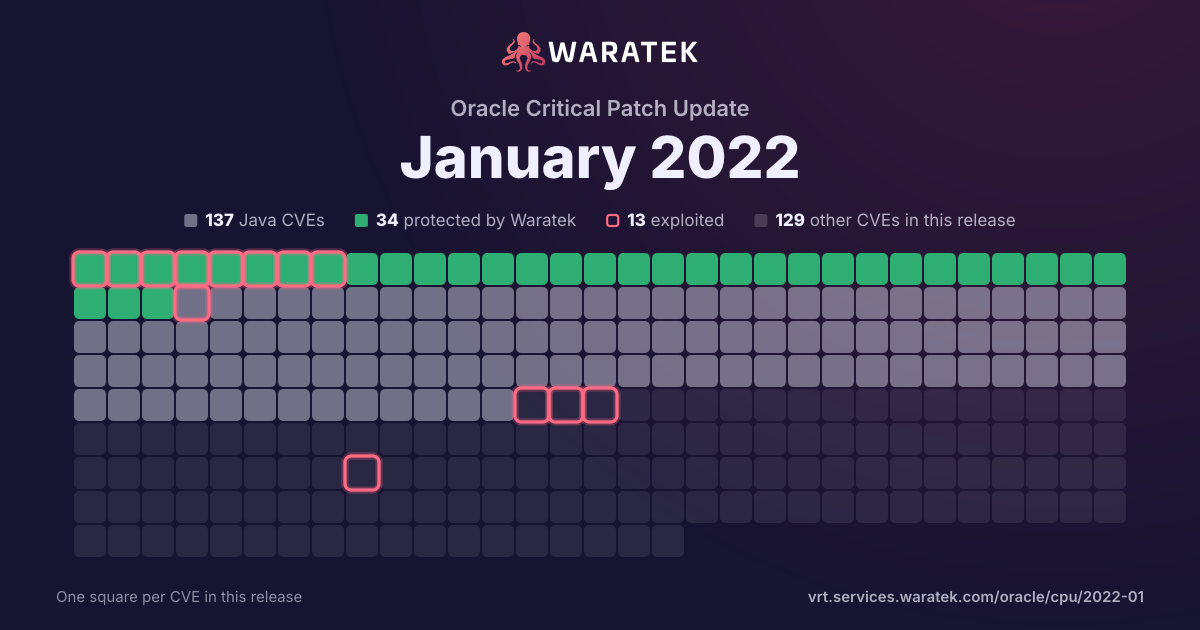
By status
34Protected by Waratek3Mitigation candidate100No exploit published57Outside Waratek scope72Not applicable
13Exploited, marked by the ring
No exploit published. For 71 of them, Oracle's security advisory is the source of public detail.
Protected by Waratek. Waratek RASP can block exploitation of these on systems that have not applied the patch yet.
Overview 57 matches · 32 in Waratek scope · 0 protected · 1 exploited · 0 CISA KEV · 5 public PoC · 6 EPSS ≥ 0.5
57matches
32in Waratek scope56.1%
0protected0.0%
1exploited1.8%
0CISA KEV0.0%
5public PoC8.8%
6EPSS ≥ 0.510.5%
Protected by Waratek
0
0.0%
Rule in development
0
0.0%
Mitigation candidate
2
3.5%
No exploit published
30
52.6%
Outside Waratek scope
13
22.8%
Not applicable
12
21.1%
Withdrawn CVE
0
0.0%
blocked by ARMR today
0
0.0%
partly blocked
0
0.0%
not blocked
57
100.0%
not established
0
0.0%
unrecorded
0
0.0%
split by
peak 14 / quarter
Q4 192
Outside Waratek scope1
Not applicable1
High2
not blocked2
No public exploit2
Q1 201
Outside Waratek scope1
High1
not blocked1
No public exploit1
Q2 202
Outside Waratek scope2
High2
not blocked2
No public exploit2
Q3 202
Mitigation candidate1
No exploit published1
High2
not blocked2
Working exploit published1
No public exploit1
Q4 204
No exploit published3
Not applicable1
High4
not blocked4
Proof of concept only1
No public exploit3
Q1 217
No exploit published4
Outside Waratek scope2
Not applicable1
High7
not blocked7
Exploited1
Forecast only1
No public exploit5
Q2 2110
Mitigation candidate1
No exploit published3
Outside Waratek scope1
Not applicable5
High10
not blocked10
Working exploit published2
Forecast only2
No public exploit6
Q3 2112
No exploit published7
Outside Waratek scope3
Not applicable2
High12
not blocked12
Proof of concept only2
No public exploit10
Q4 213
Outside Waratek scope1
Not applicable2
High3
not blocked3
No public exploit3
Q1 2214
No exploit published12
Outside Waratek scope2
High14
not blocked14
No public exploit14
Q4 19Q1 20Q2 20Q3 20Q4 20Q1 21Q2 21Q3 21Q4 21Q1 22
| CVE | Severity | Published▾ | Status | Exploitation | Description |
|---|---|---|---|---|---|
| CVE-2022-21395 | High | 2022-01-19 | No exploit published | No public exploit | Vulnerability in the Oracle Communications Operations Monitor product of Oracle Communications (component: Mediation Engine). Supported versions that are affected are 3.4, 4.2, 4.3, 4.4 and 5.0. Easily exploitable vulnerability allows high privileged attacker with network access via HTTP to compromise Oracle Communications Operations Monitor. Successful attacks of this vulnerability can result in takeover of Oracle Communications Operations Monitor. CVSS 3.1 Base Score 7.2 (Confidentiality, Integrity and Availability impacts). CVSS Vector: (CVSS:3.1/AV:N/AC:L/PR:H/UI:N/S:U/C:H/I:H/A:H). |
| CVE-2022-21392 | High | 2022-01-19 | No exploit published | No public exploit | Vulnerability in the Enterprise Manager Base Platform product of Oracle Enterprise Manager (component: Policy Framework). Supported versions that are affected are 13.4.0.0 and 13.5.0.0. Easily exploitable vulnerability allows low privileged attacker with network access via HTTP to compromise Enterprise Manager Base Platform. Successful attacks of this vulnerability can result in unauthorized access to critical data or complete access to all Enterprise Manager Base Platform accessible data as well as unauthorized update, insert or delete access to some of Enterprise Manager Base Platform accessible data. CVSS 3.1 Base Score 8.8 (Confidentiality and Integrity impacts). CVSS Vector: (CVSS:3.1/AV:L/AC:L/PR:L/UI:N/S:C/C:H/I:H/A:H). |
| CVE-2022-21382 | High | 2022-01-19 | No exploit published | No public exploit | Vulnerability in the Oracle Enterprise Session Border Controller product of Oracle Communications (component: WebUI). Supported versions that are affected are 8.4 and 9.0. Easily exploitable vulnerability allows low privileged attacker with network access via HTTP to compromise Oracle Enterprise Session Border Controller. While the vulnerability is in Oracle Enterprise Session Border Controller, attacks may significantly impact additional products. Successful attacks of this vulnerability can result in unauthorized creation, deletion or modification access to critical data or all Oracle Enterprise Session Border Controller accessible data. CVSS 3.1 Base Score 7.7 (Integrity impacts). CVSS Vector: (CVSS:3.1/AV:N/AC:L/PR:L/UI:N/S:C/C:N/I:H/A:N). |
| CVE-2022-21351 | High | 2022-01-19 | Outside Waratek scope | No public exploit | Vulnerability in the MySQL Server product of Oracle MySQL (component: Server: Optimizer). Supported versions that are affected are 8.0.27 and prior. Easily exploitable vulnerability allows low privileged attacker with network access via multiple protocols to compromise MySQL Server. Successful attacks of this vulnerability can result in unauthorized ability to cause a hang or frequently repeatable crash (complete DOS) of MySQL Server as well as unauthorized update, insert or delete access to some of MySQL Server accessible data. CVSS 3.1 Base Score 7.1 (Integrity and Availability impacts). CVSS Vector: (CVSS:3.1/AV:N/AC:L/PR:L/UI:N/S:U/C:N/I:L/A:H). |
| CVE-2022-21346 | High | 2022-01-19 | No exploit published | No public exploit | Vulnerability in the Oracle BI Publisher product of Oracle Fusion Middleware (component: BI Publisher Security). Supported versions that are affected are 5.5.0.0.0, 12.2.1.3.0 and 12.2.1.4.0. Easily exploitable vulnerability allows unauthenticated attacker with network access via HTTP to compromise Oracle BI Publisher. Successful attacks of this vulnerability can result in unauthorized access to critical data or complete access to all Oracle BI Publisher accessible data. CVSS 3.1 Base Score 7.5 (Confidentiality impacts). CVSS Vector: (CVSS:3.1/AV:N/AC:L/PR:N/UI:N/S:U/C:H/I:N/A:N). |
| CVE-2022-21300 | High | 2022-01-19 | No exploit published | No public exploit | Vulnerability in the PeopleSoft Enterprise CS SA Integration Pack product of Oracle PeopleSoft (component: Snapshot Integration). Supported versions that are affected are 9.0 and 9.2. Easily exploitable vulnerability allows unauthenticated attacker with network access via HTTP to compromise PeopleSoft Enterprise CS SA Integration Pack. Successful attacks of this vulnerability can result in unauthorized access to critical data or complete access to all PeopleSoft Enterprise CS SA Integration Pack accessible data. CVSS 3.1 Base Score 7.5 (Confidentiality impacts). CVSS Vector: (CVSS:3.1/AV:N/AC:L/PR:N/UI:N/S:U/C:H/I:N/A:N). |
| CVE-2022-21292 | High | 2022-01-19 | No exploit published | No public exploit | Vulnerability in the Oracle WebLogic Server product of Oracle Fusion Middleware (component: Samples). Supported versions that are affected are 12.2.1.4.0 and 14.1.1.0.0. Easily exploitable vulnerability allows unauthenticated attacker with network access via HTTP to compromise Oracle WebLogic Server. Successful attacks of this vulnerability can result in unauthorized access to critical data or complete access to all Oracle WebLogic Server accessible data. CVSS 3.1 Base Score 7.5 (Confidentiality impacts). CVSS Vector: (CVSS:3.1/AV:N/AC:L/PR:N/UI:N/S:U/C:H/I:N/A:N). |
| CVE-2022-21278 | High | 2022-01-19 | Outside Waratek scope | No public exploit | Vulnerability in the MySQL Server product of Oracle MySQL (component: Server: Optimizer). Supported versions that are affected are 8.0.26 and prior. Easily exploitable vulnerability allows low privileged attacker with network access via multiple protocols to compromise MySQL Server. Successful attacks of this vulnerability can result in unauthorized ability to cause a hang or frequently repeatable crash (complete DOS) of MySQL Server as well as unauthorized update, insert or delete access to some of MySQL Server accessible data. CVSS 3.1 Base Score 7.1 (Integrity and Availability impacts). CVSS Vector: (CVSS:3.1/AV:N/AC:L/PR:L/UI:N/S:U/C:N/I:L/A:H). |
| CVE-2022-21274 | High | 2022-01-19 | No exploit published | No public exploit | Vulnerability in the Oracle Sourcing product of Oracle E-Business Suite (component: Intelligence, RFx Creation). Supported versions that are affected are 12.2.3-12.2.11. Easily exploitable vulnerability allows low privileged attacker with network access via HTTP to compromise Oracle Sourcing. Successful attacks of this vulnerability can result in unauthorized creation, deletion or modification access to critical data or all Oracle Sourcing accessible data as well as unauthorized access to critical data or complete access to all Oracle Sourcing accessible data. CVSS 3.1 Base Score 8.1 (Confidentiality and Integrity impacts). CVSS Vector: (CVSS:3.1/AV:N/AC:L/PR:L/UI:N/S:U/C:H/I:H/A:N). |
| CVE-2022-21273 | High | 2022-01-19 | No exploit published | No public exploit | Vulnerability in the Oracle Project Costing product of Oracle E-Business Suite (component: Expenses, Currency Override). Supported versions that are affected are 12.2.3-12.2.11. Easily exploitable vulnerability allows low privileged attacker with network access via HTTP to compromise Oracle Project Costing. Successful attacks of this vulnerability can result in unauthorized creation, deletion or modification access to critical data or all Oracle Project Costing accessible data as well as unauthorized access to critical data or complete access to all Oracle Project Costing accessible data. CVSS 3.1 Base Score 8.1 (Confidentiality and Integrity impacts). CVSS Vector: (CVSS:3.1/AV:N/AC:L/PR:L/UI:N/S:U/C:H/I:H/A:N). |
| CVE-2022-21266 | High | 2022-01-19 | No exploit published | No public exploit | Vulnerability in the Oracle Communications Billing and Revenue Management product of Oracle Communications Applications (component: Pipeline Manager). Supported versions that are affected are 12.0.0.3 and 12.0.0.4. Easily exploitable vulnerability allows unauthenticated attacker with network access via HTTP to compromise Oracle Communications Billing and Revenue Management. Successful attacks of this vulnerability can result in unauthorized access to critical data or complete access to all Oracle Communications Billing and Revenue Management accessible data. CVSS 3.1 Base Score 7.5 (Confidentiality impacts). CVSS Vector: (CVSS:3.1/AV:N/AC:L/PR:N/UI:N/S:U/C:H/I:N/A:N). |
| CVE-2022-21255 | High | 2022-01-19 | No exploit published | No public exploit | Vulnerability in the Oracle Configurator product of Oracle E-Business Suite (component: UI Servlet). Supported versions that are affected are 12.2.3-12.2.11. Easily exploitable vulnerability allows low privileged attacker with network access via HTTP to compromise Oracle Configurator. Successful attacks of this vulnerability can result in unauthorized creation, deletion or modification access to critical data or all Oracle Configurator accessible data as well as unauthorized access to critical data or complete access to all Oracle Configurator accessible data. CVSS 3.1 Base Score 8.1 (Confidentiality and Integrity impacts). CVSS Vector: (CVSS:3.1/AV:N/AC:L/PR:L/UI:N/S:U/C:H/I:H/A:N). |
| CVE-2022-21251 | High | 2022-01-19 | No exploit published | No public exploit | Vulnerability in the Oracle Installed Base product of Oracle E-Business Suite (component: Instance Main). Supported versions that are affected are 12.2.3-12.2.11. Easily exploitable vulnerability allows unauthenticated attacker with network access via HTTP to compromise Oracle Installed Base. Successful attacks of this vulnerability can result in unauthorized ability to cause a hang or frequently repeatable crash (complete DOS) of Oracle Installed Base. CVSS 3.1 Base Score 7.5 (Availability impacts). CVSS Vector: (CVSS:3.1/AV:N/AC:L/PR:N/UI:N/S:U/C:N/I:N/A:H). |
| CVE-2022-21250 | High | 2022-01-19 | No exploit published | No public exploit | Vulnerability in the Oracle Trade Management product of Oracle E-Business Suite (component: GL Accounts). Supported versions that are affected are 12.2.3-12.2.11. Easily exploitable vulnerability allows low privileged attacker with network access via HTTP to compromise Oracle Trade Management. Successful attacks of this vulnerability can result in unauthorized creation, deletion or modification access to critical data or all Oracle Trade Management accessible data as well as unauthorized access to critical data or complete access to all Oracle Trade Management accessible data. CVSS 3.1 Base Score 8.1 (Confidentiality and Integrity impacts). CVSS Vector: (CVSS:3.1/AV:N/AC:L/PR:L/UI:N/S:U/C:H/I:H/A:N). |
| CVE-2021-41165 | High | 2021-11-17 | Not applicable | No public exploit | CKEditor4 is an open source WYSIWYG HTML editor. In affected version a vulnerability has been discovered in the core HTML processing module and may affect all plugins used by CKEditor 4. The vulnerability allowed to inject malformed comments HTML bypassing content sanitization, which could result in executing JavaScript code. It affects all users using the CKEditor 4 at version < 4.17.0. The problem has been recognized and patched. The fix will be available in version 4.17.0. |
| CVE-2021-21703 | High | 2021-10-25 | Not applicable | No public exploit | In PHP versions 7.3.x up to and including 7.3.31, 7.4.x below 7.4.25 and 8.0.x below 8.0.12, when running PHP FPM SAPI with main FPM daemon process running as root and child worker processes running as lower-privileged users, it is possible for the child processes to access memory shared with the main process and write to it, modifying it in a way that would cause the root process to conduct invalid memory reads and writes, which can be used to escalate privileges from local unprivileged user to the root user. |
| CVE-2021-37137 | High | 2021-10-19 | Outside Waratek scope | No public exploit | The Snappy frame decoder function doesn't restrict the chunk length which may lead to excessive memory usage. Beside this it also may buffer reserved skippable chunks until the whole chunk was received which may lead to excessive memory usage as well. This vulnerability can be triggered by supplying malicious input that decompresses to a very big size (via a network stream or a file) or by sending a huge skippable chunk. |
| CVE-2021-22946 | High | 2021-09-29 | Outside Waratek scope | Proof of concept only | A user can tell curl >= 7.20.0 and <= 7.78.0 to require a successful upgrade to TLS when speaking to an IMAP, POP3 or FTP server (`--ssl-reqd` on the command line or`CURLOPT_USE_SSL` set to `CURLUSESSL_CONTROL` or `CURLUSESSL_ALL` withlibcurl). This requirement could be bypassed if the server would return a properly crafted but perfectly legitimate response.This flaw would then make curl silently continue its operations **withoutTLS** contrary to the instructions and expectations, exposing possibly sensitive data in clear text over the network. |
| CVE-2021-3712 | High | 2021-08-24 | Outside Waratek scope | No public exploit | ASN.1 strings are represented internally within OpenSSL as an ASN1_STRING structure which contains a buffer holding the string data and a field holding the buffer length. This contrasts with normal C strings which are repesented as a buffer for the string data which is terminated with a NUL (0) byte. Although not a strict requirement, ASN.1 strings that are parsed using OpenSSL's own "d2i" functions (and other similar parsing functions) as well as any string whose value has been set with the ASN1_STRING_set() function will additionally NUL terminate the byte array in the ASN1_STRING structure. However, it is possible for applications to directly construct valid ASN1_STRING structures which do not NUL terminate the byte array by directly setting the "data" and "length" fields in the ASN1_STRING array. This can also happen by using the ASN1_STRING_set0() function. Numerous OpenSSL functions that print ASN.1 data have been found to assume that the ASN1_STRING byte array will be NUL terminated, even though this is not guaranteed for strings that have been directly constructed. Where an application requests an ASN.1 structure to be printed, and where that ASN.1 structure contains ASN1_STRINGs that have been directly constructed by the application without NUL terminating the "data" field, then a read buffer overrun can occur. The same thing can also occur during name constraints processing of certificates (for example if a certificate has been directly constructed by the application instead of loading it via the OpenSSL parsing functions, and the certificate contains non NUL terminated ASN1_STRING structures). It can also occur in the X509_get1_email(), X509_REQ_get1_email() and X509_get1_ocsp() functions. If a malicious actor can cause an application to directly construct an ASN1_STRING and then process it through one of the affected OpenSSL functions then this issue could be hit. This might result in a crash (causing a Denial of Service attack). It could also result in the disclosure of private memory contents (such as private keys, or sensitive plaintext). Fixed in OpenSSL 1.1.1l (Affected 1.1.1-1.1.1k). Fixed in OpenSSL 1.0.2za (Affected 1.0.2-1.0.2y). |
| CVE-2021-39154 | High | 2021-08-23 | No exploit published | No public exploit | XStream is a simple library to serialize objects to XML and back again. In affected versions this vulnerability may allow a remote attacker to load and execute arbitrary code from a remote host only by manipulating the processed input stream. No user is affected, who followed the recommendation to setup XStream's security framework with a whitelist limited to the minimal required types. XStream 1.4.18 uses no longer a blacklist by default, since it cannot be secured for general purpose. |
| CVE-2021-39153 | High | 2021-08-23 | No exploit published | No public exploit | XStream is a simple library to serialize objects to XML and back again. In affected versions this vulnerability may allow a remote attacker to load and execute arbitrary code from a remote host only by manipulating the processed input stream, if using the version out of the box with Java runtime version 14 to 8 or with JavaFX installed. No user is affected, who followed the recommendation to setup XStream's security framework with a whitelist limited to the minimal required types. XStream 1.4.18 uses no longer a blacklist by default, since it cannot be secured for general purpose. |
| CVE-2021-39139 | High | 2021-08-23 | No exploit published | No public exploit | XStream is a simple library to serialize objects to XML and back again. In affected versions this vulnerability may allow a remote attacker to load and execute arbitrary code from a remote host only by manipulating the processed input stream. A user is only affected if using the version out of the box with JDK 1.7u21 or below. However, this scenario can be adjusted easily to an external Xalan that works regardless of the version of the Java runtime. No user is affected, who followed the recommendation to setup XStream's security framework with a whitelist limited to the minimal required types. XStream 1.4.18 uses no longer a blacklist by default, since it cannot be secured for general purpose. |
| CVE-2021-37714 | High | 2021-08-18 | No exploit published | No public exploit | jsoup is a Java library for working with HTML. Those using jsoup versions prior to 1.14.2 to parse untrusted HTML or XML may be vulnerable to DOS attacks. If the parser is run on user supplied input, an attacker may supply content that causes the parser to get stuck (loop indefinitely until cancelled), to complete more slowly than usual, or to throw an unexpected exception. This effect may support a denial of service attack. The issue is patched in version 1.14.2. There are a few available workarounds. Users may rate limit input parsing, limit the size of inputs based on system resources, and/or implement thread watchdogs to cap and timeout parse runtimes. |
| CVE-2021-37695 | High | 2021-08-13 | Not applicable | No public exploit | ckeditor is an open source WYSIWYG HTML editor with rich content support. A potential vulnerability has been discovered in CKEditor 4 [Fake Objects](https://ckeditor.com/cke4/addon/fakeobjects) package. The vulnerability allowed to inject malformed Fake Objects HTML, which could result in executing JavaScript code. It affects all users using the CKEditor 4 plugins listed above at version < 4.16.2. The problem has been recognized and patched. The fix will be available in version 4.16.2. |
| CVE-2021-29923 | High | 2021-08-07 | Not applicable | No public exploit | Go before 1.17 does not properly consider extraneous zero characters at the beginning of an IP address octet, which (in some situations) allows attackers to bypass access control that is based on IP addresses, because of unexpected octal interpretation. This affects net.ParseIP and net.ParseCIDR. |
| CVE-2021-2351 | High | 2021-07-21 | No exploit published | No public exploit | Vulnerability in the Advanced Networking Option component of Oracle Database Server. Supported versions that are affected are 12.1.0.2, 12.2.0.1 and 19c. Difficult to exploit vulnerability allows unauthenticated attacker with network access via Oracle Net to compromise Advanced Networking Option. Successful attacks require human interaction from a person other than the attacker and while the vulnerability is in Advanced Networking Option, attacks may significantly impact additional products. Successful attacks of this vulnerability can result in takeover of Advanced Networking Option. Note: The July 2021 Critical Patch Update introduces a number of Native Network Encryption changes to deal with vulnerability CVE-2021-2351 and prevent the use of weaker ciphers. Customers should review: "Changes in Native Network Encryption with the July 2021 Critical Patch Update" (Doc ID 2791571.1). CVSS 3.1 Base Score 8.3 (Confidentiality, Integrity and Availability impacts). CVSS Vector: (CVSS:3.1/AV:N/AC:H/PR:N/UI:R/S:C/C:H/I:H/A:H). |
| CVE-2021-33909 | High | 2021-07-20 | Outside Waratek scope | Proof of concept only | fs/seq_file.c in the Linux kernel 3.16 through 5.13.x before 5.13.4 does not properly restrict seq buffer allocations, leading to an integer overflow, an Out-of-bounds Write, and escalation to root by an unprivileged user, aka CID-8cae8cd89f05. |
| CVE-2021-36090 | High | 2021-07-13 | No exploit published | No public exploit | When reading a specially crafted ZIP archive, Compress can be made to allocate large amounts of memory that finally leads to an out of memory error even for very small inputs. This could be used to mount a denial of service attack against services that use Compress' zip package. |
| CVE-2021-30639 | High | 2021-07-12 | No exploit published | No public exploit | A vulnerability in Apache Tomcat allows an attacker to remotely trigger a denial of service. An error introduced as part of a change to improve error handling during non-blocking I/O meant that the error flag associated with the Request object was not reset between requests. This meant that once a non-blocking I/O error occurred, all future requests handled by that request object would fail. Users were able to trigger non-blocking I/O errors, e.g. by dropping a connection, thereby creating the possibility of triggering a DoS. Applications that do not use non-blocking I/O are not exposed to this vulnerability. This issue affects Apache Tomcat 10.0.3 to 10.0.4; 9.0.44; 8.5.64. |
| CVE-2021-22119 | High | 2021-06-29 | No exploit published | No public exploit | Spring Security versions 5.5.x prior to 5.5.1, 5.4.x prior to 5.4.7, 5.3.x prior to 5.3.10 and 5.2.x prior to 5.2.11 are susceptible to a Denial-of-Service (DoS) attack via the initiation of the Authorization Request in an OAuth 2.0 Client Web and WebFlux application. A malicious user or attacker can send multiple requests initiating the Authorization Request for the Authorization Code Grant, which has the potential of exhausting system resources using a single session or multiple sessions. |
| CVE-2021-32723 | High | 2021-06-28 | Not applicable | No public exploit | Prism is a syntax highlighting library. Some languages before 1.24.0 are vulnerable to Regular Expression Denial of Service (ReDoS). When Prism is used to highlight untrusted (user-given) text, an attacker can craft a string that will take a very very long time to highlight. This problem has been fixed in Prism v1.24. As a workaround, do not use ASCIIDoc or ERB to highlight untrusted text. Other languages are not affected and can be used to highlight untrusted text. |
| CVE-2021-22901 | High | 2021-06-11 | Outside Waratek scope | Forecast only | curl 7.75.0 through 7.76.1 suffers from a use-after-free vulnerability resulting in already freed memory being used when a TLS 1.3 session ticket arrives over a connection. A malicious server can use this in rare unfortunate circumstances to potentially reach remote code execution in the client. When libcurl at run-time sets up support for TLS 1.3 session tickets on a connection using OpenSSL, it stores pointers to the transfer in-memory object for later retrieval when a session ticket arrives. If the connection is used by multiple transfers (like with a reused HTTP/1.1 connection or multiplexed HTTP/2 connection) that first transfer object might be freed before the new session is established on that connection and then the function will access a memory buffer that might be freed. When using that memory, libcurl might even call a function pointer in the object, making it possible for a remote code execution if the server could somehow manage to get crafted memory content into the correct place in memory. |
| CVE-2021-33560 | High | 2021-06-08 | No exploit published | No public exploit | Libgcrypt before 1.8.8 and 1.9.x before 1.9.3 mishandles ElGamal encryption because it lacks exponent blinding to address a side-channel attack against mpi_powm, and the window size is not chosen appropriately. This, for example, affects use of ElGamal in OpenPGP. |
| CVE-2020-28469 | High | 2021-06-03 | Not applicable | No public exploit | This affects the package glob-parent before 5.1.2. The enclosure regex used to check for strings ending in enclosure containing path separator. |
| CVE-2021-23017 | High | 2021-06-01 | Not applicable | Working exploit published | A security issue in nginx resolver was identified, which might allow an attacker who is able to forge UDP packets from the DNS server to cause 1-byte memory overwrite, resulting in worker process crash or potential other impact. |
| CVE-2021-29505 | High | 2021-05-28 | Mitigation candidate | Working exploit published | XStream is software for serializing Java objects to XML and back again. A vulnerability in XStream versions prior to 1.4.17 may allow a remote attacker has sufficient rights to execute commands of the host only by manipulating the processed input stream. No user who followed the recommendation to setup XStream's security framework with a whitelist limited to the minimal required types is affected. The vulnerability is patched in version 1.4.17. |
| CVE-2021-20718 | High | 2021-05-20 | Not applicable | No public exploit | mod_auth_openidc 2.4.0 to 2.4.7 allows a remote attacker to cause a denial-of-service (DoS) condition via unspecified vectors. |
| CVE-2021-3517 | High | 2021-05-19 | Not applicable | No public exploit | There is a flaw in the xml entity encoding functionality of libxml2 in versions before 2.9.11. An attacker who is able to supply a crafted file to be processed by an application linked with the affected functionality of libxml2 could trigger an out-of-bounds read. The most likely impact of this flaw is to application availability, with some potential impact to confidentiality and integrity if an attacker is able to use memory information to further exploit the application. |
| CVE-2021-28165 | High | 2021-04-01 | No exploit published | Forecast only | In Eclipse Jetty 7.2.2 to 9.4.38, 10.0.0.alpha0 to 10.0.1, and 11.0.0.alpha0 to 11.0.1, CPU usage can reach 100% upon receiving a large invalid TLS frame. |
| CVE-2020-13936 | High | 2021-03-10 | No exploit published | No public exploit | An attacker that is able to modify Velocity templates may execute arbitrary Java code or run arbitrary system commands with the same privileges as the account running the Servlet container. This applies to applications that allow untrusted users to upload/modify velocity templates running Apache Velocity Engine versions up to 2.2. |
| CVE-2020-11987 | High | 2021-02-24 | No exploit published | No public exploit | Apache Batik 1.13 is vulnerable to server-side request forgery, caused by improper input validation by the NodePickerPanel. By using a specially-crafted argument, an attacker could exploit this vulnerability to cause the underlying server to make arbitrary GET requests. |
| CVE-2021-23840 | High | 2021-02-16 | Outside Waratek scope | Forecast only | Calls to EVP_CipherUpdate, EVP_EncryptUpdate and EVP_DecryptUpdate may overflow the output length argument in some cases where the input length is close to the maximum permissable length for an integer on the platform. In such cases the return value from the function call will be 1 (indicating success), but the output length value will be negative. This could cause applications to behave incorrectly or crash. OpenSSL versions 1.1.1i and below are affected by this issue. Users of these versions should upgrade to OpenSSL 1.1.1j. OpenSSL versions 1.0.2x and below are affected by this issue. However OpenSSL 1.0.2 is out of support and no longer receiving public updates. Premium support customers of OpenSSL 1.0.2 should upgrade to 1.0.2y. Other users should upgrade to 1.1.1j. Fixed in OpenSSL 1.1.1j (Affected 1.1.1-1.1.1i). Fixed in OpenSSL 1.0.2y (Affected 1.0.2-1.0.2x). |
| CVE-2021-23337 | High | 2021-02-15 | Not applicable | Exploited | Lodash versions prior to 4.17.21 are vulnerable to Command Injection via the template function. |
| CVE-2020-13949 | High | 2021-02-12 | No exploit published | No public exploit | In Apache Thrift 0.9.3 to 0.13.0, malicious RPC clients could send short messages which would result in a large memory allocation, potentially leading to denial of service. |
| CVE-2021-3326 | High | 2021-01-27 | Outside Waratek scope | No public exploit | The iconv function in the GNU C Library (aka glibc or libc6) 2.32 and earlier, when processing invalid input sequences in the ISO-2022-JP-3 encoding, fails an assertion in the code path and aborts the program, potentially resulting in a denial of service. |
| CVE-2020-36189 | High | 2021-01-06 | No exploit published | No public exploit | FasterXML jackson-databind 2.x before 2.9.10.8 mishandles the interaction between serialization gadgets and typing, related to com.newrelic.agent.deps.ch.qos.logback.core.db.DriverManagerConnectionSource. |
| CVE-2020-28052 | High | 2020-12-18 | No exploit published | No public exploit | An issue was discovered in Legion of the Bouncy Castle BC Java 1.65 and 1.66. The OpenBSDBCrypt.checkPassword utility method compared incorrect data when checking the password, allowing incorrect passwords to indicate they were matching with previously hashed ones that were different. |
| CVE-2020-8285 | High | 2020-12-14 | Not applicable | Proof of concept only | curl 7.21.0 to and including 7.73.0 is vulnerable to uncontrolled recursion due to a stack overflow issue in FTP wildcard match parsing. |
| CVE-2020-17527 | High | 2020-12-03 | No exploit published | No public exploit | While investigating bug 64830 it was discovered that Apache Tomcat 10.0.0-M1 to 10.0.0-M9, 9.0.0-M1 to 9.0.39 and 8.5.0 to 8.5.59 could re-use an HTTP request header value from the previous stream received on an HTTP/2 connection for the request associated with the subsequent stream. While this would most likely lead to an error and the closure of the HTTP/2 connection, it is possible that information could leak between requests. |
| CVE-2020-11979 | High | 2020-10-01 | No exploit published | No public exploit | As mitigation for CVE-2020-1945 Apache Ant 1.10.8 changed the permissions of temporary files it created so that only the current user was allowed to access them. Unfortunately the fixcrlf task deleted the temporary file and created a new one without said protection, effectively nullifying the effort. This would still allow an attacker to inject modified source files into the build process. |
| CVE-2020-15824 | High | 2020-08-08 | No exploit published | No public exploit | In JetBrains Kotlin from 1.4-M1 to 1.4-RC (as Kotlin 1.3.7x is not affected by the issue. Fixed version is 1.4.0) there is a script-cache privilege escalation vulnerability due to kotlin-main-kts cached scripts in the system temp directory, which is shared by all users by default. |
| CVE-2020-13935 | High | 2020-07-14 | Mitigation candidate | Working exploit published | The payload length in a WebSocket frame was not correctly validated in Apache Tomcat 10.0.0-M1 to 10.0.0-M6, 9.0.0.M1 to 9.0.36, 8.5.0 to 8.5.56 and 7.0.27 to 7.0.104. Invalid payload lengths could trigger an infinite loop. Multiple requests with invalid payload lengths could lead to a denial of service. |
| CVE-2020-10878 | High | 2020-06-05 | Outside Waratek scope | No public exploit | Perl before 5.30.3 has an integer overflow related to mishandling of a "PL_regkind[OP(n)] == NOTHING" situation. A crafted regular expression could lead to malformed bytecode with a possibility of instruction injection. |
| CVE-2020-13817 | High | 2020-06-04 | Outside Waratek scope | No public exploit | ntpd in ntp before 4.2.8p14 and 4.3.x before 4.3.100 allows remote attackers to cause a denial of service (daemon exit or system time change) by predicting transmit timestamps for use in spoofed packets. The victim must be relying on unauthenticated IPv4 time sources. There must be an off-path attacker who can query time from the victim's ntpd instance. |
| CVE-2020-5258 | High | 2020-03-10 | Outside Waratek scope | No public exploit | In affected versions of dojo (NPM package), the deepCopy method is vulnerable to Prototype Pollution. Prototype Pollution refers to the ability to inject properties into existing JavaScript language construct prototypes, such as objects. An attacker manipulates these attributes to overwrite, or pollute, a JavaScript application object prototype of the base object by injecting other values. This has been patched in versions 1.12.8, 1.13.7, 1.14.6, 1.15.3 and 1.16.2 |
| CVE-2018-1311 | High | 2019-12-18 | Not applicable | No public exploit | The Apache Xerces-C 3.0.0 to 3.2.3 XML parser contains a use-after-free error triggered during the scanning of external DTDs. This flaw has not been addressed in the maintained version of the library and has no current mitigation other than to disable DTD processing. This can be accomplished via the DOM using a standard parser feature, or via SAX using the XERCES_DISABLE_DTD environment variable. |
| CVE-2019-13734 | High | 2019-12-10 | Outside Waratek scope | No public exploit | Out of bounds write in SQLite in Google Chrome prior to 79.0.3945.79 allowed a remote attacker to potentially exploit heap corruption via a crafted HTML page. |