
Oracle Critical Patch Update January 2022
Released January 2022 · Oracle's advisory ↗ · ← Critical Patch Update, October 2021 · Critical Patch Update, April 2022 →
266 CVEs in this release, one square each
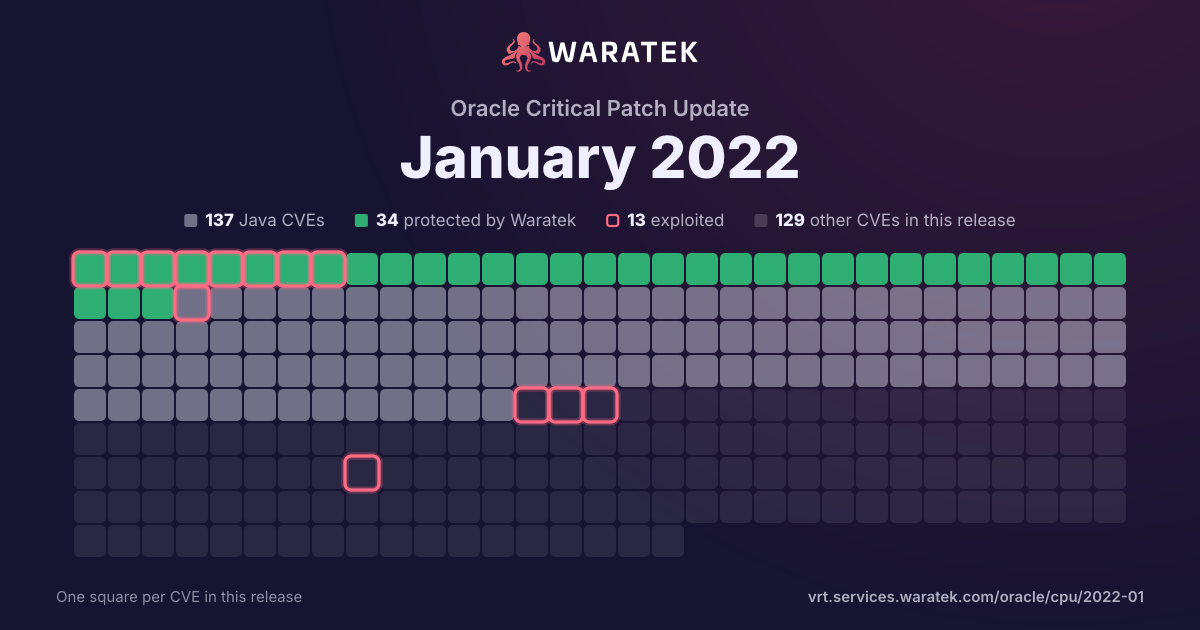
By status
34Protected by Waratek3Mitigation candidate100No exploit published57Outside Waratek scope72Not applicable
13Exploited, marked by the ring
No exploit published. For 71 of them, Oracle's security advisory is the source of public detail.
Protected by Waratek. Waratek RASP can block exploitation of these on systems that have not applied the patch yet.
Overview 232 matches · 103 in Waratek scope · 0 protected · 5 exploited · 2 CISA KEV · 9 public PoC · 15 EPSS ≥ 0.5
232matches
103in Waratek scope44.4%
0protected0.0%
5exploited2.2%
2CISA KEV0.9%
9public PoC3.9%
15EPSS ≥ 0.56.5%
Protected by Waratek
0
0.0%
Rule in development
0
0.0%
Mitigation candidate
3
1.3%
No exploit published
100
43.1%
Outside Waratek scope
57
24.6%
Not applicable
72
31.0%
Withdrawn CVE
0
0.0%
blocked by ARMR today
0
0.0%
partly blocked
0
0.0%
not blocked
232
100.0%
not established
0
0.0%
unrecorded
0
0.0%
split by
peak 151 / quarter
Q1 171
Outside Waratek scope1
Medium1
not blocked1
No public exploit1
Q2 170
Q3 170
Q4 170
Q1 181
No exploit published1
Medium1
not blocked1
No public exploit1
Q2 180
Q3 180
Q4 180
Q1 190
Q2 190
Q3 190
Q4 193
No exploit published1
Outside Waratek scope1
Not applicable1
Critical1
High2
not blocked3
No public exploit3
Q1 202
Outside Waratek scope2
High1
Medium1
not blocked2
No public exploit2
Q2 205
Outside Waratek scope5
High2
Medium3
not blocked5
Exploited2
No public exploit3
Q3 203
Mitigation candidate1
No exploit published2
High2
Medium1
not blocked3
Working exploit published1
No public exploit2
Q4 206
No exploit published4
Outside Waratek scope1
Not applicable1
High4
Medium1
Low1
not blocked6
Proof of concept only1
No public exploit5
Q1 2113
No exploit published7
Outside Waratek scope5
Not applicable1
Critical2
High7
Medium4
not blocked13
Exploited1
Proof of concept only1
Forecast only1
No public exploit10
Q2 2117
Mitigation candidate1
No exploit published5
Outside Waratek scope3
Not applicable8
Critical2
High10
Medium5
not blocked17
Working exploit published2
Forecast only3
No public exploit12
Q3 2123
Mitigation candidate1
No exploit published11
Outside Waratek scope6
Not applicable5
Critical5
High12
Medium6
not blocked23
Exploited2
Proof of concept only2
Forecast only2
No public exploit17
Q4 216
Outside Waratek scope2
Not applicable4
Critical1
High3
Medium2
not blocked6
Working exploit published1
No public exploit5
Q1 22151
No exploit published69
Outside Waratek scope31
Not applicable51
Critical6
High14
Medium109
Low22
not blocked151
Forecast only2
No public exploit149
Q2 220
Q3 220
Q4 221
Not applicable1
Medium1
not blocked1
Proof of concept only1
Q2 17Q4 17Q2 18Q4 18Q2 19Q4 19Q2 20Q4 20Q2 21Q4 21Q2 22Q4 22
| CVE | Severity | Published▾ | Status | Exploitation | Description |
|---|---|---|---|---|---|
| CVE-2020-13936 | High | 2021-03-10 | No exploit published | No public exploit | An attacker that is able to modify Velocity templates may execute arbitrary Java code or run arbitrary system commands with the same privileges as the account running the Servlet container. This applies to applications that allow untrusted users to upload/modify velocity templates running Apache Velocity Engine versions up to 2.2. |
| CVE-2020-27618 | Medium | 2021-02-26 | Outside Waratek scope | No public exploit | The iconv function in the GNU C Library (aka glibc or libc6) 2.32 and earlier, when processing invalid multi-byte input sequences in IBM1364, IBM1371, IBM1388, IBM1390, and IBM1399 encodings, fails to advance the input state, which could lead to an infinite loop in applications, resulting in a denial of service, a different vulnerability from CVE-2016-10228. |
| CVE-2020-11987 | High | 2021-02-24 | No exploit published | No public exploit | Apache Batik 1.13 is vulnerable to server-side request forgery, caused by improper input validation by the NodePickerPanel. By using a specially-crafted argument, an attacker could exploit this vulnerability to cause the underlying server to make arbitrary GET requests. |
| CVE-2021-23840 | High | 2021-02-16 | Outside Waratek scope | Forecast only | Calls to EVP_CipherUpdate, EVP_EncryptUpdate and EVP_DecryptUpdate may overflow the output length argument in some cases where the input length is close to the maximum permissable length for an integer on the platform. In such cases the return value from the function call will be 1 (indicating success), but the output length value will be negative. This could cause applications to behave incorrectly or crash. OpenSSL versions 1.1.1i and below are affected by this issue. Users of these versions should upgrade to OpenSSL 1.1.1j. OpenSSL versions 1.0.2x and below are affected by this issue. However OpenSSL 1.0.2 is out of support and no longer receiving public updates. Premium support customers of OpenSSL 1.0.2 should upgrade to 1.0.2y. Other users should upgrade to 1.1.1j. Fixed in OpenSSL 1.1.1j (Affected 1.1.1-1.1.1i). Fixed in OpenSSL 1.0.2y (Affected 1.0.2-1.0.2x). |
| CVE-2021-23337 | High | 2021-02-15 | Not applicable | Exploited | Lodash versions prior to 4.17.21 are vulnerable to Command Injection via the template function. |
| CVE-2020-13949 | High | 2021-02-12 | No exploit published | No public exploit | In Apache Thrift 0.9.3 to 0.13.0, malicious RPC clients could send short messages which would result in a large memory allocation, potentially leading to denial of service. |
| CVE-2020-29582 | Medium | 2021-02-03 | No exploit published | No public exploit | In JetBrains Kotlin before 1.4.21, a vulnerable Java API was used for temporary file and folder creation. An attacker was able to read data from such files and list directories due to insecure permissions. |
| CVE-2021-3326 | High | 2021-01-27 | Outside Waratek scope | No public exploit | The iconv function in the GNU C Library (aka glibc or libc6) 2.32 and earlier, when processing invalid input sequences in the ISO-2022-JP-3 encoding, fails an assertion in the code path and aborts the program, potentially resulting in a denial of service. |
| CVE-2020-8554 | Medium | 2021-01-21 | Outside Waratek scope | No public exploit | Kubernetes API server in all versions allow an attacker who is able to create a ClusterIP service and set the spec.externalIPs field, to intercept traffic to that IP address. Additionally, an attacker who is able to patch the status (which is considered a privileged operation and should not typically be granted to users) of a LoadBalancer service can set the status.loadBalancer.ingress.ip to similar effect. |
| CVE-2021-3177 | Critical | 2021-01-19 | Outside Waratek scope | Proof of concept only | Python 3.x through 3.9.1 has a buffer overflow in PyCArg_repr in _ctypes/callproc.c, which may lead to remote code execution in certain Python applications that accept floating-point numbers as untrusted input, as demonstrated by a 1e300 argument to c_double.from_param. This occurs because sprintf is used unsafely. |
| CVE-2020-36189 | High | 2021-01-06 | No exploit published | No public exploit | FasterXML jackson-databind 2.x before 2.9.10.8 mishandles the interaction between serialization gadgets and typing, related to com.newrelic.agent.deps.ch.qos.logback.core.db.DriverManagerConnectionSource. |
| CVE-2020-28052 | High | 2020-12-18 | No exploit published | No public exploit | An issue was discovered in Legion of the Bouncy Castle BC Java 1.65 and 1.66. The OpenBSDBCrypt.checkPassword utility method compared incorrect data when checking the password, allowing incorrect passwords to indicate they were matching with previously hashed ones that were different. |
| CVE-2020-8285 | High | 2020-12-14 | Not applicable | Proof of concept only | curl 7.21.0 to and including 7.73.0 is vulnerable to uncontrolled recursion due to a stack overflow issue in FTP wildcard match parsing. |
| CVE-2020-8908 | Low | 2020-12-10 | No exploit published | No public exploit | A temp directory creation vulnerability exists in all versions of Guava, allowing an attacker with access to the machine to potentially access data in a temporary directory created by the Guava API com.google.common.io.Files.createTempDir(). By default, on unix-like systems, the created directory is world-readable (readable by an attacker with access to the system). The method in question has been marked @Deprecated in versions 30.0 and later and should not be used. For Android developers, we recommend choosing a temporary directory API provided by Android, such as context.getCacheDir(). For other Java developers, we recommend migrating to the Java 7 API java.nio.file.Files.createTempDirectory() which explicitly configures permissions of 700, or configuring the Java runtime's java.io.tmpdir system property to point to a location whose permissions are appropriately configured. |
| CVE-2020-17527 | High | 2020-12-03 | No exploit published | No public exploit | While investigating bug 64830 it was discovered that Apache Tomcat 10.0.0-M1 to 10.0.0-M9, 9.0.0-M1 to 9.0.39 and 8.5.0 to 8.5.59 could re-use an HTTP request header value from the previous stream received on an HTTP/2 connection for the request associated with the subsequent stream. While this would most likely lead to an error and the closure of the HTTP/2 connection, it is possible that information could leak between requests. |
| CVE-2020-13956 | Medium | 2020-12-02 | Outside Waratek scope | No public exploit | Apache HttpClient versions prior to version 4.5.13 and 5.0.3 can misinterpret malformed authority component in request URIs passed to the library as java.net.URI object and pick the wrong target host for request execution. |
| CVE-2020-11979 | High | 2020-10-01 | No exploit published | No public exploit | As mitigation for CVE-2020-1945 Apache Ant 1.10.8 changed the permissions of temporary files it created so that only the current user was allowed to access them. Unfortunately the fixcrlf task deleted the temporary file and created a new one without said protection, effectively nullifying the effort. This would still allow an attacker to inject modified source files into the build process. |
| CVE-2020-5421 | Medium | 2020-09-19 | No exploit published | No public exploit | In Spring Framework versions 5.2.0 - 5.2.8, 5.1.0 - 5.1.17, 5.0.0 - 5.0.18, 4.3.0 - 4.3.28, and older unsupported versions, the protections against RFD attacks from CVE-2015-5211 may be bypassed depending on the browser used through the use of a jsessionid path parameter. |
| CVE-2020-15824 | High | 2020-08-08 | No exploit published | No public exploit | In JetBrains Kotlin from 1.4-M1 to 1.4-RC (as Kotlin 1.3.7x is not affected by the issue. Fixed version is 1.4.0) there is a script-cache privilege escalation vulnerability due to kotlin-main-kts cached scripts in the system temp directory, which is shared by all users by default. |
| CVE-2020-13935 | High | 2020-07-14 | Mitigation candidate | Working exploit published | The payload length in a WebSocket frame was not correctly validated in Apache Tomcat 10.0.0-M1 to 10.0.0-M6, 9.0.0.M1 to 9.0.36, 8.5.0 to 8.5.56 and 7.0.27 to 7.0.104. Invalid payload lengths could trigger an infinite loop. Multiple requests with invalid payload lengths could lead to a denial of service. |
| CVE-2020-10878 | High | 2020-06-05 | Outside Waratek scope | No public exploit | Perl before 5.30.3 has an integer overflow related to mishandling of a "PL_regkind[OP(n)] == NOTHING" situation. A crafted regular expression could lead to malformed bytecode with a possibility of instruction injection. |
| CVE-2020-13817 | High | 2020-06-04 | Outside Waratek scope | No public exploit | ntpd in ntp before 4.2.8p14 and 4.3.x before 4.3.100 allows remote attackers to cause a denial of service (daemon exit or system time change) by predicting transmit timestamps for use in spoofed packets. The victim must be relying on unauthenticated IPv4 time sources. There must be an off-path attacker who can query time from the victim's ntpd instance. |
| CVE-2020-11023 | Medium | 2020-04-29 | Outside Waratek scope | Exploited | In jQuery versions greater than or equal to 1.0.3 and before 3.5.0, passing HTML containing <option> elements from untrusted sources - even after sanitizing it - to one of jQuery's DOM manipulation methods (i.e. .html(), .append(), and others) may execute untrusted code. This problem is patched in jQuery 3.5.0. |
| CVE-2020-11022 | Medium | 2020-04-29 | Outside Waratek scope | Exploited | In jQuery starting with 1.12.0 and before 3.5.0, passing HTML from untrusted sources - even after sanitizing it - to one of jQuery's DOM manipulation methods (i.e. .html(), .append(), and others) may execute untrusted code. This problem is patched in jQuery 3.5.0. |
| CVE-2020-2934 | Medium | 2020-04-15 | Outside Waratek scope | No public exploit | Vulnerability in the MySQL Connectors product of Oracle MySQL (component: Connector/J). Supported versions that are affected are 8.0.19 and prior and 5.1.48 and prior. Difficult to exploit vulnerability allows unauthenticated attacker with network access via multiple protocols to compromise MySQL Connectors. Successful attacks require human interaction from a person other than the attacker. Successful attacks of this vulnerability can result in unauthorized update, insert or delete access to some of MySQL Connectors accessible data as well as unauthorized read access to a subset of MySQL Connectors accessible data and unauthorized ability to cause a partial denial of service (partial DOS) of MySQL Connectors. CVSS 3.0 Base Score 5.0 (Confidentiality, Integrity and Availability impacts). CVSS Vector: (CVSS:3.0/AV:N/AC:H/PR:N/UI:R/S:U/C:L/I:L/A:L). |
| CVE-2020-5258 | High | 2020-03-10 | Outside Waratek scope | No public exploit | In affected versions of dojo (NPM package), the deepCopy method is vulnerable to Prototype Pollution. Prototype Pollution refers to the ability to inject properties into existing JavaScript language construct prototypes, such as objects. An attacker manipulates these attributes to overwrite, or pollute, a JavaScript application object prototype of the base object by injecting other values. This has been patched in versions 1.12.8, 1.13.7, 1.14.6, 1.15.3 and 1.16.2 |
| CVE-2020-9281 | Medium | 2020-03-07 | Outside Waratek scope | No public exploit | A cross-site scripting (XSS) vulnerability in the HTML Data Processor for CKEditor 4.0 before 4.14 allows remote attackers to inject arbitrary web script through a crafted "protected" comment (with the cke_protected syntax). |
| CVE-2018-1311 | High | 2019-12-18 | Not applicable | No public exploit | The Apache Xerces-C 3.0.0 to 3.2.3 XML parser contains a use-after-free error triggered during the scanning of external DTDs. This flaw has not been addressed in the maintained version of the library and has no current mitigation other than to disable DTD processing. This can be accomplished via the DOM using a standard parser feature, or via SAX using the XERCES_DISABLE_DTD environment variable. |
| CVE-2019-13734 | High | 2019-12-10 | Outside Waratek scope | No public exploit | Out of bounds write in SQLite in Google Chrome prior to 79.0.3945.79 allowed a remote attacker to potentially exploit heap corruption via a crafted HTML page. |
| CVE-2019-17495 | Critical | 2019-10-10 | No exploit published | No public exploit | A Cascading Style Sheets (CSS) injection vulnerability in Swagger UI before 3.23.11 allows attackers to use the Relative Path Overwrite (RPO) technique to perform CSS-based input field value exfiltration, such as exfiltration of a CSRF token value. In other words, this product intentionally allows the embedding of untrusted JSON data from remote servers, but it was not previously known that <style>@import within the JSON data was a functional attack method. |
| CVE-2018-1324 | Medium | 2018-03-16 | No exploit published | No public exploit | A specially crafted ZIP archive can be used to cause an infinite loop inside of Apache Commons Compress' extra field parser used by the ZipFile and ZipArchiveInputStream classes in versions 1.11 to 1.15. This can be used to mount a denial of service attack against services that use Compress' zip package. |
| CVE-2016-7103 | Medium | 2017-03-15 | Outside Waratek scope | No public exploit | Cross-site scripting (XSS) vulnerability in jQuery UI before 1.12.0 might allow remote attackers to inject arbitrary web script or HTML via the closeText parameter of the dialog function. |