
Oracle Critical Patch Update January 2022
Released January 2022 · Oracle's advisory ↗ · ← Critical Patch Update, October 2021 · Critical Patch Update, April 2022 →
266 CVEs in this release, one square each
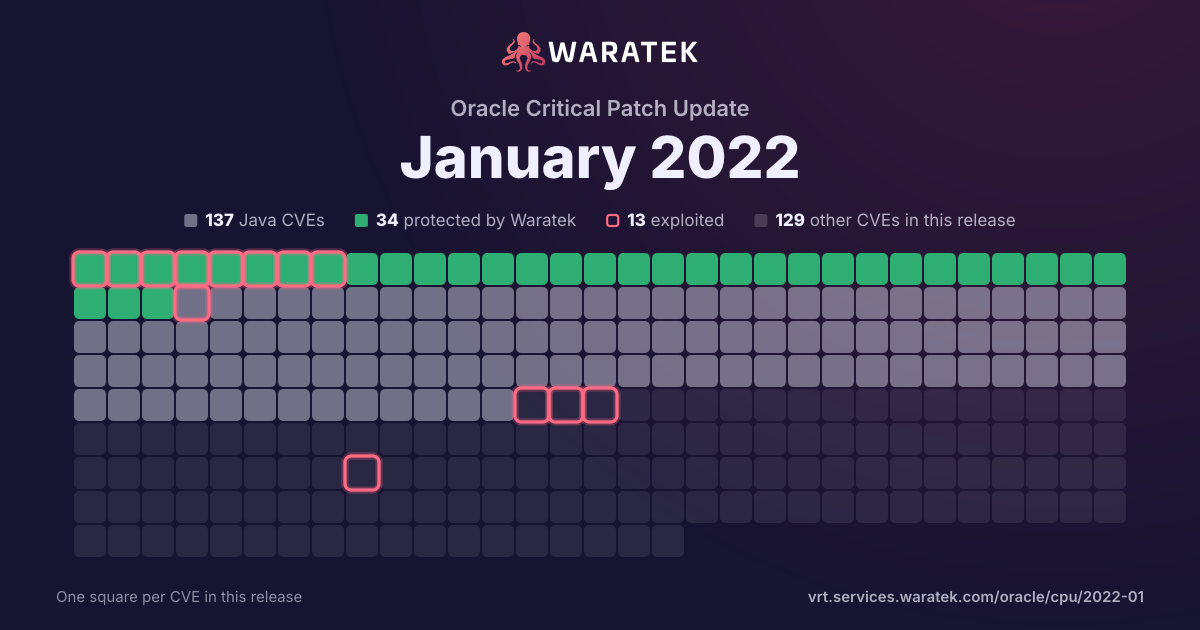
By status
34Protected by Waratek3Mitigation candidate100No exploit published57Outside Waratek scope72Not applicable
13Exploited, marked by the ring
No exploit published. For 71 of them, Oracle's security advisory is the source of public detail.
Protected by Waratek. Waratek RASP can block exploitation of these on systems that have not applied the patch yet.
Overview 137 matches · 34 protected · 9 exploited · 2 CISA KEV · 11 public PoC · 13 EPSS ≥ 0.5
Protected by Waratek
34
24.8%
Rule in development
0
0.0%
Mitigation candidate
3
2.2%
No exploit published
100
73.0%
blocked by ARMR today
34
24.8%
partly blocked
0
0.0%
not blocked
103
75.2%
not established
0
0.0%
unrecorded
0
0.0%
split by
peak 81 / quarter
Q1 181
No exploit published1
Medium1
not blocked1
No public exploit1
Q2 180
Q3 180
Q4 180
Q1 190
Q2 190
Q3 191
Protected by Waratek1
High1
blocked by ARMR today1
No public exploit1
Q4 192
Protected by Waratek1
No exploit published1
Critical1
Medium1
blocked by ARMR today1
not blocked1
No public exploit2
Q1 200
Q2 201
Protected by Waratek1
Critical1
blocked by ARMR today1
No public exploit1
Q3 205
Protected by Waratek2
Mitigation candidate1
No exploit published2
High4
Medium1
blocked by ARMR today2
not blocked3
Working exploit published1
No public exploit4
Q4 208
Protected by Waratek4
No exploit published4
Critical1
High5
Medium1
Low1
blocked by ARMR today4
not blocked4
Exploited1
No public exploit7
Q1 2110
Protected by Waratek3
No exploit published7
Critical2
High5
Medium3
blocked by ARMR today3
not blocked7
Exploited1
No public exploit9
Q2 2110
Protected by Waratek4
Mitigation candidate1
No exploit published5
High5
Medium5
blocked by ARMR today4
not blocked6
Working exploit published3
Forecast only1
No public exploit6
Q3 2113
Protected by Waratek1
Mitigation candidate1
No exploit published11
Critical1
High7
Medium5
blocked by ARMR today1
not blocked12
Exploited2
Forecast only1
No public exploit10
Q4 215
Protected by Waratek5
Critical1
High2
Medium2
blocked by ARMR today5
Exploited3
No public exploit2
Q1 2281
Protected by Waratek12
No exploit published69
Critical8
High13
Medium56
Low4
blocked by ARMR today12
not blocked69
Exploited2
Proof of concept only1
No public exploit78
Q1 18Q3 18Q1 19Q3 19Q1 20Q3 20Q1 21Q3 21Q1 22
| CVE | Severity | Published▾ | Status | Exploitation | Description |
|---|---|---|---|---|---|
| CVE-2021-31812 | Medium | 2021-06-12 | No exploit published | No public exploit | In Apache PDFBox, a carefully crafted PDF file can trigger an infinite loop while loading the file. This issue affects Apache PDFBox version 2.0.23 and prior 2.0.x versions. |
| CVE-2021-33560 | High | 2021-06-08 | No exploit published | No public exploit | Libgcrypt before 1.8.8 and 1.9.x before 1.9.3 mishandles ElGamal encryption because it lacks exponent blinding to address a side-channel attack against mpi_powm, and the window size is not chosen appropriately. This, for example, affects use of ElGamal in OpenPGP. |
| CVE-2020-6950 | Medium | 2021-06-02 | Protected by Waratek | Working exploit published | Directory traversal in Eclipse Mojarra before 2.3.14 allows attackers to read arbitrary files via the loc parameter or con parameter. |
| CVE-2020-14340 | Medium | 2021-06-02 | No exploit published | No public exploit | A vulnerability was discovered in XNIO where file descriptor leak caused by growing amounts of NIO Selector file handles between garbage collection cycles. It may allow the attacker to cause a denial of service. It affects XNIO versions 3.6.0.Beta1 through 3.8.1.Final. |
| CVE-2021-29505 | High | 2021-05-28 | Mitigation candidate | Working exploit published | XStream is software for serializing Java objects to XML and back again. A vulnerability in XStream versions prior to 1.4.17 may allow a remote attacker has sufficient rights to execute commands of the host only by manipulating the processed input stream. No user who followed the recommendation to setup XStream's security framework with a whitelist limited to the minimal required types is affected. The vulnerability is patched in version 1.4.17. |
| CVE-2021-22118 | High | 2021-05-27 | Protected by Waratek | No public exploit | In Spring Framework, versions 5.2.x prior to 5.2.15 and versions 5.3.x prior to 5.3.7, a WebFlux application is vulnerable to a privilege escalation: by (re)creating the temporary storage directory, a locally authenticated malicious user can read or modify files that have been uploaded to the WebFlux application, or overwrite arbitrary files with multipart request data. |
| CVE-2021-29425 | Medium | 2021-04-13 | Protected by Waratek | No public exploit | In Apache Commons IO before 2.7, When invoking the method FileNameUtils.normalize with an improper input string, like "//../foo", or "\\..\foo", the result would be the same value, thus possibly providing access to files in the parent directory, but not further above (thus "limited" path traversal), if the calling code would use the result to construct a path value. |
| CVE-2021-28165 | High | 2021-04-01 | No exploit published | Forecast only | In Eclipse Jetty 7.2.2 to 9.4.38, 10.0.0.alpha0 to 10.0.1, and 11.0.0.alpha0 to 11.0.1, CPU usage can reach 100% upon receiving a large invalid TLS frame. |
| CVE-2021-28164 | Medium | 2021-04-01 | Protected by Waratek | Working exploit published | In Eclipse Jetty 9.4.37.v20210219 to 9.4.38.v20210224, the default compliance mode allows requests with URIs that contain %2e or %2e%2e segments to access protected resources within the WEB-INF directory. For example a request to /context/%2e/WEB-INF/web.xml can retrieve the web.xml file. This can reveal sensitive information regarding the implementation of a web application. |
| CVE-2021-21409 | Medium | 2021-03-30 | No exploit published | No public exploit | Netty is an open-source, asynchronous event-driven network application framework for rapid development of maintainable high performance protocol servers & clients. In Netty (io.netty:netty-codec-http2) before version 4.1.61.Final there is a vulnerability that enables request smuggling. The content-length header is not correctly validated if the request only uses a single Http2HeaderFrame with the endStream set to to true. This could lead to request smuggling if the request is proxied to a remote peer and translated to HTTP/1.1. This is a followup of GHSA-wm47-8v5p-wjpj/CVE-2021-21295 which did miss to fix this one case. This was fixed as part of 4.1.61.Final. |
| CVE-2021-21783 | Critical | 2021-03-25 | No exploit published | No public exploit | A code execution vulnerability exists in the WS-Addressing plugin functionality of Genivia gSOAP 2.8.107. A specially crafted SOAP request can lead to remote code execution. An attacker can send an HTTP request to trigger this vulnerability. |
| CVE-2020-13936 | High | 2021-03-10 | No exploit published | No public exploit | An attacker that is able to modify Velocity templates may execute arbitrary Java code or run arbitrary system commands with the same privileges as the account running the Servlet container. This applies to applications that allow untrusted users to upload/modify velocity templates running Apache Velocity Engine versions up to 2.2. |
| CVE-2021-25122 | High | 2021-03-01 | Protected by Waratek | No public exploit | When responding to new h2c connection requests, Apache Tomcat versions 10.0.0-M1 to 10.0.0, 9.0.0.M1 to 9.0.41 and 8.5.0 to 8.5.61 could duplicate request headers and a limited amount of request body from one request to another meaning user A and user B could both see the results of user A's request. |
| CVE-2020-11987 | High | 2021-02-24 | No exploit published | No public exploit | Apache Batik 1.13 is vulnerable to server-side request forgery, caused by improper input validation by the NodePickerPanel. By using a specially-crafted argument, an attacker could exploit this vulnerability to cause the underlying server to make arbitrary GET requests. |
| CVE-2021-27568 | Medium | 2021-02-23 | Protected by Waratek | No public exploit | An issue was discovered in netplex json-smart-v1 through 2015-10-23 and json-smart-v2 through 2.4. An exception is thrown from a function, but it is not caught, as demonstrated by NumberFormatException. When it is not caught, it may cause programs using the library to crash or expose sensitive information. |
| CVE-2020-13949 | High | 2021-02-12 | No exploit published | No public exploit | In Apache Thrift 0.9.3 to 0.13.0, malicious RPC clients could send short messages which would result in a large memory allocation, potentially leading to denial of service. |
| CVE-2020-29582 | Medium | 2021-02-03 | No exploit published | No public exploit | In JetBrains Kotlin before 1.4.21, a vulnerable Java API was used for temporary file and folder creation. An attacker was able to read data from such files and list directories due to insecure permissions. |
| CVE-2020-14756 | Critical | 2021-01-20 | Protected by Waratek | Exploited | Vulnerability in the Oracle Coherence product of Oracle Fusion Middleware (component: Core Components). Supported versions that are affected are 3.7.1.0, 12.1.3.0.0, 12.2.1.3.0, 12.2.1.4.0 and 14.1.1.0.0. Easily exploitable vulnerability allows unauthenticated attacker with network access via IIOP, T3 to compromise Oracle Coherence. Successful attacks of this vulnerability can result in takeover of Oracle Coherence. CVSS 3.1 Base Score 9.8 (Confidentiality, Integrity and Availability impacts). CVSS Vector: (CVSS:3.1/AV:N/AC:L/PR:N/UI:N/S:U/C:H/I:H/A:H). |
| CVE-2020-36189 | High | 2021-01-06 | No exploit published | No public exploit | FasterXML jackson-databind 2.x before 2.9.10.8 mishandles the interaction between serialization gadgets and typing, related to com.newrelic.agent.deps.ch.qos.logback.core.db.DriverManagerConnectionSource. |
| CVE-2020-28052 | High | 2020-12-18 | No exploit published | No public exploit | An issue was discovered in Legion of the Bouncy Castle BC Java 1.65 and 1.66. The OpenBSDBCrypt.checkPassword utility method compared incorrect data when checking the password, allowing incorrect passwords to indicate they were matching with previously hashed ones that were different. |
| CVE-2020-17530 | Critical | 2020-12-11 | Protected by Waratek | Exploited | Forced OGNL evaluation, when evaluated on raw user input in tag attributes, may lead to remote code execution. Affected software : Apache Struts 2.0.0 - Struts 2.5.25. |
| CVE-2020-8908 | Low | 2020-12-10 | No exploit published | No public exploit | A temp directory creation vulnerability exists in all versions of Guava, allowing an attacker with access to the machine to potentially access data in a temporary directory created by the Guava API com.google.common.io.Files.createTempDir(). By default, on unix-like systems, the created directory is world-readable (readable by an attacker with access to the system). The method in question has been marked @Deprecated in versions 30.0 and later and should not be used. For Android developers, we recommend choosing a temporary directory API provided by Android, such as context.getCacheDir(). For other Java developers, we recommend migrating to the Java 7 API java.nio.file.Files.createTempDirectory() which explicitly configures permissions of 700, or configuring the Java runtime's java.io.tmpdir system property to point to a location whose permissions are appropriately configured. |
| CVE-2020-17521 | Medium | 2020-12-07 | Protected by Waratek | No public exploit | Apache Groovy provides extension methods to aid with creating temporary directories. Prior to this fix, Groovy's implementation of those extension methods was using a now superseded Java JDK method call that is potentially not secure on some operating systems in some contexts. Users not using the extension methods mentioned in the advisory are not affected, but may wish to read the advisory for further details. Versions Affected: 2.0 to 2.4.20, 2.5.0 to 2.5.13, 3.0.0 to 3.0.6, and 4.0.0-alpha-1. Fixed in versions 2.4.21, 2.5.14, 3.0.7, 4.0.0-alpha-2. |
| CVE-2020-25649 | High | 2020-12-03 | Protected by Waratek | No public exploit | A flaw was found in FasterXML Jackson Databind, where it did not have entity expansion secured properly. This flaw allows vulnerability to XML external entity (XXE) attacks. The highest threat from this vulnerability is data integrity. |
| CVE-2020-17527 | High | 2020-12-03 | No exploit published | No public exploit | While investigating bug 64830 it was discovered that Apache Tomcat 10.0.0-M1 to 10.0.0-M9, 9.0.0-M1 to 9.0.39 and 8.5.0 to 8.5.59 could re-use an HTTP request header value from the previous stream received on an HTTP/2 connection for the request associated with the subsequent stream. While this would most likely lead to an error and the closure of the HTTP/2 connection, it is possible that information could leak between requests. |
| CVE-2019-17566 | High | 2020-11-12 | Protected by Waratek | No public exploit | Apache Batik is vulnerable to server-side request forgery, caused by improper input validation by the "xlink:href" attributes. By using a specially-crafted argument, an attacker could exploit this vulnerability to cause the underlying server to make arbitrary GET requests. |
| CVE-2020-11979 | High | 2020-10-01 | No exploit published | No public exploit | As mitigation for CVE-2020-1945 Apache Ant 1.10.8 changed the permissions of temporary files it created so that only the current user was allowed to access them. Unfortunately the fixcrlf task deleted the temporary file and created a new one without said protection, effectively nullifying the effort. This would still allow an attacker to inject modified source files into the build process. |
| CVE-2020-5421 | Medium | 2020-09-19 | No exploit published | No public exploit | In Spring Framework versions 5.2.0 - 5.2.8, 5.1.0 - 5.1.17, 5.0.0 - 5.0.18, 4.3.0 - 4.3.28, and older unsupported versions, the protections against RFD attacks from CVE-2015-5211 may be bypassed depending on the browser used through the use of a jsessionid path parameter. |
| CVE-2020-24750 | High | 2020-09-17 | Protected by Waratek | No public exploit | FasterXML jackson-databind 2.x before 2.9.10.6 mishandles the interaction between serialization gadgets and typing, related to com.pastdev.httpcomponents.configuration.JndiConfiguration. |
| CVE-2020-7712 | High | 2020-08-30 | Protected by Waratek | No public exploit | This affects the package json before 10.0.0. It is possible to inject arbritary commands using the parseLookup function. |
| CVE-2020-15824 | High | 2020-08-08 | No exploit published | No public exploit | In JetBrains Kotlin from 1.4-M1 to 1.4-RC (as Kotlin 1.3.7x is not affected by the issue. Fixed version is 1.4.0) there is a script-cache privilege escalation vulnerability due to kotlin-main-kts cached scripts in the system temp directory, which is shared by all users by default. |
| CVE-2020-13935 | High | 2020-07-14 | Mitigation candidate | Working exploit published | The payload length in a WebSocket frame was not correctly validated in Apache Tomcat 10.0.0-M1 to 10.0.0-M6, 9.0.0.M1 to 9.0.36, 8.5.0 to 8.5.56 and 7.0.27 to 7.0.104. Invalid payload lengths could trigger an infinite loop. Multiple requests with invalid payload lengths could lead to a denial of service. |
| CVE-2020-10683 | Critical | 2020-05-01 | Protected by Waratek | No public exploit | dom4j before 2.0.3 and 2.1.x before 2.1.3 allows external DTDs and External Entities by default, which might enable XXE attacks. However, there is popular external documentation from OWASP showing how to enable the safe, non-default behavior in any application that uses dom4j. |
| CVE-2019-10219 | Medium | 2019-11-08 | Protected by Waratek | No public exploit | A vulnerability was found in Hibernate-Validator. The SafeHtml validator annotation fails to properly sanitize payloads consisting of potentially malicious code in HTML comments and instructions. This vulnerability can result in an XSS attack. |
| CVE-2019-17495 | Critical | 2019-10-10 | No exploit published | No public exploit | A Cascading Style Sheets (CSS) injection vulnerability in Swagger UI before 3.23.11 allows attackers to use the Relative Path Overwrite (RPO) technique to perform CSS-based input field value exfiltration, such as exfiltration of a CSRF token value. In other words, this product intentionally allows the embedding of untrusted JSON data from remote servers, but it was not previously known that <style>@import within the JSON data was a functional attack method. |
| CVE-2019-10086 | High | 2019-08-20 | Protected by Waratek | No public exploit | In Apache Commons Beanutils 1.9.2, a special BeanIntrospector class was added which allows suppressing the ability for an attacker to access the classloader via the class property available on all Java objects. We, however were not using this by default characteristic of the PropertyUtilsBean. |
| CVE-2018-1324 | Medium | 2018-03-16 | No exploit published | No public exploit | A specially crafted ZIP archive can be used to cause an infinite loop inside of Apache Commons Compress' extra field parser used by the ZipFile and ZipArchiveInputStream classes in versions 1.11 to 1.15. This can be used to mount a denial of service attack against services that use Compress' zip package. |