
Oracle Critical Patch Update January 2022
Released January 2022 · Oracle's advisory ↗ · ← Critical Patch Update, October 2021 · Critical Patch Update, April 2022 →
266 CVEs in this release, one square each
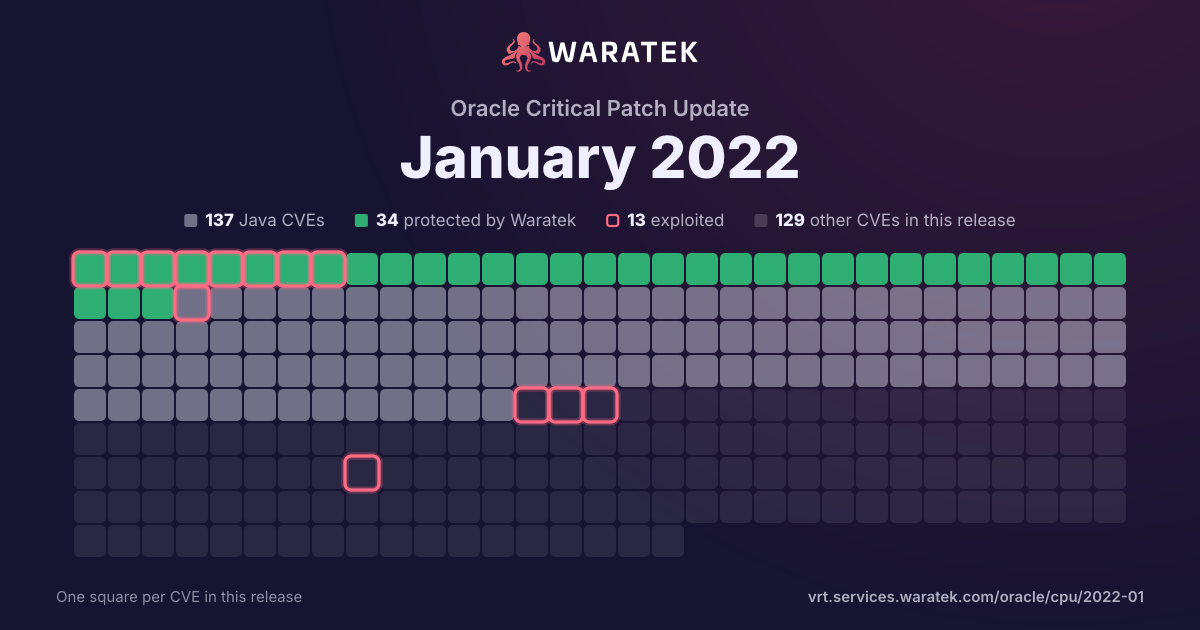
By status
34Protected by Waratek3Mitigation candidate100No exploit published57Outside Waratek scope72Not applicable
13Exploited, marked by the ring
No exploit published. For 71 of them, Oracle's security advisory is the source of public detail.
Protected by Waratek. Waratek RASP can block exploitation of these on systems that have not applied the patch yet.
Overview 233 matches · 121 in Waratek scope · 23 protected · 0 exploited · 0 CISA KEV · 0 public PoC · 0 EPSS ≥ 0.5
233matches
121in Waratek scope51.9%
23protected9.9%
0exploited0.0%
0CISA KEV0.0%
0public PoC0.0%
0EPSS ≥ 0.50.0%
Protected by Waratek
23
9.9%
Rule in development
0
0.0%
Mitigation candidate
0
0.0%
No exploit published
98
42.1%
Outside Waratek scope
46
19.7%
Not applicable
66
28.3%
Withdrawn CVE
0
0.0%
blocked by ARMR today
23
9.9%
partly blocked
0
0.0%
not blocked
210
90.1%
not established
0
0.0%
unrecorded
0
0.0%
Exploited
0
0.0%
Working exploit published
0
0.0%
Proof of concept only
0
0.0%
Forecast only
0
0.0%
No public exploit
233
100.0%
split by
peak 158 / quarter
Q1 171
Outside Waratek scope1
Medium1
not blocked1
No public exploit1
Q2 170
Q3 170
Q4 170
Q1 181
No exploit published1
Medium1
not blocked1
No public exploit1
Q2 180
Q3 180
Q4 180
Q1 190
Q2 190
Q3 191
Protected by Waratek1
High1
blocked by ARMR today1
No public exploit1
Q4 194
Protected by Waratek1
No exploit published1
Outside Waratek scope1
Not applicable1
Critical1
High2
Medium1
blocked by ARMR today1
not blocked3
No public exploit4
Q1 202
Outside Waratek scope2
High1
Medium1
not blocked2
No public exploit2
Q2 204
Protected by Waratek1
Outside Waratek scope3
Critical1
High2
Medium1
blocked by ARMR today1
not blocked3
No public exploit4
Q3 204
Protected by Waratek2
No exploit published2
High3
Medium1
blocked by ARMR today2
not blocked2
No public exploit4
Q4 208
Protected by Waratek3
No exploit published4
Outside Waratek scope1
High5
Medium2
Low1
blocked by ARMR today3
not blocked5
No public exploit8
Q1 2112
Protected by Waratek2
No exploit published7
Outside Waratek scope3
Critical1
High6
Medium5
blocked by ARMR today2
not blocked10
No public exploit12
Q2 2114
Protected by Waratek2
No exploit published4
Outside Waratek scope1
Not applicable7
Critical1
High7
Medium6
blocked by ARMR today2
not blocked12
No public exploit14
Q3 2117
No exploit published10
Outside Waratek scope2
Not applicable5
Critical3
High10
Medium4
not blocked17
No public exploit17
Q4 217
Protected by Waratek2
Outside Waratek scope1
Not applicable4
Critical1
High4
Medium2
blocked by ARMR today2
not blocked5
No public exploit7
Q1 22158
Protected by Waratek9
No exploit published69
Outside Waratek scope31
Not applicable49
Critical7
High14
Medium114
Low23
blocked by ARMR today9
not blocked149
No public exploit158
Q1 17Q3 17Q1 18Q3 18Q1 19Q3 19Q1 20Q3 20Q1 21Q3 21Q1 22
| CVE | Severity | Published▾ | Status | Exploitation | Description |
|---|---|---|---|---|---|
| CVE-2022-21298 | Low | 2022-01-19 | Not applicable | No public exploit | Vulnerability in the Oracle Solaris product of Oracle Systems (component: Install). The supported version that is affected is 11. Easily exploitable vulnerability allows low privileged attacker with logon to the infrastructure where Oracle Solaris executes to compromise Oracle Solaris. Successful attacks require human interaction from a person other than the attacker. Successful attacks of this vulnerability can result in unauthorized update, insert or delete access to some of Oracle Solaris accessible data and unauthorized ability to cause a partial denial of service (partial DOS) of Oracle Solaris. CVSS 3.1 Base Score 3.9 (Integrity and Availability impacts). CVSS Vector: (CVSS:3.1/AV:L/AC:L/PR:L/UI:R/S:U/C:N/I:L/A:L). |
| CVE-2022-21297 | Medium | 2022-01-19 | Outside Waratek scope | No public exploit | Vulnerability in the MySQL Server product of Oracle MySQL (component: Server: Optimizer). Supported versions that are affected are 8.0.26 and prior. Easily exploitable vulnerability allows high privileged attacker with network access via multiple protocols to compromise MySQL Server. Successful attacks of this vulnerability can result in unauthorized ability to cause a hang or frequently repeatable crash (complete DOS) of MySQL Server. CVSS 3.1 Base Score 4.9 (Availability impacts). CVSS Vector: (CVSS:3.1/AV:N/AC:L/PR:H/UI:N/S:U/C:N/I:N/A:H). |
| CVE-2022-21296 | Medium | 2022-01-19 | Protected by Waratek | No public exploit | Vulnerability in the Oracle Java SE, Oracle GraalVM Enterprise Edition product of Oracle Java SE (component: JAXP). Supported versions that are affected are Oracle Java SE: 7u321, 8u311, 11.0.13, 17.0.1; Oracle GraalVM Enterprise Edition: 20.3.4 and 21.3.0. Easily exploitable vulnerability allows unauthenticated attacker with network access via multiple protocols to compromise Oracle Java SE, Oracle GraalVM Enterprise Edition. Successful attacks of this vulnerability can result in unauthorized read access to a subset of Oracle Java SE, Oracle GraalVM Enterprise Edition accessible data. Note: This vulnerability applies to Java deployments, typically in clients running sandboxed Java Web Start applications or sandboxed Java applets, that load and run untrusted code (e.g., code that comes from the internet) and rely on the Java sandbox for security. This vulnerability can also be exploited by using APIs in the specified Component, e.g., through a web service which supplies data to the APIs. CVSS 3.1 Base Score 5.3 (Confidentiality impacts). CVSS Vector: (CVSS:3.1/AV:N/AC:L/PR:N/UI:N/S:U/C:L/I:N/A:N). |
| CVE-2022-21295 | Low | 2022-01-19 | Not applicable | No public exploit | Vulnerability in the Oracle VM VirtualBox product of Oracle Virtualization (component: Core). The supported version that is affected is Prior to 6.1.32. Easily exploitable vulnerability allows low privileged attacker with logon to the infrastructure where Oracle VM VirtualBox executes to compromise Oracle VM VirtualBox. While the vulnerability is in Oracle VM VirtualBox, attacks may significantly impact additional products. Successful attacks of this vulnerability can result in unauthorized read access to a subset of Oracle VM VirtualBox accessible data. Note: This vulnerability applies to Windows systems only. CVSS 3.1 Base Score 3.8 (Confidentiality impacts). CVSS Vector: (CVSS:3.1/AV:L/AC:L/PR:L/UI:N/S:C/C:L/I:N/A:N). |
| CVE-2022-21294 | Medium | 2022-01-19 | Protected by Waratek | No public exploit | Vulnerability in the Oracle Java SE, Oracle GraalVM Enterprise Edition product of Oracle Java SE (component: Libraries). Supported versions that are affected are Oracle Java SE: 7u321, 8u311, 11.0.13, 17.0.1; Oracle GraalVM Enterprise Edition: 20.3.4 and 21.3.0. Easily exploitable vulnerability allows unauthenticated attacker with network access via multiple protocols to compromise Oracle Java SE, Oracle GraalVM Enterprise Edition. Successful attacks of this vulnerability can result in unauthorized ability to cause a partial denial of service (partial DOS) of Oracle Java SE, Oracle GraalVM Enterprise Edition. Note: This vulnerability applies to Java deployments, typically in clients running sandboxed Java Web Start applications or sandboxed Java applets, that load and run untrusted code (e.g., code that comes from the internet) and rely on the Java sandbox for security. This vulnerability can also be exploited by using APIs in the specified Component, e.g., through a web service which supplies data to the APIs. CVSS 3.1 Base Score 5.3 (Availability impacts). CVSS Vector: (CVSS:3.1/AV:N/AC:L/PR:N/UI:N/S:U/C:N/I:N/A:L). |
| CVE-2022-21293 | Medium | 2022-01-19 | Outside Waratek scope | No public exploit | Vulnerability in the Oracle Java SE, Oracle GraalVM Enterprise Edition product of Oracle Java SE (component: Libraries). Supported versions that are affected are Oracle Java SE: 7u321, 8u311, 11.0.13, 17.0.1; Oracle GraalVM Enterprise Edition: 20.3.4 and 21.3.0. Easily exploitable vulnerability allows unauthenticated attacker with network access via multiple protocols to compromise Oracle Java SE, Oracle GraalVM Enterprise Edition. Successful attacks of this vulnerability can result in unauthorized ability to cause a partial denial of service (partial DOS) of Oracle Java SE, Oracle GraalVM Enterprise Edition. Note: This vulnerability applies to Java deployments, typically in clients running sandboxed Java Web Start applications or sandboxed Java applets, that load and run untrusted code (e.g., code that comes from the internet) and rely on the Java sandbox for security. This vulnerability can also be exploited by using APIs in the specified Component, e.g., through a web service which supplies data to the APIs. CVSS 3.1 Base Score 5.3 (Availability impacts). CVSS Vector: (CVSS:3.1/AV:N/AC:L/PR:N/UI:N/S:U/C:N/I:N/A:L). |
| CVE-2022-21292 | High | 2022-01-19 | No exploit published | No public exploit | Vulnerability in the Oracle WebLogic Server product of Oracle Fusion Middleware (component: Samples). Supported versions that are affected are 12.2.1.4.0 and 14.1.1.0.0. Easily exploitable vulnerability allows unauthenticated attacker with network access via HTTP to compromise Oracle WebLogic Server. Successful attacks of this vulnerability can result in unauthorized access to critical data or complete access to all Oracle WebLogic Server accessible data. CVSS 3.1 Base Score 7.5 (Confidentiality impacts). CVSS Vector: (CVSS:3.1/AV:N/AC:L/PR:N/UI:N/S:U/C:H/I:N/A:N). |
| CVE-2022-21291 | Medium | 2022-01-19 | No exploit published | No public exploit | Vulnerability in the Oracle Java SE, Oracle GraalVM Enterprise Edition product of Oracle Java SE (component: Hotspot). Supported versions that are affected are Oracle Java SE: 7u321, 8u311, 11.0.13, 17.0.1; Oracle GraalVM Enterprise Edition: 20.3.4 and 21.3.0. Easily exploitable vulnerability allows unauthenticated attacker with network access via multiple protocols to compromise Oracle Java SE, Oracle GraalVM Enterprise Edition. Successful attacks of this vulnerability can result in unauthorized update, insert or delete access to some of Oracle Java SE, Oracle GraalVM Enterprise Edition accessible data. Note: This vulnerability applies to Java deployments, typically in clients running sandboxed Java Web Start applications or sandboxed Java applets, that load and run untrusted code (e.g., code that comes from the internet) and rely on the Java sandbox for security. This vulnerability can also be exploited by using APIs in the specified Component, e.g., through a web service which supplies data to the APIs. CVSS 3.1 Base Score 5.3 (Integrity impacts). CVSS Vector: (CVSS:3.1/AV:N/AC:L/PR:N/UI:N/S:U/C:N/I:L/A:N). |
| CVE-2022-21290 | Medium | 2022-01-19 | Not applicable | No public exploit | Vulnerability in the MySQL Cluster product of Oracle MySQL (component: Cluster: General). Supported versions that are affected are 8.0.27 and prior. Difficult to exploit vulnerability allows high privileged attacker with access to the physical communication segment attached to the hardware where the MySQL Cluster executes to compromise MySQL Cluster. Successful attacks require human interaction from a person other than the attacker. Successful attacks of this vulnerability can result in takeover of MySQL Cluster. CVSS 3.1 Base Score 6.3 (Confidentiality, Integrity and Availability impacts). CVSS Vector: (CVSS:3.1/AV:A/AC:H/PR:H/UI:R/S:U/C:H/I:H/A:H). |
| CVE-2022-21289 | Medium | 2022-01-19 | Not applicable | No public exploit | Vulnerability in the MySQL Cluster product of Oracle MySQL (component: Cluster: General). Supported versions that are affected are 7.4.34 and prior, 7.5.24 and prior, 7.6.20 and prior and 8.0.27 and prior. Difficult to exploit vulnerability allows high privileged attacker with access to the physical communication segment attached to the hardware where the MySQL Cluster executes to compromise MySQL Cluster. Successful attacks require human interaction from a person other than the attacker. Successful attacks of this vulnerability can result in takeover of MySQL Cluster. CVSS 3.1 Base Score 6.3 (Confidentiality, Integrity and Availability impacts). CVSS Vector: (CVSS:3.1/AV:A/AC:H/PR:H/UI:R/S:U/C:H/I:H/A:H). |
| CVE-2022-21288 | Medium | 2022-01-19 | Not applicable | No public exploit | Vulnerability in the MySQL Cluster product of Oracle MySQL (component: Cluster: General). Supported versions that are affected are 7.4.34 and prior, 7.5.24 and prior, 7.6.20 and prior and 8.0.27 and prior. Difficult to exploit vulnerability allows high privileged attacker with access to the physical communication segment attached to the hardware where the MySQL Cluster executes to compromise MySQL Cluster. Successful attacks require human interaction from a person other than the attacker. Successful attacks of this vulnerability can result in takeover of MySQL Cluster. CVSS 3.1 Base Score 6.3 (Confidentiality, Integrity and Availability impacts). CVSS Vector: (CVSS:3.1/AV:A/AC:H/PR:H/UI:R/S:U/C:H/I:H/A:H). |
| CVE-2022-21287 | Medium | 2022-01-19 | Not applicable | No public exploit | Vulnerability in the MySQL Cluster product of Oracle MySQL (component: Cluster: General). Supported versions that are affected are 7.4.34 and prior, 7.5.24 and prior, 7.6.20 and prior and 8.0.27 and prior. Difficult to exploit vulnerability allows high privileged attacker with access to the physical communication segment attached to the hardware where the MySQL Cluster executes to compromise MySQL Cluster. Successful attacks require human interaction from a person other than the attacker. Successful attacks of this vulnerability can result in takeover of MySQL Cluster. CVSS 3.1 Base Score 6.3 (Confidentiality, Integrity and Availability impacts). CVSS Vector: (CVSS:3.1/AV:A/AC:H/PR:H/UI:R/S:U/C:H/I:H/A:H). |
| CVE-2022-21286 | Medium | 2022-01-19 | Not applicable | No public exploit | Vulnerability in the MySQL Cluster product of Oracle MySQL (component: Cluster: General). Supported versions that are affected are 7.4.34 and prior, 7.5.24 and prior, 7.6.20 and prior and 8.0.27 and prior. Difficult to exploit vulnerability allows high privileged attacker with access to the physical communication segment attached to the hardware where the MySQL Cluster executes to compromise MySQL Cluster. Successful attacks require human interaction from a person other than the attacker. Successful attacks of this vulnerability can result in takeover of MySQL Cluster. CVSS 3.1 Base Score 6.3 (Confidentiality, Integrity and Availability impacts). CVSS Vector: (CVSS:3.1/AV:A/AC:H/PR:H/UI:R/S:U/C:H/I:H/A:H). |
| CVE-2022-21285 | Medium | 2022-01-19 | Not applicable | No public exploit | Vulnerability in the MySQL Cluster product of Oracle MySQL (component: Cluster: General). Supported versions that are affected are 7.4.34 and prior, 7.5.24 and prior, 7.6.20 and prior and 8.0.27 and prior. Difficult to exploit vulnerability allows high privileged attacker with access to the physical communication segment attached to the hardware where the MySQL Cluster executes to compromise MySQL Cluster. Successful attacks require human interaction from a person other than the attacker. Successful attacks of this vulnerability can result in takeover of MySQL Cluster. CVSS 3.1 Base Score 6.3 (Confidentiality, Integrity and Availability impacts). CVSS Vector: (CVSS:3.1/AV:A/AC:H/PR:H/UI:R/S:U/C:H/I:H/A:H). |
| CVE-2022-21284 | Medium | 2022-01-19 | Not applicable | No public exploit | Vulnerability in the MySQL Cluster product of Oracle MySQL (component: Cluster: General). Supported versions that are affected are 7.4.34 and prior, 7.5.24 and prior, 7.6.20 and prior and 8.0.27 and prior. Difficult to exploit vulnerability allows high privileged attacker with access to the physical communication segment attached to the hardware where the MySQL Cluster executes to compromise MySQL Cluster. Successful attacks require human interaction from a person other than the attacker. Successful attacks of this vulnerability can result in takeover of MySQL Cluster. CVSS 3.1 Base Score 6.3 (Confidentiality, Integrity and Availability impacts). CVSS Vector: (CVSS:3.1/AV:A/AC:H/PR:H/UI:R/S:U/C:H/I:H/A:H). |
| CVE-2022-21283 | Medium | 2022-01-19 | Protected by Waratek | No public exploit | Vulnerability in the Oracle Java SE, Oracle GraalVM Enterprise Edition product of Oracle Java SE (component: Libraries). Supported versions that are affected are Oracle Java SE: 11.0.13, 17.0.1; Oracle GraalVM Enterprise Edition: 20.3.4 and 21.3.0. Easily exploitable vulnerability allows unauthenticated attacker with network access via multiple protocols to compromise Oracle Java SE, Oracle GraalVM Enterprise Edition. Successful attacks of this vulnerability can result in unauthorized ability to cause a partial denial of service (partial DOS) of Oracle Java SE, Oracle GraalVM Enterprise Edition. Note: This vulnerability applies to Java deployments, typically in clients running sandboxed Java Web Start applications or sandboxed Java applets, that load and run untrusted code (e.g., code that comes from the internet) and rely on the Java sandbox for security. This vulnerability can also be exploited by using APIs in the specified Component, e.g., through a web service which supplies data to the APIs. CVSS 3.1 Base Score 5.3 (Availability impacts). CVSS Vector: (CVSS:3.1/AV:N/AC:L/PR:N/UI:N/S:U/C:N/I:N/A:L). |
| CVE-2022-21282 | Medium | 2022-01-19 | Protected by Waratek | No public exploit | Vulnerability in the Oracle Java SE, Oracle GraalVM Enterprise Edition product of Oracle Java SE (component: JAXP). Supported versions that are affected are Oracle Java SE: 7u321, 8u311, 11.0.13, 17.0.1; Oracle GraalVM Enterprise Edition: 20.3.4 and 21.3.0. Easily exploitable vulnerability allows unauthenticated attacker with network access via multiple protocols to compromise Oracle Java SE, Oracle GraalVM Enterprise Edition. Successful attacks of this vulnerability can result in unauthorized read access to a subset of Oracle Java SE, Oracle GraalVM Enterprise Edition accessible data. Note: This vulnerability applies to Java deployments, typically in clients running sandboxed Java Web Start applications or sandboxed Java applets, that load and run untrusted code (e.g., code that comes from the internet) and rely on the Java sandbox for security. This vulnerability can also be exploited by using APIs in the specified Component, e.g., through a web service which supplies data to the APIs. CVSS 3.1 Base Score 5.3 (Confidentiality impacts). CVSS Vector: (CVSS:3.1/AV:N/AC:L/PR:N/UI:N/S:U/C:L/I:N/A:N). |
| CVE-2022-21281 | Medium | 2022-01-19 | No exploit published | No public exploit | Vulnerability in the Primavera Portfolio Management product of Oracle Construction and Engineering (component: Web Access). Supported versions that are affected are 18.0.0.0-18.0.3.0, 19.0.0.0-19.0.1.2, 20.0.0.0 and 20.0.0.1. Easily exploitable vulnerability allows high privileged attacker with network access via HTTP to compromise Primavera Portfolio Management. Successful attacks require human interaction from a person other than the attacker and while the vulnerability is in Primavera Portfolio Management, attacks may significantly impact additional products. Successful attacks of this vulnerability can result in unauthorized update, insert or delete access to some of Primavera Portfolio Management accessible data as well as unauthorized read access to a subset of Primavera Portfolio Management accessible data. CVSS 3.1 Base Score 4.8 (Confidentiality and Integrity impacts). CVSS Vector: (CVSS:3.1/AV:N/AC:L/PR:H/UI:R/S:C/C:L/I:L/A:N). |
| CVE-2022-21278 | High | 2022-01-19 | Outside Waratek scope | No public exploit | Vulnerability in the MySQL Server product of Oracle MySQL (component: Server: Optimizer). Supported versions that are affected are 8.0.26 and prior. Easily exploitable vulnerability allows low privileged attacker with network access via multiple protocols to compromise MySQL Server. Successful attacks of this vulnerability can result in unauthorized ability to cause a hang or frequently repeatable crash (complete DOS) of MySQL Server as well as unauthorized update, insert or delete access to some of MySQL Server accessible data. CVSS 3.1 Base Score 7.1 (Integrity and Availability impacts). CVSS Vector: (CVSS:3.1/AV:N/AC:L/PR:L/UI:N/S:U/C:N/I:L/A:H). |
| CVE-2022-21277 | Medium | 2022-01-19 | No exploit published | No public exploit | Vulnerability in the Oracle Java SE, Oracle GraalVM Enterprise Edition product of Oracle Java SE (component: ImageIO). Supported versions that are affected are Oracle Java SE: 11.0.13, 17.0.1; Oracle GraalVM Enterprise Edition: 20.3.4 and 21.3.0. Easily exploitable vulnerability allows unauthenticated attacker with network access via multiple protocols to compromise Oracle Java SE, Oracle GraalVM Enterprise Edition. Successful attacks of this vulnerability can result in unauthorized ability to cause a partial denial of service (partial DOS) of Oracle Java SE, Oracle GraalVM Enterprise Edition. Note: This vulnerability applies to Java deployments, typically in clients running sandboxed Java Web Start applications or sandboxed Java applets, that load and run untrusted code (e.g., code that comes from the internet) and rely on the Java sandbox for security. This vulnerability can also be exploited by using APIs in the specified Component, e.g., through a web service which supplies data to the APIs. CVSS 3.1 Base Score 5.3 (Availability impacts). CVSS Vector: (CVSS:3.1/AV:N/AC:L/PR:N/UI:N/S:U/C:N/I:N/A:L). |
| CVE-2022-21276 | Critical | 2022-01-19 | No exploit published | No public exploit | Vulnerability in the Oracle Communications Billing and Revenue Management product of Oracle Communications Applications (component: Connection Manager). Supported versions that are affected are 12.0.0.3 and 12.0.0.4. Easily exploitable vulnerability allows low privileged attacker with network access via HTTP to compromise Oracle Communications Billing and Revenue Management. While the vulnerability is in Oracle Communications Billing and Revenue Management, attacks may significantly impact additional products. Successful attacks of this vulnerability can result in takeover of Oracle Communications Billing and Revenue Management. CVSS 3.1 Base Score 9.9 (Confidentiality, Integrity and Availability impacts). CVSS Vector: (CVSS:3.1/AV:N/AC:L/PR:L/UI:N/S:C/C:H/I:H/A:H). |
| CVE-2022-21275 | Critical | 2022-01-19 | No exploit published | No public exploit | Vulnerability in the Oracle Communications Billing and Revenue Management product of Oracle Communications Applications (component: Connection Manager). Supported versions that are affected are 12.0.0.3 and 12.0.0.4. Easily exploitable vulnerability allows unauthenticated attacker with network access via HTTP to compromise Oracle Communications Billing and Revenue Management. While the vulnerability is in Oracle Communications Billing and Revenue Management, attacks may significantly impact additional products. Successful attacks of this vulnerability can result in takeover of Oracle Communications Billing and Revenue Management. CVSS 3.1 Base Score 10.0 (Confidentiality, Integrity and Availability impacts). CVSS Vector: (CVSS:3.1/AV:N/AC:L/PR:N/UI:N/S:C/C:H/I:H/A:H). |
| CVE-2022-21274 | High | 2022-01-19 | No exploit published | No public exploit | Vulnerability in the Oracle Sourcing product of Oracle E-Business Suite (component: Intelligence, RFx Creation). Supported versions that are affected are 12.2.3-12.2.11. Easily exploitable vulnerability allows low privileged attacker with network access via HTTP to compromise Oracle Sourcing. Successful attacks of this vulnerability can result in unauthorized creation, deletion or modification access to critical data or all Oracle Sourcing accessible data as well as unauthorized access to critical data or complete access to all Oracle Sourcing accessible data. CVSS 3.1 Base Score 8.1 (Confidentiality and Integrity impacts). CVSS Vector: (CVSS:3.1/AV:N/AC:L/PR:L/UI:N/S:U/C:H/I:H/A:N). |
| CVE-2022-21273 | High | 2022-01-19 | No exploit published | No public exploit | Vulnerability in the Oracle Project Costing product of Oracle E-Business Suite (component: Expenses, Currency Override). Supported versions that are affected are 12.2.3-12.2.11. Easily exploitable vulnerability allows low privileged attacker with network access via HTTP to compromise Oracle Project Costing. Successful attacks of this vulnerability can result in unauthorized creation, deletion or modification access to critical data or all Oracle Project Costing accessible data as well as unauthorized access to critical data or complete access to all Oracle Project Costing accessible data. CVSS 3.1 Base Score 8.1 (Confidentiality and Integrity impacts). CVSS Vector: (CVSS:3.1/AV:N/AC:L/PR:L/UI:N/S:U/C:H/I:H/A:N). |
| CVE-2022-21272 | Medium | 2022-01-19 | No exploit published | No public exploit | Vulnerability in the PeopleSoft Enterprise PeopleTools product of Oracle PeopleSoft (component: Portal). Supported versions that are affected are 8.57, 8.58 and 8.59. Easily exploitable vulnerability allows unauthenticated attacker with network access via HTTP to compromise PeopleSoft Enterprise PeopleTools. Successful attacks require human interaction from a person other than the attacker and while the vulnerability is in PeopleSoft Enterprise PeopleTools, attacks may significantly impact additional products. Successful attacks of this vulnerability can result in unauthorized update, insert or delete access to some of PeopleSoft Enterprise PeopleTools accessible data as well as unauthorized read access to a subset of PeopleSoft Enterprise PeopleTools accessible data. CVSS 3.1 Base Score 6.1 (Confidentiality and Integrity impacts). CVSS Vector: (CVSS:3.1/AV:N/AC:L/PR:N/UI:R/S:C/C:L/I:L/A:N). |
| CVE-2022-21271 | Medium | 2022-01-19 | Outside Waratek scope | No public exploit | Vulnerability in the Oracle Java SE, Oracle GraalVM Enterprise Edition product of Oracle Java SE (component: Libraries). Supported versions that are affected are Oracle Java SE: 7u321, 8u311, 11.0.13; Oracle GraalVM Enterprise Edition: 20.3.4 and 21.3.0. Easily exploitable vulnerability allows unauthenticated attacker with network access via multiple protocols to compromise Oracle Java SE, Oracle GraalVM Enterprise Edition. Successful attacks of this vulnerability can result in unauthorized ability to cause a partial denial of service (partial DOS) of Oracle Java SE, Oracle GraalVM Enterprise Edition. Note: This vulnerability applies to Java deployments, typically in clients running sandboxed Java Web Start applications or sandboxed Java applets, that load and run untrusted code (e.g., code that comes from the internet) and rely on the Java sandbox for security. This vulnerability can also be exploited by using APIs in the specified Component, e.g., through a web service which supplies data to the APIs. CVSS 3.1 Base Score 5.3 (Availability impacts). CVSS Vector: (CVSS:3.1/AV:N/AC:L/PR:N/UI:N/S:U/C:N/I:N/A:L). |
| CVE-2022-21270 | Medium | 2022-01-19 | Outside Waratek scope | No public exploit | Vulnerability in the MySQL Server product of Oracle MySQL (component: Server: Federated). Supported versions that are affected are 5.7.36 and prior and 8.0.27 and prior. Easily exploitable vulnerability allows high privileged attacker with network access via multiple protocols to compromise MySQL Server. Successful attacks of this vulnerability can result in unauthorized ability to cause a hang or frequently repeatable crash (complete DOS) of MySQL Server. CVSS 3.1 Base Score 4.9 (Availability impacts). CVSS Vector: (CVSS:3.1/AV:N/AC:L/PR:H/UI:N/S:U/C:N/I:N/A:H). |
| CVE-2022-21269 | Medium | 2022-01-19 | No exploit published | No public exploit | Vulnerability in the Primavera Portfolio Management product of Oracle Construction and Engineering (component: Web Access). Supported versions that are affected are 18.0.0.0-18.0.3.0, 19.0.0.0-19.0.1.2, 20.0.0.0 and 20.0.0.1. Easily exploitable vulnerability allows unauthenticated attacker with network access via HTTP to compromise Primavera Portfolio Management. Successful attacks require human interaction from a person other than the attacker and while the vulnerability is in Primavera Portfolio Management, attacks may significantly impact additional products. Successful attacks of this vulnerability can result in unauthorized update, insert or delete access to some of Primavera Portfolio Management accessible data as well as unauthorized read access to a subset of Primavera Portfolio Management accessible data. CVSS 3.1 Base Score 6.1 (Confidentiality and Integrity impacts). CVSS Vector: (CVSS:3.1/AV:N/AC:L/PR:N/UI:R/S:C/C:L/I:L/A:N). |
| CVE-2022-21268 | Low | 2022-01-19 | No exploit published | No public exploit | Vulnerability in the Oracle Communications Billing and Revenue Management product of Oracle Communications Applications (component: Pipeline Manager). Supported versions that are affected are 12.0.0.3 and 12.0.0.4. Easily exploitable vulnerability allows low privileged attacker with logon to the infrastructure where Oracle Communications Billing and Revenue Management executes to compromise Oracle Communications Billing and Revenue Management. Successful attacks of this vulnerability can result in unauthorized read access to a subset of Oracle Communications Billing and Revenue Management accessible data. CVSS 3.1 Base Score 3.3 (Confidentiality impacts). CVSS Vector: (CVSS:3.1/AV:L/AC:L/PR:L/UI:N/S:U/C:L/I:N/A:N). |
| CVE-2022-21267 | Low | 2022-01-19 | No exploit published | No public exploit | Vulnerability in the Oracle Communications Billing and Revenue Management product of Oracle Communications Applications (component: Pipeline Manager). Supported versions that are affected are 12.0.0.3 and 12.0.0.4. Easily exploitable vulnerability allows low privileged attacker with logon to the infrastructure where Oracle Communications Billing and Revenue Management executes to compromise Oracle Communications Billing and Revenue Management. Successful attacks of this vulnerability can result in unauthorized read access to a subset of Oracle Communications Billing and Revenue Management accessible data. CVSS 3.1 Base Score 3.3 (Confidentiality impacts). CVSS Vector: (CVSS:3.1/AV:L/AC:L/PR:L/UI:N/S:U/C:L/I:N/A:N). |
| CVE-2022-21266 | High | 2022-01-19 | No exploit published | No public exploit | Vulnerability in the Oracle Communications Billing and Revenue Management product of Oracle Communications Applications (component: Pipeline Manager). Supported versions that are affected are 12.0.0.3 and 12.0.0.4. Easily exploitable vulnerability allows unauthenticated attacker with network access via HTTP to compromise Oracle Communications Billing and Revenue Management. Successful attacks of this vulnerability can result in unauthorized access to critical data or complete access to all Oracle Communications Billing and Revenue Management accessible data. CVSS 3.1 Base Score 7.5 (Confidentiality impacts). CVSS Vector: (CVSS:3.1/AV:N/AC:L/PR:N/UI:N/S:U/C:H/I:N/A:N). |
| CVE-2022-21265 | Low | 2022-01-19 | Outside Waratek scope | No public exploit | Vulnerability in the MySQL Server product of Oracle MySQL (component: Server: Optimizer). Supported versions that are affected are 8.0.27 and prior. Easily exploitable vulnerability allows high privileged attacker with network access via multiple protocols to compromise MySQL Server. Successful attacks of this vulnerability can result in unauthorized update, insert or delete access to some of MySQL Server accessible data and unauthorized ability to cause a partial denial of service (partial DOS) of MySQL Server. CVSS 3.1 Base Score 3.8 (Integrity and Availability impacts). CVSS Vector: (CVSS:3.1/AV:N/AC:L/PR:H/UI:N/S:U/C:N/I:L/A:L). |
| CVE-2022-21264 | Medium | 2022-01-19 | Outside Waratek scope | No public exploit | Vulnerability in the MySQL Server product of Oracle MySQL (component: Server: Optimizer). Supported versions that are affected are 8.0.27 and prior. Easily exploitable vulnerability allows high privileged attacker with network access via multiple protocols to compromise MySQL Server. Successful attacks of this vulnerability can result in unauthorized ability to cause a hang or frequently repeatable crash (complete DOS) of MySQL Server. CVSS 3.1 Base Score 4.9 (Availability impacts). CVSS Vector: (CVSS:3.1/AV:N/AC:L/PR:H/UI:N/S:U/C:N/I:N/A:H). |
| CVE-2022-21263 | Medium | 2022-01-19 | Not applicable | No public exploit | Vulnerability in the Oracle Solaris product of Oracle Systems (component: Fault Management Architecture). The supported version that is affected is 11. Easily exploitable vulnerability allows low privileged attacker with logon to the infrastructure where Oracle Solaris executes to compromise Oracle Solaris. Successful attacks require human interaction from a person other than the attacker. Successful attacks of this vulnerability can result in unauthorized update, insert or delete access to some of Oracle Solaris accessible data as well as unauthorized read access to a subset of Oracle Solaris accessible data and unauthorized ability to cause a partial denial of service (partial DOS) of Oracle Solaris. CVSS 3.1 Base Score 4.8 (Confidentiality, Integrity and Availability impacts). CVSS Vector: (CVSS:3.1/AV:L/AC:L/PR:L/UI:R/S:U/C:L/I:L/A:L). |
| CVE-2022-21262 | Medium | 2022-01-19 | No exploit published | No public exploit | Vulnerability in the Oracle WebLogic Server product of Oracle Fusion Middleware (component: Samples). Supported versions that are affected are 12.2.1.4.0 and 14.1.1.0.0. Easily exploitable vulnerability allows unauthenticated attacker with network access via HTTP to compromise Oracle WebLogic Server. Successful attacks require human interaction from a person other than the attacker and while the vulnerability is in Oracle WebLogic Server, attacks may significantly impact additional products. Successful attacks of this vulnerability can result in unauthorized update, insert or delete access to some of Oracle WebLogic Server accessible data as well as unauthorized read access to a subset of Oracle WebLogic Server accessible data. CVSS 3.1 Base Score 6.1 (Confidentiality and Integrity impacts). CVSS Vector: (CVSS:3.1/AV:N/AC:L/PR:N/UI:R/S:C/C:L/I:L/A:N). |
| CVE-2022-21261 | Medium | 2022-01-19 | No exploit published | No public exploit | Vulnerability in the Oracle WebLogic Server product of Oracle Fusion Middleware (component: Samples). Supported versions that are affected are 12.2.1.4.0 and 14.1.1.0.0. Easily exploitable vulnerability allows unauthenticated attacker with network access via HTTP to compromise Oracle WebLogic Server. Successful attacks require human interaction from a person other than the attacker and while the vulnerability is in Oracle WebLogic Server, attacks may significantly impact additional products. Successful attacks of this vulnerability can result in unauthorized update, insert or delete access to some of Oracle WebLogic Server accessible data as well as unauthorized read access to a subset of Oracle WebLogic Server accessible data. CVSS 3.1 Base Score 6.1 (Confidentiality and Integrity impacts). CVSS Vector: (CVSS:3.1/AV:N/AC:L/PR:N/UI:R/S:C/C:L/I:L/A:N). |
| CVE-2022-21260 | Medium | 2022-01-19 | No exploit published | No public exploit | Vulnerability in the Oracle WebLogic Server product of Oracle Fusion Middleware (component: Samples). Supported versions that are affected are 12.2.1.4.0 and 14.1.1.0.0. Easily exploitable vulnerability allows unauthenticated attacker with network access via HTTP to compromise Oracle WebLogic Server. Successful attacks require human interaction from a person other than the attacker and while the vulnerability is in Oracle WebLogic Server, attacks may significantly impact additional products. Successful attacks of this vulnerability can result in unauthorized update, insert or delete access to some of Oracle WebLogic Server accessible data as well as unauthorized read access to a subset of Oracle WebLogic Server accessible data. CVSS 3.1 Base Score 6.1 (Confidentiality and Integrity impacts). CVSS Vector: (CVSS:3.1/AV:N/AC:L/PR:N/UI:R/S:C/C:L/I:L/A:N). |
| CVE-2022-21259 | Medium | 2022-01-19 | No exploit published | No public exploit | Vulnerability in the Oracle WebLogic Server product of Oracle Fusion Middleware (component: Samples). Supported versions that are affected are 12.2.1.4.0 and 14.1.1.0.0. Easily exploitable vulnerability allows unauthenticated attacker with network access via HTTP to compromise Oracle WebLogic Server. Successful attacks require human interaction from a person other than the attacker and while the vulnerability is in Oracle WebLogic Server, attacks may significantly impact additional products. Successful attacks of this vulnerability can result in unauthorized update, insert or delete access to some of Oracle WebLogic Server accessible data as well as unauthorized read access to a subset of Oracle WebLogic Server accessible data. CVSS 3.1 Base Score 6.1 (Confidentiality and Integrity impacts). CVSS Vector: (CVSS:3.1/AV:N/AC:L/PR:N/UI:R/S:C/C:L/I:L/A:N). |
| CVE-2022-21258 | Medium | 2022-01-19 | No exploit published | No public exploit | Vulnerability in the Oracle WebLogic Server product of Oracle Fusion Middleware (component: Samples). The supported version that is affected is 14.1.1.0.0. Easily exploitable vulnerability allows unauthenticated attacker with network access via HTTP to compromise Oracle WebLogic Server. Successful attacks require human interaction from a person other than the attacker and while the vulnerability is in Oracle WebLogic Server, attacks may significantly impact additional products. Successful attacks of this vulnerability can result in unauthorized update, insert or delete access to some of Oracle WebLogic Server accessible data as well as unauthorized read access to a subset of Oracle WebLogic Server accessible data. CVSS 3.1 Base Score 6.1 (Confidentiality and Integrity impacts). CVSS Vector: (CVSS:3.1/AV:N/AC:L/PR:N/UI:R/S:C/C:L/I:L/A:N). |
| CVE-2022-21257 | Medium | 2022-01-19 | No exploit published | No public exploit | Vulnerability in the Oracle WebLogic Server product of Oracle Fusion Middleware (component: Samples). Supported versions that are affected are 12.2.1.4.0 and 14.1.1.0.0. Easily exploitable vulnerability allows unauthenticated attacker with network access via HTTP to compromise Oracle WebLogic Server. Successful attacks require human interaction from a person other than the attacker and while the vulnerability is in Oracle WebLogic Server, attacks may significantly impact additional products. Successful attacks of this vulnerability can result in unauthorized update, insert or delete access to some of Oracle WebLogic Server accessible data as well as unauthorized read access to a subset of Oracle WebLogic Server accessible data. CVSS 3.1 Base Score 6.1 (Confidentiality and Integrity impacts). CVSS Vector: (CVSS:3.1/AV:N/AC:L/PR:N/UI:R/S:C/C:L/I:L/A:N). |
| CVE-2022-21256 | Medium | 2022-01-19 | Outside Waratek scope | No public exploit | Vulnerability in the MySQL Server product of Oracle MySQL (component: Server: Group Replication Plugin). Supported versions that are affected are 8.0.27 and prior. Easily exploitable vulnerability allows high privileged attacker with network access via multiple protocols to compromise MySQL Server. Successful attacks of this vulnerability can result in unauthorized ability to cause a hang or frequently repeatable crash (complete DOS) of MySQL Server. CVSS 3.1 Base Score 4.9 (Availability impacts). CVSS Vector: (CVSS:3.1/AV:N/AC:L/PR:H/UI:N/S:U/C:N/I:N/A:H). |
| CVE-2022-21255 | High | 2022-01-19 | No exploit published | No public exploit | Vulnerability in the Oracle Configurator product of Oracle E-Business Suite (component: UI Servlet). Supported versions that are affected are 12.2.3-12.2.11. Easily exploitable vulnerability allows low privileged attacker with network access via HTTP to compromise Oracle Configurator. Successful attacks of this vulnerability can result in unauthorized creation, deletion or modification access to critical data or all Oracle Configurator accessible data as well as unauthorized access to critical data or complete access to all Oracle Configurator accessible data. CVSS 3.1 Base Score 8.1 (Confidentiality and Integrity impacts). CVSS Vector: (CVSS:3.1/AV:N/AC:L/PR:L/UI:N/S:U/C:H/I:H/A:N). |
| CVE-2022-21254 | Medium | 2022-01-19 | Outside Waratek scope | No public exploit | Vulnerability in the MySQL Server product of Oracle MySQL (component: Server: Optimizer). Supported versions that are affected are 8.0.27 and prior. Difficult to exploit vulnerability allows low privileged attacker with network access via multiple protocols to compromise MySQL Server. Successful attacks of this vulnerability can result in unauthorized ability to cause a hang or frequently repeatable crash (complete DOS) of MySQL Server. CVSS 3.1 Base Score 5.3 (Availability impacts). CVSS Vector: (CVSS:3.1/AV:N/AC:H/PR:L/UI:N/S:U/C:N/I:N/A:H). |
| CVE-2022-21253 | Medium | 2022-01-19 | Outside Waratek scope | No public exploit | Vulnerability in the MySQL Server product of Oracle MySQL (component: Server: Optimizer). Supported versions that are affected are 8.0.27 and prior. Easily exploitable vulnerability allows high privileged attacker with network access via multiple protocols to compromise MySQL Server. Successful attacks of this vulnerability can result in unauthorized ability to cause a hang or frequently repeatable crash (complete DOS) of MySQL Server. CVSS 3.1 Base Score 4.9 (Availability impacts). CVSS Vector: (CVSS:3.1/AV:N/AC:L/PR:H/UI:N/S:U/C:N/I:N/A:H). |
| CVE-2022-21252 | Medium | 2022-01-19 | No exploit published | No public exploit | Vulnerability in the Oracle WebLogic Server product of Oracle Fusion Middleware (component: Samples). Supported versions that are affected are 12.2.1.4.0 and 14.1.1.0.0. Easily exploitable vulnerability allows unauthenticated attacker with network access via HTTP to compromise Oracle WebLogic Server. Successful attacks of this vulnerability can result in unauthorized update, insert or delete access to some of Oracle WebLogic Server accessible data as well as unauthorized read access to a subset of Oracle WebLogic Server accessible data. CVSS 3.1 Base Score 6.5 (Confidentiality and Integrity impacts). CVSS Vector: (CVSS:3.1/AV:N/AC:L/PR:N/UI:N/S:U/C:L/I:L/A:N). |
| CVE-2022-21251 | High | 2022-01-19 | No exploit published | No public exploit | Vulnerability in the Oracle Installed Base product of Oracle E-Business Suite (component: Instance Main). Supported versions that are affected are 12.2.3-12.2.11. Easily exploitable vulnerability allows unauthenticated attacker with network access via HTTP to compromise Oracle Installed Base. Successful attacks of this vulnerability can result in unauthorized ability to cause a hang or frequently repeatable crash (complete DOS) of Oracle Installed Base. CVSS 3.1 Base Score 7.5 (Availability impacts). CVSS Vector: (CVSS:3.1/AV:N/AC:L/PR:N/UI:N/S:U/C:N/I:N/A:H). |
| CVE-2022-21250 | High | 2022-01-19 | No exploit published | No public exploit | Vulnerability in the Oracle Trade Management product of Oracle E-Business Suite (component: GL Accounts). Supported versions that are affected are 12.2.3-12.2.11. Easily exploitable vulnerability allows low privileged attacker with network access via HTTP to compromise Oracle Trade Management. Successful attacks of this vulnerability can result in unauthorized creation, deletion or modification access to critical data or all Oracle Trade Management accessible data as well as unauthorized access to critical data or complete access to all Oracle Trade Management accessible data. CVSS 3.1 Base Score 8.1 (Confidentiality and Integrity impacts). CVSS Vector: (CVSS:3.1/AV:N/AC:L/PR:L/UI:N/S:U/C:H/I:H/A:N). |
| CVE-2022-21249 | Low | 2022-01-19 | Outside Waratek scope | No public exploit | Vulnerability in the MySQL Server product of Oracle MySQL (component: Server: DDL). Supported versions that are affected are 8.0.27 and prior. Easily exploitable vulnerability allows high privileged attacker with network access via multiple protocols to compromise MySQL Server. Successful attacks of this vulnerability can result in unauthorized ability to cause a partial denial of service (partial DOS) of MySQL Server. CVSS 3.1 Base Score 2.7 (Availability impacts). CVSS Vector: (CVSS:3.1/AV:N/AC:L/PR:H/UI:N/S:U/C:N/I:N/A:L). |
| CVE-2022-21248 | Low | 2022-01-19 | Protected by Waratek | No public exploit | Vulnerability in the Oracle Java SE, Oracle GraalVM Enterprise Edition product of Oracle Java SE (component: Serialization). Supported versions that are affected are Oracle Java SE: 7u321, 8u311, 11.0.13, 17.0.1; Oracle GraalVM Enterprise Edition: 20.3.4 and 21.3.0. Difficult to exploit vulnerability allows unauthenticated attacker with network access via multiple protocols to compromise Oracle Java SE, Oracle GraalVM Enterprise Edition. Successful attacks of this vulnerability can result in unauthorized update, insert or delete access to some of Oracle Java SE, Oracle GraalVM Enterprise Edition accessible data. Note: This vulnerability applies to Java deployments, typically in clients running sandboxed Java Web Start applications or sandboxed Java applets, that load and run untrusted code (e.g., code that comes from the internet) and rely on the Java sandbox for security. This vulnerability can also be exploited by using APIs in the specified Component, e.g., through a web service which supplies data to the APIs. CVSS 3.1 Base Score 3.7 (Integrity impacts). CVSS Vector: (CVSS:3.1/AV:N/AC:H/PR:N/UI:N/S:U/C:N/I:L/A:N). |
| CVE-2022-21247 | Low | 2022-01-19 | Not applicable | No public exploit | Vulnerability in the Core RDBMS component of Oracle Database Server. Supported versions that are affected are 12.2.0.1 and 19c. Easily exploitable vulnerability allows high privileged attacker having Create Session, Execute Catalog Role privilege with network access via Oracle Net to compromise Core RDBMS. Successful attacks of this vulnerability can result in unauthorized read access to a subset of Core RDBMS accessible data. CVSS 3.1 Base Score 2.7 (Confidentiality impacts). CVSS Vector: (CVSS:3.1/AV:N/AC:L/PR:H/UI:N/S:U/C:L/I:N/A:N). |
| CVE-2022-21246 | Medium | 2022-01-19 | No exploit published | No public exploit | Vulnerability in the Oracle Communications Operations Monitor product of Oracle Communications (component: Mediation Engine). Supported versions that are affected are 3.4, 4.2, 4.3, 4.4 and 5.0. Easily exploitable vulnerability allows low privileged attacker with network access via HTTP to compromise Oracle Communications Operations Monitor. Successful attacks require human interaction from a person other than the attacker and while the vulnerability is in Oracle Communications Operations Monitor, attacks may significantly impact additional products. Successful attacks of this vulnerability can result in unauthorized update, insert or delete access to some of Oracle Communications Operations Monitor accessible data as well as unauthorized read access to a subset of Oracle Communications Operations Monitor accessible data. CVSS 3.1 Base Score 5.4 (Confidentiality and Integrity impacts). CVSS Vector: (CVSS:3.1/AV:N/AC:L/PR:L/UI:R/S:C/C:L/I:L/A:N). |
| CVE-2022-21245 | Medium | 2022-01-19 | Outside Waratek scope | No public exploit | Vulnerability in the MySQL Server product of Oracle MySQL (component: Server: Security: Privileges). Supported versions that are affected are 5.7.36 and prior and 8.0.27 and prior. Easily exploitable vulnerability allows low privileged attacker with network access via multiple protocols to compromise MySQL Server. Successful attacks of this vulnerability can result in unauthorized update, insert or delete access to some of MySQL Server accessible data. CVSS 3.1 Base Score 4.3 (Integrity impacts). CVSS Vector: (CVSS:3.1/AV:N/AC:L/PR:L/UI:N/S:U/C:N/I:L/A:N). |
| CVE-2022-21244 | Medium | 2022-01-19 | No exploit published | No public exploit | Vulnerability in the Primavera Portfolio Management product of Oracle Construction and Engineering (component: Web Access). Supported versions that are affected are 18.0.0.0-18.0.3.0, 19.0.0.0-19.0.1.2, 20.0.0.0 and 20.0.0.1. Easily exploitable vulnerability allows unauthenticated attacker with network access via HTTP to compromise Primavera Portfolio Management. Successful attacks require human interaction from a person other than the attacker. Successful attacks of this vulnerability can result in unauthorized update, insert or delete access to some of Primavera Portfolio Management accessible data. CVSS 3.1 Base Score 4.3 (Integrity impacts). CVSS Vector: (CVSS:3.1/AV:N/AC:L/PR:N/UI:R/S:U/C:N/I:L/A:N). |
| CVE-2022-21243 | Medium | 2022-01-19 | No exploit published | No public exploit | Vulnerability in the Primavera Portfolio Management product of Oracle Construction and Engineering (component: Web Access). Supported versions that are affected are 18.0.0.0-18.0.3.0, 19.0.0.0-19.0.1.2, 20.0.0.0 and 20.0.0.1. Easily exploitable vulnerability allows low privileged attacker with network access via HTTP to compromise Primavera Portfolio Management. Successful attacks of this vulnerability can result in unauthorized ability to cause a partial denial of service (partial DOS) of Primavera Portfolio Management. CVSS 3.1 Base Score 4.3 (Availability impacts). CVSS Vector: (CVSS:3.1/AV:N/AC:L/PR:L/UI:N/S:U/C:N/I:N/A:L). |
| CVE-2022-21242 | Medium | 2022-01-19 | No exploit published | No public exploit | Vulnerability in the Primavera Portfolio Management product of Oracle Construction and Engineering (component: Web Access). Supported versions that are affected are 18.0.0.0-18.0.3.0, 19.0.0.0-19.0.1.2, 20.0.0.0 and 20.0.0.1. Easily exploitable vulnerability allows low privileged attacker with network access via HTTP to compromise Primavera Portfolio Management. Successful attacks require human interaction from a person other than the attacker and while the vulnerability is in Primavera Portfolio Management, attacks may significantly impact additional products. Successful attacks of this vulnerability can result in unauthorized update, insert or delete access to some of Primavera Portfolio Management accessible data as well as unauthorized read access to a subset of Primavera Portfolio Management accessible data. CVSS 3.1 Base Score 5.4 (Confidentiality and Integrity impacts). CVSS Vector: (CVSS:3.1/AV:N/AC:L/PR:L/UI:R/S:C/C:L/I:L/A:N). |
| CVE-2021-35687 | Medium | 2022-01-19 | No exploit published | No public exploit | Vulnerability in the Oracle Financial Services Analytical Applications Infrastructure product of Oracle Financial Services Applications (component: Unified Metadata Manager). Supported versions that are affected are 8.0.7-8.1.1. Easily exploitable vulnerability allows unauthenticated attacker with network access via HTTP to compromise Oracle Financial Services Analytical Applications Infrastructure. Successful attacks of this vulnerability can result in unauthorized read access to a subset of Oracle Financial Services Analytical Applications Infrastructure accessible data. CVSS 3.1 Base Score 5.3 (Confidentiality impacts). CVSS Vector: (CVSS:3.1/AV:N/AC:L/PR:N/UI:N/S:U/C:L/I:N/A:N). |
| CVE-2021-35686 | Medium | 2022-01-19 | No exploit published | No public exploit | Vulnerability in the Oracle Financial Services Analytical Applications Infrastructure product of Oracle Financial Services Applications (component: Unified Metadata Manager). Supported versions that are affected are 8.0.7-8.1.1. Easily exploitable vulnerability allows low privileged attacker with network access via HTTP to compromise Oracle Financial Services Analytical Applications Infrastructure. Successful attacks of this vulnerability can result in unauthorized read access to a subset of Oracle Financial Services Analytical Applications Infrastructure accessible data. CVSS 3.1 Base Score 4.3 (Confidentiality impacts). CVSS Vector: (CVSS:3.1/AV:N/AC:L/PR:L/UI:N/S:U/C:L/I:N/A:N). |
| CVE-2021-35683 | Critical | 2022-01-19 | No exploit published | No public exploit | Vulnerability in the Oracle Essbase Administration Services product of Oracle Essbase (component: EAS Console). The supported version that is affected is Prior to 11.1.2.4.047. Easily exploitable vulnerability allows low privileged attacker with network access via HTTP to compromise Oracle Essbase Administration Services. While the vulnerability is in Oracle Essbase Administration Services, attacks may significantly impact additional products. Successful attacks of this vulnerability can result in takeover of Oracle Essbase Administration Services. CVSS 3.1 Base Score 9.9 (Confidentiality, Integrity and Availability impacts). CVSS Vector: (CVSS:3.1/AV:N/AC:L/PR:L/UI:N/S:C/C:H/I:H/A:H). |
| CVE-2021-41165 | High | 2021-11-17 | Not applicable | No public exploit | CKEditor4 is an open source WYSIWYG HTML editor. In affected version a vulnerability has been discovered in the core HTML processing module and may affect all plugins used by CKEditor 4. The vulnerability allowed to inject malformed comments HTML bypassing content sanitization, which could result in executing JavaScript code. It affects all users using the CKEditor 4 at version < 4.17.0. The problem has been recognized and patched. The fix will be available in version 4.17.0. |
| CVE-2021-22959 | Medium | 2021-11-15 | Not applicable | No public exploit | The parser in accepts requests with a space (SP) right after the header name before the colon. This can lead to HTTP Request Smuggling (HRS) in llhttp < v2.1.4 and < v6.0.6. |
| CVE-2021-21703 | High | 2021-10-25 | Not applicable | No public exploit | In PHP versions 7.3.x up to and including 7.3.31, 7.4.x below 7.4.25 and 8.0.x below 8.0.12, when running PHP FPM SAPI with main FPM daemon process running as root and child worker processes running as lower-privileged users, it is possible for the child processes to access memory shared with the main process and write to it, modifying it in a way that would cause the root process to conduct invalid memory reads and writes, which can be used to escalate privileges from local unprivileged user to the root user. |
| CVE-2021-37137 | High | 2021-10-19 | Outside Waratek scope | No public exploit | The Snappy frame decoder function doesn't restrict the chunk length which may lead to excessive memory usage. Beside this it also may buffer reserved skippable chunks until the whole chunk was received which may lead to excessive memory usage as well. This vulnerability can be triggered by supplying malicious input that decompresses to a very big size (via a network stream or a file) or by sending a huge skippable chunk. |
| CVE-2021-42575 | Critical | 2021-10-18 | Protected by Waratek | No public exploit | The OWASP Java HTML Sanitizer before 20211018.1 does not properly enforce policies associated with the SELECT, STYLE, and OPTION elements. |
| CVE-2021-42340 | High | 2021-10-14 | Protected by Waratek | No public exploit | The fix for bug 63362 present in Apache Tomcat 10.1.0-M1 to 10.1.0-M5, 10.0.0-M1 to 10.0.11, 9.0.40 to 9.0.53 and 8.5.60 to 8.5.71 introduced a memory leak. The object introduced to collect metrics for HTTP upgrade connections was not released for WebSocket connections once the connection was closed. This created a memory leak that, over time, could lead to a denial of service via an OutOfMemoryError. |
| CVE-2021-21705 | Medium | 2021-10-04 | Not applicable | No public exploit | In PHP versions 7.3.x below 7.3.29, 7.4.x below 7.4.21 and 8.0.x below 8.0.8, when using URL validation functionality via filter_var() function with FILTER_VALIDATE_URL parameter, an URL with invalid password field can be accepted as valid. This can lead to the code incorrectly parsing the URL and potentially leading to other security implications - like contacting a wrong server or making a wrong access decision. |
| CVE-2021-23440 | Critical | 2021-09-12 | Not applicable | No public exploit | This affects the package set-value before <2.0.1, >=3.0.0 <4.0.1. A type confusion vulnerability can lead to a bypass of CVE-2019-10747 when the user-provided keys used in the path parameter are arrays. |
| CVE-2021-3634 | Medium | 2021-08-31 | Outside Waratek scope | No public exploit | A flaw has been found in libssh in versions prior to 0.9.6. The SSH protocol keeps track of two shared secrets during the lifetime of the session. One of them is called secret_hash and the other session_id. Initially, both of them are the same, but after key re-exchange, previous session_id is kept and used as an input to new secret_hash. Historically, both of these buffers had shared length variable, which worked as long as these buffers were same. But the key re-exchange operation can also change the key exchange method, which can be based on hash of different size, eventually creating "secret_hash" of different size than the session_id has. This becomes an issue when the session_id memory is zeroed or when it is used again during second key re-exchange. |
| CVE-2021-3712 | High | 2021-08-24 | Outside Waratek scope | No public exploit | ASN.1 strings are represented internally within OpenSSL as an ASN1_STRING structure which contains a buffer holding the string data and a field holding the buffer length. This contrasts with normal C strings which are repesented as a buffer for the string data which is terminated with a NUL (0) byte. Although not a strict requirement, ASN.1 strings that are parsed using OpenSSL's own "d2i" functions (and other similar parsing functions) as well as any string whose value has been set with the ASN1_STRING_set() function will additionally NUL terminate the byte array in the ASN1_STRING structure. However, it is possible for applications to directly construct valid ASN1_STRING structures which do not NUL terminate the byte array by directly setting the "data" and "length" fields in the ASN1_STRING array. This can also happen by using the ASN1_STRING_set0() function. Numerous OpenSSL functions that print ASN.1 data have been found to assume that the ASN1_STRING byte array will be NUL terminated, even though this is not guaranteed for strings that have been directly constructed. Where an application requests an ASN.1 structure to be printed, and where that ASN.1 structure contains ASN1_STRINGs that have been directly constructed by the application without NUL terminating the "data" field, then a read buffer overrun can occur. The same thing can also occur during name constraints processing of certificates (for example if a certificate has been directly constructed by the application instead of loading it via the OpenSSL parsing functions, and the certificate contains non NUL terminated ASN1_STRING structures). It can also occur in the X509_get1_email(), X509_REQ_get1_email() and X509_get1_ocsp() functions. If a malicious actor can cause an application to directly construct an ASN1_STRING and then process it through one of the affected OpenSSL functions then this issue could be hit. This might result in a crash (causing a Denial of Service attack). It could also result in the disclosure of private memory contents (such as private keys, or sensitive plaintext). Fixed in OpenSSL 1.1.1l (Affected 1.1.1-1.1.1k). Fixed in OpenSSL 1.0.2za (Affected 1.0.2-1.0.2y). |
| CVE-2021-39154 | High | 2021-08-23 | No exploit published | No public exploit | XStream is a simple library to serialize objects to XML and back again. In affected versions this vulnerability may allow a remote attacker to load and execute arbitrary code from a remote host only by manipulating the processed input stream. No user is affected, who followed the recommendation to setup XStream's security framework with a whitelist limited to the minimal required types. XStream 1.4.18 uses no longer a blacklist by default, since it cannot be secured for general purpose. |
| CVE-2021-39153 | High | 2021-08-23 | No exploit published | No public exploit | XStream is a simple library to serialize objects to XML and back again. In affected versions this vulnerability may allow a remote attacker to load and execute arbitrary code from a remote host only by manipulating the processed input stream, if using the version out of the box with Java runtime version 14 to 8 or with JavaFX installed. No user is affected, who followed the recommendation to setup XStream's security framework with a whitelist limited to the minimal required types. XStream 1.4.18 uses no longer a blacklist by default, since it cannot be secured for general purpose. |
| CVE-2021-39139 | High | 2021-08-23 | No exploit published | No public exploit | XStream is a simple library to serialize objects to XML and back again. In affected versions this vulnerability may allow a remote attacker to load and execute arbitrary code from a remote host only by manipulating the processed input stream. A user is only affected if using the version out of the box with JDK 1.7u21 or below. However, this scenario can be adjusted easily to an external Xalan that works regardless of the version of the Java runtime. No user is affected, who followed the recommendation to setup XStream's security framework with a whitelist limited to the minimal required types. XStream 1.4.18 uses no longer a blacklist by default, since it cannot be secured for general purpose. |
| CVE-2021-37714 | High | 2021-08-18 | No exploit published | No public exploit | jsoup is a Java library for working with HTML. Those using jsoup versions prior to 1.14.2 to parse untrusted HTML or XML may be vulnerable to DOS attacks. If the parser is run on user supplied input, an attacker may supply content that causes the parser to get stuck (loop indefinitely until cancelled), to complete more slowly than usual, or to throw an unexpected exception. This effect may support a denial of service attack. The issue is patched in version 1.14.2. There are a few available workarounds. Users may rate limit input parsing, limit the size of inputs based on system resources, and/or implement thread watchdogs to cap and timeout parse runtimes. |
| CVE-2021-32827 | Critical | 2021-08-16 | No exploit published | No public exploit | MockServer is open source software which enables easy mocking of any system you integrate with via HTTP or HTTPS. An attacker that can trick a victim into visiting a malicious site while running MockServer locally, will be able to run arbitrary code on the MockServer machine. With an overly broad default CORS configuration MockServer allows any site to send cross-site requests. Additionally, MockServer allows you to create dynamic expectations using Javascript or Velocity templates. Both engines may allow an attacker to execute arbitrary code on-behalf of MockServer. By combining these two issues (Overly broad CORS configuration + Script injection), an attacker could serve a malicious page so that if a developer running MockServer visits it, they will get compromised. For more details including a PoC see the referenced GHSL-2021-059. |
| CVE-2021-22931 | Critical | 2021-08-16 | Not applicable | No public exploit | Node.js before 16.6.0, 14.17.4, and 12.22.4 is vulnerable to Remote Code Execution, XSS, Application crashes due to missing input validation of host names returned by Domain Name Servers in Node.js dns library which can lead to output of wrong hostnames (leading to Domain Hijacking) and injection vulnerabilities in applications using the library. |
| CVE-2021-37695 | High | 2021-08-13 | Not applicable | No public exploit | ckeditor is an open source WYSIWYG HTML editor with rich content support. A potential vulnerability has been discovered in CKEditor 4 [Fake Objects](https://ckeditor.com/cke4/addon/fakeobjects) package. The vulnerability allowed to inject malformed Fake Objects HTML, which could result in executing JavaScript code. It affects all users using the CKEditor 4 plugins listed above at version < 4.16.2. The problem has been recognized and patched. The fix will be available in version 4.16.2. |
| CVE-2021-29923 | High | 2021-08-07 | Not applicable | No public exploit | Go before 1.17 does not properly consider extraneous zero characters at the beginning of an IP address octet, which (in some situations) allows attackers to bypass access control that is based on IP addresses, because of unexpected octal interpretation. This affects net.ParseIP and net.ParseCIDR. |
| CVE-2021-2351 | High | 2021-07-21 | No exploit published | No public exploit | Vulnerability in the Advanced Networking Option component of Oracle Database Server. Supported versions that are affected are 12.1.0.2, 12.2.0.1 and 19c. Difficult to exploit vulnerability allows unauthenticated attacker with network access via Oracle Net to compromise Advanced Networking Option. Successful attacks require human interaction from a person other than the attacker and while the vulnerability is in Advanced Networking Option, attacks may significantly impact additional products. Successful attacks of this vulnerability can result in takeover of Advanced Networking Option. Note: The July 2021 Critical Patch Update introduces a number of Native Network Encryption changes to deal with vulnerability CVE-2021-2351 and prevent the use of weaker ciphers. Customers should review: "Changes in Native Network Encryption with the July 2021 Critical Patch Update" (Doc ID 2791571.1). CVSS 3.1 Base Score 8.3 (Confidentiality, Integrity and Availability impacts). CVSS Vector: (CVSS:3.1/AV:N/AC:H/PR:N/UI:R/S:C/C:H/I:H/A:H). |
| CVE-2021-35043 | Medium | 2021-07-19 | No exploit published | No public exploit | OWASP AntiSamy before 1.6.4 allows XSS via HTML attributes when using the HTML output serializer (XHTML is not affected). This was demonstrated by a javascript: URL with : as the replacement for the : character. |
| CVE-2021-32014 | Medium | 2021-07-19 | Not applicable | No public exploit | SheetJS and SheetJS Pro through 0.16.9 allows attackers to cause a denial of service (CPU consumption) via a crafted .xlsx document that is mishandled when read by xlsx.js. |
| CVE-2021-36374 | Medium | 2021-07-14 | No exploit published | No public exploit | When reading a specially crafted ZIP archive, or a derived formats, an Apache Ant build can be made to allocate large amounts of memory that leads to an out of memory error, even for small inputs. This can be used to disrupt builds using Apache Ant. Commonly used derived formats from ZIP archives are for instance JAR files and many office files. Apache Ant prior to 1.9.16 and 1.10.11 were affected. |
| CVE-2021-36090 | High | 2021-07-13 | No exploit published | No public exploit | When reading a specially crafted ZIP archive, Compress can be made to allocate large amounts of memory that finally leads to an out of memory error even for very small inputs. This could be used to mount a denial of service attack against services that use Compress' zip package. |
| CVE-2021-30639 | High | 2021-07-12 | No exploit published | No public exploit | A vulnerability in Apache Tomcat allows an attacker to remotely trigger a denial of service. An error introduced as part of a change to improve error handling during non-blocking I/O meant that the error flag associated with the Request object was not reset between requests. This meant that once a non-blocking I/O error occurred, all future requests handled by that request object would fail. Users were able to trigger non-blocking I/O errors, e.g. by dropping a connection, thereby creating the possibility of triggering a DoS. Applications that do not use non-blocking I/O are not exposed to this vulnerability. This issue affects Apache Tomcat 10.0.3 to 10.0.4; 9.0.44; 8.5.64. |
| CVE-2021-22119 | High | 2021-06-29 | No exploit published | No public exploit | Spring Security versions 5.5.x prior to 5.5.1, 5.4.x prior to 5.4.7, 5.3.x prior to 5.3.10 and 5.2.x prior to 5.2.11 are susceptible to a Denial-of-Service (DoS) attack via the initiation of the Authorization Request in an OAuth 2.0 Client Web and WebFlux application. A malicious user or attacker can send multiple requests initiating the Authorization Request for the Authorization Code Grant, which has the potential of exhausting system resources using a single session or multiple sessions. |
| CVE-2021-32723 | High | 2021-06-28 | Not applicable | No public exploit | Prism is a syntax highlighting library. Some languages before 1.24.0 are vulnerable to Regular Expression Denial of Service (ReDoS). When Prism is used to highlight untrusted (user-given) text, an attacker can craft a string that will take a very very long time to highlight. This problem has been fixed in Prism v1.24. As a workaround, do not use ASCIIDoc or ERB to highlight untrusted text. Other languages are not affected and can be used to highlight untrusted text. |
| CVE-2021-31812 | Medium | 2021-06-12 | No exploit published | No public exploit | In Apache PDFBox, a carefully crafted PDF file can trigger an infinite loop while loading the file. This issue affects Apache PDFBox version 2.0.23 and prior 2.0.x versions. |
| CVE-2021-33560 | High | 2021-06-08 | No exploit published | No public exploit | Libgcrypt before 1.8.8 and 1.9.x before 1.9.3 mishandles ElGamal encryption because it lacks exponent blinding to address a side-channel attack against mpi_powm, and the window size is not chosen appropriately. This, for example, affects use of ElGamal in OpenPGP. |
| CVE-2021-33880 | Medium | 2021-06-06 | Not applicable | No public exploit | The aaugustin websockets library before 9.1 for Python has an Observable Timing Discrepancy on servers when HTTP Basic Authentication is enabled with basic_auth_protocol_factory(credentials=...). An attacker may be able to guess a password via a timing attack. |
| CVE-2020-28469 | High | 2021-06-03 | Not applicable | No public exploit | This affects the package glob-parent before 5.1.2. The enclosure regex used to check for strings ending in enclosure containing path separator. |
| CVE-2020-14340 | Medium | 2021-06-02 | No exploit published | No public exploit | A vulnerability was discovered in XNIO where file descriptor leak caused by growing amounts of NIO Selector file handles between garbage collection cycles. It may allow the attacker to cause a denial of service. It affects XNIO versions 3.6.0.Beta1 through 3.8.1.Final. |
| CVE-2021-22118 | High | 2021-05-27 | Protected by Waratek | No public exploit | In Spring Framework, versions 5.2.x prior to 5.2.15 and versions 5.3.x prior to 5.3.7, a WebFlux application is vulnerable to a privilege escalation: by (re)creating the temporary storage directory, a locally authenticated malicious user can read or modify files that have been uploaded to the WebFlux application, or overwrite arbitrary files with multipart request data. |
| CVE-2021-3426 | Medium | 2021-05-20 | Not applicable | No public exploit | There's a flaw in Python 3's pydoc. A local or adjacent attacker who discovers or is able to convince another local or adjacent user to start a pydoc server could access the server and use it to disclose sensitive information belonging to the other user that they would not normally be able to access. The highest risk of this flaw is to data confidentiality. This flaw affects Python versions before 3.8.9, Python versions before 3.9.3 and Python versions before 3.10.0a7. |
| CVE-2021-20718 | High | 2021-05-20 | Not applicable | No public exploit | mod_auth_openidc 2.4.0 to 2.4.7 allows a remote attacker to cause a denial-of-service (DoS) condition via unspecified vectors. |
| CVE-2021-3517 | High | 2021-05-19 | Not applicable | No public exploit | There is a flaw in the xml entity encoding functionality of libxml2 in versions before 2.9.11. An attacker who is able to supply a crafted file to be processed by an application linked with the affected functionality of libxml2 could trigger an out-of-bounds read. The most likely impact of this flaw is to application availability, with some potential impact to confidentiality and integrity if an attacker is able to use memory information to further exploit the application. |
| CVE-2021-29921 | Critical | 2021-05-06 | Outside Waratek scope | No public exploit | In Python before 3,9,5, the ipaddress library mishandles leading zero characters in the octets of an IP address string. This (in some situations) allows attackers to bypass access control that is based on IP addresses. |
| CVE-2021-29425 | Medium | 2021-04-13 | Protected by Waratek | No public exploit | In Apache Commons IO before 2.7, When invoking the method FileNameUtils.normalize with an improper input string, like "//../foo", or "\\..\foo", the result would be the same value, thus possibly providing access to files in the parent directory, but not further above (thus "limited" path traversal), if the calling code would use the result to construct a path value. |
| CVE-2021-3448 | Medium | 2021-04-08 | Not applicable | No public exploit | A flaw was found in dnsmasq in versions before 2.85. When configured to use a specific server for a given network interface, dnsmasq uses a fixed port while forwarding queries. An attacker on the network, able to find the outgoing port used by dnsmasq, only needs to guess the random transmission ID to forge a reply and get it accepted by dnsmasq. This flaw makes a DNS Cache Poisoning attack much easier. The highest threat from this vulnerability is to data integrity. |
| CVE-2021-21409 | Medium | 2021-03-30 | No exploit published | No public exploit | Netty is an open-source, asynchronous event-driven network application framework for rapid development of maintainable high performance protocol servers & clients. In Netty (io.netty:netty-codec-http2) before version 4.1.61.Final there is a vulnerability that enables request smuggling. The content-length header is not correctly validated if the request only uses a single Http2HeaderFrame with the endStream set to to true. This could lead to request smuggling if the request is proxied to a remote peer and translated to HTTP/1.1. This is a followup of GHSA-wm47-8v5p-wjpj/CVE-2021-21295 which did miss to fix this one case. This was fixed as part of 4.1.61.Final. |
| CVE-2021-21783 | Critical | 2021-03-25 | No exploit published | No public exploit | A code execution vulnerability exists in the WS-Addressing plugin functionality of Genivia gSOAP 2.8.107. A specially crafted SOAP request can lead to remote code execution. An attacker can send an HTTP request to trigger this vulnerability. |
| CVE-2020-13936 | High | 2021-03-10 | No exploit published | No public exploit | An attacker that is able to modify Velocity templates may execute arbitrary Java code or run arbitrary system commands with the same privileges as the account running the Servlet container. This applies to applications that allow untrusted users to upload/modify velocity templates running Apache Velocity Engine versions up to 2.2. |
| CVE-2021-25122 | High | 2021-03-01 | Protected by Waratek | No public exploit | When responding to new h2c connection requests, Apache Tomcat versions 10.0.0-M1 to 10.0.0, 9.0.0.M1 to 9.0.41 and 8.5.0 to 8.5.61 could duplicate request headers and a limited amount of request body from one request to another meaning user A and user B could both see the results of user A's request. |