
Oracle Critical Patch Update January 2022
Released January 2022 · Oracle's advisory ↗ · ← Critical Patch Update, October 2021 · Critical Patch Update, April 2022 →
266 CVEs in this release, one square each
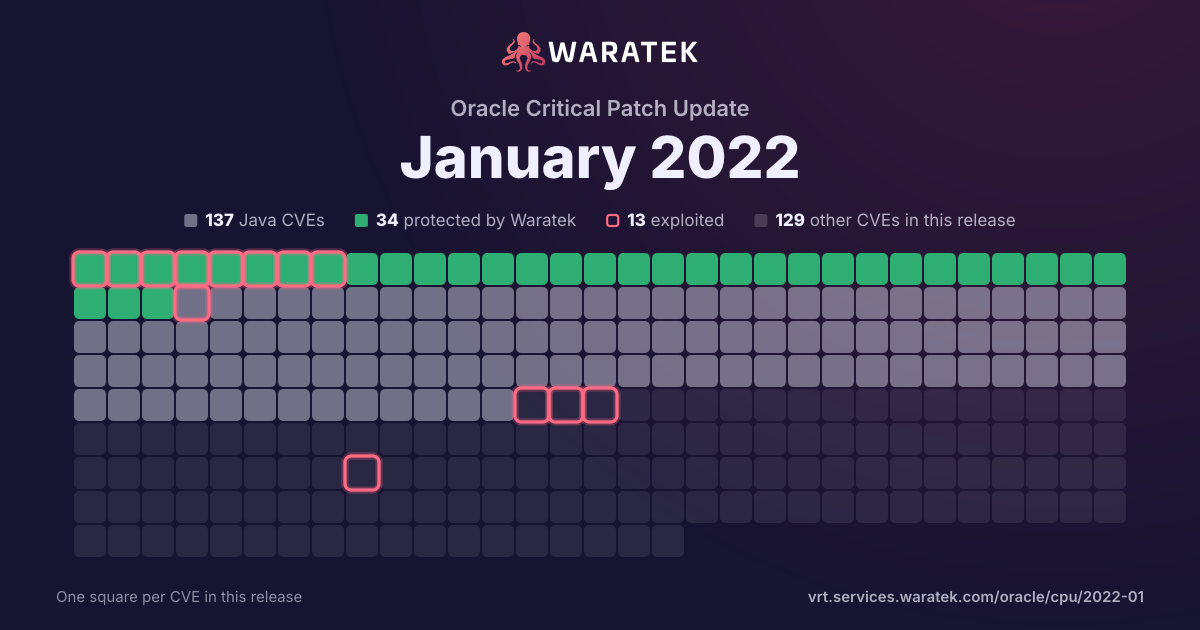
By status
29Protected by Waratek4Mitigation candidate111No exploit published2Outside Waratek scope120Not applicable
13Exploited, marked by the ring
No exploit published. For 69 of them, Oracle's security advisory is the source of public detail.
Protected by Waratek. Waratek RASP can block exploitation of these on systems that have not applied the patch yet.
Overview 32 matches · 10 protected · 1 exploited · 1 CISA KEV · 2 public PoC · 2 EPSS ≥ 0.5
Protected by Waratek
10
31.2%
Rule in development
0
0.0%
Mitigation candidate
0
0.0%
No exploit published
22
68.8%
blocked by ARMR today
10
31.2%
partly blocked
0
0.0%
not blocked
22
68.8%
not established
0
0.0%
unrecorded
0
0.0%
Exploited
1
3.1%
Working exploit published
1
3.1%
Proof of concept only
0
0.0%
Forecast only
1
3.1%
No public exploit
29
90.6%
split by
peak 10 / quarter
Q3 191
Protected by Waratek1
High1
blocked by ARMR today1
No public exploit1
Q4 191
No exploit published1
High1
not blocked1
No public exploit1
Q1 201
No exploit published1
High1
not blocked1
No public exploit1
Q2 201
Protected by Waratek1
Critical1
blocked by ARMR today1
No public exploit1
Q3 203
No exploit published3
High2
Medium1
not blocked3
No public exploit3
Q4 208
Protected by Waratek4
No exploit published4
Critical1
High4
Medium2
Low1
blocked by ARMR today4
not blocked4
Exploited1
No public exploit7
Q1 2110
Protected by Waratek2
No exploit published8
Critical1
High5
Medium4
blocked by ARMR today2
not blocked8
No public exploit10
Q2 217
Protected by Waratek2
No exploit published5
High4
Medium3
blocked by ARMR today2
not blocked5
Working exploit published1
Forecast only1
No public exploit5
Q3 19Q4 19Q1 20Q2 20Q3 20Q4 20Q1 21Q2 21
| CVE | Severity | Published▾ | Status | Exploitation | Description |
|---|---|---|---|---|---|
| CVE-2021-22119 | High | 2021-06-29 | No exploit published | No public exploit | Spring Security versions 5.5.x prior to 5.5.1, 5.4.x prior to 5.4.7, 5.3.x prior to 5.3.10 and 5.2.x prior to 5.2.11 are susceptible to a Denial-of-Service (DoS) attack via the initiation of the Authorization Request in an OAuth 2.0 Client Web and WebFlux application. A malicious user or attacker can send multiple requests initiating the Authorization Request for the Authorization Code Grant, which has the potential of exhausting system resources using a single session or multiple sessions. |
| CVE-2021-33560 | High | 2021-06-08 | No exploit published | No public exploit | Libgcrypt before 1.8.8 and 1.9.x before 1.9.3 mishandles ElGamal encryption because it lacks exponent blinding to address a side-channel attack against mpi_powm, and the window size is not chosen appropriately. This, for example, affects use of ElGamal in OpenPGP. |
| CVE-2020-6950 | Medium | 2021-06-02 | Protected by Waratek | Working exploit published | Directory traversal in Eclipse Mojarra before 2.3.14 allows attackers to read arbitrary files via the loc parameter or con parameter. |
| CVE-2020-14340 | Medium | 2021-06-02 | No exploit published | No public exploit | A vulnerability was discovered in XNIO where file descriptor leak caused by growing amounts of NIO Selector file handles between garbage collection cycles. It may allow the attacker to cause a denial of service. It affects XNIO versions 3.6.0.Beta1 through 3.8.1.Final. |
| CVE-2021-22118 | High | 2021-05-27 | No exploit published | No public exploit | In Spring Framework, versions 5.2.x prior to 5.2.15 and versions 5.3.x prior to 5.3.7, a WebFlux application is vulnerable to a privilege escalation: by (re)creating the temporary storage directory, a locally authenticated malicious user can read or modify files that have been uploaded to the WebFlux application, or overwrite arbitrary files with multipart request data. |
| CVE-2021-29425 | Medium | 2021-04-13 | Protected by Waratek | No public exploit | In Apache Commons IO before 2.7, When invoking the method FileNameUtils.normalize with an improper input string, like "//../foo", or "\\..\foo", the result would be the same value, thus possibly providing access to files in the parent directory, but not further above (thus "limited" path traversal), if the calling code would use the result to construct a path value. |
| CVE-2021-28165 | High | 2021-04-01 | No exploit published | Forecast only | In Eclipse Jetty 7.2.2 to 9.4.38, 10.0.0.alpha0 to 10.0.1, and 11.0.0.alpha0 to 11.0.1, CPU usage can reach 100% upon receiving a large invalid TLS frame. |
| CVE-2021-21409 | Medium | 2021-03-30 | No exploit published | No public exploit | Netty is an open-source, asynchronous event-driven network application framework for rapid development of maintainable high performance protocol servers & clients. In Netty (io.netty:netty-codec-http2) before version 4.1.61.Final there is a vulnerability that enables request smuggling. The content-length header is not correctly validated if the request only uses a single Http2HeaderFrame with the endStream set to to true. This could lead to request smuggling if the request is proxied to a remote peer and translated to HTTP/1.1. This is a followup of GHSA-wm47-8v5p-wjpj/CVE-2021-21295 which did miss to fix this one case. This was fixed as part of 4.1.61.Final. |
| CVE-2021-21783 | Critical | 2021-03-25 | No exploit published | No public exploit | A code execution vulnerability exists in the WS-Addressing plugin functionality of Genivia gSOAP 2.8.107. A specially crafted SOAP request can lead to remote code execution. An attacker can send an HTTP request to trigger this vulnerability. |
| CVE-2020-13936 | High | 2021-03-10 | No exploit published | No public exploit | An attacker that is able to modify Velocity templates may execute arbitrary Java code or run arbitrary system commands with the same privileges as the account running the Servlet container. This applies to applications that allow untrusted users to upload/modify velocity templates running Apache Velocity Engine versions up to 2.2. |
| CVE-2021-25122 | High | 2021-03-01 | Protected by Waratek | No public exploit | When responding to new h2c connection requests, Apache Tomcat versions 10.0.0-M1 to 10.0.0, 9.0.0.M1 to 9.0.41 and 8.5.0 to 8.5.61 could duplicate request headers and a limited amount of request body from one request to another meaning user A and user B could both see the results of user A's request. |
| CVE-2020-11987 | High | 2021-02-24 | No exploit published | No public exploit | Apache Batik 1.13 is vulnerable to server-side request forgery, caused by improper input validation by the NodePickerPanel. By using a specially-crafted argument, an attacker could exploit this vulnerability to cause the underlying server to make arbitrary GET requests. |
| CVE-2021-27568 | Medium | 2021-02-23 | Protected by Waratek | No public exploit | An issue was discovered in netplex json-smart-v1 through 2015-10-23 and json-smart-v2 through 2.4. An exception is thrown from a function, but it is not caught, as demonstrated by NumberFormatException. When it is not caught, it may cause programs using the library to crash or expose sensitive information. |
| CVE-2020-13949 | High | 2021-02-12 | No exploit published | No public exploit | In Apache Thrift 0.9.3 to 0.13.0, malicious RPC clients could send short messages which would result in a large memory allocation, potentially leading to denial of service. |
| CVE-2020-29582 | Medium | 2021-02-03 | No exploit published | No public exploit | In JetBrains Kotlin before 1.4.21, a vulnerable Java API was used for temporary file and folder creation. An attacker was able to read data from such files and list directories due to insecure permissions. |
| CVE-2020-8554 | Medium | 2021-01-21 | No exploit published | No public exploit | Kubernetes API server in all versions allow an attacker who is able to create a ClusterIP service and set the spec.externalIPs field, to intercept traffic to that IP address. Additionally, an attacker who is able to patch the status (which is considered a privileged operation and should not typically be granted to users) of a LoadBalancer service can set the status.loadBalancer.ingress.ip to similar effect. |
| CVE-2020-36189 | High | 2021-01-06 | No exploit published | No public exploit | FasterXML jackson-databind 2.x before 2.9.10.8 mishandles the interaction between serialization gadgets and typing, related to com.newrelic.agent.deps.ch.qos.logback.core.db.DriverManagerConnectionSource. |
| CVE-2020-28052 | High | 2020-12-18 | No exploit published | No public exploit | An issue was discovered in Legion of the Bouncy Castle BC Java 1.65 and 1.66. The OpenBSDBCrypt.checkPassword utility method compared incorrect data when checking the password, allowing incorrect passwords to indicate they were matching with previously hashed ones that were different. |
| CVE-2020-17530 | Critical | 2020-12-11 | Protected by Waratek | Exploited | Forced OGNL evaluation, when evaluated on raw user input in tag attributes, may lead to remote code execution. Affected software : Apache Struts 2.0.0 - Struts 2.5.25. |
| CVE-2020-8908 | Low | 2020-12-10 | No exploit published | No public exploit | A temp directory creation vulnerability exists in all versions of Guava, allowing an attacker with access to the machine to potentially access data in a temporary directory created by the Guava API com.google.common.io.Files.createTempDir(). By default, on unix-like systems, the created directory is world-readable (readable by an attacker with access to the system). The method in question has been marked @Deprecated in versions 30.0 and later and should not be used. For Android developers, we recommend choosing a temporary directory API provided by Android, such as context.getCacheDir(). For other Java developers, we recommend migrating to the Java 7 API java.nio.file.Files.createTempDirectory() which explicitly configures permissions of 700, or configuring the Java runtime's java.io.tmpdir system property to point to a location whose permissions are appropriately configured. |
| CVE-2020-17521 | Medium | 2020-12-07 | Protected by Waratek | No public exploit | Apache Groovy provides extension methods to aid with creating temporary directories. Prior to this fix, Groovy's implementation of those extension methods was using a now superseded Java JDK method call that is potentially not secure on some operating systems in some contexts. Users not using the extension methods mentioned in the advisory are not affected, but may wish to read the advisory for further details. Versions Affected: 2.0 to 2.4.20, 2.5.0 to 2.5.13, 3.0.0 to 3.0.6, and 4.0.0-alpha-1. Fixed in versions 2.4.21, 2.5.14, 3.0.7, 4.0.0-alpha-2. |
| CVE-2020-25649 | High | 2020-12-03 | Protected by Waratek | No public exploit | A flaw was found in FasterXML Jackson Databind, where it did not have entity expansion secured properly. This flaw allows vulnerability to XML external entity (XXE) attacks. The highest threat from this vulnerability is data integrity. |
| CVE-2020-17527 | High | 2020-12-03 | No exploit published | No public exploit | While investigating bug 64830 it was discovered that Apache Tomcat 10.0.0-M1 to 10.0.0-M9, 9.0.0-M1 to 9.0.39 and 8.5.0 to 8.5.59 could re-use an HTTP request header value from the previous stream received on an HTTP/2 connection for the request associated with the subsequent stream. While this would most likely lead to an error and the closure of the HTTP/2 connection, it is possible that information could leak between requests. |
| CVE-2020-13956 | Medium | 2020-12-02 | No exploit published | No public exploit | Apache HttpClient versions prior to version 4.5.13 and 5.0.3 can misinterpret malformed authority component in request URIs passed to the library as java.net.URI object and pick the wrong target host for request execution. |
| CVE-2019-17566 | High | 2020-11-12 | Protected by Waratek | No public exploit | Apache Batik is vulnerable to server-side request forgery, caused by improper input validation by the "xlink:href" attributes. By using a specially-crafted argument, an attacker could exploit this vulnerability to cause the underlying server to make arbitrary GET requests. |
| CVE-2020-5421 | Medium | 2020-09-19 | No exploit published | No public exploit | In Spring Framework versions 5.2.0 - 5.2.8, 5.1.0 - 5.1.17, 5.0.0 - 5.0.18, 4.3.0 - 4.3.28, and older unsupported versions, the protections against RFD attacks from CVE-2015-5211 may be bypassed depending on the browser used through the use of a jsessionid path parameter. |
| CVE-2020-24750 | High | 2020-09-17 | No exploit published | No public exploit | FasterXML jackson-databind 2.x before 2.9.10.6 mishandles the interaction between serialization gadgets and typing, related to com.pastdev.httpcomponents.configuration.JndiConfiguration. |
| CVE-2020-15824 | High | 2020-08-08 | No exploit published | No public exploit | In JetBrains Kotlin from 1.4-M1 to 1.4-RC (as Kotlin 1.3.7x is not affected by the issue. Fixed version is 1.4.0) there is a script-cache privilege escalation vulnerability due to kotlin-main-kts cached scripts in the system temp directory, which is shared by all users by default. |
| CVE-2020-10683 | Critical | 2020-05-01 | Protected by Waratek | No public exploit | dom4j before 2.0.3 and 2.1.x before 2.1.3 allows external DTDs and External Entities by default, which might enable XXE attacks. However, there is popular external documentation from OWASP showing how to enable the safe, non-default behavior in any application that uses dom4j. |
| CVE-2020-5258 | High | 2020-03-10 | No exploit published | No public exploit | In affected versions of dojo (NPM package), the deepCopy method is vulnerable to Prototype Pollution. Prototype Pollution refers to the ability to inject properties into existing JavaScript language construct prototypes, such as objects. An attacker manipulates these attributes to overwrite, or pollute, a JavaScript application object prototype of the base object by injecting other values. This has been patched in versions 1.12.8, 1.13.7, 1.14.6, 1.15.3 and 1.16.2 |
| CVE-2019-13734 | High | 2019-12-10 | No exploit published | No public exploit | Out of bounds write in SQLite in Google Chrome prior to 79.0.3945.79 allowed a remote attacker to potentially exploit heap corruption via a crafted HTML page. |
| CVE-2019-10086 | High | 2019-08-20 | Protected by Waratek | No public exploit | In Apache Commons Beanutils 1.9.2, a special BeanIntrospector class was added which allows suppressing the ability for an attacker to access the classloader via the class property available on all Java objects. We, however were not using this by default characteristic of the PropertyUtilsBean. |