
Oracle Critical Patch Update January 2022
Released January 2022 · Oracle's advisory ↗ · ← Critical Patch Update, October 2021 · Critical Patch Update, April 2022 →
266 CVEs in this release, one square each
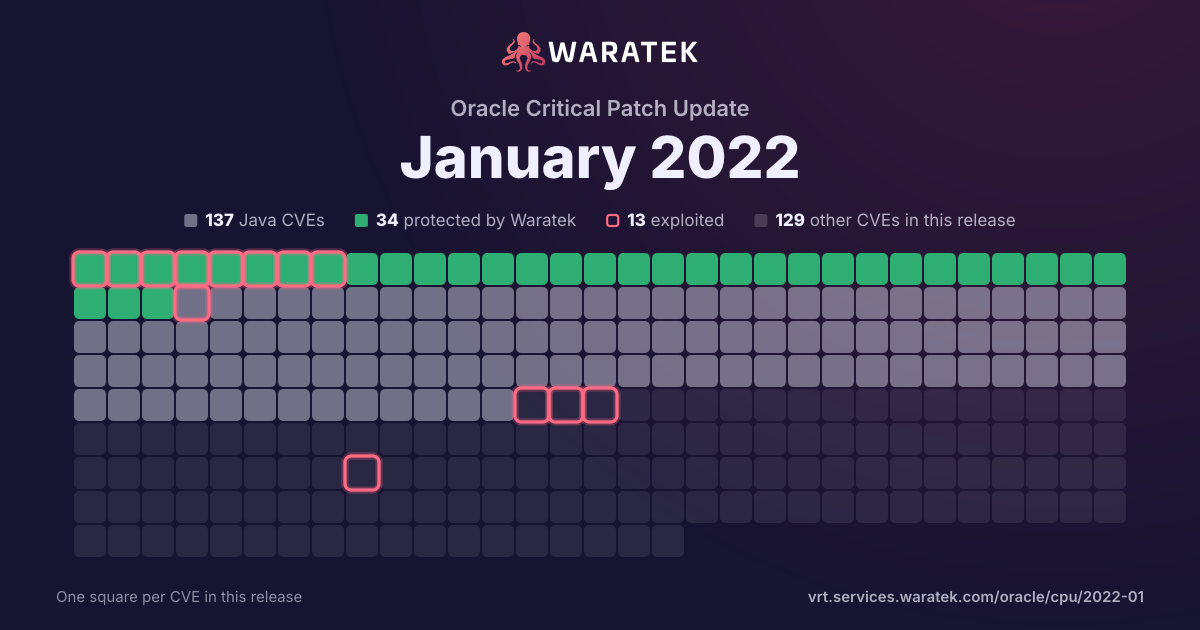
By status
29Protected by Waratek4Mitigation candidate111No exploit published2Outside Waratek scope120Not applicable
13Exploited, marked by the ring
No exploit published. For 69 of them, Oracle's security advisory is the source of public detail.
Protected by Waratek. Waratek RASP can block exploitation of these on systems that have not applied the patch yet.
Overview 7 matches · 2 protected · 0 exploited · 0 CISA KEV · 1 public PoC · 1 EPSS ≥ 0.5
Protected by Waratek
2
28.6%
Rule in development
0
0.0%
Mitigation candidate
0
0.0%
No exploit published
5
71.4%
blocked by ARMR today
2
28.6%
partly blocked
0
0.0%
not blocked
5
71.4%
not established
0
0.0%
unrecorded
0
0.0%
Exploited
0
0.0%
Working exploit published
1
14.3%
Proof of concept only
0
0.0%
Forecast only
1
14.3%
No public exploit
5
71.4%
split by
peak 4 / month
Apr 212
Protected by Waratek1
No exploit published1
High1
Medium1
blocked by ARMR today1
not blocked1
Forecast only1
No public exploit1
May 211
No exploit published1
High1
not blocked1
No public exploit1
Jun 214
Protected by Waratek1
No exploit published3
High2
Medium2
blocked by ARMR today1
not blocked3
Working exploit published1
No public exploit3
Apr 21May 21Jun 21
| CVE | Severity | Published▾ | Status | Exploitation | Description |
|---|---|---|---|---|---|
| CVE-2021-22119 | High | 2021-06-29 | No exploit published | No public exploit | Spring Security versions 5.5.x prior to 5.5.1, 5.4.x prior to 5.4.7, 5.3.x prior to 5.3.10 and 5.2.x prior to 5.2.11 are susceptible to a Denial-of-Service (DoS) attack via the initiation of the Authorization Request in an OAuth 2.0 Client Web and WebFlux application. A malicious user or attacker can send multiple requests initiating the Authorization Request for the Authorization Code Grant, which has the potential of exhausting system resources using a single session or multiple sessions. |
| CVE-2021-33560 | High | 2021-06-08 | No exploit published | No public exploit | Libgcrypt before 1.8.8 and 1.9.x before 1.9.3 mishandles ElGamal encryption because it lacks exponent blinding to address a side-channel attack against mpi_powm, and the window size is not chosen appropriately. This, for example, affects use of ElGamal in OpenPGP. |
| CVE-2020-6950 | Medium | 2021-06-02 | Protected by Waratek | Working exploit published | Directory traversal in Eclipse Mojarra before 2.3.14 allows attackers to read arbitrary files via the loc parameter or con parameter. |
| CVE-2020-14340 | Medium | 2021-06-02 | No exploit published | No public exploit | A vulnerability was discovered in XNIO where file descriptor leak caused by growing amounts of NIO Selector file handles between garbage collection cycles. It may allow the attacker to cause a denial of service. It affects XNIO versions 3.6.0.Beta1 through 3.8.1.Final. |
| CVE-2021-22118 | High | 2021-05-27 | No exploit published | No public exploit | In Spring Framework, versions 5.2.x prior to 5.2.15 and versions 5.3.x prior to 5.3.7, a WebFlux application is vulnerable to a privilege escalation: by (re)creating the temporary storage directory, a locally authenticated malicious user can read or modify files that have been uploaded to the WebFlux application, or overwrite arbitrary files with multipart request data. |
| CVE-2021-29425 | Medium | 2021-04-13 | Protected by Waratek | No public exploit | In Apache Commons IO before 2.7, When invoking the method FileNameUtils.normalize with an improper input string, like "//../foo", or "\\..\foo", the result would be the same value, thus possibly providing access to files in the parent directory, but not further above (thus "limited" path traversal), if the calling code would use the result to construct a path value. |
| CVE-2021-28165 | High | 2021-04-01 | No exploit published | Forecast only | In Eclipse Jetty 7.2.2 to 9.4.38, 10.0.0.alpha0 to 10.0.1, and 11.0.0.alpha0 to 11.0.1, CPU usage can reach 100% upon receiving a large invalid TLS frame. |