
Oracle Critical Patch Update January 2022
Released January 2022 · Oracle's advisory ↗ · ← Critical Patch Update, October 2021 · Critical Patch Update, April 2022 →
266 CVEs in this release, one square each
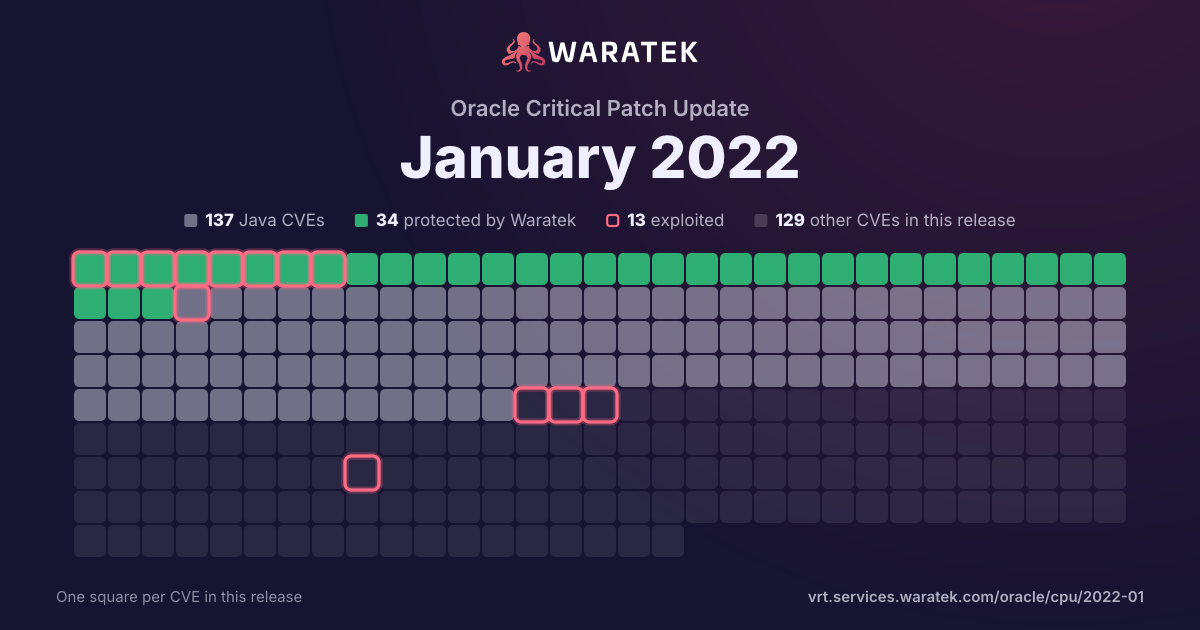
By status
29Protected by Waratek6Mitigation candidate112No exploit published2Outside Waratek scope117Not applicable
13Exploited, marked by the ring
No exploit published. For 69 of them, Oracle's security advisory is the source of public detail.
Protected by Waratek. Waratek RASP can block exploitation of these on systems that have not applied the patch yet.
Overview 3 matches · 0 protected · 0 exploited · 0 CISA KEV · 2 public PoC
Protected by Waratek
0
0.0%
Rule in development
0
0.0%
Mitigation candidate
2
66.7%
No exploit published
1
33.3%
blocked by ARMR today
0
0.0%
partly blocked
0
0.0%
not blocked
3
100.0%
not established
0
0.0%
unrecorded
0
0.0%
Exploited
0
0.0%
Working exploit published
2
66.7%
Proof of concept only
0
0.0%
Forecast only
1
33.3%
No public exploit
0
0.0%
| CVE | Severity | Published▾ | Status | Exploitation | Description |
|---|---|---|---|---|---|
| CVE-2021-29505 | High | 2021-05-28 | Mitigation candidate | Working exploit published | XStream is software for serializing Java objects to XML and back again. A vulnerability in XStream versions prior to 1.4.17 may allow a remote attacker has sufficient rights to execute commands of the host only by manipulating the processed input stream. No user who followed the recommendation to setup XStream's security framework with a whitelist limited to the minimal required types is affected. The vulnerability is patched in version 1.4.17. |
| CVE-2021-28165 | High | 2021-04-01 | No exploit published | Forecast only | In Eclipse Jetty 7.2.2 to 9.4.38, 10.0.0.alpha0 to 10.0.1, and 11.0.0.alpha0 to 11.0.1, CPU usage can reach 100% upon receiving a large invalid TLS frame. |
| CVE-2021-28164 | Medium | 2021-04-01 | Mitigation candidate | Working exploit published | In Eclipse Jetty 9.4.37.v20210219 to 9.4.38.v20210224, the default compliance mode allows requests with URIs that contain %2e or %2e%2e segments to access protected resources within the WEB-INF directory. For example a request to /context/%2e/WEB-INF/web.xml can retrieve the web.xml file. This can reveal sensitive information regarding the implementation of a web application. |