
Oracle Critical Patch Update October 2021
Released October 2021 · Oracle's advisory ↗ · ← Critical Patch Update, July 2021 · Critical Patch Update, January 2022 →
231 CVEs in this release, one square each
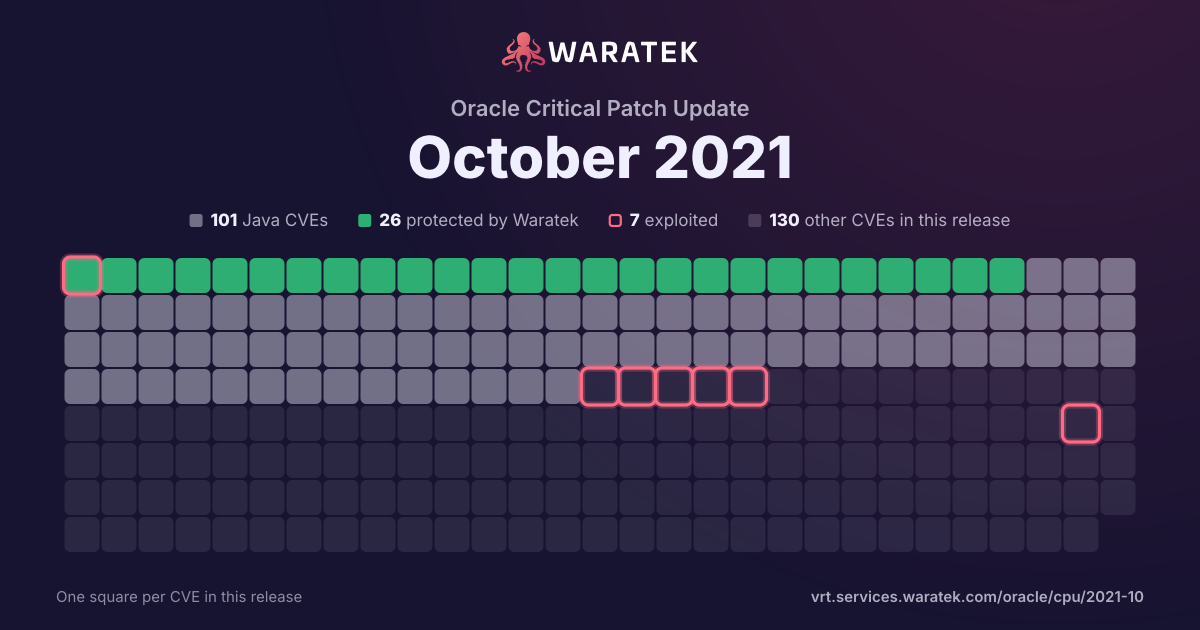
By status
25Protected by Waratek6Mitigation candidate81No exploit published3Outside Waratek scope116Not applicable
7Exploited, marked by the ring
No exploit published. For 48 of them, Oracle's security advisory is the source of public detail.
Protected by Waratek. Waratek RASP can block exploitation of these on systems that have not applied the patch yet.
Overview 12 matches · 3 protected · 0 exploited · 0 CISA KEV · 3 public PoC · 3 EPSS ≥ 0.5
Protected by Waratek
3
25.0%
Rule in development
0
0.0%
Mitigation candidate
2
16.7%
No exploit published
7
58.3%
blocked by ARMR today
3
25.0%
partly blocked
0
0.0%
not blocked
9
75.0%
not established
0
0.0%
unrecorded
0
0.0%
Exploited
0
0.0%
Working exploit published
2
16.7%
Proof of concept only
1
8.3%
Forecast only
0
0.0%
No public exploit
9
75.0%
split by
peak 4 / quarter
Q2 191
Mitigation candidate1
High1
not blocked1
Working exploit published1
Q3 191
Protected by Waratek1
High1
blocked by ARMR today1
No public exploit1
Q4 190
Q1 202
Mitigation candidate1
No exploit published1
High2
not blocked2
Proof of concept only1
No public exploit1
Q2 201
Protected by Waratek1
High1
blocked by ARMR today1
Working exploit published1
Q3 201
No exploit published1
High1
not blocked1
No public exploit1
Q4 204
Protected by Waratek1
No exploit published3
High4
blocked by ARMR today1
not blocked3
No public exploit4
Q1 212
No exploit published2
High2
not blocked2
No public exploit2
Q2 19Q3 19Q4 19Q1 20Q2 20Q3 20Q4 20Q1 21
| CVE | Severity | Published▾ | Status | Exploitation | Description |
|---|---|---|---|---|---|
| CVE-2020-11987 | High | 2021-02-24 | No exploit published | No public exploit | Apache Batik 1.13 is vulnerable to server-side request forgery, caused by improper input validation by the NodePickerPanel. By using a specially-crafted argument, an attacker could exploit this vulnerability to cause the underlying server to make arbitrary GET requests. |
| CVE-2021-22112 | High | 2021-02-23 | No exploit published | No public exploit | Spring Security 5.4.x prior to 5.4.4, 5.3.x prior to 5.3.8.RELEASE, 5.2.x prior to 5.2.9.RELEASE, and older unsupported versions can fail to save the SecurityContext if it is changed more than once in a single request.A malicious user cannot cause the bug to happen (it must be programmed in). However, if the application's intent is to only allow the user to run with elevated privileges in a small portion of the application, the bug can be leveraged to extend those privileges to the rest of the application. |
| CVE-2020-28052 | High | 2020-12-18 | No exploit published | No public exploit | An issue was discovered in Legion of the Bouncy Castle BC Java 1.65 and 1.66. The OpenBSDBCrypt.checkPassword utility method compared incorrect data when checking the password, allowing incorrect passwords to indicate they were matching with previously hashed ones that were different. |
| CVE-2020-25649 | High | 2020-12-03 | Protected by Waratek | No public exploit | A flaw was found in FasterXML Jackson Databind, where it did not have entity expansion secured properly. This flaw allows vulnerability to XML external entity (XXE) attacks. The highest threat from this vulnerability is data integrity. |
| CVE-2020-27216 | High | 2020-10-23 | No exploit published | No public exploit | In Eclipse Jetty versions 1.0 thru 9.4.32.v20200930, 10.0.0.alpha1 thru 10.0.0.beta2, and 11.0.0.alpha1 thru 11.0.0.beta2O, on Unix like systems, the system's temporary directory is shared between all users on that system. A collocated user can observe the process of creating a temporary sub directory in the shared temporary directory and race to complete the creation of the temporary subdirectory. If the attacker wins the race then they will have read and write permission to the subdirectory used to unpack web applications, including their WEB-INF/lib jar files and JSP files. If any code is ever executed out of this temporary directory, this can lead to a local privilege escalation vulnerability. |
| CVE-2020-25648 | High | 2020-10-20 | No exploit published | No public exploit | A flaw was found in the way NSS handled CCS (ChangeCipherSpec) messages in TLS 1.3. This flaw allows a remote attacker to send multiple CCS messages, causing a denial of service for servers compiled with the NSS library. The highest threat from this vulnerability is to system availability. This flaw affects NSS versions before 3.58. |
| CVE-2020-24750 | High | 2020-09-17 | No exploit published | No public exploit | FasterXML jackson-databind 2.x before 2.9.10.6 mishandles the interaction between serialization gadgets and typing, related to com.pastdev.httpcomponents.configuration.JndiConfiguration. |
| CVE-2020-9484 | High | 2020-05-20 | Protected by Waratek | Working exploit published | When using Apache Tomcat versions 10.0.0-M1 to 10.0.0-M4, 9.0.0.M1 to 9.0.34, 8.5.0 to 8.5.54 and 7.0.0 to 7.0.103 if a) an attacker is able to control the contents and name of a file on the server; and b) the server is configured to use the PersistenceManager with a FileStore; and c) the PersistenceManager is configured with sessionAttributeValueClassNameFilter="null" (the default unless a SecurityManager is used) or a sufficiently lax filter to allow the attacker provided object to be deserialized; and d) the attacker knows the relative file path from the storage location used by FileStore to the file the attacker has control over; then, using a specifically crafted request, the attacker will be able to trigger remote code execution via deserialization of the file under their control. Note that all of conditions a) to d) must be true for the attack to succeed. |
| CVE-2020-5258 | High | 2020-03-10 | No exploit published | No public exploit | In affected versions of dojo (NPM package), the deepCopy method is vulnerable to Prototype Pollution. Prototype Pollution refers to the ability to inject properties into existing JavaScript language construct prototypes, such as objects. An attacker manipulates these attributes to overwrite, or pollute, a JavaScript application object prototype of the base object by injecting other values. This has been patched in versions 1.12.8, 1.13.7, 1.14.6, 1.15.3 and 1.16.2 |
| CVE-2020-5398 | High | 2020-01-17 | Mitigation candidate | Proof of concept only | In Spring Framework, versions 5.2.x prior to 5.2.3, versions 5.1.x prior to 5.1.13, and versions 5.0.x prior to 5.0.16, an application is vulnerable to a reflected file download (RFD) attack when it sets a "Content-Disposition" header in the response where the filename attribute is derived from user supplied input. |
| CVE-2019-10086 | High | 2019-08-20 | Protected by Waratek | No public exploit | In Apache Commons Beanutils 1.9.2, a special BeanIntrospector class was added which allows suppressing the ability for an attacker to access the classloader via the class property available on all Java objects. We, however were not using this by default characteristic of the PropertyUtilsBean. |
| CVE-2019-0227 | High | 2019-05-01 | Mitigation candidate | Working exploit published | A Server Side Request Forgery (SSRF) vulnerability affected the Apache Axis 1.4 distribution that was last released in 2006. Security and bug commits commits continue in the projects Axis 1.x Subversion repository, legacy users are encouraged to build from source. The successor to Axis 1.x is Axis2, the latest version is 1.7.9 and is not vulnerable to this issue. |