
Oracle Critical Patch Update July 2021
Released July 2021 · Oracle's advisory ↗ · ← Critical Patch Update, April 2021 · Critical Patch Update, October 2021 →
231 CVEs in this release, one square each
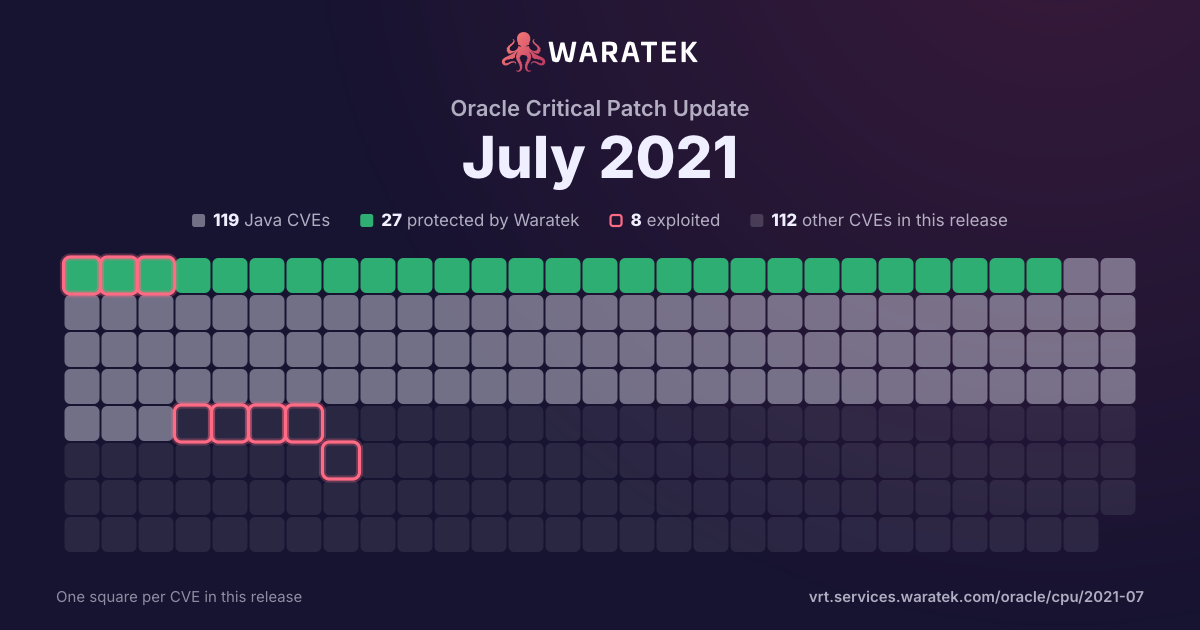
By status
27Protected by Waratek2Mitigation candidate90No exploit published33Outside Waratek scope79Not applicable
8Exploited, marked by the ring
No exploit published. For 70 of them, Oracle's security advisory is the source of public detail.
Protected by Waratek. Waratek RASP can block exploitation of these on systems that have not applied the patch yet.
Overview 58 matches · 12 protected · 0 exploited · 0 CISA KEV · 2 public PoC · 3 EPSS ≥ 0.5
Protected by Waratek
12
20.7%
Rule in development
0
0.0%
Mitigation candidate
1
1.7%
No exploit published
45
77.6%
blocked by ARMR today
12
20.7%
partly blocked
0
0.0%
not blocked
46
79.3%
not established
0
0.0%
unrecorded
0
0.0%
Exploited
0
0.0%
Working exploit published
2
3.4%
Proof of concept only
0
0.0%
Forecast only
1
1.7%
No public exploit
55
94.8%
split by
peak 37 / year
20151
Protected by Waratek1
High1
blocked by ARMR today1
No public exploit1
20160
20172
No exploit published2
High2
not blocked2
No public exploit2
20180
20192
Protected by Waratek1
No exploit published1
High2
blocked by ARMR today1
not blocked1
No public exploit2
202016
Protected by Waratek8
Mitigation candidate1
No exploit published7
High16
blocked by ARMR today8
not blocked8
Working exploit published2
No public exploit14
202137
Protected by Waratek2
No exploit published35
High37
blocked by ARMR today2
not blocked35
Forecast only1
No public exploit36
2015201620172018201920202021
| CVE | Severity | Published▾ | Status | Exploitation | Description |
|---|---|---|---|---|---|
| CVE-2021-2458 | High | 2021-07-21 | No exploit published | No public exploit | Vulnerability in the Identity Manager product of Oracle Fusion Middleware (component: Identity Console). Supported versions that are affected are 11.1.2.2.0, 11.1.2.3.0, 12.2.1.3.0 and 12.2.1.4.0. Easily exploitable vulnerability allows low privileged attacker with network access via HTTP to compromise Identity Manager. Successful attacks require human interaction from a person other than the attacker and while the vulnerability is in Identity Manager, attacks may significantly impact additional products. Successful attacks of this vulnerability can result in unauthorized access to critical data or complete access to all Identity Manager accessible data as well as unauthorized update, insert or delete access to some of Identity Manager accessible data. CVSS 3.1 Base Score 7.6 (Confidentiality and Integrity impacts). CVSS Vector: (CVSS:3.1/AV:N/AC:L/PR:L/UI:R/S:C/C:H/I:L/A:N). |
| CVE-2021-2436 | High | 2021-07-21 | No exploit published | No public exploit | Vulnerability in the Oracle Common Applications product of Oracle E-Business Suite (component: CRM User Management Framework). Supported versions that are affected are 12.1.1-12.1.3 and 12.2.3-12.2.10. Easily exploitable vulnerability allows unauthenticated attacker with network access via HTTP to compromise Oracle Common Applications. Successful attacks require human interaction from a person other than the attacker and while the vulnerability is in Oracle Common Applications, attacks may significantly impact additional products. Successful attacks of this vulnerability can result in unauthorized access to critical data or complete access to all Oracle Common Applications accessible data as well as unauthorized update, insert or delete access to some of Oracle Common Applications accessible data. CVSS 3.1 Base Score 8.2 (Confidentiality and Integrity impacts). CVSS Vector: (CVSS:3.1/AV:N/AC:L/PR:N/UI:R/S:C/C:H/I:L/A:N). |
| CVE-2021-2435 | High | 2021-07-21 | No exploit published | No public exploit | Vulnerability in the Essbase Analytic Provider Services product of Oracle Essbase (component: JAPI). The supported version that is affected is 11.1.2.4. Easily exploitable vulnerability allows unauthenticated attacker with network access via HTTP to compromise Essbase Analytic Provider Services. Successful attacks require human interaction from a person other than the attacker. Successful attacks of this vulnerability can result in unauthorized creation, deletion or modification access to critical data or all Essbase Analytic Provider Services accessible data as well as unauthorized access to critical data or complete access to all Essbase Analytic Provider Services accessible data. CVSS 3.1 Base Score 8.1 (Confidentiality and Integrity impacts). CVSS Vector: (CVSS:3.1/AV:N/AC:L/PR:N/UI:R/S:U/C:H/I:H/A:N). |
| CVE-2021-2434 | High | 2021-07-21 | No exploit published | No public exploit | Vulnerability in the Oracle Web Applications Desktop Integrator product of Oracle E-Business Suite (component: Application Service). Supported versions that are affected are 12.1.3 and 12.2.3-12.2.10. Easily exploitable vulnerability allows low privileged attacker with network access via HTTP to compromise Oracle Web Applications Desktop Integrator. Successful attacks of this vulnerability can result in unauthorized creation, deletion or modification access to critical data or all Oracle Web Applications Desktop Integrator accessible data as well as unauthorized access to critical data or complete access to all Oracle Web Applications Desktop Integrator accessible data. CVSS 3.1 Base Score 8.1 (Confidentiality and Integrity impacts). CVSS Vector: (CVSS:3.1/AV:N/AC:L/PR:L/UI:N/S:U/C:H/I:H/A:N). |
| CVE-2021-2433 | High | 2021-07-21 | No exploit published | No public exploit | Vulnerability in the Essbase Analytic Provider Services product of Oracle Essbase (component: Web Services). Supported versions that are affected are 11.1.2.4 and 21.2. Easily exploitable vulnerability allows unauthenticated attacker with network access via HTTP to compromise Essbase Analytic Provider Services. Successful attacks of this vulnerability can result in unauthorized ability to cause a hang or frequently repeatable crash (complete DOS) of Essbase Analytic Provider Services. CVSS 3.1 Base Score 7.5 (Availability impacts). CVSS Vector: (CVSS:3.1/AV:N/AC:L/PR:N/UI:N/S:U/C:N/I:N/A:H). |
| CVE-2021-2428 | High | 2021-07-21 | No exploit published | No public exploit | Vulnerability in the Oracle Coherence product of Oracle Fusion Middleware (component: Core). Supported versions that are affected are 12.1.3.0.0, 12.2.1.3.0, 12.2.1.4.0 and 14.1.1.0.0. Difficult to exploit vulnerability allows unauthenticated attacker with network access via T3, IIOP to compromise Oracle Coherence. Successful attacks of this vulnerability can result in takeover of Oracle Coherence. CVSS 3.1 Base Score 8.1 (Confidentiality, Integrity and Availability impacts). CVSS Vector: (CVSS:3.1/AV:N/AC:H/PR:N/UI:N/S:U/C:H/I:H/A:H). |
| CVE-2021-2415 | High | 2021-07-21 | No exploit published | No public exploit | Vulnerability in the Oracle Time and Labor product of Oracle E-Business Suite (component: Timecard). Supported versions that are affected are 12.1.1-12.1.3 and 12.2.3-12.2.10. Easily exploitable vulnerability allows low privileged attacker with network access via HTTP to compromise Oracle Time and Labor. Successful attacks of this vulnerability can result in unauthorized creation, deletion or modification access to critical data or all Oracle Time and Labor accessible data as well as unauthorized access to critical data or complete access to all Oracle Time and Labor accessible data. CVSS 3.1 Base Score 8.1 (Confidentiality and Integrity impacts). CVSS Vector: (CVSS:3.1/AV:N/AC:L/PR:L/UI:N/S:U/C:H/I:H/A:N). |
| CVE-2021-2406 | High | 2021-07-21 | No exploit published | No public exploit | Vulnerability in the Oracle Collaborative Planning product of Oracle E-Business Suite (component: User Interface). Supported versions that are affected are 12.1.1-12.1.3. Easily exploitable vulnerability allows low privileged attacker with network access via HTTP to compromise Oracle Collaborative Planning. Successful attacks of this vulnerability can result in unauthorized creation, deletion or modification access to critical data or all Oracle Collaborative Planning accessible data as well as unauthorized access to critical data or complete access to all Oracle Collaborative Planning accessible data. CVSS 3.1 Base Score 8.1 (Confidentiality and Integrity impacts). CVSS Vector: (CVSS:3.1/AV:N/AC:L/PR:L/UI:N/S:U/C:H/I:H/A:N). |
| CVE-2021-2405 | High | 2021-07-21 | No exploit published | No public exploit | Vulnerability in the Oracle Engineering product of Oracle E-Business Suite (component: Change Management). Supported versions that are affected are 12.2.3-12.2.10. Easily exploitable vulnerability allows low privileged attacker with network access via HTTP to compromise Oracle Engineering. Successful attacks of this vulnerability can result in unauthorized creation, deletion or modification access to critical data or all Oracle Engineering accessible data as well as unauthorized access to critical data or complete access to all Oracle Engineering accessible data. CVSS 3.1 Base Score 8.1 (Confidentiality and Integrity impacts). CVSS Vector: (CVSS:3.1/AV:N/AC:L/PR:L/UI:N/S:U/C:H/I:H/A:N). |
| CVE-2021-2400 | High | 2021-07-21 | No exploit published | Forecast only | Vulnerability in the Oracle BI Publisher product of Oracle Fusion Middleware (component: E-Business Suite - XDO). Supported versions that are affected are 5.5.0.0.0, 11.1.1.9.0, 12.2.1.3.0 and 12.2.1.4.0. Easily exploitable vulnerability allows unauthenticated attacker with network access via HTTP to compromise Oracle BI Publisher. Successful attacks of this vulnerability can result in unauthorized access to critical data or complete access to all Oracle BI Publisher accessible data. CVSS 3.1 Base Score 7.5 (Confidentiality impacts). CVSS Vector: (CVSS:3.1/AV:N/AC:L/PR:N/UI:N/S:U/C:H/I:N/A:N). |
| CVE-2021-2398 | High | 2021-07-21 | No exploit published | No public exploit | Vulnerability in the Oracle Advanced Outbound Telephony product of Oracle E-Business Suite (component: Region Mapping). Supported versions that are affected are 12.1.1-12.1.3 and 12.2.3-12.2.10. Easily exploitable vulnerability allows low privileged attacker with network access via HTTP to compromise Oracle Advanced Outbound Telephony. Successful attacks of this vulnerability can result in unauthorized creation, deletion or modification access to critical data or all Oracle Advanced Outbound Telephony accessible data as well as unauthorized access to critical data or complete access to all Oracle Advanced Outbound Telephony accessible data. CVSS 3.1 Base Score 8.1 (Confidentiality and Integrity impacts). CVSS Vector: (CVSS:3.1/AV:N/AC:L/PR:L/UI:N/S:U/C:H/I:H/A:N). |
| CVE-2021-2396 | High | 2021-07-21 | No exploit published | No public exploit | Vulnerability in the Oracle BI Publisher product of Oracle Fusion Middleware (component: E-Business Suite - XDO). Supported versions that are affected are 5.5.0.0.0, 11.1.1.9.0, 12.2.1.3.0 and 12.2.1.4.0. Easily exploitable vulnerability allows low privileged attacker with network access via HTTP to compromise Oracle BI Publisher. Successful attacks of this vulnerability can result in takeover of Oracle BI Publisher. CVSS 3.1 Base Score 8.8 (Confidentiality, Integrity and Availability impacts). CVSS Vector: (CVSS:3.1/AV:N/AC:L/PR:L/UI:N/S:U/C:H/I:H/A:H). |
| CVE-2021-2395 | High | 2021-07-21 | No exploit published | No public exploit | Vulnerability in the Oracle Hospitality Reporting and Analytics product of Oracle Food and Beverage Applications (component: iCare, Configuration). The supported version that is affected is 9.1.0. Easily exploitable vulnerability allows low privileged attacker with network access via HTTP to compromise Oracle Hospitality Reporting and Analytics. Successful attacks of this vulnerability can result in unauthorized creation, deletion or modification access to critical data or all Oracle Hospitality Reporting and Analytics accessible data as well as unauthorized access to critical data or complete access to all Oracle Hospitality Reporting and Analytics accessible data. CVSS 3.1 Base Score 8.1 (Confidentiality and Integrity impacts). CVSS Vector: (CVSS:3.1/AV:N/AC:L/PR:L/UI:N/S:U/C:H/I:H/A:N). |
| CVE-2021-2393 | High | 2021-07-21 | No exploit published | No public exploit | Vulnerability in the Oracle E-Records product of Oracle E-Business Suite (component: E-signatures). Supported versions that are affected are 12.1.1-12.1.3 and 12.2.3-12.2.10. Easily exploitable vulnerability allows low privileged attacker with network access via HTTP to compromise Oracle E-Records. Successful attacks of this vulnerability can result in unauthorized creation, deletion or modification access to critical data or all Oracle E-Records accessible data as well as unauthorized access to critical data or complete access to all Oracle E-Records accessible data. CVSS 3.1 Base Score 8.1 (Confidentiality and Integrity impacts). CVSS Vector: (CVSS:3.1/AV:N/AC:L/PR:L/UI:N/S:U/C:H/I:H/A:N). |
| CVE-2021-2392 | High | 2021-07-21 | No exploit published | No public exploit | Vulnerability in the Oracle BI Publisher product of Oracle Fusion Middleware (component: BI Publisher Security). Supported versions that are affected are 5.5.0.0.0, 11.1.1.9.0, 12.2.1.3.0 and 12.2.1.4.0. Easily exploitable vulnerability allows low privileged attacker with network access via HTTP to compromise Oracle BI Publisher. Successful attacks of this vulnerability can result in takeover of Oracle BI Publisher. CVSS 3.1 Base Score 8.8 (Confidentiality, Integrity and Availability impacts). CVSS Vector: (CVSS:3.1/AV:N/AC:L/PR:L/UI:N/S:U/C:H/I:H/A:H). |
| CVE-2021-2391 | High | 2021-07-21 | No exploit published | No public exploit | Vulnerability in the Oracle BI Publisher product of Oracle Fusion Middleware (component: Scheduler). Supported versions that are affected are 5.5.0.0.0, 11.1.1.9.0, 12.2.1.3.0 and 12.2.1.4.0. Easily exploitable vulnerability allows low privileged attacker with network access via HTTP to compromise Oracle BI Publisher. Successful attacks of this vulnerability can result in takeover of Oracle BI Publisher. CVSS 3.1 Base Score 8.8 (Confidentiality, Integrity and Availability impacts). CVSS Vector: (CVSS:3.1/AV:N/AC:L/PR:L/UI:N/S:U/C:H/I:H/A:H). |
| CVE-2021-2380 | High | 2021-07-21 | No exploit published | No public exploit | Vulnerability in the Oracle Applications Framework product of Oracle E-Business Suite (component: Attachments / File Upload). Supported versions that are affected are 12.1.3 and 12.2.3-12.2.10. Easily exploitable vulnerability allows low privileged attacker with network access via HTTP to compromise Oracle Applications Framework. Successful attacks require human interaction from a person other than the attacker and while the vulnerability is in Oracle Applications Framework, attacks may significantly impact additional products. Successful attacks of this vulnerability can result in unauthorized access to critical data or complete access to all Oracle Applications Framework accessible data as well as unauthorized update, insert or delete access to some of Oracle Applications Framework accessible data. CVSS 3.1 Base Score 7.6 (Confidentiality and Integrity impacts). CVSS Vector: (CVSS:3.1/AV:N/AC:L/PR:L/UI:R/S:C/C:H/I:L/A:N). |
| CVE-2021-2378 | High | 2021-07-21 | No exploit published | No public exploit | Vulnerability in the Oracle WebLogic Server product of Oracle Fusion Middleware (component: Core). Supported versions that are affected are 10.3.6.0.0, 12.1.3.0.0, 12.2.1.3.0, 12.2.1.4.0 and 14.1.1.0.0. Easily exploitable vulnerability allows unauthenticated attacker with network access via T3, IIOP to compromise Oracle WebLogic Server. Successful attacks of this vulnerability can result in unauthorized ability to cause a hang or frequently repeatable crash (complete DOS) of Oracle WebLogic Server. CVSS 3.1 Base Score 7.5 (Availability impacts). CVSS Vector: (CVSS:3.1/AV:N/AC:L/PR:N/UI:N/S:U/C:N/I:N/A:H). |
| CVE-2021-2376 | High | 2021-07-21 | No exploit published | No public exploit | Vulnerability in the Oracle WebLogic Server product of Oracle Fusion Middleware (component: Web Services). Supported versions that are affected are 10.3.6.0.0, 12.1.3.0.0, 12.2.1.3.0, 12.2.1.4.0 and 14.1.1.0.0. Easily exploitable vulnerability allows unauthenticated attacker with network access via T3, IIOP to compromise Oracle WebLogic Server. Successful attacks of this vulnerability can result in unauthorized ability to cause a hang or frequently repeatable crash (complete DOS) of Oracle WebLogic Server. CVSS 3.1 Base Score 7.5 (Availability impacts). CVSS Vector: (CVSS:3.1/AV:N/AC:L/PR:N/UI:N/S:U/C:N/I:N/A:H). |
| CVE-2021-2371 | High | 2021-07-21 | No exploit published | No public exploit | Vulnerability in the Oracle Coherence product of Oracle Fusion Middleware (component: Core). Supported versions that are affected are 3.7.1.0, 12.1.3.0.0, 12.2.1.3.0, 12.2.1.4.0 and 14.1.1.0.0. Easily exploitable vulnerability allows unauthenticated attacker with network access via T3, IIOP to compromise Oracle Coherence. Successful attacks of this vulnerability can result in unauthorized ability to cause a hang or frequently repeatable crash (complete DOS) of Oracle Coherence. CVSS 3.1 Base Score 7.5 (Availability impacts). CVSS Vector: (CVSS:3.1/AV:N/AC:L/PR:N/UI:N/S:U/C:N/I:N/A:H). |
| CVE-2021-2365 | High | 2021-07-21 | No exploit published | No public exploit | Vulnerability in the Oracle Human Resources product of Oracle E-Business Suite (component: People Management). Supported versions that are affected are 12.1.1-12.1.3. Easily exploitable vulnerability allows low privileged attacker with network access via HTTP to compromise Oracle Human Resources. Successful attacks of this vulnerability can result in unauthorized creation, deletion or modification access to critical data or all Oracle Human Resources accessible data as well as unauthorized access to critical data or complete access to all Oracle Human Resources accessible data. CVSS 3.1 Base Score 8.1 (Confidentiality and Integrity impacts). CVSS Vector: (CVSS:3.1/AV:N/AC:L/PR:L/UI:N/S:U/C:H/I:H/A:N). |
| CVE-2021-2364 | High | 2021-07-21 | No exploit published | No public exploit | Vulnerability in the Oracle iSupplier Portal product of Oracle E-Business Suite (component: Accounts). Supported versions that are affected are 12.1.1-12.1.3 and 12.2.3-12.2.10. Easily exploitable vulnerability allows low privileged attacker with network access via HTTP to compromise Oracle iSupplier Portal. Successful attacks of this vulnerability can result in unauthorized creation, deletion or modification access to critical data or all Oracle iSupplier Portal accessible data as well as unauthorized access to critical data or complete access to all Oracle iSupplier Portal accessible data. CVSS 3.1 Base Score 8.1 (Confidentiality and Integrity impacts). CVSS Vector: (CVSS:3.1/AV:N/AC:L/PR:L/UI:N/S:U/C:H/I:H/A:N). |
| CVE-2021-2363 | High | 2021-07-21 | No exploit published | No public exploit | Vulnerability in the Oracle Public Sector Financials (International) product of Oracle E-Business Suite (component: Authorization). Supported versions that are affected are 12.1.1-12.1.3. Easily exploitable vulnerability allows low privileged attacker with network access via HTTP to compromise Oracle Public Sector Financials (International). Successful attacks of this vulnerability can result in unauthorized creation, deletion or modification access to critical data or all Oracle Public Sector Financials (International) accessible data as well as unauthorized access to critical data or complete access to all Oracle Public Sector Financials (International) accessible data. CVSS 3.1 Base Score 8.1 (Confidentiality and Integrity impacts). CVSS Vector: (CVSS:3.1/AV:N/AC:L/PR:L/UI:N/S:U/C:H/I:H/A:N). |
| CVE-2021-2362 | High | 2021-07-21 | No exploit published | No public exploit | Vulnerability in the Oracle Field Service product of Oracle E-Business Suite (component: Wireless). Supported versions that are affected are 12.1.1-12.1.3. Easily exploitable vulnerability allows low privileged attacker with network access via HTTP to compromise Oracle Field Service. Successful attacks of this vulnerability can result in unauthorized creation, deletion or modification access to critical data or all Oracle Field Service accessible data as well as unauthorized access to critical data or complete access to all Oracle Field Service accessible data. CVSS 3.1 Base Score 8.1 (Confidentiality and Integrity impacts). CVSS Vector: (CVSS:3.1/AV:N/AC:L/PR:L/UI:N/S:U/C:H/I:H/A:N). |
| CVE-2021-2361 | High | 2021-07-21 | No exploit published | No public exploit | Vulnerability in the Oracle Advanced Inbound Telephony product of Oracle E-Business Suite (component: SDK client integration). Supported versions that are affected are 12.1.1-12.1.3 and 12.2.3-12.2.10. Easily exploitable vulnerability allows low privileged attacker with network access via HTTP to compromise Oracle Advanced Inbound Telephony. Successful attacks of this vulnerability can result in unauthorized creation, deletion or modification access to critical data or all Oracle Advanced Inbound Telephony accessible data as well as unauthorized access to critical data or complete access to all Oracle Advanced Inbound Telephony accessible data. CVSS 3.1 Base Score 8.1 (Confidentiality and Integrity impacts). CVSS Vector: (CVSS:3.1/AV:N/AC:L/PR:L/UI:N/S:U/C:H/I:H/A:N). |
| CVE-2021-2360 | High | 2021-07-21 | No exploit published | No public exploit | Vulnerability in the Oracle Approvals Management product of Oracle E-Business Suite (component: AME Page rendering). Supported versions that are affected are 12.1.1-12.1.3. Easily exploitable vulnerability allows low privileged attacker with network access via HTTP to compromise Oracle Approvals Management. Successful attacks of this vulnerability can result in unauthorized creation, deletion or modification access to critical data or all Oracle Approvals Management accessible data as well as unauthorized access to critical data or complete access to all Oracle Approvals Management accessible data. CVSS 3.1 Base Score 8.1 (Confidentiality and Integrity impacts). CVSS Vector: (CVSS:3.1/AV:N/AC:L/PR:L/UI:N/S:U/C:H/I:H/A:N). |
| CVE-2021-2359 | High | 2021-07-21 | No exploit published | No public exploit | Vulnerability in the Oracle Marketing product of Oracle E-Business Suite (component: Marketing Administration). Supported versions that are affected are 12.1.1-12.1.3 and 12.2.3-12.2.10. Easily exploitable vulnerability allows unauthenticated attacker with network access via HTTP to compromise Oracle Marketing. Successful attacks require human interaction from a person other than the attacker and while the vulnerability is in Oracle Marketing, attacks may significantly impact additional products. Successful attacks of this vulnerability can result in unauthorized access to critical data or complete access to all Oracle Marketing accessible data as well as unauthorized update, insert or delete access to some of Oracle Marketing accessible data. CVSS 3.1 Base Score 8.2 (Confidentiality and Integrity impacts). CVSS Vector: (CVSS:3.1/AV:N/AC:L/PR:N/UI:R/S:C/C:H/I:L/A:N). |
| CVE-2021-2351 | High | 2021-07-21 | No exploit published | No public exploit | Vulnerability in the Advanced Networking Option component of Oracle Database Server. Supported versions that are affected are 12.1.0.2, 12.2.0.1 and 19c. Difficult to exploit vulnerability allows unauthenticated attacker with network access via Oracle Net to compromise Advanced Networking Option. Successful attacks require human interaction from a person other than the attacker and while the vulnerability is in Advanced Networking Option, attacks may significantly impact additional products. Successful attacks of this vulnerability can result in takeover of Advanced Networking Option. Note: The July 2021 Critical Patch Update introduces a number of Native Network Encryption changes to deal with vulnerability CVE-2021-2351 and prevent the use of weaker ciphers. Customers should review: "Changes in Native Network Encryption with the July 2021 Critical Patch Update" (Doc ID 2791571.1). CVSS 3.1 Base Score 8.3 (Confidentiality, Integrity and Availability impacts). CVSS Vector: (CVSS:3.1/AV:N/AC:H/PR:N/UI:R/S:C/C:H/I:H/A:H). |
| CVE-2021-2350 | High | 2021-07-21 | No exploit published | No public exploit | Vulnerability in the Hyperion Essbase Administration Services product of Oracle Essbase (component: EAS Console). Supported versions that are affected are 11.1.2.4 and 21.2. Easily exploitable vulnerability allows unauthenticated attacker with network access via HTTP to compromise Hyperion Essbase Administration Services. Successful attacks of this vulnerability can result in unauthorized access to critical data or complete access to all Hyperion Essbase Administration Services accessible data. CVSS 3.1 Base Score 7.5 (Confidentiality impacts). CVSS Vector: (CVSS:3.1/AV:N/AC:L/PR:N/UI:N/S:U/C:H/I:N/A:N). |
| CVE-2021-2349 | High | 2021-07-21 | No exploit published | No public exploit | Vulnerability in the Hyperion Essbase Administration Services product of Oracle Essbase (component: EAS Console). Supported versions that are affected are 11.1.2.4 and 21.2. Easily exploitable vulnerability allows unauthenticated attacker with network access via HTTP to compromise Hyperion Essbase Administration Services. While the vulnerability is in Hyperion Essbase Administration Services, attacks may significantly impact additional products. Successful attacks of this vulnerability can result in unauthorized access to critical data or complete access to all Hyperion Essbase Administration Services accessible data. CVSS 3.1 Base Score 8.6 (Confidentiality impacts). CVSS Vector: (CVSS:3.1/AV:N/AC:L/PR:N/UI:N/S:C/C:H/I:N/A:N). |
| CVE-2021-2344 | High | 2021-07-21 | No exploit published | No public exploit | Vulnerability in the Oracle Coherence product of Oracle Fusion Middleware (component: Core). Supported versions that are affected are 3.7.1.0, 12.1.3.0.0, 12.2.1.3.0, 12.2.1.4.0 and 14.1.1.0.0. Easily exploitable vulnerability allows unauthenticated attacker with network access via T3, IIOP to compromise Oracle Coherence. Successful attacks of this vulnerability can result in unauthorized ability to cause a hang or frequently repeatable crash (complete DOS) of Oracle Coherence. CVSS 3.1 Base Score 7.5 (Availability impacts). CVSS Vector: (CVSS:3.1/AV:N/AC:L/PR:N/UI:N/S:U/C:N/I:N/A:H). |
| CVE-2021-22118 | High | 2021-05-27 | Protected by Waratek | No public exploit | In Spring Framework, versions 5.2.x prior to 5.2.15 and versions 5.3.x prior to 5.3.7, a WebFlux application is vulnerable to a privilege escalation: by (re)creating the temporary storage directory, a locally authenticated malicious user can read or modify files that have been uploaded to the WebFlux application, or overwrite arbitrary files with multipart request data. |
| CVE-2021-25122 | High | 2021-03-01 | Protected by Waratek | No public exploit | When responding to new h2c connection requests, Apache Tomcat versions 10.0.0-M1 to 10.0.0, 9.0.0.M1 to 9.0.41 and 8.5.0 to 8.5.61 could duplicate request headers and a limited amount of request body from one request to another meaning user A and user B could both see the results of user A's request. |
| CVE-2020-11987 | High | 2021-02-24 | No exploit published | No public exploit | Apache Batik 1.13 is vulnerable to server-side request forgery, caused by improper input validation by the NodePickerPanel. By using a specially-crafted argument, an attacker could exploit this vulnerability to cause the underlying server to make arbitrary GET requests. |
| CVE-2021-22112 | High | 2021-02-23 | No exploit published | No public exploit | Spring Security 5.4.x prior to 5.4.4, 5.3.x prior to 5.3.8.RELEASE, 5.2.x prior to 5.2.9.RELEASE, and older unsupported versions can fail to save the SecurityContext if it is changed more than once in a single request.A malicious user cannot cause the bug to happen (it must be programmed in). However, if the application's intent is to only allow the user to run with elevated privileges in a small portion of the application, the bug can be leveraged to extend those privileges to the rest of the application. |
| CVE-2021-26117 | High | 2021-01-27 | No exploit published | No public exploit | The optional ActiveMQ LDAP login module can be configured to use anonymous access to the LDAP server. In this case, for Apache ActiveMQ Artemis prior to version 2.16.0 and Apache ActiveMQ prior to versions 5.16.1 and 5.15.14, the anonymous context is used to verify a valid users password in error, resulting in no check on the password. |
| CVE-2021-20190 | High | 2021-01-19 | No exploit published | No public exploit | A flaw was found in jackson-databind before 2.9.10.7. FasterXML mishandles the interaction between serialization gadgets and typing. The highest threat from this vulnerability is to data confidentiality and integrity as well as system availability. |
| CVE-2020-28052 | High | 2020-12-18 | No exploit published | No public exploit | An issue was discovered in Legion of the Bouncy Castle BC Java 1.65 and 1.66. The OpenBSDBCrypt.checkPassword utility method compared incorrect data when checking the password, allowing incorrect passwords to indicate they were matching with previously hashed ones that were different. |
| CVE-2020-35490 | High | 2020-12-17 | No exploit published | No public exploit | FasterXML jackson-databind 2.x before 2.9.10.8 mishandles the interaction between serialization gadgets and typing, related to org.apache.commons.dbcp2.datasources.PerUserPoolDataSource. |
| CVE-2020-25649 | High | 2020-12-03 | Protected by Waratek | No public exploit | A flaw was found in FasterXML Jackson Databind, where it did not have entity expansion secured properly. This flaw allows vulnerability to XML external entity (XXE) attacks. The highest threat from this vulnerability is data integrity. |
| CVE-2020-17527 | High | 2020-12-03 | No exploit published | No public exploit | While investigating bug 64830 it was discovered that Apache Tomcat 10.0.0-M1 to 10.0.0-M9, 9.0.0-M1 to 9.0.39 and 8.5.0 to 8.5.59 could re-use an HTTP request header value from the previous stream received on an HTTP/2 connection for the request associated with the subsequent stream. While this would most likely lead to an error and the closure of the HTTP/2 connection, it is possible that information could leak between requests. |
| CVE-2020-25638 | High | 2020-12-02 | Protected by Waratek | No public exploit | A flaw was found in hibernate-core in versions prior to and including 5.4.23.Final. A SQL injection in the implementation of the JPA Criteria API can permit unsanitized literals when a literal is used in the SQL comments of the query. This flaw could allow an attacker to access unauthorized information or possibly conduct further attacks. The highest threat from this vulnerability is to data confidentiality and integrity. |
| CVE-2019-17566 | High | 2020-11-12 | Protected by Waratek | No public exploit | Apache Batik is vulnerable to server-side request forgery, caused by improper input validation by the "xlink:href" attributes. By using a specially-crafted argument, an attacker could exploit this vulnerability to cause the underlying server to make arbitrary GET requests. |
| CVE-2020-7760 | High | 2020-10-30 | No exploit published | No public exploit | This affects the package codemirror before 5.58.2; the package org.apache.marmotta.webjars:codemirror before 5.58.2. The vulnerable regular expression is located in https://github.com/codemirror/CodeMirror/blob/cdb228ac736369c685865b122b736cd0d397836c/mode/javascript/javascript.jsL129. The ReDOS vulnerability of the regex is mainly due to the sub-pattern (s|/*.*?*/)* |
| CVE-2020-27216 | High | 2020-10-23 | No exploit published | No public exploit | In Eclipse Jetty versions 1.0 thru 9.4.32.v20200930, 10.0.0.alpha1 thru 10.0.0.beta2, and 11.0.0.alpha1 thru 11.0.0.beta2O, on Unix like systems, the system's temporary directory is shared between all users on that system. A collocated user can observe the process of creating a temporary sub directory in the shared temporary directory and race to complete the creation of the temporary subdirectory. If the attacker wins the race then they will have read and write permission to the subdirectory used to unpack web applications, including their WEB-INF/lib jar files and JSP files. If any code is ever executed out of this temporary directory, this can lead to a local privilege escalation vulnerability. |
| CVE-2020-11979 | High | 2020-10-01 | No exploit published | No public exploit | As mitigation for CVE-2020-1945 Apache Ant 1.10.8 changed the permissions of temporary files it created so that only the current user was allowed to access them. Unfortunately the fixcrlf task deleted the temporary file and created a new one without said protection, effectively nullifying the effort. This would still allow an attacker to inject modified source files into the build process. |
| CVE-2020-24750 | High | 2020-09-17 | Protected by Waratek | No public exploit | FasterXML jackson-databind 2.x before 2.9.10.6 mishandles the interaction between serialization gadgets and typing, related to com.pastdev.httpcomponents.configuration.JndiConfiguration. |
| CVE-2020-7712 | High | 2020-08-30 | Protected by Waratek | No public exploit | This affects the package json before 10.0.0. It is possible to inject arbritary commands using the parseLookup function. |
| CVE-2020-13935 | High | 2020-07-14 | Mitigation candidate | Working exploit published | The payload length in a WebSocket frame was not correctly validated in Apache Tomcat 10.0.0-M1 to 10.0.0-M6, 9.0.0.M1 to 9.0.36, 8.5.0 to 8.5.56 and 7.0.27 to 7.0.104. Invalid payload lengths could trigger an infinite loop. Multiple requests with invalid payload lengths could lead to a denial of service. |
| CVE-2020-14195 | High | 2020-06-16 | Protected by Waratek | No public exploit | FasterXML jackson-databind 2.x before 2.9.10.5 mishandles the interaction between serialization gadgets and typing, related to org.jsecurity.realm.jndi.JndiRealmFactory (aka org.jsecurity). |
| CVE-2020-9484 | High | 2020-05-20 | Protected by Waratek | Working exploit published | When using Apache Tomcat versions 10.0.0-M1 to 10.0.0-M4, 9.0.0.M1 to 9.0.34, 8.5.0 to 8.5.54 and 7.0.0 to 7.0.103 if a) an attacker is able to control the contents and name of a file on the server; and b) the server is configured to use the PersistenceManager with a FileStore; and c) the PersistenceManager is configured with sessionAttributeValueClassNameFilter="null" (the default unless a SecurityManager is used) or a sufficiently lax filter to allow the attacker provided object to be deserialized; and d) the attacker knows the relative file path from the storage location used by FileStore to the file the attacker has control over; then, using a specifically crafted request, the attacker will be able to trigger remote code execution via deserialization of the file under their control. Note that all of conditions a) to d) must be true for the attack to succeed. |
| CVE-2020-2604 | High | 2020-01-15 | Protected by Waratek | No public exploit | Vulnerability in the Java SE, Java SE Embedded product of Oracle Java SE (component: Serialization). Supported versions that are affected are Java SE: 7u241, 8u231, 11.0.5 and 13.0.1; Java SE Embedded: 8u231. Difficult to exploit vulnerability allows unauthenticated attacker with network access via multiple protocols to compromise Java SE, Java SE Embedded. Successful attacks of this vulnerability can result in takeover of Java SE, Java SE Embedded. Note: This vulnerability applies to Java deployments, typically in clients running sandboxed Java Web Start applications or sandboxed Java applets (in Java SE 8), that load and run untrusted code (e.g., code that comes from the internet) and rely on the Java sandbox for security. This vulnerability can also be exploited by using APIs in the specified Component, e.g., through a web service which supplies data to the APIs. CVSS v3.0 Base Score 8.1 (Confidentiality, Integrity and Availability impacts). CVSS Vector: (CVSS:3.0/AV:N/AC:H/PR:N/UI:N/S:U/C:H/I:H/A:H). |
| CVE-2019-12399 | High | 2020-01-14 | No exploit published | No public exploit | When Connect workers in Apache Kafka 2.0.0, 2.0.1, 2.1.0, 2.1.1, 2.2.0, 2.2.1, or 2.3.0 are configured with one or more config providers, and a connector is created/updated on that Connect cluster to use an externalized secret variable in a substring of a connector configuration property value, then any client can issue a request to the same Connect cluster to obtain the connector's task configuration and the response will contain the plaintext secret rather than the externalized secrets variables. |
| CVE-2019-12402 | High | 2019-08-30 | No exploit published | No public exploit | The file name encoding algorithm used internally in Apache Commons Compress 1.15 to 1.18 can get into an infinite loop when faced with specially crafted inputs. This can lead to a denial of service attack if an attacker can choose the file names inside of an archive created by Compress. |
| CVE-2019-10086 | High | 2019-08-20 | Protected by Waratek | No public exploit | In Apache Commons Beanutils 1.9.2, a special BeanIntrospector class was added which allows suppressing the ability for an attacker to access the classloader via the class property available on all Java objects. We, however were not using this by default characteristic of the PropertyUtilsBean. |
| CVE-2012-0881 | High | 2017-10-30 | No exploit published | No public exploit | Apache Xerces2 Java Parser before 2.12.0 allows remote attackers to cause a denial of service (CPU consumption) via a crafted message to an XML service, which triggers hash table collisions. |
| CVE-2017-9735 | High | 2017-06-16 | No exploit published | No public exploit | Jetty through 9.4.x is prone to a timing channel in util/security/Password.java, which makes it easier for remote attackers to obtain access by observing elapsed times before rejection of incorrect passwords. |
| CVE-2015-0254 | High | 2015-03-09 | Protected by Waratek | No public exploit | Apache Standard Taglibs before 1.2.3 allows remote attackers to execute arbitrary code or conduct external XML entity (XXE) attacks via a crafted XSLT extension in a (1) <x:parse> or (2) <x:transform> JSTL XML tag. |