
Oracle Critical Patch Update April 2021
Released April 2021 · Oracle's advisory ↗ · ← Critical Patch Update, January 2021 · Critical Patch Update, July 2021 →
258 CVEs in this release, one square each
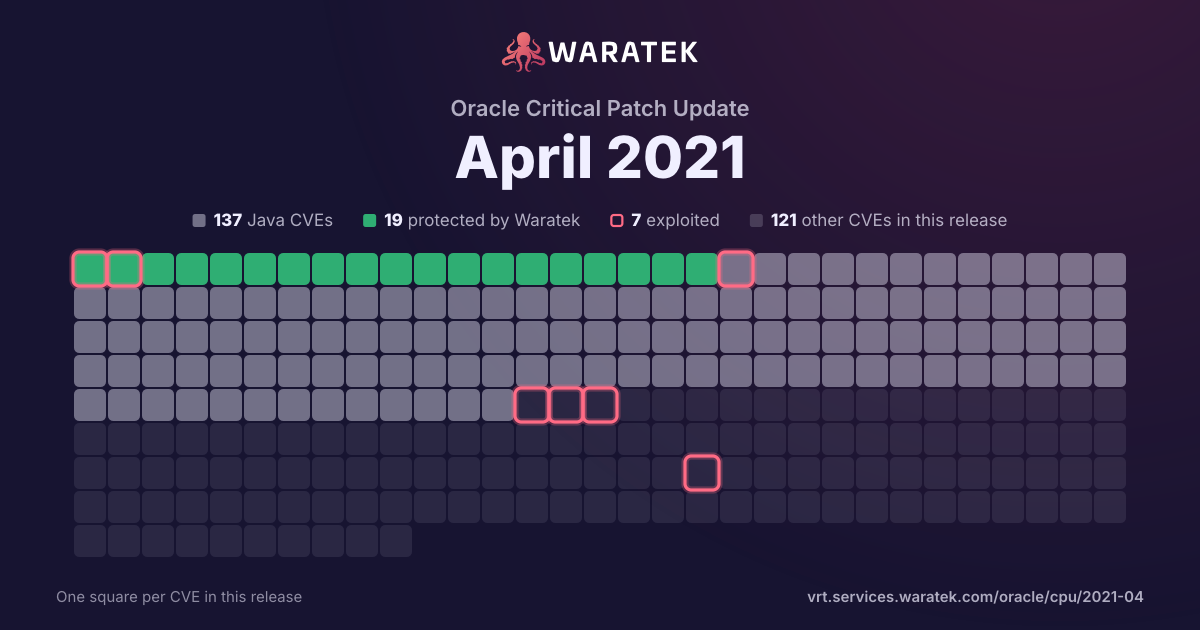
By status
19Protected by Waratek3Mitigation candidate115No exploit published67Outside Waratek scope54Not applicable
7Exploited, marked by the ring
No exploit published. For 97 of them, Oracle's security advisory is the source of public detail.
Protected by Waratek. Waratek RASP can block exploitation of these on systems that have not applied the patch yet.
Overview 30 matches · 18 in Waratek scope · 6 protected · 4 exploited · 2 CISA KEV · 6 public PoC · 3 EPSS ≥ 0.5
30matches
18in Waratek scope60.0%
6protected20.0%
4exploited13.3%
2CISA KEV6.7%
6public PoC20.0%
3EPSS ≥ 0.510.0%
Protected by Waratek
6
20.0%
Rule in development
0
0.0%
Mitigation candidate
2
6.7%
No exploit published
10
33.3%
Outside Waratek scope
3
10.0%
Not applicable
9
30.0%
Withdrawn CVE
0
0.0%
blocked by ARMR today
6
20.0%
partly blocked
0
0.0%
not blocked
24
80.0%
not established
0
0.0%
unrecorded
0
0.0%
Exploited
4
13.3%
Working exploit published
0
0.0%
Proof of concept only
2
6.7%
Forecast only
1
3.3%
No public exploit
23
76.7%
split by
peak 15 / quarter
Q1 191
Protected by Waratek1
Critical1
blocked by ARMR today1
No public exploit1
Q2 191
Protected by Waratek1
Critical1
blocked by ARMR today1
No public exploit1
Q3 190
Q4 193
No exploit published2
Outside Waratek scope1
Critical3
not blocked3
Proof of concept only1
No public exploit2
Q1 202
No exploit published1
Outside Waratek scope1
Critical2
not blocked2
Forecast only1
No public exploit1
Q2 203
Protected by Waratek1
Mitigation candidate1
Outside Waratek scope1
Critical3
blocked by ARMR today1
not blocked2
Exploited1
No public exploit2
Q3 204
Protected by Waratek1
No exploit published2
Not applicable1
Critical4
blocked by ARMR today1
not blocked3
Exploited1
No public exploit3
Q4 201
Protected by Waratek1
Critical1
blocked by ARMR today1
Exploited1
Q1 210
Q2 2115
Protected by Waratek1
Mitigation candidate1
No exploit published5
Not applicable8
Critical15
blocked by ARMR today1
not blocked14
Exploited1
Proof of concept only1
No public exploit13
Q1 19Q2 19Q3 19Q4 19Q1 20Q2 20Q3 20Q4 20Q1 21Q2 21
| CVE | Severity | Published▾ | Status | Exploitation | Description |
|---|---|---|---|---|---|
| CVE-2021-2320 | Critical | 2021-04-22 | Not applicable | No public exploit | Vulnerability in the Oracle Cloud Infrastructure Storage Gateway product of Oracle Storage Gateway (component: Management Console). The supported version that is affected is Prior to 1.4. Easily exploitable vulnerability allows high privileged attacker with network access via HTTP to compromise Oracle Cloud Infrastructure Storage Gateway. While the vulnerability is in Oracle Cloud Infrastructure Storage Gateway, attacks may significantly impact additional products. Successful attacks of this vulnerability can result in takeover of Oracle Cloud Infrastructure Storage Gateway. Note: Updating the Oracle Cloud Infrastructure Storage Gateway to version 1.4 or later will address these vulnerabilities. Download the latest version of Oracle Cloud Infrastructure Storage Gateway from <a href=" https://www.oracle.com/downloads/cloud/oci-storage-gateway-downloads.html">here. Refer to Document <a href="https://support.oracle.com/rs?type=doc&id=2768897.1">2768897.1 for more details. CVSS 3.1 Base Score 9.1 (Confidentiality, Integrity and Availability impacts). CVSS Vector: (CVSS:3.1/AV:N/AC:L/PR:H/UI:N/S:C/C:H/I:H/A:H). |
| CVE-2021-2319 | Critical | 2021-04-22 | Not applicable | No public exploit | Vulnerability in the Oracle Cloud Infrastructure Storage Gateway product of Oracle Storage Gateway (component: Management Console). The supported version that is affected is Prior to 1.4. Easily exploitable vulnerability allows high privileged attacker with network access via HTTP to compromise Oracle Cloud Infrastructure Storage Gateway. While the vulnerability is in Oracle Cloud Infrastructure Storage Gateway, attacks may significantly impact additional products. Successful attacks of this vulnerability can result in takeover of Oracle Cloud Infrastructure Storage Gateway. Note: Updating the Oracle Cloud Infrastructure Storage Gateway to version 1.4 or later will address these vulnerabilities. Download the latest version of Oracle Cloud Infrastructure Storage Gateway from <a href=" https://www.oracle.com/downloads/cloud/oci-storage-gateway-downloads.html">here. Refer to Document <a href="https://support.oracle.com/rs?type=doc&id=2768897.1">2768897.1 for more details. CVSS 3.1 Base Score 9.1 (Confidentiality, Integrity and Availability impacts). CVSS Vector: (CVSS:3.1/AV:N/AC:L/PR:H/UI:N/S:C/C:H/I:H/A:H). |
| CVE-2021-2318 | Critical | 2021-04-22 | Not applicable | No public exploit | Vulnerability in the Oracle Cloud Infrastructure Storage Gateway product of Oracle Storage Gateway (component: Management Console). The supported version that is affected is Prior to 1.4. Easily exploitable vulnerability allows high privileged attacker with network access via HTTP to compromise Oracle Cloud Infrastructure Storage Gateway. While the vulnerability is in Oracle Cloud Infrastructure Storage Gateway, attacks may significantly impact additional products. Successful attacks of this vulnerability can result in takeover of Oracle Cloud Infrastructure Storage Gateway. Note: Updating the Oracle Cloud Infrastructure Storage Gateway to version 1.4 or later will address these vulnerabilities. Download the latest version of Oracle Cloud Infrastructure Storage Gateway from <a href=" https://www.oracle.com/downloads/cloud/oci-storage-gateway-downloads.html">here. Refer to Document <a href="https://support.oracle.com/rs?type=doc&id=2768897.1">2768897.1 for more details. CVSS 3.1 Base Score 9.1 (Confidentiality, Integrity and Availability impacts). CVSS Vector: (CVSS:3.1/AV:N/AC:L/PR:H/UI:N/S:C/C:H/I:H/A:H). |
| CVE-2021-2317 | Critical | 2021-04-22 | Not applicable | No public exploit | Vulnerability in the Oracle Cloud Infrastructure Storage Gateway product of Oracle Storage Gateway (component: Management Console). The supported version that is affected is Prior to 1.4. Easily exploitable vulnerability allows unauthenticated attacker with network access via HTTP to compromise Oracle Cloud Infrastructure Storage Gateway. While the vulnerability is in Oracle Cloud Infrastructure Storage Gateway, attacks may significantly impact additional products. Successful attacks of this vulnerability can result in takeover of Oracle Cloud Infrastructure Storage Gateway. Note: Updating the Oracle Cloud Infrastructure Storage Gateway to version 1.4 or later will address these vulnerabilities. Download the latest version of Oracle Cloud Infrastructure Storage Gateway from <a href=" https://www.oracle.com/downloads/cloud/oci-storage-gateway-downloads.html">here. Refer to Document <a href="https://support.oracle.com/rs?type=doc&id=2768897.1">2768897.1 for more details. CVSS 3.1 Base Score 10.0 (Confidentiality, Integrity and Availability impacts). CVSS Vector: (CVSS:3.1/AV:N/AC:L/PR:N/UI:N/S:C/C:H/I:H/A:H). |
| CVE-2021-2302 | Critical | 2021-04-22 | Mitigation candidate | Proof of concept only | Vulnerability in the Oracle Platform Security for Java product of Oracle Fusion Middleware (component: OPSS). Supported versions that are affected are 11.1.1.9.0, 12.2.1.3.0 and 12.2.1.4.0. Easily exploitable vulnerability allows unauthenticated attacker with network access via HTTP to compromise Oracle Platform Security for Java. Successful attacks of this vulnerability can result in takeover of Oracle Platform Security for Java. CVSS 3.1 Base Score 9.8 (Confidentiality, Integrity and Availability impacts). CVSS Vector: (CVSS:3.1/AV:N/AC:L/PR:N/UI:N/S:U/C:H/I:H/A:H). |
| CVE-2021-2256 | Critical | 2021-04-22 | Not applicable | No public exploit | Vulnerability in the Oracle Storage Cloud Software Appliance product of Oracle Storage Gateway (component: Management Console). The supported version that is affected is Prior to 16.3.1.4.2. Easily exploitable vulnerability allows unauthenticated attacker with network access via HTTP to compromise Oracle Storage Cloud Software Appliance. While the vulnerability is in Oracle Storage Cloud Software Appliance, attacks may significantly impact additional products. Successful attacks of this vulnerability can result in takeover of Oracle Storage Cloud Software Appliance. Note: Updating the Oracle Storage Cloud Software Appliance to version 16.3.1.4.2 or later will address these vulnerabilities. Download the latest version of Oracle Storage Cloud Software Appliance from <a href=" https://www.oracle.com/downloads/cloud/oscsa-downloads.html">here. Refer to Document <a href="https://support.oracle.com/rstype=doc&id=2768897.1">2768897.1 for more details. CVSS 3.1 Base Score 10.0 (Confidentiality, Integrity and Availability impacts). CVSS Vector: (CVSS:3.1/AV:N/AC:L/PR:N/UI:N/S:C/C:H/I:H/A:H). |
| CVE-2021-2253 | Critical | 2021-04-22 | No exploit published | No public exploit | Vulnerability in the Oracle Advanced Supply Chain Planning product of Oracle Supply Chain (component: Core). Supported versions that are affected are 12.1 and 12.2. Easily exploitable vulnerability allows unauthenticated attacker with network access via HTTP to compromise Oracle Advanced Supply Chain Planning. Successful attacks of this vulnerability can result in unauthorized creation, deletion or modification access to critical data or all Oracle Advanced Supply Chain Planning accessible data as well as unauthorized access to critical data or complete access to all Oracle Advanced Supply Chain Planning accessible data. CVSS 3.1 Base Score 9.1 (Confidentiality and Integrity impacts). CVSS Vector: (CVSS:3.1/AV:N/AC:L/PR:N/UI:N/S:U/C:H/I:H/A:N). |
| CVE-2021-2248 | Critical | 2021-04-22 | Not applicable | No public exploit | Vulnerability in the Oracle Secure Global Desktop product of Oracle Virtualization (component: Server). The supported version that is affected is 5.6. Easily exploitable vulnerability allows unauthenticated attacker with network access via multiple protocols to compromise Oracle Secure Global Desktop. While the vulnerability is in Oracle Secure Global Desktop, attacks may significantly impact additional products. Successful attacks of this vulnerability can result in takeover of Oracle Secure Global Desktop. |
| CVE-2021-2244 | Critical | 2021-04-22 | No exploit published | No public exploit | Vulnerability in the Hyperion Analytic Provider Services product of Oracle Hyperion (component: JAPI) and Essbase Analytic Provider Services product of Oracle Essbase (component: JAPI). Supported versions that are affected are Hyperion Analytic Provider Services 11.1.2.4 and 12.2.1.4, and Essbase Analytic Provider Services 21.2. Easily exploitable vulnerability allows unauthenticated attacker with network access via HTTP to compromise Hyperion Analytic Provider Services. Successful attacks require human interaction from a person other than the attacker and while the vulnerability is in Hyperion Analytic Provider Services, attacks may significantly impact additional products. Successful attacks of this vulnerability can result in takeover of Hyperion Analytic Provider Services. CVSS 3.1 Base Score 10.0 (Confidentiality, Integrity and Availability impacts). CVSS Vector: (CVSS:3.1/AV:N/AC:L/PR:N/UI:N/S:C/C:H/I:H/A:H). |
| CVE-2021-2221 | Critical | 2021-04-22 | Not applicable | No public exploit | Vulnerability in the Oracle Secure Global Desktop product of Oracle Virtualization (component: Client). The supported version that is affected is 5.6. Easily exploitable vulnerability allows unauthenticated attacker with network access via multiple protocols to compromise Oracle Secure Global Desktop. Successful attacks require human interaction from a person other than the attacker and while the vulnerability is in Oracle Secure Global Desktop, attacks may significantly impact additional products. Successful attacks of this vulnerability can result in takeover of Oracle Secure Global Desktop. |
| CVE-2021-2205 | Critical | 2021-04-22 | No exploit published | No public exploit | Vulnerability in the Oracle Marketing product of Oracle E-Business Suite (component: Marketing Administration). Supported versions that are affected are 12.2.7-12.2.10. Easily exploitable vulnerability allows unauthenticated attacker with network access via HTTP to compromise Oracle Marketing. Successful attacks of this vulnerability can result in unauthorized creation, deletion or modification access to critical data or all Oracle Marketing accessible data as well as unauthorized access to critical data or complete access to all Oracle Marketing accessible data. CVSS 3.1 Base Score 9.1 (Confidentiality and Integrity impacts). CVSS Vector: (CVSS:3.1/AV:N/AC:L/PR:N/UI:N/S:U/C:H/I:H/A:N). |
| CVE-2021-2200 | Critical | 2021-04-22 | No exploit published | No public exploit | Vulnerability in the Oracle Applications Framework product of Oracle E-Business Suite (component: Home page). The supported version that is affected is 12.2.10. Easily exploitable vulnerability allows unauthenticated attacker with network access via HTTP to compromise Oracle Applications Framework. Successful attacks of this vulnerability can result in unauthorized creation, deletion or modification access to critical data or all Oracle Applications Framework accessible data as well as unauthorized access to critical data or complete access to all Oracle Applications Framework accessible data. CVSS 3.1 Base Score 9.1 (Confidentiality and Integrity impacts). CVSS Vector: (CVSS:3.1/AV:N/AC:L/PR:N/UI:N/S:U/C:H/I:H/A:N). |
| CVE-2021-2177 | Critical | 2021-04-22 | Not applicable | No public exploit | Vulnerability in the Oracle Secure Global Desktop product of Oracle Virtualization (component: Gateway). The supported version that is affected is 5.6. Easily exploitable vulnerability allows unauthenticated attacker with network access via multiple protocols to compromise Oracle Secure Global Desktop. While the vulnerability is in Oracle Secure Global Desktop, attacks may significantly impact additional products. Successful attacks of this vulnerability can result in takeover of Oracle Secure Global Desktop. |
| CVE-2021-2136 | Critical | 2021-04-22 | No exploit published | No public exploit | Vulnerability in the Oracle WebLogic Server product of Oracle Fusion Middleware (component: Core). Supported versions that are affected are 12.1.3.0.0, 12.2.1.3.0, 12.2.1.4.0 and 14.1.1.0.0. Easily exploitable vulnerability allows unauthenticated attacker with network access via IIOP to compromise Oracle WebLogic Server. Successful attacks of this vulnerability can result in takeover of Oracle WebLogic Server. CVSS 3.1 Base Score 9.8 (Confidentiality, Integrity and Availability impacts). CVSS Vector: (CVSS:3.1/AV:N/AC:L/PR:N/UI:N/S:U/C:H/I:H/A:H). |
| CVE-2021-2135 | Critical | 2021-04-22 | Protected by Waratek | Exploited | Vulnerability in the Oracle WebLogic Server product of Oracle Fusion Middleware (component: Coherence Container). Supported versions that are affected are 12.2.1.3.0, 12.2.1.4.0 and 14.1.1.0.0. Easily exploitable vulnerability allows unauthenticated attacker with network access via T3, IIOP to compromise Oracle WebLogic Server. Successful attacks of this vulnerability can result in takeover of Oracle WebLogic Server. CVSS 3.1 Base Score 9.8 (Confidentiality, Integrity and Availability impacts). CVSS Vector: (CVSS:3.1/AV:N/AC:L/PR:N/UI:N/S:U/C:H/I:H/A:H). |
| CVE-2020-17530 | Critical | 2020-12-11 | Protected by Waratek | Exploited | Forced OGNL evaluation, when evaluated on raw user input in tag attributes, may lead to remote code execution. Affected software : Apache Struts 2.0.0 - Struts 2.5.25. |
| CVE-2020-11998 | Critical | 2020-09-10 | Protected by Waratek | No public exploit | A regression has been introduced in the commit preventing JMX re-bind. By passing an empty environment map to RMIConnectorServer, instead of the map that contains the authentication credentials, it leaves ActiveMQ open to the following attack: https://docs.oracle.com/javase/8/docs/technotes/guides/management/agent.html "A remote client could create a javax.management.loading.MLet MBean and use it to create new MBeans from arbitrary URLs, at least if there is no security manager. In other words, a rogue remote client could make your Java application execute arbitrary code." Mitigation: Upgrade to Apache ActiveMQ 5.15.13 |
| CVE-2020-1472 | Critical | 2020-08-17 | Not applicable | Exploited | An elevation of privilege vulnerability exists when an attacker establishes a vulnerable Netlogon secure channel connection to a domain controller, using the Netlogon Remote Protocol (MS-NRPC). An attacker who successfully exploited the vulnerability could run a specially crafted application on a device on the network. To exploit the vulnerability, an unauthenticated attacker would be required to use MS-NRPC to connect to a domain controller to obtain domain administrator access. Microsoft is addressing the vulnerability in a phased two-part rollout. These updates address the vulnerability by modifying how Netlogon handles the usage of Netlogon secure channels. For guidelines on how to manage the changes required for this vulnerability and more information on the phased rollout, see How to manage the changes in Netlogon secure channel connections associated with CVE-2020-1472 (updated September 28, 2020). When the second phase of Windows updates become available in Q1 2021, customers will be notified via a revision to this security vulnerability. If you wish to be notified when these updates are released, we recommend that you register for the security notifications mailer to be alerted of content changes to this advisory. See Microsoft Technical Security Notifications. |
| CVE-2020-5413 | Critical | 2020-07-31 | No exploit published | No public exploit | Spring Integration framework provides Kryo Codec implementations as an alternative for Java (de)serialization. When Kryo is configured with default options, all unregistered classes are resolved on demand. This leads to the "deserialization gadgets" exploit when provided data contains malicious code for execution during deserialization. In order to protect against this type of attack, Kryo can be configured to require a set of trusted classes for (de)serialization. Spring Integration should be proactive against blocking unknown "deserialization gadgets" when configuring Kryo in code. |
| CVE-2019-17638 | Critical | 2020-07-09 | No exploit published | No public exploit | In Eclipse Jetty, versions 9.4.27.v20200227 to 9.4.29.v20200521, in case of too large response headers, Jetty throws an exception to produce an HTTP 431 error. When this happens, the ByteBuffer containing the HTTP response headers is released back to the ByteBufferPool twice. Because of this double release, two threads can acquire the same ByteBuffer from the pool and while thread1 is about to use the ByteBuffer to write response1 data, thread2 fills the ByteBuffer with other data. Thread1 then proceeds to write the buffer that now contains different data. This results in client1, which issued request1 seeing data from another request or response which could contain sensitive data belonging to client2 (HTTP session ids, authentication credentials, etc.). If the Jetty version cannot be upgraded, the vulnerability can be significantly reduced by configuring a responseHeaderSize significantly larger than the requestHeaderSize (12KB responseHeaderSize and 8KB requestHeaderSize). |
| CVE-2020-9480 | Critical | 2020-06-23 | Mitigation candidate | Exploited | In Apache Spark 2.4.5 and earlier, a standalone resource manager's master may be configured to require authentication (spark.authenticate) via a shared secret. When enabled, however, a specially-crafted RPC to the master can succeed in starting an application's resources on the Spark cluster, even without the shared key. This can be leveraged to execute shell commands on the host machine. This does not affect Spark clusters using other resource managers (YARN, Mesos, etc). |
| CVE-2018-1285 | Critical | 2020-05-11 | Outside Waratek scope | No public exploit | Apache log4net versions before 2.0.10 do not disable XML external entities when parsing log4net configuration files. This allows for XXE-based attacks in applications that accept attacker-controlled log4net configuration files. |
| CVE-2020-10683 | Critical | 2020-05-01 | Protected by Waratek | No public exploit | dom4j before 2.0.3 and 2.1.x before 2.1.3 allows external DTDs and External Entities by default, which might enable XXE attacks. However, there is popular external documentation from OWASP showing how to enable the safe, non-default behavior in any application that uses dom4j. |
| CVE-2020-10188 | Critical | 2020-03-06 | Outside Waratek scope | Forecast only | utility.c in telnetd in netkit telnet through 0.17 allows remote attackers to execute arbitrary code via short writes or urgent data, because of a buffer overflow involving the netclear and nextitem functions. |
| CVE-2019-0219 | Critical | 2020-01-14 | No exploit published | No public exploit | A website running in the InAppBrowser webview on Android could execute arbitrary JavaScript in the main application's webview using a specially crafted gap-iab: URI. |
| CVE-2019-2904 | Critical | 2019-10-16 | No exploit published | No public exploit | Vulnerability in the Oracle JDeveloper and ADF product of Oracle Fusion Middleware (component: ADF Faces). Supported versions that are affected are 11.1.1.9.0, 12.1.3.0.0 and 12.2.1.3.0. Easily exploitable vulnerability allows unauthenticated attacker with network access via HTTP to compromise Oracle JDeveloper and ADF. Successful attacks of this vulnerability can result in takeover of Oracle JDeveloper and ADF. CVSS 3.0 Base Score 9.8 (Confidentiality, Integrity and Availability impacts). CVSS Vector: (CVSS:3.0/AV:N/AC:L/PR:N/UI:N/S:U/C:H/I:H/A:H). |
| CVE-2019-17195 | Critical | 2019-10-15 | Outside Waratek scope | Proof of concept only | Connect2id Nimbus JOSE+JWT before v7.9 can throw various uncaught exceptions while parsing a JWT, which could result in an application crash (potential information disclosure) or a potential authentication bypass. |
| CVE-2019-17495 | Critical | 2019-10-10 | No exploit published | No public exploit | A Cascading Style Sheets (CSS) injection vulnerability in Swagger UI before 3.23.11 allows attackers to use the Relative Path Overwrite (RPO) technique to perform CSS-based input field value exfiltration, such as exfiltration of a CSRF token value. In other words, this product intentionally allows the embedding of untrusted JSON data from remote servers, but it was not previously known that <style>@import within the JSON data was a functional attack method. |
| CVE-2019-0228 | Critical | 2019-04-17 | Protected by Waratek | No public exploit | Apache PDFBox 2.0.14 does not properly initialize the XML parser, which allows context-dependent attackers to conduct XML External Entity (XXE) attacks via a crafted XFDF. |
| CVE-2019-3773 | Critical | 2019-01-18 | Protected by Waratek | No public exploit | Spring Web Services, versions 2.4.3, 3.0.4, and older unsupported versions of all three projects, were susceptible to XML External Entity Injection (XXE) when receiving XML data from untrusted sources. |