
Oracle Critical Patch Update April 2021
Released April 2021 · Oracle's advisory ↗ · ← Critical Patch Update, January 2021 · Critical Patch Update, July 2021 →
258 CVEs in this release, one square each
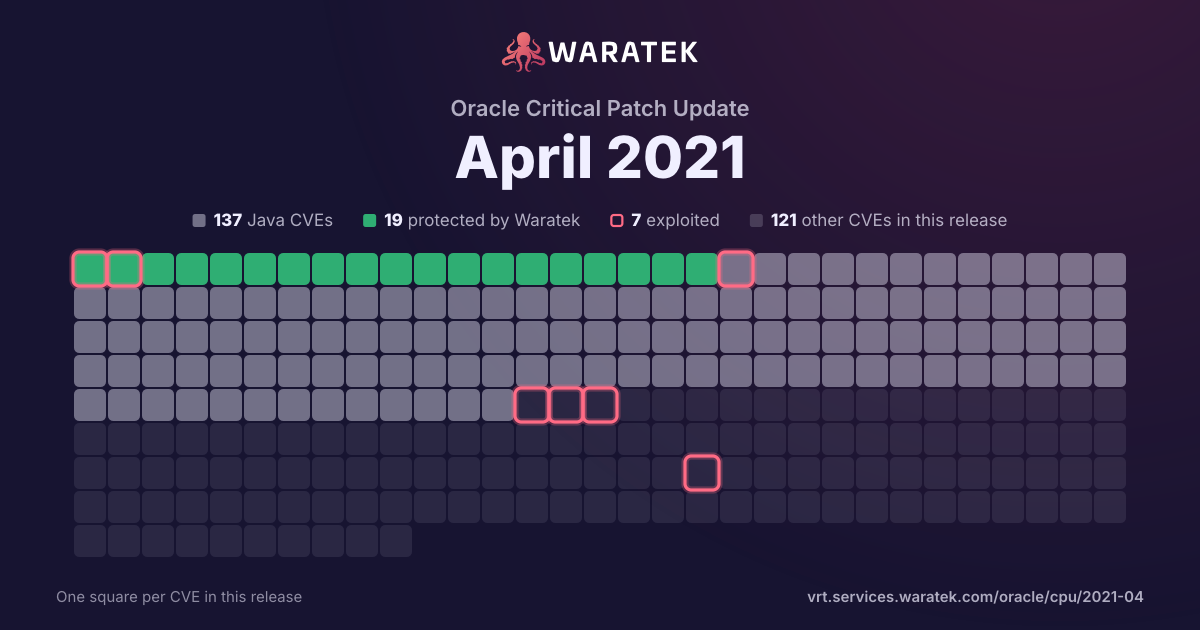
By status
20Protected by Waratek9Mitigation candidate125No exploit published2Outside Waratek scope102Not applicable
7Exploited, marked by the ring
No exploit published. For 101 of them, Oracle's security advisory is the source of public detail.
Protected by Waratek. Waratek RASP can block exploitation of these on systems that have not applied the patch yet.
Overview 11 matches · 3 protected · 3 exploited · 1 CISA KEV · 5 public PoC · 5 EPSS ≥ 0.5
Protected by Waratek
3
27.3%
Rule in development
0
0.0%
Mitigation candidate
4
36.4%
No exploit published
4
36.4%
blocked by ARMR today
3
27.3%
partly blocked
0
0.0%
not blocked
8
72.7%
not established
0
0.0%
unrecorded
0
0.0%
Exploited
3
27.3%
Working exploit published
2
18.2%
Proof of concept only
0
0.0%
Forecast only
1
9.1%
No public exploit
5
45.5%
split by
peak 4 / quarter
Q1 172
Protected by Waratek1
No exploit published1
Medium2
blocked by ARMR today1
not blocked1
Working exploit published1
No public exploit1
Q2 170
Q3 171
Protected by Waratek1
Medium1
blocked by ARMR today1
No public exploit1
Q4 170
Q1 180
Q2 180
Q3 180
Q4 180
Q1 190
Q2 192
Mitigation candidate2
Medium2
not blocked2
Exploited1
Working exploit published1
Q3 191
No exploit published1
Medium1
not blocked1
No public exploit1
Q4 191
Protected by Waratek1
Medium1
blocked by ARMR today1
No public exploit1
Q1 200
Q2 204
Mitigation candidate2
No exploit published2
Medium4
not blocked4
Exploited2
Forecast only1
No public exploit1
Q2 17Q4 17Q2 18Q4 18Q2 19Q4 19Q2 20
| CVE | Severity | Published▾ | Status | Exploitation | Description |
|---|---|---|---|---|---|
| CVE-2020-11023 | Medium | 2020-04-29 | Mitigation candidate | Exploited | In jQuery versions greater than or equal to 1.0.3 and before 3.5.0, passing HTML containing <option> elements from untrusted sources - even after sanitizing it - to one of jQuery's DOM manipulation methods (i.e. .html(), .append(), and others) may execute untrusted code. This problem is patched in jQuery 3.5.0. |
| CVE-2020-11022 | Medium | 2020-04-29 | Mitigation candidate | Exploited | In jQuery starting with 1.12.0 and before 3.5.0, passing HTML from untrusted sources - even after sanitizing it - to one of jQuery's DOM manipulation methods (i.e. .html(), .append(), and others) may execute untrusted code. This problem is patched in jQuery 3.5.0. |
| CVE-2020-9489 | Medium | 2020-04-27 | No exploit published | No public exploit | A carefully crafted or corrupt file may trigger a System.exit in Tika's OneNote Parser. Crafted or corrupted files can also cause out of memory errors and/or infinite loops in Tika's ICNSParser, MP3Parser, MP4Parser, SAS7BDATParser, OneNoteParser and ImageParser. Apache Tika users should upgrade to 1.24.1 or later. The vulnerabilities in the MP4Parser were partially fixed by upgrading the com.googlecode:isoparser:1.1.22 dependency to org.tallison:isoparser:1.9.41.2. For unrelated security reasons, we upgraded org.apache.cxf to 3.3.6 as part of the 1.24.1 release. |
| CVE-2020-1927 | Medium | 2020-04-02 | No exploit published | Forecast only | In Apache HTTP Server 2.4.0 to 2.4.41, redirects configured with mod_rewrite that were intended to be self-referential might be fooled by encoded newlines and redirect instead to an an unexpected URL within the request URL. |
| CVE-2019-10080 | Medium | 2019-11-19 | Protected by Waratek | No public exploit | The XMLFileLookupService in NiFi versions 1.3.0 to 1.9.2 allowed trusted users to inadvertently configure a potentially malicious XML file. The XML file has the ability to make external calls to services (via XXE) and reveal information such as the versions of Java, Jersey, and Apache that the NiFI instance uses. |
| CVE-2019-3740 | Medium | 2019-09-18 | No exploit published | No public exploit | RSA BSAFE Crypto-J versions prior to 6.2.5 are vulnerable to an Information Exposure Through Timing Discrepancy vulnerabilities during DSA key generation. A malicious remote attacker could potentially exploit those vulnerabilities to recover DSA keys. |
| CVE-2019-0221 | Medium | 2019-05-28 | Mitigation candidate | Working exploit published | The SSI printenv command in Apache Tomcat 9.0.0.M1 to 9.0.0.17, 8.5.0 to 8.5.39 and 7.0.0 to 7.0.93 echoes user provided data without escaping and is, therefore, vulnerable to XSS. SSI is disabled by default. The printenv command is intended for debugging and is unlikely to be present in a production website. |
| CVE-2019-11358 | Medium | 2019-04-20 | Mitigation candidate | Exploited | jQuery before 3.4.0, as used in Drupal, Backdrop CMS, and other products, mishandles jQuery.extend(true, {}, ...) because of Object.prototype pollution. If an unsanitized source object contained an enumerable __proto__ property, it could extend the native Object.prototype. |
| CVE-2017-14735 | Medium | 2017-09-25 | Protected by Waratek | No public exploit | OWASP AntiSamy before 1.5.7 allows XSS via HTML5 entities, as demonstrated by use of : to construct a javascript: URL. |
| CVE-2016-7103 | Medium | 2017-03-15 | No exploit published | No public exploit | Cross-site scripting (XSS) vulnerability in jQuery UI before 1.12.0 might allow remote attackers to inject arbitrary web script or HTML via the closeText parameter of the dialog function. |
| CVE-2016-5725 | Medium | 2017-01-19 | Protected by Waratek | Working exploit published | Directory traversal vulnerability in JCraft JSch before 0.1.54 on Windows, when the mode is ChannelSftp.OVERWRITE, allows remote SFTP servers to write to arbitrary files via a ..\ (dot dot backslash) in a response to a recursive GET command. |