
Oracle Critical Patch Update April 2021
Released April 2021 · Oracle's advisory ↗ · ← Critical Patch Update, January 2021 · Critical Patch Update, July 2021 →
258 CVEs in this release, one square each
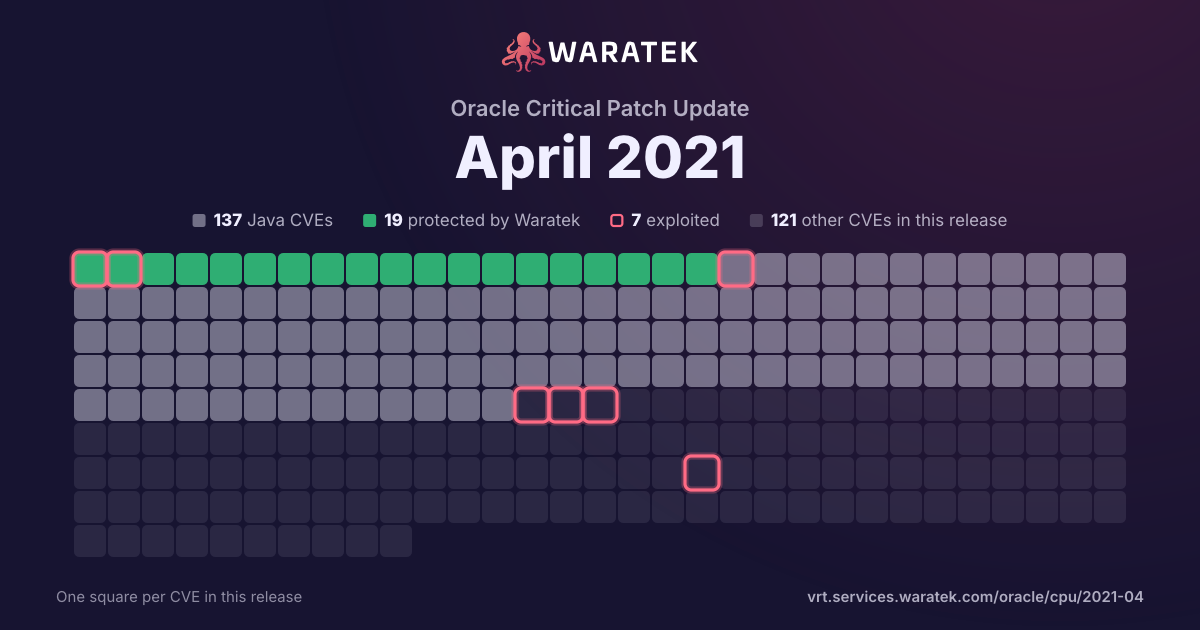
By status
20Protected by Waratek9Mitigation candidate125No exploit published2Outside Waratek scope102Not applicable
7Exploited, marked by the ring
No exploit published. For 101 of them, Oracle's security advisory is the source of public detail.
Protected by Waratek. Waratek RASP can block exploitation of these on systems that have not applied the patch yet.
Overview 9 matches · 3 in Waratek scope · 0 protected · 0 exploited · 0 CISA KEV · 1 public PoC · 3 EPSS ≥ 0.5
9matches
3in Waratek scope33.3%
0protected0.0%
0exploited0.0%
0CISA KEV0.0%
1public PoC11.1%
3EPSS ≥ 0.533.3%
Protected by Waratek
0
0.0%
Rule in development
0
0.0%
Mitigation candidate
0
0.0%
No exploit published
3
33.3%
Outside Waratek scope
0
0.0%
Not applicable
6
66.7%
Withdrawn CVE
0
0.0%
blocked by ARMR today
0
0.0%
partly blocked
0
0.0%
not blocked
9
100.0%
not established
0
0.0%
unrecorded
0
0.0%
Exploited
0
0.0%
Working exploit published
0
0.0%
Proof of concept only
1
11.1%
Forecast only
2
22.2%
No public exploit
6
66.7%
split by
peak 4 / month
Jan 21Feb 21Mar 21
| CVE | Severity | Published▾ | Status | Exploitation | Description |
|---|---|---|---|---|---|
| CVE-2021-3450 | High | 2021-03-25 | Not applicable | No public exploit | The X509_V_FLAG_X509_STRICT flag enables additional security checks of the certificates present in a certificate chain. It is not set by default. Starting from OpenSSL version 1.1.1h a check to disallow certificates in the chain that have explicitly encoded elliptic curve parameters was added as an additional strict check. An error in the implementation of this check meant that the result of a previous check to confirm that certificates in the chain are valid CA certificates was overwritten. This effectively bypasses the check that non-CA certificates must not be able to issue other certificates. If a "purpose" has been configured then there is a subsequent opportunity for checks that the certificate is a valid CA. All of the named "purpose" values implemented in libcrypto perform this check. Therefore, where a purpose is set the certificate chain will still be rejected even when the strict flag has been used. A purpose is set by default in libssl client and server certificate verification routines, but it can be overridden or removed by an application. In order to be affected, an application must explicitly set the X509_V_FLAG_X509_STRICT verification flag and either not set a purpose for the certificate verification or, in the case of TLS client or server applications, override the default purpose. OpenSSL versions 1.1.1h and newer are affected by this issue. Users of these versions should upgrade to OpenSSL 1.1.1k. OpenSSL 1.0.2 is not impacted by this issue. Fixed in OpenSSL 1.1.1k (Affected 1.1.1h-1.1.1j). |
| CVE-2021-3449 | Medium | 2021-03-25 | Not applicable | Proof of concept only | An OpenSSL TLS server may crash if sent a maliciously crafted renegotiation ClientHello message from a client. If a TLSv1.2 renegotiation ClientHello omits the signature_algorithms extension (where it was present in the initial ClientHello), but includes a signature_algorithms_cert extension then a NULL pointer dereference will result, leading to a crash and a denial of service attack. A server is only vulnerable if it has TLSv1.2 and renegotiation enabled (which is the default configuration). OpenSSL TLS clients are not impacted by this issue. All OpenSSL 1.1.1 versions are affected by this issue. Users of these versions should upgrade to OpenSSL 1.1.1k. OpenSSL 1.0.2 is not impacted by this issue. Fixed in OpenSSL 1.1.1k (Affected 1.1.1-1.1.1j). |
| CVE-2021-20227 | Medium | 2021-03-23 | Not applicable | No public exploit | A flaw was found in SQLite's SELECT query functionality (src/select.c). This flaw allows an attacker who is capable of running SQL queries locally on the SQLite database to cause a denial of service or possible code execution by triggering a use-after-free. The highest threat from this vulnerability is to system availability. |
| CVE-2021-22883 | High | 2021-03-03 | Not applicable | Forecast only | Node.js before 10.24.0, 12.21.0, 14.16.0, and 15.10.0 is vulnerable to a denial of service attack when too many connection attempts with an 'unknownProtocol' are established. This leads to a leak of file descriptors. If a file descriptor limit is configured on the system, then the server is unable to accept new connections and prevent the process also from opening, e.g. a file. If no file descriptor limit is configured, then this lead to an excessive memory usage and cause the system to run out of memory. |
| CVE-2020-27223 | Medium | 2021-02-26 | No exploit published | Forecast only | In Eclipse Jetty 9.4.6.v20170531 to 9.4.36.v20210114 (inclusive), 10.0.0, and 11.0.0 when Jetty handles a request containing multiple Accept headers with a large number of “quality” (i.e. q) parameters, the server may enter a denial of service (DoS) state due to high CPU usage processing those quality values, resulting in minutes of CPU time exhausted processing those quality values. |
| CVE-2020-11987 | High | 2021-02-24 | No exploit published | No public exploit | Apache Batik 1.13 is vulnerable to server-side request forgery, caused by improper input validation by the NodePickerPanel. By using a specially-crafted argument, an attacker could exploit this vulnerability to cause the underlying server to make arbitrary GET requests. |
| CVE-2021-22112 | High | 2021-02-23 | No exploit published | No public exploit | Spring Security 5.4.x prior to 5.4.4, 5.3.x prior to 5.3.8.RELEASE, 5.2.x prior to 5.2.9.RELEASE, and older unsupported versions can fail to save the SecurityContext if it is changed more than once in a single request.A malicious user cannot cause the bug to happen (it must be programmed in). However, if the application's intent is to only allow the user to run with elevated privileges in a small portion of the application, the bug can be leveraged to extend those privileges to the rest of the application. |
| CVE-2021-23841 | Medium | 2021-02-16 | Not applicable | No public exploit | The OpenSSL public API function X509_issuer_and_serial_hash() attempts to create a unique hash value based on the issuer and serial number data contained within an X509 certificate. However it fails to correctly handle any errors that may occur while parsing the issuer field (which might occur if the issuer field is maliciously constructed). This may subsequently result in a NULL pointer deref and a crash leading to a potential denial of service attack. The function X509_issuer_and_serial_hash() is never directly called by OpenSSL itself so applications are only vulnerable if they use this function directly and they use it on certificates that may have been obtained from untrusted sources. OpenSSL versions 1.1.1i and below are affected by this issue. Users of these versions should upgrade to OpenSSL 1.1.1j. OpenSSL versions 1.0.2x and below are affected by this issue. However OpenSSL 1.0.2 is out of support and no longer receiving public updates. Premium support customers of OpenSSL 1.0.2 should upgrade to 1.0.2y. Other users should upgrade to 1.1.1j. Fixed in OpenSSL 1.1.1j (Affected 1.1.1-1.1.1i). Fixed in OpenSSL 1.0.2y (Affected 1.0.2-1.0.2x). |
| CVE-2020-27842 | Medium | 2021-01-05 | Not applicable | No public exploit | There's a flaw in openjpeg's t2 encoder in versions prior to 2.4.0. An attacker who is able to provide crafted input to be processed by openjpeg could cause a null pointer dereference. The highest impact of this flaw is to application availability. |