
Oracle Critical Patch Update April 2021
Released April 2021 · Oracle's advisory ↗ · ← Critical Patch Update, January 2021 · Critical Patch Update, July 2021 →
258 CVEs in this release, one square each
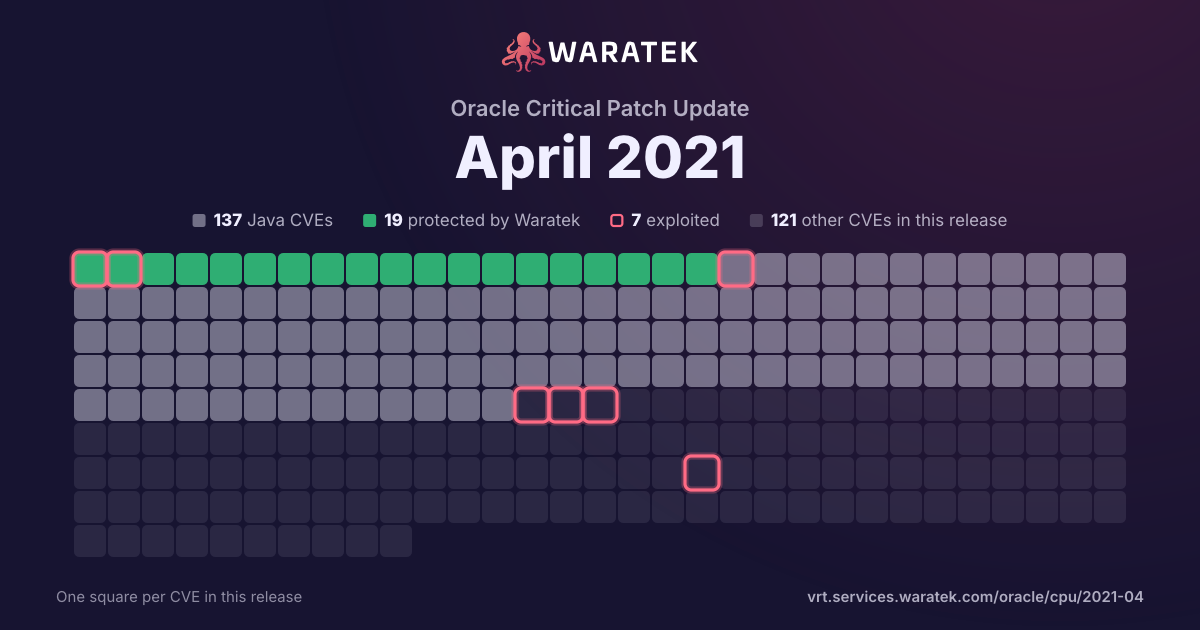
By status
20Protected by Waratek9Mitigation candidate125No exploit published2Outside Waratek scope102Not applicable
7Exploited, marked by the ring
No exploit published. For 101 of them, Oracle's security advisory is the source of public detail.
Protected by Waratek. Waratek RASP can block exploitation of these on systems that have not applied the patch yet.
Overview 4 matches · 1 protected · 0 exploited · 0 CISA KEV · 0 public PoC · 0 EPSS ≥ 0.5
Protected by Waratek
1
25.0%
Rule in development
0
0.0%
Mitigation candidate
0
0.0%
No exploit published
3
75.0%
blocked by ARMR today
1
25.0%
partly blocked
0
0.0%
not blocked
3
75.0%
not established
0
0.0%
unrecorded
0
0.0%
Exploited
0
0.0%
Working exploit published
0
0.0%
Proof of concept only
0
0.0%
Forecast only
0
0.0%
No public exploit
4
100.0%
| CVE | Severity | Published▾ | Status | Exploitation | Description |
|---|---|---|---|---|---|
| CVE-2020-17521 | Medium | 2020-12-07 | Protected by Waratek | No public exploit | Apache Groovy provides extension methods to aid with creating temporary directories. Prior to this fix, Groovy's implementation of those extension methods was using a now superseded Java JDK method call that is potentially not secure on some operating systems in some contexts. Users not using the extension methods mentioned in the advisory are not affected, but may wish to read the advisory for further details. Versions Affected: 2.0 to 2.4.20, 2.5.0 to 2.5.13, 3.0.0 to 3.0.6, and 4.0.0-alpha-1. Fixed in versions 2.4.21, 2.5.14, 3.0.7, 4.0.0-alpha-2. |
| CVE-2020-13956 | Medium | 2020-12-02 | No exploit published | No public exploit | Apache HttpClient versions prior to version 4.5.13 and 5.0.3 can misinterpret malformed authority component in request URIs passed to the library as java.net.URI object and pick the wrong target host for request execution. |
| CVE-2020-27218 | Medium | 2020-11-28 | No exploit published | No public exploit | In Eclipse Jetty version 9.4.0.RC0 to 9.4.34.v20201102, 10.0.0.alpha0 to 10.0.0.beta2, and 11.0.0.alpha0 to 11.0.0.beta2, if GZIP request body inflation is enabled and requests from different clients are multiplexed onto a single connection, and if an attacker can send a request with a body that is received entirely but not consumed by the application, then a subsequent request on the same connection will see that body prepended to its body. The attacker will not see any data but may inject data into the body of the subsequent request. |
| CVE-2020-13954 | Medium | 2020-11-12 | No exploit published | No public exploit | By default, Apache CXF creates a /services page containing a listing of the available endpoint names and addresses. This webpage is vulnerable to a reflected Cross-Site Scripting (XSS) attack via the styleSheetPath, which allows a malicious actor to inject javascript into the web page. This vulnerability affects all versions of Apache CXF prior to 3.4.1 and 3.3.8. Please note that this is a separate issue to CVE-2019-17573. |