
Oracle Critical Patch Update April 2021
Released April 2021 · Oracle's advisory ↗ · ← Critical Patch Update, January 2021 · Critical Patch Update, July 2021 →
258 CVEs in this release, one square each
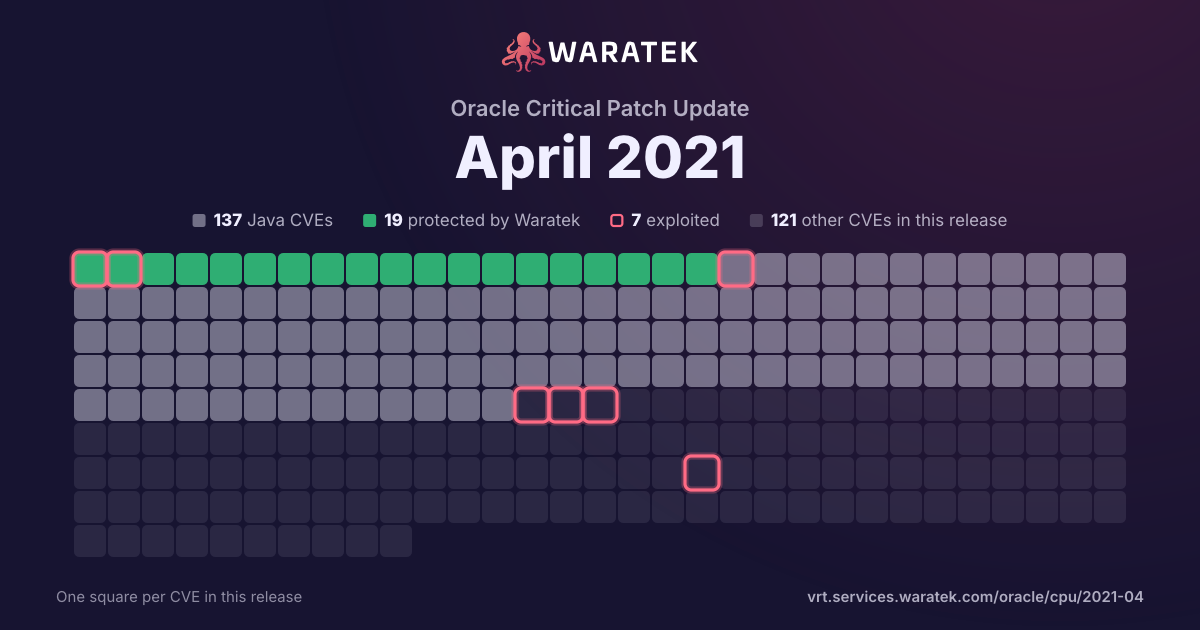
By status
20Protected by Waratek9Mitigation candidate125No exploit published2Outside Waratek scope102Not applicable
7Exploited, marked by the ring
No exploit published. For 101 of them, Oracle's security advisory is the source of public detail.
Protected by Waratek. Waratek RASP can block exploitation of these on systems that have not applied the patch yet.
Overview 7 matches · 6 in Waratek scope · 0 protected · 2 exploited · 1 CISA KEV · 3 public PoC · 4 EPSS ≥ 0.5
7matches
6in Waratek scope85.7%
0protected0.0%
2exploited28.6%
1CISA KEV14.3%
3public PoC42.9%
4EPSS ≥ 0.557.1%
Protected by Waratek
0
0.0%
Rule in development
0
0.0%
Mitigation candidate
2
28.6%
No exploit published
4
57.1%
Outside Waratek scope
0
0.0%
Not applicable
1
14.3%
Withdrawn CVE
0
0.0%
blocked by ARMR today
0
0.0%
partly blocked
0
0.0%
not blocked
7
100.0%
not established
0
0.0%
unrecorded
0
0.0%
Exploited
2
28.6%
Working exploit published
0
0.0%
Proof of concept only
1
14.3%
Forecast only
1
14.3%
No public exploit
3
42.9%
| CVE | Severity | Published▾ | Status | Exploitation | Description |
|---|---|---|---|---|---|
| CVE-2020-11023 | Medium | 2020-04-29 | Mitigation candidate | Exploited | In jQuery versions greater than or equal to 1.0.3 and before 3.5.0, passing HTML containing <option> elements from untrusted sources - even after sanitizing it - to one of jQuery's DOM manipulation methods (i.e. .html(), .append(), and others) may execute untrusted code. This problem is patched in jQuery 3.5.0. |
| CVE-2020-11022 | Medium | 2020-04-29 | Mitigation candidate | Exploited | In jQuery starting with 1.12.0 and before 3.5.0, passing HTML from untrusted sources - even after sanitizing it - to one of jQuery's DOM manipulation methods (i.e. .html(), .append(), and others) may execute untrusted code. This problem is patched in jQuery 3.5.0. |
| CVE-2020-9489 | Medium | 2020-04-27 | No exploit published | No public exploit | A carefully crafted or corrupt file may trigger a System.exit in Tika's OneNote Parser. Crafted or corrupted files can also cause out of memory errors and/or infinite loops in Tika's ICNSParser, MP3Parser, MP4Parser, SAS7BDATParser, OneNoteParser and ImageParser. Apache Tika users should upgrade to 1.24.1 or later. The vulnerabilities in the MP4Parser were partially fixed by upgrading the com.googlecode:isoparser:1.1.22 dependency to org.tallison:isoparser:1.9.41.2. For unrelated security reasons, we upgraded org.apache.cxf to 3.3.6 as part of the 1.24.1 release. |
| CVE-2020-9488 | Low | 2020-04-27 | No exploit published | No public exploit | Improper validation of certificate with host mismatch in Apache Log4j SMTP appender. This could allow an SMTPS connection to be intercepted by a man-in-the-middle attack which could leak any log messages sent through that appender. Fixed in Apache Log4j 2.12.3 and 2.13.1 |
| CVE-2020-1967 | High | 2020-04-21 | Not applicable | Proof of concept only | Server or client applications that call the SSL_check_chain() function during or after a TLS 1.3 handshake may crash due to a NULL pointer dereference as a result of incorrect handling of the "signature_algorithms_cert" TLS extension. The crash occurs if an invalid or unrecognised signature algorithm is received from the peer. This could be exploited by a malicious peer in a Denial of Service attack. OpenSSL version 1.1.1d, 1.1.1e, and 1.1.1f are affected by this issue. This issue did not affect OpenSSL versions prior to 1.1.1d. Fixed in OpenSSL 1.1.1g (Affected 1.1.1d-1.1.1f). |
| CVE-2020-11612 | High | 2020-04-07 | No exploit published | No public exploit | The ZlibDecoders in Netty 4.1.x before 4.1.46 allow for unbounded memory allocation while decoding a ZlibEncoded byte stream. An attacker could send a large ZlibEncoded byte stream to the Netty server, forcing the server to allocate all of its free memory to a single decoder. |
| CVE-2020-1927 | Medium | 2020-04-02 | No exploit published | Forecast only | In Apache HTTP Server 2.4.0 to 2.4.41, redirects configured with mod_rewrite that were intended to be self-referential might be fooled by encoded newlines and redirect instead to an an unexpected URL within the request URL. |