
Oracle Critical Patch Update April 2021
Released April 2021 · Oracle's advisory ↗ · ← Critical Patch Update, January 2021 · Critical Patch Update, July 2021 →
258 CVEs in this release, one square each
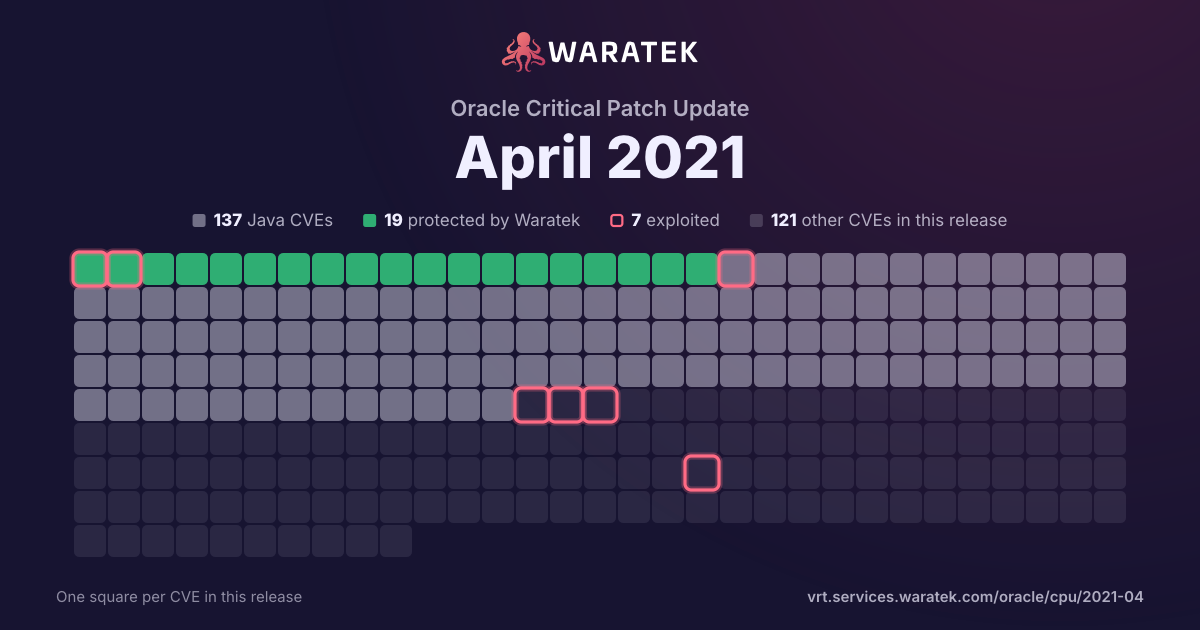
By status
18Protected by Waratek1Rule in development5Mitigation candidate126No exploit published2Outside Waratek scope106Not applicable
7Exploited, marked by the ring
No exploit published. For 98 of them, Oracle's security advisory is the source of public detail.
Protected by Waratek. Waratek RASP can block exploitation of these on systems that have not applied the patch yet.
Overview 11 matches · 3 protected · 0 exploited · 0 CISA KEV · 2 public PoC · 2 EPSS ≥ 0.5
Protected by Waratek
3
27.3%
Rule in development
0
0.0%
Mitigation candidate
1
9.1%
No exploit published
7
63.6%
blocked by ARMR today
3
27.3%
partly blocked
0
0.0%
not blocked
8
72.7%
not established
0
0.0%
unrecorded
0
0.0%
Exploited
0
0.0%
Working exploit published
2
18.2%
Proof of concept only
0
0.0%
Forecast only
1
9.1%
No public exploit
8
72.7%
split by
peak 3 / quarter
Q1 171
Protected by Waratek1
Medium1
blocked by ARMR today1
Working exploit published1
Q2 170
Q3 171
Protected by Waratek1
Medium1
blocked by ARMR today1
No public exploit1
Q4 170
Q1 180
Q2 180
Q3 180
Q4 180
Q1 190
Q2 191
Mitigation candidate1
Medium1
not blocked1
Working exploit published1
Q3 191
No exploit published1
Medium1
not blocked1
No public exploit1
Q4 190
Q1 200
Q2 203
No exploit published3
Medium3
not blocked3
Forecast only1
No public exploit2
Q3 201
No exploit published1
Medium1
not blocked1
No public exploit1
Q4 203
Protected by Waratek1
No exploit published2
Medium3
blocked by ARMR today1
not blocked2
No public exploit3
Q2 17Q4 17Q2 18Q4 18Q2 19Q4 19Q2 20Q4 20
| CVE | Severity | Published▾ | Status | Exploitation | Description |
|---|---|---|---|---|---|
| CVE-2020-17521 | Medium | 2020-12-07 | Protected by Waratek | No public exploit | Apache Groovy provides extension methods to aid with creating temporary directories. Prior to this fix, Groovy's implementation of those extension methods was using a now superseded Java JDK method call that is potentially not secure on some operating systems in some contexts. Users not using the extension methods mentioned in the advisory are not affected, but may wish to read the advisory for further details. Versions Affected: 2.0 to 2.4.20, 2.5.0 to 2.5.13, 3.0.0 to 3.0.6, and 4.0.0-alpha-1. Fixed in versions 2.4.21, 2.5.14, 3.0.7, 4.0.0-alpha-2. |
| CVE-2020-13956 | Medium | 2020-12-02 | No exploit published | No public exploit | Apache HttpClient versions prior to version 4.5.13 and 5.0.3 can misinterpret malformed authority component in request URIs passed to the library as java.net.URI object and pick the wrong target host for request execution. |
| CVE-2020-13954 | Medium | 2020-11-12 | No exploit published | No public exploit | By default, Apache CXF creates a /services page containing a listing of the available endpoint names and addresses. This webpage is vulnerable to a reflected Cross-Site Scripting (XSS) attack via the styleSheetPath, which allows a malicious actor to inject javascript into the web page. This vulnerability affects all versions of Apache CXF prior to 3.4.1 and 3.3.8. Please note that this is a separate issue to CVE-2019-17573. |
| CVE-2020-5421 | Medium | 2020-09-19 | No exploit published | No public exploit | In Spring Framework versions 5.2.0 - 5.2.8, 5.1.0 - 5.1.17, 5.0.0 - 5.0.18, 4.3.0 - 4.3.28, and older unsupported versions, the protections against RFD attacks from CVE-2015-5211 may be bypassed depending on the browser used through the use of a jsessionid path parameter. |
| CVE-2020-1945 | Medium | 2020-05-14 | No exploit published | No public exploit | Apache Ant 1.1 to 1.9.14 and 1.10.0 to 1.10.7 uses the default temporary directory identified by the Java system property java.io.tmpdir for several tasks and may thus leak sensitive information. The fixcrlf and replaceregexp tasks also copy files from the temporary directory back into the build tree allowing an attacker to inject modified source files into the build process. |
| CVE-2020-9489 | Medium | 2020-04-27 | No exploit published | No public exploit | A carefully crafted or corrupt file may trigger a System.exit in Tika's OneNote Parser. Crafted or corrupted files can also cause out of memory errors and/or infinite loops in Tika's ICNSParser, MP3Parser, MP4Parser, SAS7BDATParser, OneNoteParser and ImageParser. Apache Tika users should upgrade to 1.24.1 or later. The vulnerabilities in the MP4Parser were partially fixed by upgrading the com.googlecode:isoparser:1.1.22 dependency to org.tallison:isoparser:1.9.41.2. For unrelated security reasons, we upgraded org.apache.cxf to 3.3.6 as part of the 1.24.1 release. |
| CVE-2020-1927 | Medium | 2020-04-02 | No exploit published | Forecast only | In Apache HTTP Server 2.4.0 to 2.4.41, redirects configured with mod_rewrite that were intended to be self-referential might be fooled by encoded newlines and redirect instead to an an unexpected URL within the request URL. |
| CVE-2019-3740 | Medium | 2019-09-18 | No exploit published | No public exploit | RSA BSAFE Crypto-J versions prior to 6.2.5 are vulnerable to an Information Exposure Through Timing Discrepancy vulnerabilities during DSA key generation. A malicious remote attacker could potentially exploit those vulnerabilities to recover DSA keys. |
| CVE-2019-0221 | Medium | 2019-05-28 | Mitigation candidate | Working exploit published | The SSI printenv command in Apache Tomcat 9.0.0.M1 to 9.0.0.17, 8.5.0 to 8.5.39 and 7.0.0 to 7.0.93 echoes user provided data without escaping and is, therefore, vulnerable to XSS. SSI is disabled by default. The printenv command is intended for debugging and is unlikely to be present in a production website. |
| CVE-2017-14735 | Medium | 2017-09-25 | Protected by Waratek | No public exploit | OWASP AntiSamy before 1.5.7 allows XSS via HTML5 entities, as demonstrated by use of : to construct a javascript: URL. |
| CVE-2016-5725 | Medium | 2017-01-19 | Protected by Waratek | Working exploit published | Directory traversal vulnerability in JCraft JSch before 0.1.54 on Windows, when the mode is ChannelSftp.OVERWRITE, allows remote SFTP servers to write to arbitrary files via a ..\ (dot dot backslash) in a response to a recursive GET command. |