
Oracle Critical Patch Update April 2021
Released April 2021 · Oracle's advisory ↗ · ← Critical Patch Update, January 2021 · Critical Patch Update, July 2021 →
258 CVEs in this release, one square each
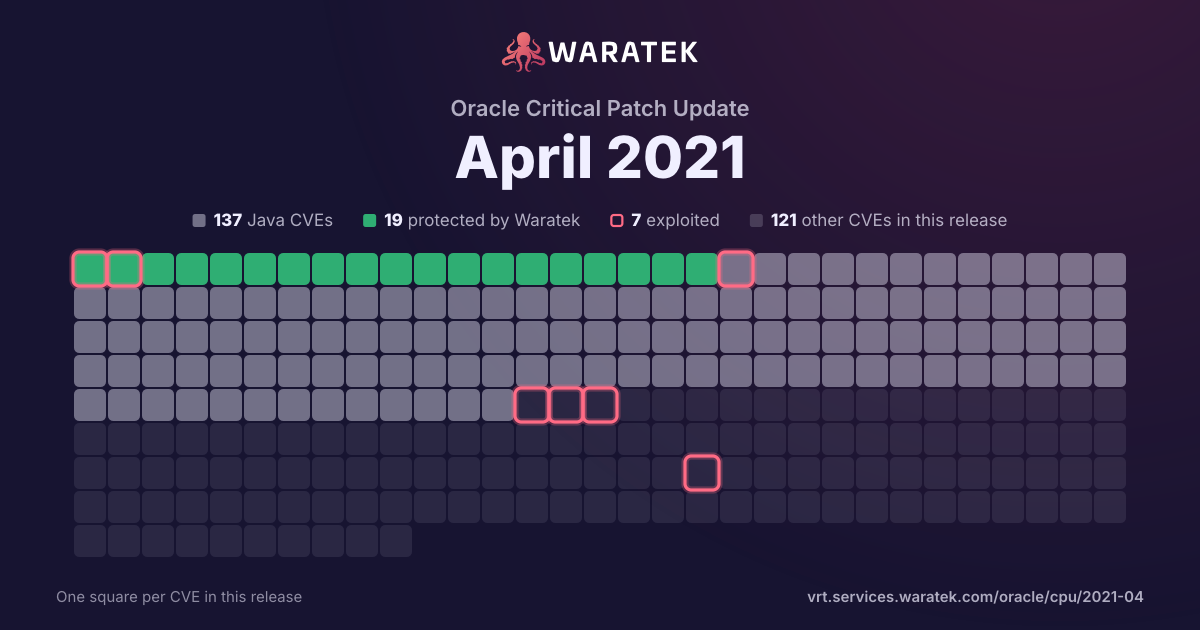
By status
18Protected by Waratek1Rule in development5Mitigation candidate126No exploit published2Outside Waratek scope106Not applicable
7Exploited, marked by the ring
No exploit published. For 98 of them, Oracle's security advisory is the source of public detail.
Protected by Waratek. Waratek RASP can block exploitation of these on systems that have not applied the patch yet.
Overview 7 matches · 3 protected · 2 exploited · 1 CISA KEV · 3 public PoC · 2 EPSS ≥ 0.5
Protected by Waratek
3
42.9%
Rule in development
1
14.3%
Mitigation candidate
1
14.3%
No exploit published
2
28.6%
blocked by ARMR today
3
42.9%
partly blocked
0
0.0%
not blocked
4
57.1%
not established
0
0.0%
unrecorded
0
0.0%
Exploited
2
28.6%
Working exploit published
0
0.0%
Proof of concept only
1
14.3%
Forecast only
1
14.3%
No public exploit
3
42.9%
split by
peak 2 / month
Oct 192
Mitigation candidate1
No exploit published1
Critical2
not blocked2
Proof of concept only1
No public exploit1
Nov 190
Dec 190
Jan 200
Feb 200
Mar 200
Apr 200
May 201
Protected by Waratek1
Critical1
blocked by ARMR today1
No public exploit1
Jun 201
Rule in development1
Critical1
not blocked1
Exploited1
Jul 201
No exploit published1
Critical1
not blocked1
No public exploit1
Aug 200
Sep 201
Protected by Waratek1
Critical1
blocked by ARMR today1
Forecast only1
Oct 200
Nov 200
Dec 201
Protected by Waratek1
Critical1
blocked by ARMR today1
Exploited1
Oct 19Dec 19Feb 20Apr 20Jun 20Aug 20Oct 20Dec 20
| CVE | Severity | Published▾ | Status | Exploitation | Description |
|---|---|---|---|---|---|
| CVE-2020-17530 | Critical | 2020-12-11 | Protected by Waratek | Exploited | Forced OGNL evaluation, when evaluated on raw user input in tag attributes, may lead to remote code execution. Affected software : Apache Struts 2.0.0 - Struts 2.5.25. |
| CVE-2020-11998 | Critical | 2020-09-10 | Protected by Waratek | Forecast only | A regression has been introduced in the commit preventing JMX re-bind. By passing an empty environment map to RMIConnectorServer, instead of the map that contains the authentication credentials, it leaves ActiveMQ open to the following attack: https://docs.oracle.com/javase/8/docs/technotes/guides/management/agent.html "A remote client could create a javax.management.loading.MLet MBean and use it to create new MBeans from arbitrary URLs, at least if there is no security manager. In other words, a rogue remote client could make your Java application execute arbitrary code." Mitigation: Upgrade to Apache ActiveMQ 5.15.13 |
| CVE-2019-17638 | Critical | 2020-07-09 | No exploit published | No public exploit | In Eclipse Jetty, versions 9.4.27.v20200227 to 9.4.29.v20200521, in case of too large response headers, Jetty throws an exception to produce an HTTP 431 error. When this happens, the ByteBuffer containing the HTTP response headers is released back to the ByteBufferPool twice. Because of this double release, two threads can acquire the same ByteBuffer from the pool and while thread1 is about to use the ByteBuffer to write response1 data, thread2 fills the ByteBuffer with other data. Thread1 then proceeds to write the buffer that now contains different data. This results in client1, which issued request1 seeing data from another request or response which could contain sensitive data belonging to client2 (HTTP session ids, authentication credentials, etc.). If the Jetty version cannot be upgraded, the vulnerability can be significantly reduced by configuring a responseHeaderSize significantly larger than the requestHeaderSize (12KB responseHeaderSize and 8KB requestHeaderSize). |
| CVE-2020-9480 | Critical | 2020-06-23 | Rule in development | Exploited | In Apache Spark 2.4.5 and earlier, a standalone resource manager's master may be configured to require authentication (spark.authenticate) via a shared secret. When enabled, however, a specially-crafted RPC to the master can succeed in starting an application's resources on the Spark cluster, even without the shared key. This can be leveraged to execute shell commands on the host machine. This does not affect Spark clusters using other resource managers (YARN, Mesos, etc). |
| CVE-2020-10683 | Critical | 2020-05-01 | Protected by Waratek | No public exploit | dom4j before 2.0.3 and 2.1.x before 2.1.3 allows external DTDs and External Entities by default, which might enable XXE attacks. However, there is popular external documentation from OWASP showing how to enable the safe, non-default behavior in any application that uses dom4j. |
| CVE-2019-2904 | Critical | 2019-10-16 | No exploit published | No public exploit | Vulnerability in the Oracle JDeveloper and ADF product of Oracle Fusion Middleware (component: ADF Faces). Supported versions that are affected are 11.1.1.9.0, 12.1.3.0.0 and 12.2.1.3.0. Easily exploitable vulnerability allows unauthenticated attacker with network access via HTTP to compromise Oracle JDeveloper and ADF. Successful attacks of this vulnerability can result in takeover of Oracle JDeveloper and ADF. CVSS 3.0 Base Score 9.8 (Confidentiality, Integrity and Availability impacts). CVSS Vector: (CVSS:3.0/AV:N/AC:L/PR:N/UI:N/S:U/C:H/I:H/A:H). |
| CVE-2019-17195 | Critical | 2019-10-15 | Mitigation candidate | Proof of concept only | Connect2id Nimbus JOSE+JWT before v7.9 can throw various uncaught exceptions while parsing a JWT, which could result in an application crash (potential information disclosure) or a potential authentication bypass. |