
Oracle Critical Patch Update April 2021
Released April 2021 · Oracle's advisory ↗ · ← Critical Patch Update, January 2021 · Critical Patch Update, July 2021 →
258 CVEs in this release, one square each
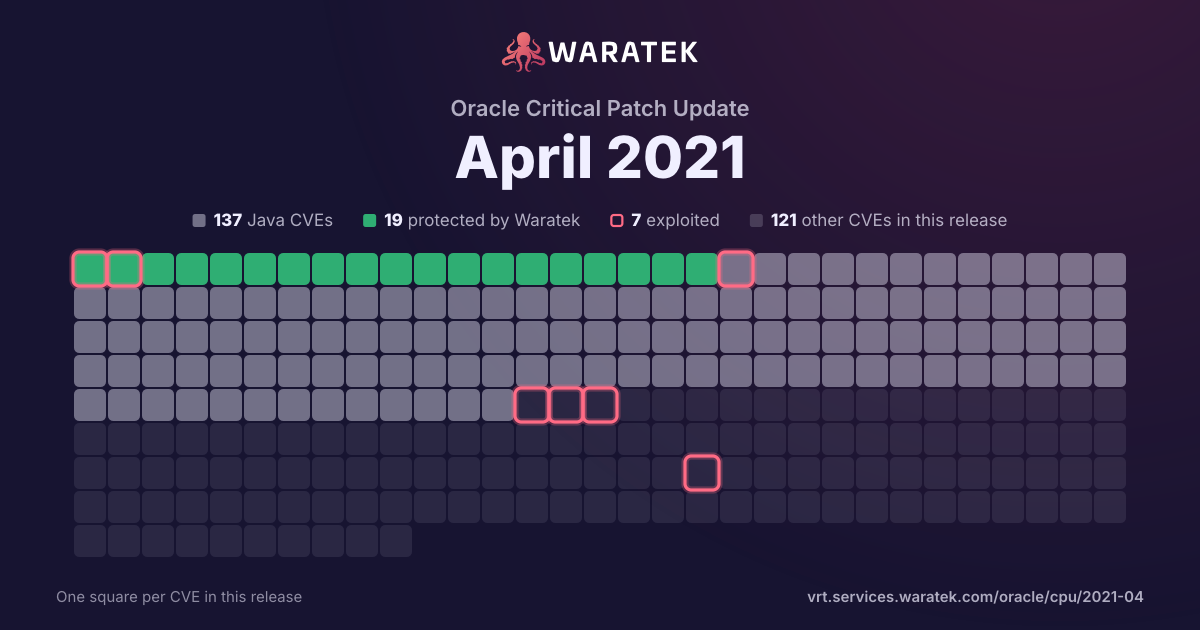
By status
18Protected by Waratek1Rule in development5Mitigation candidate126No exploit published2Outside Waratek scope106Not applicable
7Exploited, marked by the ring
No exploit published. For 98 of them, Oracle's security advisory is the source of public detail.
Protected by Waratek. Waratek RASP can block exploitation of these on systems that have not applied the patch yet.
Overview 11 matches · 5 protected · 1 exploited · 1 CISA KEV · 2 public PoC · 2 EPSS ≥ 0.5
Protected by Waratek
5
45.5%
Rule in development
0
0.0%
Mitigation candidate
0
0.0%
No exploit published
6
54.5%
blocked by ARMR today
5
45.5%
partly blocked
0
0.0%
not blocked
6
54.5%
not established
0
0.0%
unrecorded
0
0.0%
Exploited
1
9.1%
Working exploit published
1
9.1%
Proof of concept only
0
0.0%
Forecast only
0
0.0%
No public exploit
9
81.8%
split by
peak 7 / month
Oct 201
No exploit published1
High1
not blocked1
No public exploit1
Nov 203
Protected by Waratek2
No exploit published1
High2
Medium1
blocked by ARMR today2
not blocked1
Working exploit published1
No public exploit2
Dec 207
Protected by Waratek3
No exploit published4
Critical1
High3
Medium2
Low1
blocked by ARMR today3
not blocked4
Exploited1
No public exploit6
Oct 20Nov 20Dec 20
| CVE | Severity | Published▾ | Status | Exploitation | Description |
|---|---|---|---|---|---|
| CVE-2020-28052 | High | 2020-12-18 | No exploit published | No public exploit | An issue was discovered in Legion of the Bouncy Castle BC Java 1.65 and 1.66. The OpenBSDBCrypt.checkPassword utility method compared incorrect data when checking the password, allowing incorrect passwords to indicate they were matching with previously hashed ones that were different. |
| CVE-2020-5360 | High | 2020-12-16 | No exploit published | No public exploit | Dell BSAFE Micro Edition Suite, versions prior to 4.5, are vulnerable to a Buffer Under-Read Vulnerability. An unauthenticated remote attacker could potentially exploit this vulnerability resulting in undefined behaviour, or a crash of the affected systems. |
| CVE-2020-17530 | Critical | 2020-12-11 | Protected by Waratek | Exploited | Forced OGNL evaluation, when evaluated on raw user input in tag attributes, may lead to remote code execution. Affected software : Apache Struts 2.0.0 - Struts 2.5.25. |
| CVE-2020-8908 | Low | 2020-12-10 | No exploit published | No public exploit | A temp directory creation vulnerability exists in all versions of Guava, allowing an attacker with access to the machine to potentially access data in a temporary directory created by the Guava API com.google.common.io.Files.createTempDir(). By default, on unix-like systems, the created directory is world-readable (readable by an attacker with access to the system). The method in question has been marked @Deprecated in versions 30.0 and later and should not be used. For Android developers, we recommend choosing a temporary directory API provided by Android, such as context.getCacheDir(). For other Java developers, we recommend migrating to the Java 7 API java.nio.file.Files.createTempDirectory() which explicitly configures permissions of 700, or configuring the Java runtime's java.io.tmpdir system property to point to a location whose permissions are appropriately configured. |
| CVE-2020-17521 | Medium | 2020-12-07 | Protected by Waratek | No public exploit | Apache Groovy provides extension methods to aid with creating temporary directories. Prior to this fix, Groovy's implementation of those extension methods was using a now superseded Java JDK method call that is potentially not secure on some operating systems in some contexts. Users not using the extension methods mentioned in the advisory are not affected, but may wish to read the advisory for further details. Versions Affected: 2.0 to 2.4.20, 2.5.0 to 2.5.13, 3.0.0 to 3.0.6, and 4.0.0-alpha-1. Fixed in versions 2.4.21, 2.5.14, 3.0.7, 4.0.0-alpha-2. |
| CVE-2020-25649 | High | 2020-12-03 | Protected by Waratek | No public exploit | A flaw was found in FasterXML Jackson Databind, where it did not have entity expansion secured properly. This flaw allows vulnerability to XML external entity (XXE) attacks. The highest threat from this vulnerability is data integrity. |
| CVE-2020-13956 | Medium | 2020-12-02 | No exploit published | No public exploit | Apache HttpClient versions prior to version 4.5.13 and 5.0.3 can misinterpret malformed authority component in request URIs passed to the library as java.net.URI object and pick the wrong target host for request execution. |
| CVE-2020-26217 | High | 2020-11-16 | Protected by Waratek | Working exploit published | XStream before version 1.4.14 is vulnerable to Remote Code Execution.The vulnerability may allow a remote attacker to run arbitrary shell commands only by manipulating the processed input stream. Only users who rely on blocklists are affected. Anyone using XStream's Security Framework allowlist is not affected. The linked advisory provides code workarounds for users who cannot upgrade. The issue is fixed in version 1.4.14. |
| CVE-2020-13954 | Medium | 2020-11-12 | No exploit published | No public exploit | By default, Apache CXF creates a /services page containing a listing of the available endpoint names and addresses. This webpage is vulnerable to a reflected Cross-Site Scripting (XSS) attack via the styleSheetPath, which allows a malicious actor to inject javascript into the web page. This vulnerability affects all versions of Apache CXF prior to 3.4.1 and 3.3.8. Please note that this is a separate issue to CVE-2019-17573. |
| CVE-2019-17566 | High | 2020-11-12 | Protected by Waratek | No public exploit | Apache Batik is vulnerable to server-side request forgery, caused by improper input validation by the "xlink:href" attributes. By using a specially-crafted argument, an attacker could exploit this vulnerability to cause the underlying server to make arbitrary GET requests. |
| CVE-2020-11979 | High | 2020-10-01 | No exploit published | No public exploit | As mitigation for CVE-2020-1945 Apache Ant 1.10.8 changed the permissions of temporary files it created so that only the current user was allowed to access them. Unfortunately the fixcrlf task deleted the temporary file and created a new one without said protection, effectively nullifying the effort. This would still allow an attacker to inject modified source files into the build process. |