
Oracle Critical Patch Update April 2021
Released April 2021 · Oracle's advisory ↗ · ← Critical Patch Update, January 2021 · Critical Patch Update, July 2021 →
258 CVEs in this release, one square each
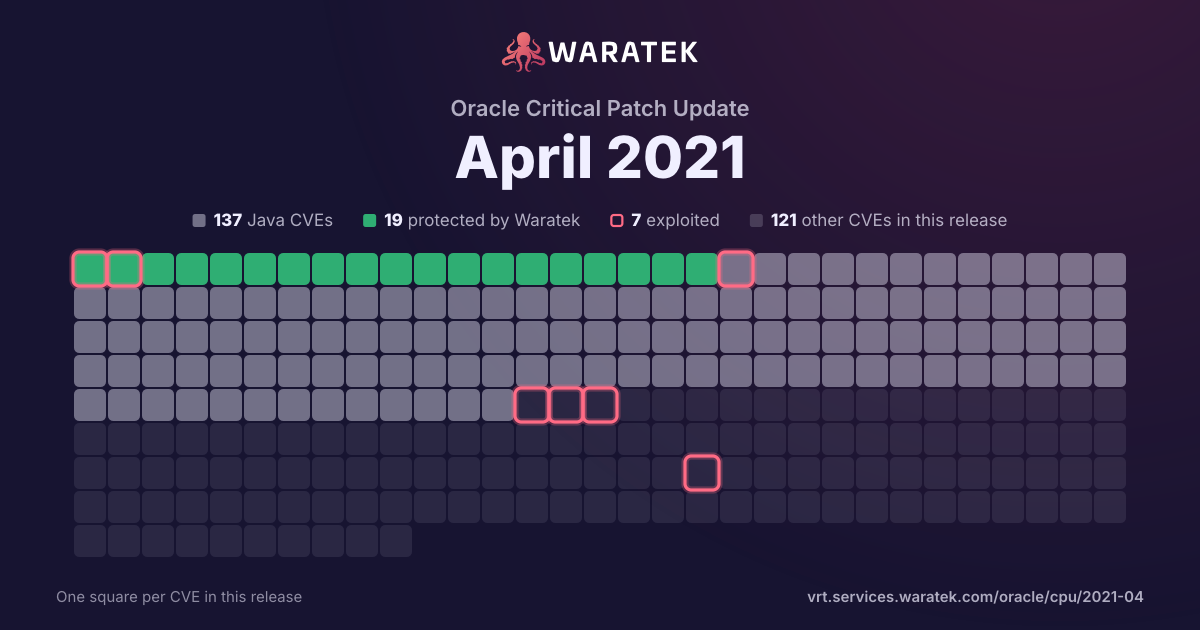
By status
20Protected by Waratek9Mitigation candidate125No exploit published2Outside Waratek scope102Not applicable
7Exploited, marked by the ring
No exploit published. For 101 of them, Oracle's security advisory is the source of public detail.
Protected by Waratek. Waratek RASP can block exploitation of these on systems that have not applied the patch yet.
Overview 9 matches · 0 protected · 0 exploited · 0 CISA KEV · 0 public PoC · 0 EPSS ≥ 0.5
9matches
0protected0.0%
0exploited0.0%
0CISA KEV0.0%
0public PoC0.0%
0EPSS ≥ 0.50.0%
Protected by Waratek
0
0.0%
Rule in development
0
0.0%
Mitigation candidate
0
0.0%
No exploit published
9
100.0%
blocked by ARMR today
0
0.0%
partly blocked
0
0.0%
not blocked
9
100.0%
not established
0
0.0%
unrecorded
0
0.0%
Exploited
0
0.0%
Working exploit published
0
0.0%
Proof of concept only
0
0.0%
Forecast only
0
0.0%
No public exploit
9
100.0%
split by
peak 2 / quarter
Q1 171
No exploit published1
Medium1
not blocked1
No public exploit1
Q2 170
Q3 170
Q4 170
Q1 181
No exploit published1
High1
not blocked1
No public exploit1
Q2 181
No exploit published1
High1
not blocked1
No public exploit1
Q3 180
Q4 180
Q1 190
Q2 190
Q3 192
No exploit published2
High1
Medium1
not blocked2
No public exploit2
Q4 192
No exploit published2
Critical2
not blocked2
No public exploit2
Q1 202
No exploit published2
Critical1
High1
not blocked2
No public exploit2
Q1 17Q3 17Q1 18Q3 18Q1 19Q3 19Q1 20
| CVE | Severity | Published▾ | Status | Exploitation | Description |
|---|---|---|---|---|---|
| CVE-2019-12423 | High | 2020-01-16 | No exploit published | No public exploit | Apache CXF ships with a OpenId Connect JWK Keys service, which allows a client to obtain the public keys in JWK format, which can then be used to verify the signature of tokens issued by the service. Typically, the service obtains the public key from a local keystore (JKS/PKCS12) by specifing the path of the keystore and the alias of the keystore entry. This case is not vulnerable. However it is also possible to obtain the keys from a JWK keystore file, by setting the configuration parameter "rs.security.keystore.type" to "jwk". For this case all keys are returned in this file "as is", including all private key and secret key credentials. This is an obvious security risk if the user has configured the signature keystore file with private or secret key credentials. From CXF 3.3.5 and 3.2.12, it is mandatory to specify an alias corresponding to the id of the key in the JWK file, and only this key is returned. In addition, any private key information is omitted by default. "oct" keys, which contain secret keys, are not returned at all. |
| CVE-2019-0219 | Critical | 2020-01-14 | No exploit published | No public exploit | A website running in the InAppBrowser webview on Android could execute arbitrary JavaScript in the main application's webview using a specially crafted gap-iab: URI. |
| CVE-2019-2904 | Critical | 2019-10-16 | No exploit published | No public exploit | Vulnerability in the Oracle JDeveloper and ADF product of Oracle Fusion Middleware (component: ADF Faces). Supported versions that are affected are 11.1.1.9.0, 12.1.3.0.0 and 12.2.1.3.0. Easily exploitable vulnerability allows unauthenticated attacker with network access via HTTP to compromise Oracle JDeveloper and ADF. Successful attacks of this vulnerability can result in takeover of Oracle JDeveloper and ADF. CVSS 3.0 Base Score 9.8 (Confidentiality, Integrity and Availability impacts). CVSS Vector: (CVSS:3.0/AV:N/AC:L/PR:N/UI:N/S:U/C:H/I:H/A:H). |
| CVE-2019-17495 | Critical | 2019-10-10 | No exploit published | No public exploit | A Cascading Style Sheets (CSS) injection vulnerability in Swagger UI before 3.23.11 allows attackers to use the Relative Path Overwrite (RPO) technique to perform CSS-based input field value exfiltration, such as exfiltration of a CSRF token value. In other words, this product intentionally allows the embedding of untrusted JSON data from remote servers, but it was not previously known that <style>@import within the JSON data was a functional attack method. |
| CVE-2019-3740 | Medium | 2019-09-18 | No exploit published | No public exploit | RSA BSAFE Crypto-J versions prior to 6.2.5 are vulnerable to an Information Exposure Through Timing Discrepancy vulnerabilities during DSA key generation. A malicious remote attacker could potentially exploit those vulnerabilities to recover DSA keys. |
| CVE-2019-12402 | High | 2019-08-30 | No exploit published | No public exploit | The file name encoding algorithm used internally in Apache Commons Compress 1.15 to 1.18 can get into an infinite loop when faced with specially crafted inputs. This can lead to a denial of service attack if an attacker can choose the file names inside of an archive created by Compress. |
| CVE-2018-1000180 | High | 2018-06-05 | No exploit published | No public exploit | Bouncy Castle BC 1.54 - 1.59, BC-FJA 1.0.0, BC-FJA 1.0.1 and earlier have a flaw in the Low-level interface to RSA key pair generator, specifically RSA Key Pairs generated in low-level API with added certainty may have less M-R tests than expected. This appears to be fixed in versions BC 1.60 beta 4 and later, BC-FJA 1.0.2 and later. |
| CVE-2017-12626 | High | 2018-01-29 | No exploit published | No public exploit | Apache POI in versions prior to release 3.17 are vulnerable to Denial of Service Attacks: 1) Infinite Loops while parsing crafted WMF, EMF, MSG and macros (POI bugs 61338 and 61294), and 2) Out of Memory Exceptions while parsing crafted DOC, PPT and XLS (POI bugs 52372 and 61295). |
| CVE-2016-7103 | Medium | 2017-03-15 | No exploit published | No public exploit | Cross-site scripting (XSS) vulnerability in jQuery UI before 1.12.0 might allow remote attackers to inject arbitrary web script or HTML via the closeText parameter of the dialog function. |