
Oracle Critical Patch Update April 2021
Released April 2021 · Oracle's advisory ↗ · ← Critical Patch Update, January 2021 · Critical Patch Update, July 2021 →
258 CVEs in this release, one square each
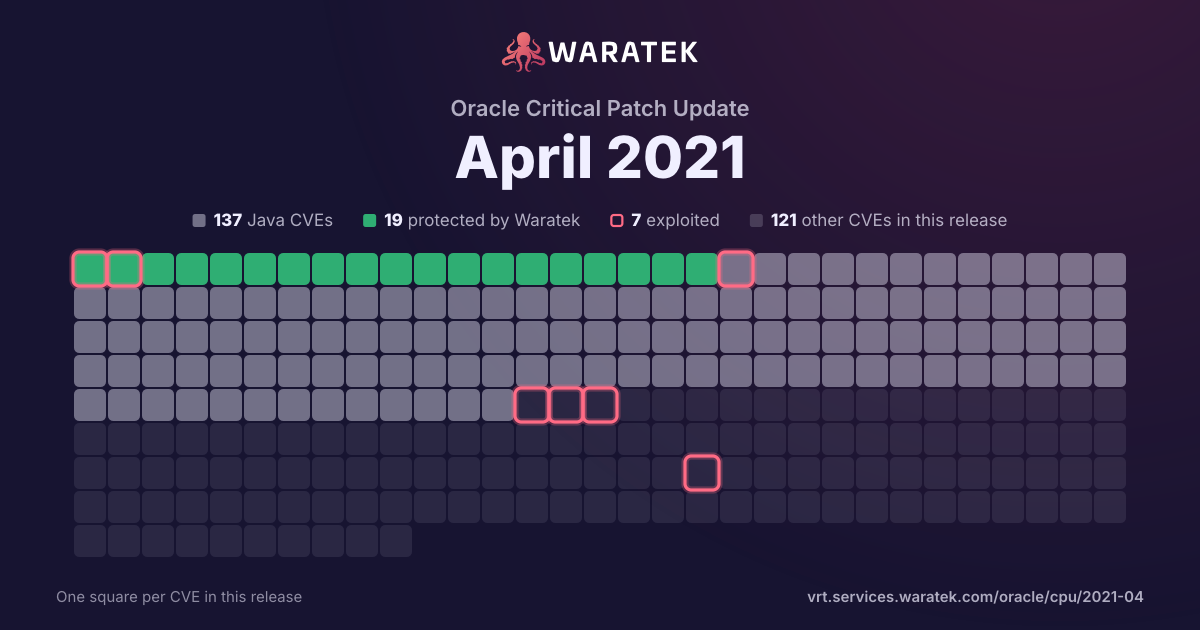
By status
19Protected by Waratek3Mitigation candidate115No exploit published67Outside Waratek scope54Not applicable
7Exploited, marked by the ring
No exploit published. For 97 of them, Oracle's security advisory is the source of public detail.
Protected by Waratek. Waratek RASP can block exploitation of these on systems that have not applied the patch yet.
Overview 6 matches · 3 in Waratek scope · 0 protected · 0 exploited · 0 CISA KEV · 0 public PoC
Protected by Waratek
0
0.0%
Rule in development
0
0.0%
Mitigation candidate
0
0.0%
No exploit published
3
50.0%
Outside Waratek scope
2
33.3%
Not applicable
1
16.7%
Withdrawn CVE
0
0.0%
blocked by ARMR today
0
0.0%
partly blocked
0
0.0%
not blocked
6
100.0%
not established
0
0.0%
unrecorded
0
0.0%
Exploited
0
0.0%
Working exploit published
0
0.0%
Proof of concept only
0
0.0%
Forecast only
6
100.0%
No public exploit
0
0.0%
split by
peak 2 / month
Mar 201
Outside Waratek scope1
Critical1
not blocked1
Forecast only1
Apr 201
Outside Waratek scope1
Medium1
not blocked1
Forecast only1
May 200
Jun 200
Jul 200
Aug 200
Sep 200
Oct 200
Nov 200
Dec 200
Jan 210
Feb 211
No exploit published1
Medium1
not blocked1
Forecast only1
Mar 211
Not applicable1
High1
not blocked1
Forecast only1
Apr 212
No exploit published2
High2
not blocked2
Forecast only2
Apr 20Jun 20Aug 20Oct 20Dec 20Feb 21Apr 21
| CVE | Severity | Published▾ | Status | Exploitation | Description |
|---|---|---|---|---|---|
| CVE-2021-2198 | High | 2021-04-22 | No exploit published | Forecast only | Vulnerability in the Oracle Knowledge Management product of Oracle E-Business Suite (component: Setup, Admin). Supported versions that are affected are 12.1.1-12.1.3 and 12.2.3-12.2.10. Easily exploitable vulnerability allows unauthenticated attacker with network access via HTTP to compromise Oracle Knowledge Management. Successful attacks require human interaction from a person other than the attacker and while the vulnerability is in Oracle Knowledge Management, attacks may significantly impact additional products. Successful attacks of this vulnerability can result in unauthorized access to critical data or complete access to all Oracle Knowledge Management accessible data as well as unauthorized update, insert or delete access to some of Oracle Knowledge Management accessible data. CVSS 3.1 Base Score 8.2 (Confidentiality and Integrity impacts). CVSS Vector: (CVSS:3.1/AV:N/AC:L/PR:N/UI:R/S:C/C:H/I:L/A:N). |
| CVE-2021-2190 | High | 2021-04-22 | No exploit published | Forecast only | Vulnerability in the Oracle Sales Offline product of Oracle E-Business Suite (component: Template). Supported versions that are affected are 12.1.1-12.1.3 and 12.2.3-12.2.10. Easily exploitable vulnerability allows unauthenticated attacker with network access via HTTP to compromise Oracle Sales Offline. Successful attacks of this vulnerability can result in unauthorized ability to cause a hang or frequently repeatable crash (complete DOS) of Oracle Sales Offline. CVSS 3.1 Base Score 7.5 (Availability impacts). CVSS Vector: (CVSS:3.1/AV:N/AC:L/PR:N/UI:N/S:U/C:N/I:N/A:H). |
| CVE-2021-22883 | High | 2021-03-03 | Not applicable | Forecast only | Node.js before 10.24.0, 12.21.0, 14.16.0, and 15.10.0 is vulnerable to a denial of service attack when too many connection attempts with an 'unknownProtocol' are established. This leads to a leak of file descriptors. If a file descriptor limit is configured on the system, then the server is unable to accept new connections and prevent the process also from opening, e.g. a file. If no file descriptor limit is configured, then this lead to an excessive memory usage and cause the system to run out of memory. |
| CVE-2020-27223 | Medium | 2021-02-26 | No exploit published | Forecast only | In Eclipse Jetty 9.4.6.v20170531 to 9.4.36.v20210114 (inclusive), 10.0.0, and 11.0.0 when Jetty handles a request containing multiple Accept headers with a large number of “quality” (i.e. q) parameters, the server may enter a denial of service (DoS) state due to high CPU usage processing those quality values, resulting in minutes of CPU time exhausted processing those quality values. |
| CVE-2020-1927 | Medium | 2020-04-02 | Outside Waratek scope | Forecast only | In Apache HTTP Server 2.4.0 to 2.4.41, redirects configured with mod_rewrite that were intended to be self-referential might be fooled by encoded newlines and redirect instead to an an unexpected URL within the request URL. |
| CVE-2020-10188 | Critical | 2020-03-06 | Outside Waratek scope | Forecast only | utility.c in telnetd in netkit telnet through 0.17 allows remote attackers to execute arbitrary code via short writes or urgent data, because of a buffer overflow involving the netclear and nextitem functions. |