
Oracle Critical Patch Update January 2021
Released January 2021 · Oracle's advisory ↗ · ← Critical Patch Update, October 2020 · Critical Patch Update, April 2021 →
202 CVEs in this release, one square each
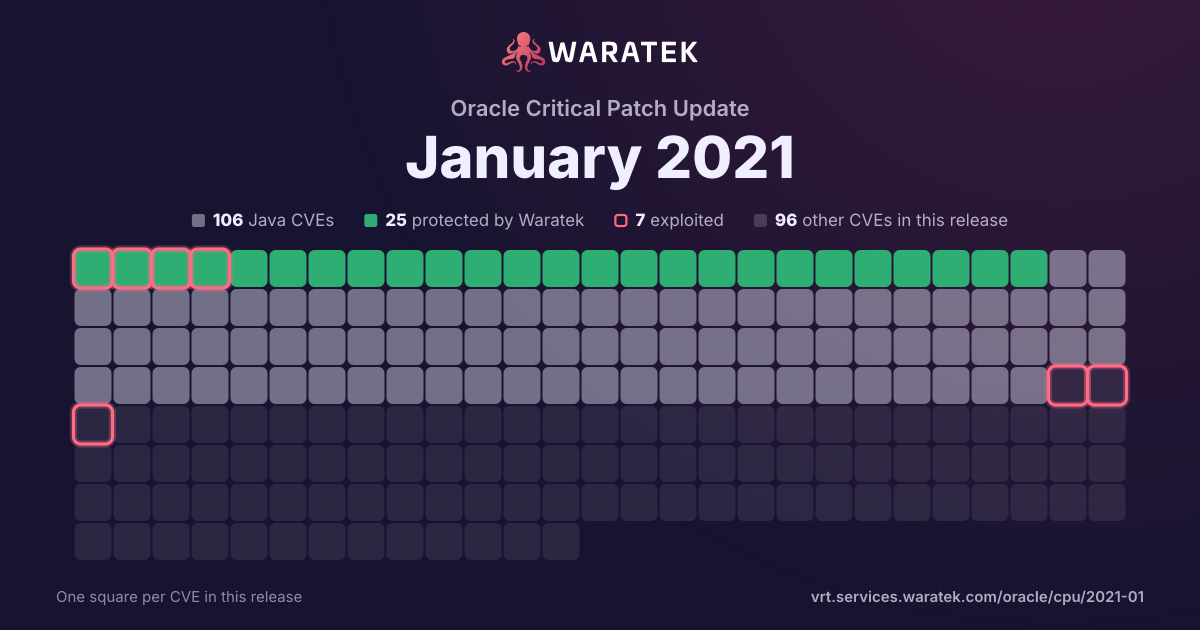
By status
27Protected by Waratek9Mitigation candidate85No exploit published81Not applicable
7Exploited, marked by the ring
No exploit published. For 68 of them, Oracle's security advisory is the source of public detail.
Protected by Waratek. Waratek RASP can block exploitation of these on systems that have not applied the patch yet.
Overview 5 matches · 0 in Waratek scope · 0 protected · 0 exploited · 0 CISA KEV · 1 public PoC · 1 EPSS ≥ 0.5
5matches
0in Waratek scope0.0%
0protected0.0%
0exploited0.0%
0CISA KEV0.0%
1public PoC20.0%
1EPSS ≥ 0.520.0%
Protected by Waratek
0
0.0%
Rule in development
0
0.0%
Mitigation candidate
0
0.0%
No exploit published
0
0.0%
Outside Waratek scope
0
0.0%
Not applicable
5
100.0%
Withdrawn CVE
0
0.0%
blocked by ARMR today
0
0.0%
partly blocked
0
0.0%
not blocked
5
100.0%
not established
0
0.0%
unrecorded
0
0.0%
Exploited
0
0.0%
Working exploit published
0
0.0%
Proof of concept only
1
20.0%
Forecast only
0
0.0%
No public exploit
4
80.0%
split by
peak 2 / quarter
Q2 151
Not applicable1
Low1
not blocked1
Proof of concept only1
Q3 150
Q4 150
Q1 160
Q2 160
Q3 160
Q4 160
Q1 170
Q2 170
Q3 170
Q4 170
Q1 180
Q2 181
Not applicable1
Critical1
not blocked1
No public exploit1
Q3 180
Q4 180
Q1 192
Not applicable2
Critical1
Medium1
not blocked2
No public exploit2
Q2 190
Q3 191
Not applicable1
Critical1
not blocked1
No public exploit1
Q3 15Q1 16Q3 16Q1 17Q3 17Q1 18Q3 18Q1 19Q3 19
| CVE | Severity | Published▾ | Status | Exploitation | Description |
|---|---|---|---|---|---|
| CVE-2019-10744 | Critical | 2019-07-26 | Not applicable | No public exploit | Versions of lodash lower than 4.17.12 are vulnerable to Prototype Pollution. The function defaultsDeep could be tricked into adding or modifying properties of Object.prototype using a constructor payload. |
| CVE-2019-1559 | Medium | 2019-02-27 | Not applicable | No public exploit | If an application encounters a fatal protocol error and then calls SSL_shutdown() twice (once to send a close_notify, and once to receive one) then OpenSSL can respond differently to the calling application if a 0 byte record is received with invalid padding compared to if a 0 byte record is received with an invalid MAC. If the application then behaves differently based on that in a way that is detectable to the remote peer, then this amounts to a padding oracle that could be used to decrypt data. In order for this to be exploitable "non-stitched" ciphersuites must be in use. Stitched ciphersuites are optimised implementations of certain commonly used ciphersuites. Also the application must call SSL_shutdown() twice even if a protocol error has occurred (applications should not do this but some do anyway). Fixed in OpenSSL 1.0.2r (Affected 1.0.2-1.0.2q). |
| CVE-2019-7164 | Critical | 2019-02-20 | Not applicable | No public exploit | SQLAlchemy through 1.2.17 and 1.3.x through 1.3.0b2 allows SQL Injection via the order_by parameter. |
| CVE-2018-9019 | Critical | 2018-05-22 | Not applicable | No public exploit | SQL Injection vulnerability in Dolibarr before version 7.0.2 allows remote attackers to execute arbitrary SQL commands via the sortfield parameter to /accountancy/admin/accountmodel.php, /accountancy/admin/categories_list.php, /accountancy/admin/journals_list.php, /admin/dict.php, /admin/mails_templates.php, or /admin/website.php. |
| CVE-2015-4000 | Low | 2015-05-21 | Not applicable | Proof of concept only | The TLS protocol 1.2 and earlier, when a DHE_EXPORT ciphersuite is enabled on a server but not on a client, does not properly convey a DHE_EXPORT choice, which allows man-in-the-middle attackers to conduct cipher-downgrade attacks by rewriting a ClientHello with DHE replaced by DHE_EXPORT and then rewriting a ServerHello with DHE_EXPORT replaced by DHE, aka the "Logjam" issue. |