
Oracle Critical Patch Update January 2021
Released January 2021 · Oracle's advisory ↗ · ← Critical Patch Update, October 2020 · Critical Patch Update, April 2021 →
202 CVEs in this release, one square each
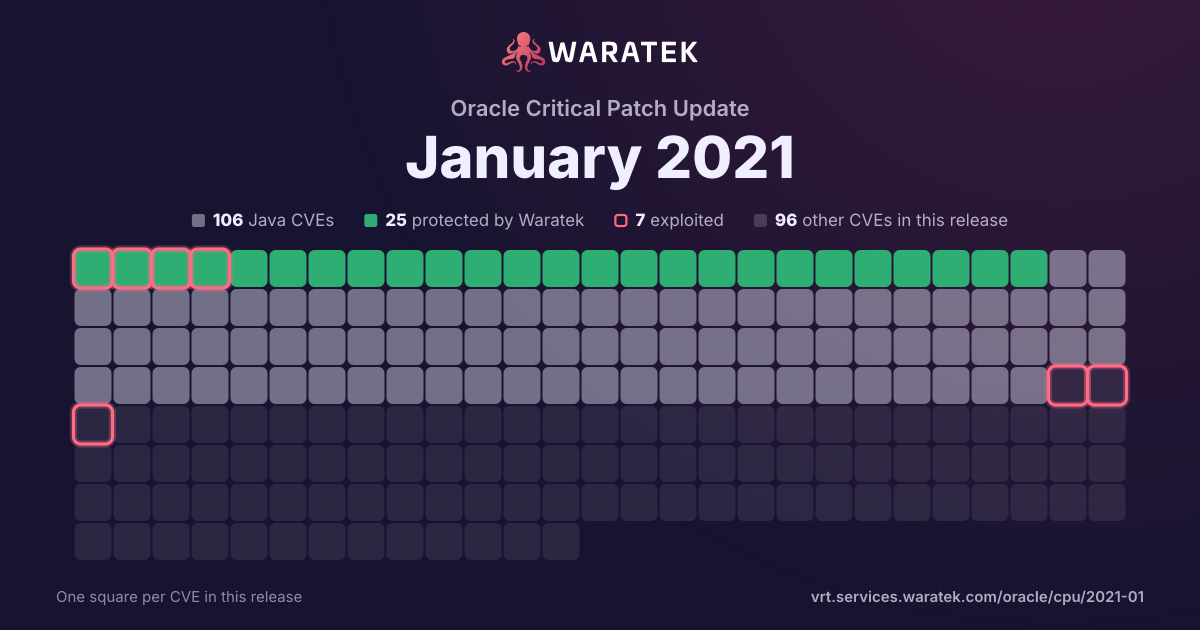
By status
25Protected by Waratek3Mitigation candidate78No exploit published59Outside Waratek scope37Not applicable
7Exploited, marked by the ring
No exploit published. For 66 of them, Oracle's security advisory is the source of public detail.
Protected by Waratek. Waratek RASP can block exploitation of these on systems that have not applied the patch yet.
Overview 2 matches · 1 protected · 0 exploited · 0 CISA KEV · 0 EPSS ≥ 0.5
Protected by Waratek
1
50.0%
Rule in development
0
0.0%
Mitigation candidate
1
50.0%
No exploit published
0
0.0%
Outside Waratek scope
0
0.0%
Not applicable
0
0.0%
Withdrawn CVE
0
0.0%
blocked by ARMR today
1
50.0%
partly blocked
0
0.0%
not blocked
1
50.0%
not established
0
0.0%
unrecorded
0
0.0%
Exploited
0
0.0%
Working exploit published
2
100.0%
Proof of concept only
0
0.0%
Forecast only
0
0.0%
No public exploit
0
0.0%
split by
peak 1 / quarter
Q1 17Q2 17Q3 17Q4 17Q1 18Q2 18Q3 18Q4 18Q1 19Q2 19
| CVE | Severity | Published▾ | Status | Exploitation | Description |
|---|---|---|---|---|---|
| CVE-2019-11269 | Medium | 2019-06-12 | Mitigation candidate | Working exploit published | Spring Security OAuth versions 2.3 prior to 2.3.6, 2.2 prior to 2.2.5, 2.1 prior to 2.1.5, and 2.0 prior to 2.0.18, as well as older unsupported versions could be susceptible to an open redirector attack that can leak an authorization code. A malicious user or attacker can craft a request to the authorization endpoint using the authorization code grant type, and specify a manipulated redirection URI via the redirect_uri parameter. This can cause the authorization server to redirect the resource owner user-agent to a URI under the control of the attacker with the leaked authorization code. |
| CVE-2016-5725 | Medium | 2017-01-19 | Protected by Waratek | Working exploit published | Directory traversal vulnerability in JCraft JSch before 0.1.54 on Windows, when the mode is ChannelSftp.OVERWRITE, allows remote SFTP servers to write to arbitrary files via a ..\ (dot dot backslash) in a response to a recursive GET command. |