
Oracle Critical Patch Update January 2021
Released January 2021 · Oracle's advisory ↗ · ← Critical Patch Update, October 2020 · Critical Patch Update, April 2021 →
202 CVEs in this release, one square each
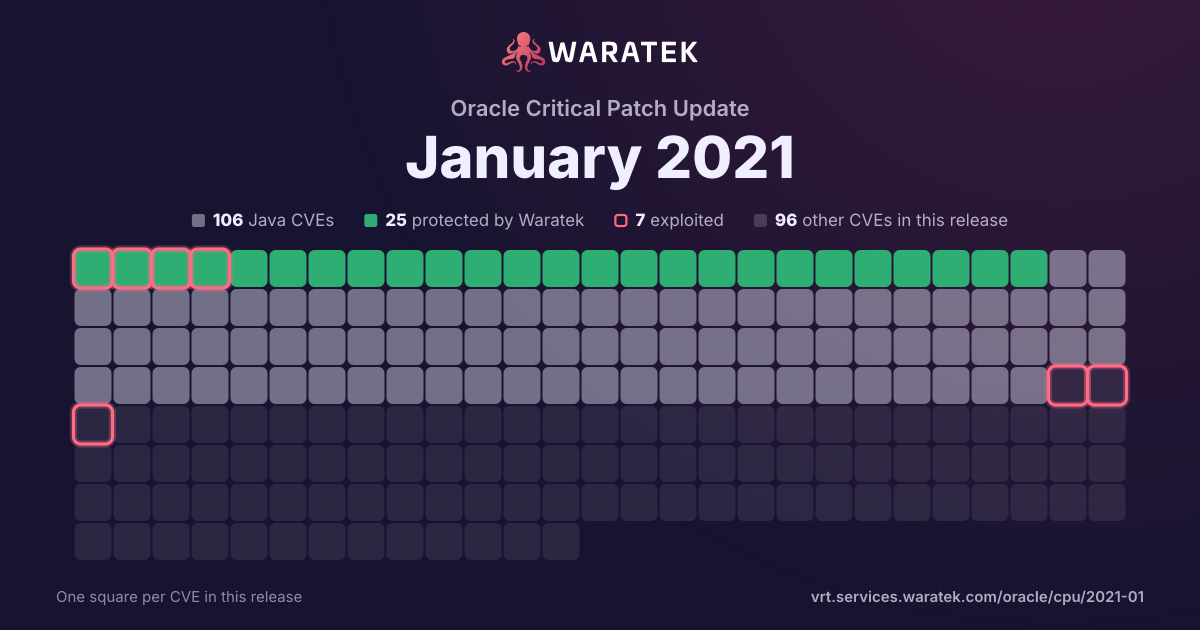
By status
25Protected by Waratek3Mitigation candidate78No exploit published59Outside Waratek scope37Not applicable
7Exploited, marked by the ring
No exploit published. For 66 of them, Oracle's security advisory is the source of public detail.
Protected by Waratek. Waratek RASP can block exploitation of these on systems that have not applied the patch yet.
Overview 27 matches · 7 protected · 0 exploited · 0 CISA KEV · 2 public PoC · 0 EPSS ≥ 0.5
Protected by Waratek
7
25.9%
Rule in development
0
0.0%
Mitigation candidate
1
3.7%
No exploit published
19
70.4%
blocked by ARMR today
7
25.9%
partly blocked
0
0.0%
not blocked
20
74.1%
not established
0
0.0%
unrecorded
0
0.0%
Exploited
0
0.0%
Working exploit published
2
7.4%
Proof of concept only
0
0.0%
Forecast only
0
0.0%
No public exploit
25
92.6%
split by
peak 15 / quarter
Q1 171
Protected by Waratek1
Medium1
blocked by ARMR today1
Working exploit published1
Q2 170
Q3 170
Q4 170
Q1 180
Q2 182
Protected by Waratek2
Medium2
blocked by ARMR today2
No public exploit2
Q3 180
Q4 180
Q1 190
Q2 192
Mitigation candidate1
No exploit published1
Medium2
not blocked2
Working exploit published1
No public exploit1
Q3 190
Q4 192
Protected by Waratek2
Medium2
blocked by ARMR today2
No public exploit2
Q1 200
Q2 201
No exploit published1
Medium1
not blocked1
No public exploit1
Q3 201
No exploit published1
Medium1
not blocked1
No public exploit1
Q4 203
Protected by Waratek2
No exploit published1
Medium3
blocked by ARMR today2
not blocked1
No public exploit3
Q1 2115
No exploit published15
Medium15
not blocked15
No public exploit15
Q1 17Q3 17Q1 18Q3 18Q1 19Q3 19Q1 20Q3 20Q1 21
| CVE | Severity | Published▾ | Status | Exploitation | Description |
|---|---|---|---|---|---|
| CVE-2021-2113 | Medium | 2021-01-20 | No exploit published | No public exploit | Vulnerability in the Oracle Financial Services Revenue Management and Billing product of Oracle Financial Services Applications (component: On Demand Billing). Supported versions that are affected are 2.9.0.0 and 2.9.0.1. Easily exploitable vulnerability allows low privileged attacker with network access via HTTP to compromise Oracle Financial Services Revenue Management and Billing. Successful attacks of this vulnerability can result in unauthorized update, insert or delete access to some of Oracle Financial Services Revenue Management and Billing accessible data. CVSS 3.1 Base Score 4.3 (Integrity impacts). CVSS Vector: (CVSS:3.1/AV:N/AC:L/PR:L/UI:N/S:U/C:N/I:L/A:N). |
| CVE-2021-2110 | Medium | 2021-01-20 | No exploit published | No public exploit | Vulnerability in the Oracle Argus Safety product of Oracle Health Sciences Applications (component: Letters). The supported version that is affected is 8.2.2. Easily exploitable vulnerability allows low privileged attacker with network access via HTTP to compromise Oracle Argus Safety. While the vulnerability is in Oracle Argus Safety, attacks may significantly impact additional products. Successful attacks of this vulnerability can result in unauthorized read access to a subset of Oracle Argus Safety accessible data. CVSS 3.1 Base Score 5.0 (Confidentiality impacts). CVSS Vector: (CVSS:3.1/AV:N/AC:L/PR:L/UI:N/S:C/C:L/I:N/A:N). |
| CVE-2021-2059 | Medium | 2021-01-20 | No exploit published | No public exploit | Vulnerability in the Oracle iStore product of Oracle E-Business Suite (component: Web interface). Supported versions that are affected are 12.1.1-12.1.3 and 12.2.3-12.2.10. Easily exploitable vulnerability allows unauthenticated attacker with network access via HTTP to compromise Oracle iStore. Successful attacks of this vulnerability can result in unauthorized read access to a subset of Oracle iStore accessible data. CVSS 3.1 Base Score 5.3 (Confidentiality impacts). CVSS Vector: (CVSS:3.1/AV:N/AC:L/PR:N/UI:N/S:U/C:L/I:N/A:N). |
| CVE-2021-2057 | Medium | 2021-01-20 | No exploit published | No public exploit | Vulnerability in the Oracle Retail Customer Management and Segmentation Foundation product of Oracle Retail Applications (component: Internal Operations). The supported version that is affected is 19.0. Easily exploitable vulnerability allows low privileged attacker with network access via HTTP to compromise Oracle Retail Customer Management and Segmentation Foundation. Successful attacks of this vulnerability can result in unauthorized update, insert or delete access to some of Oracle Retail Customer Management and Segmentation Foundation accessible data as well as unauthorized read access to a subset of Oracle Retail Customer Management and Segmentation Foundation accessible data and unauthorized ability to cause a partial denial of service (partial DOS) of Oracle Retail Customer Management and Segmentation Foundation. CVSS 3.1 Base Score 6.3 (Confidentiality, Integrity and Availability impacts). CVSS Vector: (CVSS:3.1/AV:N/AC:L/PR:L/UI:N/S:U/C:L/I:L/A:L). |
| CVE-2021-2052 | Medium | 2021-01-20 | No exploit published | No public exploit | Vulnerability in the JD Edwards EnterpriseOne Orchestrator product of Oracle JD Edwards (component: E1 IOT Orchestrator Security). The supported version that is affected is Prior to 9.2.5.1. Easily exploitable vulnerability allows unauthenticated attacker with network access via HTTP to compromise JD Edwards EnterpriseOne Orchestrator. While the vulnerability is in JD Edwards EnterpriseOne Orchestrator, attacks may significantly impact additional products. Successful attacks of this vulnerability can result in unauthorized read access to a subset of JD Edwards EnterpriseOne Orchestrator accessible data. CVSS 3.1 Base Score 5.8 (Confidentiality impacts). CVSS Vector: (CVSS:3.1/AV:N/AC:L/PR:N/UI:N/S:C/C:L/I:N/A:N). |
| CVE-2021-2044 | Medium | 2021-01-20 | No exploit published | No public exploit | Vulnerability in the PeopleSoft Enterprise FIN Payables product of Oracle PeopleSoft (component: Financial Sanctions). The supported version that is affected is 9.2. Easily exploitable vulnerability allows low privileged attacker with network access via HTTP to compromise PeopleSoft Enterprise FIN Payables. Successful attacks of this vulnerability can result in unauthorized access to critical data or complete access to all PeopleSoft Enterprise FIN Payables accessible data. CVSS 3.1 Base Score 6.5 (Confidentiality impacts). CVSS Vector: (CVSS:3.1/AV:N/AC:L/PR:L/UI:N/S:U/C:H/I:N/A:N). |
| CVE-2021-2043 | Medium | 2021-01-20 | No exploit published | No public exploit | Vulnerability in the PeopleSoft Enterprise PeopleTools product of Oracle PeopleSoft (component: Portal). Supported versions that are affected are 8.56, 8.57 and 8.58. Easily exploitable vulnerability allows unauthenticated attacker with network access via HTTP to compromise PeopleSoft Enterprise PeopleTools. Successful attacks require human interaction from a person other than the attacker and while the vulnerability is in PeopleSoft Enterprise PeopleTools, attacks may significantly impact additional products. Successful attacks of this vulnerability can result in unauthorized update, insert or delete access to some of PeopleSoft Enterprise PeopleTools accessible data as well as unauthorized read access to a subset of PeopleSoft Enterprise PeopleTools accessible data. CVSS 3.1 Base Score 6.1 (Confidentiality and Integrity impacts). CVSS Vector: (CVSS:3.1/AV:N/AC:L/PR:N/UI:R/S:C/C:L/I:L/A:N). |
| CVE-2021-2040 | Medium | 2021-01-20 | No exploit published | No public exploit | Vulnerability in the Oracle Argus Safety product of Oracle Health Sciences Applications (component: Case Form, Local Affiliate Form). The supported version that is affected is 8.2.2. Easily exploitable vulnerability allows unauthenticated attacker with network access via HTTP to compromise Oracle Argus Safety. Successful attacks require human interaction from a person other than the attacker and while the vulnerability is in Oracle Argus Safety, attacks may significantly impact additional products. Successful attacks of this vulnerability can result in unauthorized update, insert or delete access to some of Oracle Argus Safety accessible data as well as unauthorized read access to a subset of Oracle Argus Safety accessible data. CVSS 3.1 Base Score 6.1 (Confidentiality and Integrity impacts). CVSS Vector: (CVSS:3.1/AV:N/AC:L/PR:N/UI:R/S:C/C:L/I:L/A:N). |
| CVE-2021-2033 | Medium | 2021-01-20 | No exploit published | No public exploit | Vulnerability in the Oracle WebLogic Server product of Oracle Fusion Middleware (component: Core Components). Supported versions that are affected are 12.1.3.0.0, 12.2.1.3.0, 12.2.1.4.0 and 14.1.1.0.0. Easily exploitable vulnerability allows low privileged attacker with network access via HTTP to compromise Oracle WebLogic Server. Successful attacks of this vulnerability can result in unauthorized ability to cause a partial denial of service (partial DOS) of Oracle WebLogic Server. CVSS 3.1 Base Score 4.3 (Availability impacts). CVSS Vector: (CVSS:3.1/AV:N/AC:L/PR:L/UI:N/S:U/C:N/I:N/A:L). |
| CVE-2021-2023 | Medium | 2021-01-20 | No exploit published | No public exploit | Vulnerability in the Oracle Installed Base product of Oracle E-Business Suite (component: APIs). Supported versions that are affected are 12.1.1-12.1.3 and 12.2.3-12.2.9. Easily exploitable vulnerability allows unauthenticated attacker with network access via HTTP to compromise Oracle Installed Base. Successful attacks require human interaction from a person other than the attacker and while the vulnerability is in Oracle Installed Base, attacks may significantly impact additional products. Successful attacks of this vulnerability can result in unauthorized update, insert or delete access to some of Oracle Installed Base accessible data. CVSS 3.1 Base Score 4.7 (Integrity impacts). CVSS Vector: (CVSS:3.1/AV:N/AC:L/PR:N/UI:R/S:C/C:N/I:L/A:N). |
| CVE-2021-2017 | Medium | 2021-01-20 | No exploit published | No public exploit | Vulnerability in the Oracle User Management product of Oracle E-Business Suite (component: Proxy User Delegation). Supported versions that are affected are 12.1.3 and 12.2.3-12.2.10. Easily exploitable vulnerability allows low privileged attacker with network access via HTTP to compromise Oracle User Management. Successful attacks of this vulnerability can result in unauthorized read access to a subset of Oracle User Management accessible data. CVSS 3.1 Base Score 4.3 (Confidentiality impacts). CVSS Vector: (CVSS:3.1/AV:N/AC:L/PR:L/UI:N/S:U/C:L/I:N/A:N). |
| CVE-2021-2005 | Medium | 2021-01-20 | No exploit published | No public exploit | Vulnerability in the Oracle Business Intelligence Enterprise Edition product of Oracle Fusion Middleware (component: BI Platform Security). Supported versions that are affected are 12.2.1.3.0 and 12.2.1.4.0. Easily exploitable vulnerability allows unauthenticated attacker with network access via HTTP to compromise Oracle Business Intelligence Enterprise Edition. Successful attacks require human interaction from a person other than the attacker and while the vulnerability is in Oracle Business Intelligence Enterprise Edition, attacks may significantly impact additional products. Successful attacks of this vulnerability can result in unauthorized read access to a subset of Oracle Business Intelligence Enterprise Edition accessible data. CVSS 3.1 Base Score 4.7 (Confidentiality impacts). CVSS Vector: (CVSS:3.1/AV:N/AC:L/PR:N/UI:R/S:C/C:L/I:N/A:N). |
| CVE-2021-2004 | Medium | 2021-01-20 | No exploit published | No public exploit | Vulnerability in the Siebel Core - Server BizLogic Script product of Oracle Siebel CRM (component: Integration - Scripting). Supported versions that are affected are 20.12 and prior. Easily exploitable vulnerability allows low privileged attacker with network access via HTTP to compromise Siebel Core - Server BizLogic Script. Successful attacks of this vulnerability can result in unauthorized read access to a subset of Siebel Core - Server BizLogic Script accessible data. CVSS 3.1 Base Score 4.3 (Confidentiality impacts). CVSS Vector: (CVSS:3.1/AV:N/AC:L/PR:L/UI:N/S:U/C:L/I:N/A:N). |
| CVE-2021-2003 | Medium | 2021-01-20 | No exploit published | No public exploit | Vulnerability in the Business Intelligence Enterprise Edition product of Oracle Fusion Middleware (component: Analytics Web Dashboards). Supported versions that are affected are 5.5.0.0.0, 11.1.1.9.0, 12.2.1.3.0 and 12.2.1.4.0. Easily exploitable vulnerability allows low privileged attacker with network access via HTTP to compromise Business Intelligence Enterprise Edition. Successful attacks require human interaction from a person other than the attacker and while the vulnerability is in Business Intelligence Enterprise Edition, attacks may significantly impact additional products. Successful attacks of this vulnerability can result in unauthorized update, insert or delete access to some of Business Intelligence Enterprise Edition accessible data as well as unauthorized read access to a subset of Business Intelligence Enterprise Edition accessible data. CVSS 3.1 Base Score 5.4 (Confidentiality and Integrity impacts). CVSS Vector: (CVSS:3.1/AV:N/AC:L/PR:L/UI:R/S:C/C:L/I:L/A:N). |
| CVE-2021-1995 | Medium | 2021-01-20 | No exploit published | No public exploit | Vulnerability in the Oracle WebLogic Server product of Oracle Fusion Middleware (component: Web Services). Supported versions that are affected are 10.3.6.0.0 and 12.1.3.0.0. Easily exploitable vulnerability allows low privileged attacker with network access via HTTP to compromise Oracle WebLogic Server. Successful attacks of this vulnerability can result in unauthorized creation, deletion or modification access to critical data or all Oracle WebLogic Server accessible data. CVSS 3.1 Base Score 6.5 (Integrity impacts). CVSS Vector: (CVSS:3.1/AV:N/AC:L/PR:L/UI:N/S:U/C:N/I:H/A:N). |
| CVE-2020-17521 | Medium | 2020-12-07 | Protected by Waratek | No public exploit | Apache Groovy provides extension methods to aid with creating temporary directories. Prior to this fix, Groovy's implementation of those extension methods was using a now superseded Java JDK method call that is potentially not secure on some operating systems in some contexts. Users not using the extension methods mentioned in the advisory are not affected, but may wish to read the advisory for further details. Versions Affected: 2.0 to 2.4.20, 2.5.0 to 2.5.13, 3.0.0 to 3.0.6, and 4.0.0-alpha-1. Fixed in versions 2.4.21, 2.5.14, 3.0.7, 4.0.0-alpha-2. |
| CVE-2020-13954 | Medium | 2020-11-12 | No exploit published | No public exploit | By default, Apache CXF creates a /services page containing a listing of the available endpoint names and addresses. This webpage is vulnerable to a reflected Cross-Site Scripting (XSS) attack via the styleSheetPath, which allows a malicious actor to inject javascript into the web page. This vulnerability affects all versions of Apache CXF prior to 3.4.1 and 3.3.8. Please note that this is a separate issue to CVE-2019-17573. |
| CVE-2020-14803 | Medium | 2020-10-21 | Protected by Waratek | No public exploit | Vulnerability in the Java SE product of Oracle Java SE (component: Libraries). Supported versions that are affected are Java SE: 11.0.8 and 15. Easily exploitable vulnerability allows unauthenticated attacker with network access via multiple protocols to compromise Java SE. Successful attacks of this vulnerability can result in unauthorized read access to a subset of Java SE accessible data. Note: This vulnerability applies to Java deployments, typically in clients running sandboxed Java Web Start applications or sandboxed Java applets, that load and run untrusted code (e.g., code that comes from the internet) and rely on the Java sandbox for security. This vulnerability does not apply to Java deployments, typically in servers, that load and run only trusted code (e.g., code installed by an administrator). CVSS 3.1 Base Score 5.3 (Confidentiality impacts). CVSS Vector: (CVSS:3.1/AV:N/AC:L/PR:N/UI:N/S:U/C:L/I:N/A:N). |
| CVE-2020-5421 | Medium | 2020-09-19 | No exploit published | No public exploit | In Spring Framework versions 5.2.0 - 5.2.8, 5.1.0 - 5.1.17, 5.0.0 - 5.0.18, 4.3.0 - 4.3.28, and older unsupported versions, the protections against RFD attacks from CVE-2015-5211 may be bypassed depending on the browser used through the use of a jsessionid path parameter. |
| CVE-2020-5408 | Medium | 2020-05-14 | No exploit published | No public exploit | Spring Security versions 5.3.x prior to 5.3.2, 5.2.x prior to 5.2.4, 5.1.x prior to 5.1.10, 5.0.x prior to 5.0.16 and 4.2.x prior to 4.2.16 use a fixed null initialization vector with CBC Mode in the implementation of the queryable text encryptor. A malicious user with access to the data that has been encrypted using such an encryptor may be able to derive the unencrypted values using a dictionary attack. |
| CVE-2019-12415 | Medium | 2019-10-23 | Protected by Waratek | No public exploit | In Apache POI up to 4.1.0, when using the tool XSSFExportToXml to convert user-provided Microsoft Excel documents, a specially crafted document can allow an attacker to read files from the local filesystem or from internal network resources via XML External Entity (XXE) Processing. |
| CVE-2019-17091 | Medium | 2019-10-02 | Protected by Waratek | No public exploit | faces/context/PartialViewContextImpl.java in Eclipse Mojarra, as used in Mojarra for Eclipse EE4J before 2.3.10 and Mojarra JavaServer Faces before 2.2.20, allows Reflected XSS because a client window field is mishandled. |
| CVE-2019-11269 | Medium | 2019-06-12 | Mitigation candidate | Working exploit published | Spring Security OAuth versions 2.3 prior to 2.3.6, 2.2 prior to 2.2.5, 2.1 prior to 2.1.5, and 2.0 prior to 2.0.18, as well as older unsupported versions could be susceptible to an open redirector attack that can leak an authorization code. A malicious user or attacker can craft a request to the authorization endpoint using the authorization code grant type, and specify a manipulated redirection URI via the redirect_uri parameter. This can cause the authorization server to redirect the resource owner user-agent to a URI under the control of the attacker with the leaked authorization code. |
| CVE-2019-10247 | Medium | 2019-04-22 | No exploit published | No public exploit | In Eclipse Jetty version 7.x, 8.x, 9.2.27 and older, 9.3.26 and older, and 9.4.16 and older, the server running on any OS and Jetty version combination will reveal the configured fully qualified directory base resource location on the output of the 404 error for not finding a Context that matches the requested path. The default server behavior on jetty-distribution and jetty-home will include at the end of the Handler tree a DefaultHandler, which is responsible for reporting this 404 error, it presents the various configured contexts as HTML for users to click through to. This produced HTML includes output that contains the configured fully qualified directory base resource location for each context. |
| CVE-2018-10237 | Medium | 2018-04-26 | Protected by Waratek | No public exploit | Unbounded memory allocation in Google Guava 11.0 through 24.x before 24.1.1 allows remote attackers to conduct denial of service attacks against servers that depend on this library and deserialize attacker-provided data, because the AtomicDoubleArray class (when serialized with Java serialization) and the CompoundOrdering class (when serialized with GWT serialization) perform eager allocation without appropriate checks on what a client has sent and whether the data size is reasonable. |
| CVE-2018-2587 | Medium | 2018-04-19 | Protected by Waratek | No public exploit | Vulnerability in the Oracle Access Manager component of Oracle Fusion Middleware (subcomponent: Web Server Plugin). Supported versions that are affected are 10.1.4.3.0, 11.1.2.3.0 and 12.2.1.3.0. Difficult to exploit vulnerability allows unauthenticated attacker with network access via HTTP to compromise Oracle Access Manager. Successful attacks of this vulnerability can result in unauthorized creation, deletion or modification access to critical data or all Oracle Access Manager accessible data as well as unauthorized read access to a subset of Oracle Access Manager accessible data. CVSS 3.0 Base Score 6.5 (Confidentiality and Integrity impacts). CVSS Vector: (CVSS:3.0/AV:N/AC:H/PR:N/UI:N/S:U/C:L/I:H/A:N). |
| CVE-2016-5725 | Medium | 2017-01-19 | Protected by Waratek | Working exploit published | Directory traversal vulnerability in JCraft JSch before 0.1.54 on Windows, when the mode is ChannelSftp.OVERWRITE, allows remote SFTP servers to write to arbitrary files via a ..\ (dot dot backslash) in a response to a recursive GET command. |