
Oracle Critical Patch Update January 2021
Released January 2021 · Oracle's advisory ↗ · ← Critical Patch Update, October 2020 · Critical Patch Update, April 2021 →
202 CVEs in this release, one square each
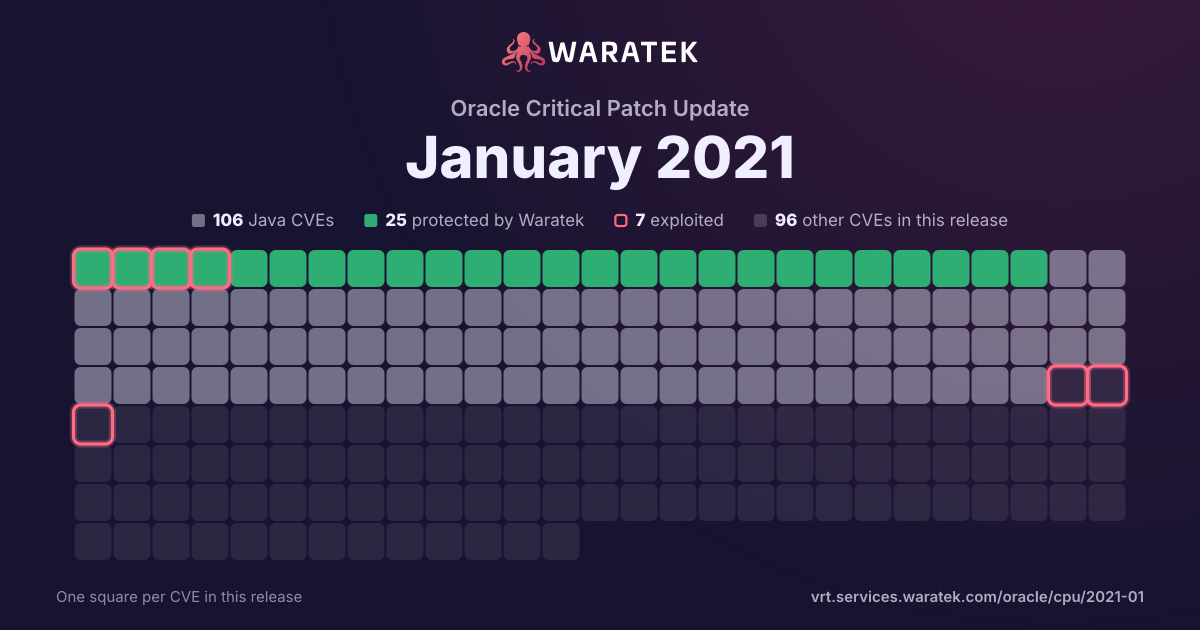
By status
25Protected by Waratek3Mitigation candidate78No exploit published59Outside Waratek scope37Not applicable
7Exploited, marked by the ring
No exploit published. For 66 of them, Oracle's security advisory is the source of public detail.
Protected by Waratek. Waratek RASP can block exploitation of these on systems that have not applied the patch yet.
Overview 7 matches · 2 protected · 0 exploited · 0 CISA KEV · 1 public PoC · 0 EPSS ≥ 0.5
Protected by Waratek
2
28.6%
Rule in development
0
0.0%
Mitigation candidate
1
14.3%
No exploit published
4
57.1%
blocked by ARMR today
2
28.6%
partly blocked
0
0.0%
not blocked
5
71.4%
not established
0
0.0%
unrecorded
0
0.0%
Exploited
0
0.0%
Working exploit published
1
14.3%
Proof of concept only
0
0.0%
Forecast only
0
0.0%
No public exploit
6
85.7%
split by
peak 2 / quarter
Q2 192
Mitigation candidate1
No exploit published1
Medium2
not blocked2
Working exploit published1
No public exploit1
Q3 190
Q4 192
Protected by Waratek2
Medium2
blocked by ARMR today2
No public exploit2
Q1 200
Q2 201
No exploit published1
Medium1
not blocked1
No public exploit1
Q3 201
No exploit published1
Medium1
not blocked1
No public exploit1
Q4 200
Q1 211
No exploit published1
Medium1
not blocked1
No public exploit1
Q2 19Q3 19Q4 19Q1 20Q2 20Q3 20Q4 20Q1 21
| CVE | Severity | Published▾ | Status | Exploitation | Description |
|---|---|---|---|---|---|
| CVE-2021-2113 | Medium | 2021-01-20 | No exploit published | No public exploit | Vulnerability in the Oracle Financial Services Revenue Management and Billing product of Oracle Financial Services Applications (component: On Demand Billing). Supported versions that are affected are 2.9.0.0 and 2.9.0.1. Easily exploitable vulnerability allows low privileged attacker with network access via HTTP to compromise Oracle Financial Services Revenue Management and Billing. Successful attacks of this vulnerability can result in unauthorized update, insert or delete access to some of Oracle Financial Services Revenue Management and Billing accessible data. CVSS 3.1 Base Score 4.3 (Integrity impacts). CVSS Vector: (CVSS:3.1/AV:N/AC:L/PR:L/UI:N/S:U/C:N/I:L/A:N). |
| CVE-2020-5421 | Medium | 2020-09-19 | No exploit published | No public exploit | In Spring Framework versions 5.2.0 - 5.2.8, 5.1.0 - 5.1.17, 5.0.0 - 5.0.18, 4.3.0 - 4.3.28, and older unsupported versions, the protections against RFD attacks from CVE-2015-5211 may be bypassed depending on the browser used through the use of a jsessionid path parameter. |
| CVE-2020-5408 | Medium | 2020-05-14 | No exploit published | No public exploit | Spring Security versions 5.3.x prior to 5.3.2, 5.2.x prior to 5.2.4, 5.1.x prior to 5.1.10, 5.0.x prior to 5.0.16 and 4.2.x prior to 4.2.16 use a fixed null initialization vector with CBC Mode in the implementation of the queryable text encryptor. A malicious user with access to the data that has been encrypted using such an encryptor may be able to derive the unencrypted values using a dictionary attack. |
| CVE-2019-12415 | Medium | 2019-10-23 | Protected by Waratek | No public exploit | In Apache POI up to 4.1.0, when using the tool XSSFExportToXml to convert user-provided Microsoft Excel documents, a specially crafted document can allow an attacker to read files from the local filesystem or from internal network resources via XML External Entity (XXE) Processing. |
| CVE-2019-17091 | Medium | 2019-10-02 | Protected by Waratek | No public exploit | faces/context/PartialViewContextImpl.java in Eclipse Mojarra, as used in Mojarra for Eclipse EE4J before 2.3.10 and Mojarra JavaServer Faces before 2.2.20, allows Reflected XSS because a client window field is mishandled. |
| CVE-2019-11269 | Medium | 2019-06-12 | Mitigation candidate | Working exploit published | Spring Security OAuth versions 2.3 prior to 2.3.6, 2.2 prior to 2.2.5, 2.1 prior to 2.1.5, and 2.0 prior to 2.0.18, as well as older unsupported versions could be susceptible to an open redirector attack that can leak an authorization code. A malicious user or attacker can craft a request to the authorization endpoint using the authorization code grant type, and specify a manipulated redirection URI via the redirect_uri parameter. This can cause the authorization server to redirect the resource owner user-agent to a URI under the control of the attacker with the leaked authorization code. |
| CVE-2019-10247 | Medium | 2019-04-22 | No exploit published | No public exploit | In Eclipse Jetty version 7.x, 8.x, 9.2.27 and older, 9.3.26 and older, and 9.4.16 and older, the server running on any OS and Jetty version combination will reveal the configured fully qualified directory base resource location on the output of the 404 error for not finding a Context that matches the requested path. The default server behavior on jetty-distribution and jetty-home will include at the end of the Handler tree a DefaultHandler, which is responsible for reporting this 404 error, it presents the various configured contexts as HTML for users to click through to. This produced HTML includes output that contains the configured fully qualified directory base resource location for each context. |