
Oracle Critical Patch Update October 2020
Released October 2020 · Oracle's advisory ↗ · ← Critical Patch Update, July 2020 · Critical Patch Update, January 2021 →
230 CVEs in this release, one square each
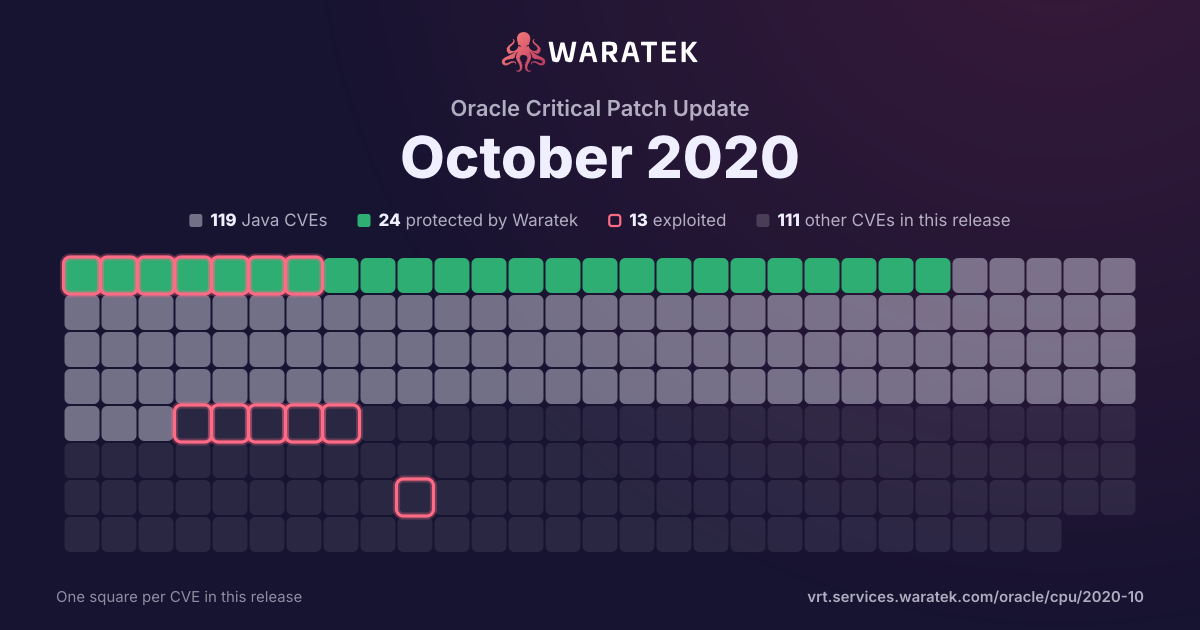
By status
24Protected by Waratek2Mitigation candidate93No exploit published64Outside Waratek scope47Not applicable
13Exploited, marked by the ring
No exploit published. For 75 of them, Oracle's security advisory is the source of public detail.
Protected by Waratek. Waratek RASP can block exploitation of these on systems that have not applied the patch yet.
Overview 9 matches · 0 in Waratek scope · 0 protected · 0 exploited · 0 CISA KEV · 1 public PoC · 1 EPSS ≥ 0.5
9matches
0in Waratek scope0.0%
0protected0.0%
0exploited0.0%
0CISA KEV0.0%
1public PoC11.1%
1EPSS ≥ 0.511.1%
Protected by Waratek
0
0.0%
Rule in development
0
0.0%
Mitigation candidate
0
0.0%
No exploit published
0
0.0%
Outside Waratek scope
0
0.0%
Not applicable
9
100.0%
Withdrawn CVE
0
0.0%
blocked by ARMR today
0
0.0%
partly blocked
0
0.0%
not blocked
9
100.0%
not established
0
0.0%
unrecorded
0
0.0%
Exploited
0
0.0%
Working exploit published
0
0.0%
Proof of concept only
1
11.1%
Forecast only
0
0.0%
No public exploit
8
88.9%
split by
peak 5 / month
Jun 191
Not applicable1
High1
not blocked1
Proof of concept only1
Jul 191
Not applicable1
High1
not blocked1
No public exploit1
Aug 190
Sep 190
Oct 190
Nov 190
Dec 190
Jan 200
Feb 200
Mar 200
Apr 200
May 200
Jun 201
Not applicable1
High1
not blocked1
No public exploit1
Jul 201
Not applicable1
High1
not blocked1
No public exploit1
Aug 200
Sep 200
Oct 205
Not applicable5
High5
not blocked5
No public exploit5
Jun 19Aug 19Oct 19Dec 19Feb 20Apr 20Jun 20Aug 20Oct 20
| CVE | Severity | Published▾ | Status | Exploitation | Description |
|---|---|---|---|---|---|
| CVE-2020-14878 | High | 2020-10-21 | Not applicable | No public exploit | Vulnerability in the MySQL Server product of Oracle MySQL (component: Server: Security: LDAP Auth). Supported versions that are affected are 8.0.21 and prior. Easily exploitable vulnerability allows low privileged attacker with access to the physical communication segment attached to the hardware where the MySQL Server executes to compromise MySQL Server. Successful attacks of this vulnerability can result in takeover of MySQL Server. CVSS 3.1 Base Score 8.0 (Confidentiality, Integrity and Availability impacts). CVSS Vector: (CVSS:3.1/AV:A/AC:L/PR:L/UI:N/S:U/C:H/I:H/A:H). |
| CVE-2020-14872 | High | 2020-10-21 | Not applicable | No public exploit | Vulnerability in the Oracle VM VirtualBox product of Oracle Virtualization (component: Core). The supported version that is affected is Prior to 6.1.16. Easily exploitable vulnerability allows high privileged attacker with logon to the infrastructure where Oracle VM VirtualBox executes to compromise Oracle VM VirtualBox. While the vulnerability is in Oracle VM VirtualBox, attacks may significantly impact additional products. Successful attacks of this vulnerability can result in takeover of Oracle VM VirtualBox. CVSS 3.1 Base Score 8.2 (Confidentiality, Integrity and Availability impacts). CVSS Vector: (CVSS:3.1/AV:L/AC:L/PR:H/UI:N/S:C/C:H/I:H/A:H). |
| CVE-2020-14807 | High | 2020-10-21 | Not applicable | No public exploit | Vulnerability in the Oracle Hospitality Suite8 product of Oracle Hospitality Applications (component: WebConnect). Supported versions that are affected are 8.10.2 and 8.11-8.14. Easily exploitable vulnerability allows unauthenticated attacker with network access via HTTP to compromise Oracle Hospitality Suite8. Successful attacks require human interaction from a person other than the attacker. Successful attacks of this vulnerability can result in unauthorized access to critical data or complete access to all Oracle Hospitality Suite8 accessible data as well as unauthorized update, insert or delete access to some of Oracle Hospitality Suite8 accessible data. CVSS 3.1 Base Score 7.1 (Confidentiality and Integrity impacts). CVSS Vector: (CVSS:3.1/AV:N/AC:L/PR:N/UI:R/S:U/C:H/I:L/A:N). |
| CVE-2020-14735 | High | 2020-10-21 | Not applicable | No public exploit | Vulnerability in the Scheduler component of Oracle Database Server. Supported versions that are affected are 11.2.0.4, 12.1.0.2, 12.2.0.1, 18c and 19c. Easily exploitable vulnerability allows low privileged attacker having Local Logon privilege with logon to the infrastructure where Scheduler executes to compromise Scheduler. While the vulnerability is in Scheduler, attacks may significantly impact additional products. Successful attacks of this vulnerability can result in takeover of Scheduler. CVSS 3.1 Base Score 8.8 (Confidentiality, Integrity and Availability impacts). CVSS Vector: (CVSS:3.1/AV:L/AC:L/PR:L/UI:N/S:C/C:H/I:H/A:H). |
| CVE-2020-14734 | High | 2020-10-21 | Not applicable | No public exploit | Vulnerability in the Oracle Text component of Oracle Database Server. Supported versions that are affected are 11.2.0.4, 12.1.0.2, 12.2.0.1, 18c and 19c. Difficult to exploit vulnerability allows unauthenticated attacker with network access via Oracle Net to compromise Oracle Text. Successful attacks of this vulnerability can result in takeover of Oracle Text. CVSS 3.1 Base Score 8.1 (Confidentiality, Integrity and Availability impacts). CVSS Vector: (CVSS:3.1/AV:N/AC:H/PR:N/UI:N/S:U/C:H/I:H/A:H). |
| CVE-2020-8174 | High | 2020-07-24 | Not applicable | No public exploit | napi_get_value_string_*() allows various kinds of memory corruption in node < 10.21.0, 12.18.0, and < 14.4.0. |
| CVE-2020-3235 | High | 2020-06-03 | Not applicable | No public exploit | A vulnerability in the Simple Network Management Protocol (SNMP) subsystem of Cisco IOS Software and Cisco IOS XE Software on Catalyst 4500 Series Switches could allow an authenticated, remote attacker to cause a denial of service (DoS) condition. The vulnerability is due to insufficient input validation when the software processes specific SNMP object identifiers. An attacker could exploit this vulnerability by sending a crafted SNMP packet to an affected device. A successful exploit could allow the attacker to cause the affected device to reload, resulting in a DoS condition. Note: To exploit this vulnerability by using SNMPv2c or earlier, the attacker must know the SNMP read-only community string for an affected system. To exploit this vulnerability by using SNMPv3, the attacker must know the user credentials for the affected system. |
| CVE-2019-1010239 | High | 2019-07-19 | Not applicable | No public exploit | DaveGamble/cJSON cJSON 1.7.8 is affected by: Improper Check for Unusual or Exceptional Conditions. The impact is: Null dereference, so attack can cause denial of service. The component is: cJSON_GetObjectItemCaseSensitive() function. The attack vector is: crafted json file. The fixed version is: 1.7.9 and later. |
| CVE-2019-11477 | High | 2019-06-19 | Not applicable | Proof of concept only | Jonathan Looney discovered that the TCP_SKB_CB(skb)->tcp_gso_segs value was subject to an integer overflow in the Linux kernel when handling TCP Selective Acknowledgments (SACKs). A remote attacker could use this to cause a denial of service. This has been fixed in stable kernel releases 4.4.182, 4.9.182, 4.14.127, 4.19.52, 5.1.11, and is fixed in commit 3b4929f65b0d8249f19a50245cd88ed1a2f78cff. |