
Oracle Critical Patch Update October 2020
Released October 2020 · Oracle's advisory ↗ · ← Critical Patch Update, July 2020 · Critical Patch Update, January 2021 →
230 CVEs in this release, one square each
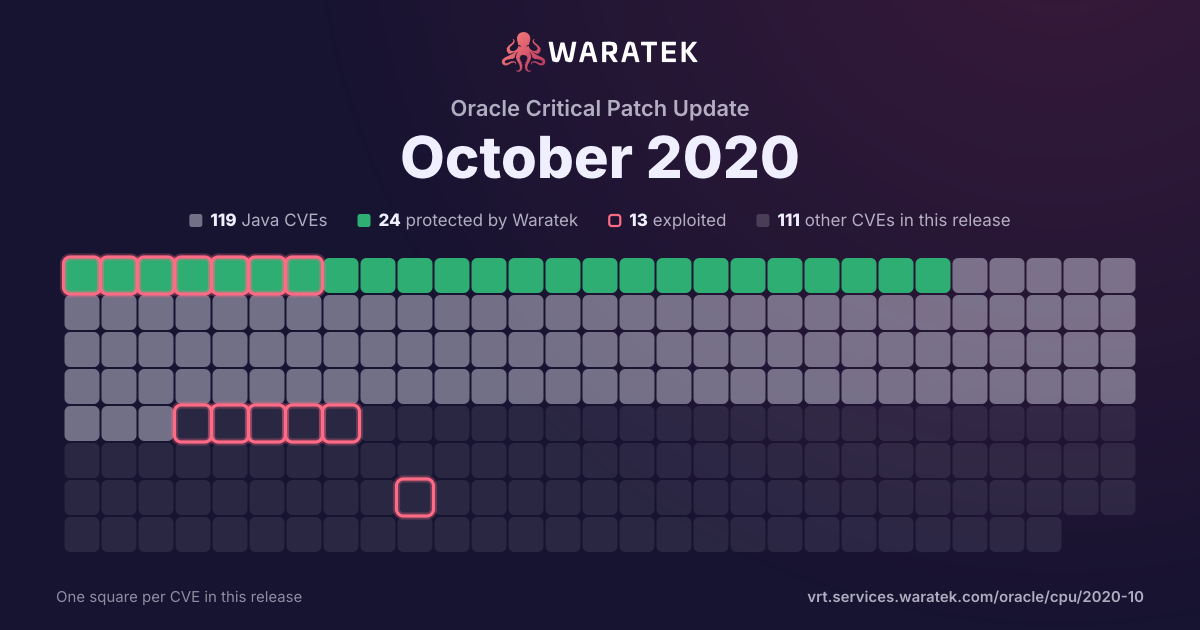
By status
24Protected by Waratek2Mitigation candidate93No exploit published64Outside Waratek scope47Not applicable
13Exploited, marked by the ring
No exploit published. For 75 of them, Oracle's security advisory is the source of public detail.
Protected by Waratek. Waratek RASP can block exploitation of these on systems that have not applied the patch yet.
Overview 34 matches · 25 in Waratek scope · 12 protected · 6 exploited · 4 CISA KEV · 7 public PoC · 8 EPSS ≥ 0.5
34matches
25in Waratek scope73.5%
12protected35.3%
6exploited17.6%
4CISA KEV11.8%
7public PoC20.6%
8EPSS ≥ 0.523.5%
Protected by Waratek
12
35.3%
Rule in development
0
0.0%
Mitigation candidate
1
2.9%
No exploit published
12
35.3%
Outside Waratek scope
6
17.6%
Not applicable
3
8.8%
Withdrawn CVE
0
0.0%
blocked by ARMR today
12
35.3%
partly blocked
0
0.0%
not blocked
22
64.7%
not established
0
0.0%
unrecorded
0
0.0%
Exploited
6
17.6%
Working exploit published
1
2.9%
Proof of concept only
0
0.0%
Forecast only
1
2.9%
No public exploit
26
76.5%
split by
peak 9 / quarter
Q4 162
Protected by Waratek1
Outside Waratek scope1
Critical2
blocked by ARMR today1
not blocked1
No public exploit2
Q1 170
Q2 171
Protected by Waratek1
Critical1
blocked by ARMR today1
Working exploit published1
Q3 171
Not applicable1
Critical1
not blocked1
No public exploit1
Q4 170
Q1 181
Protected by Waratek1
Critical1
blocked by ARMR today1
No public exploit1
Q2 181
No exploit published1
Critical1
not blocked1
No public exploit1
Q3 181
Outside Waratek scope1
Critical1
not blocked1
No public exploit1
Q4 180
Q1 191
Protected by Waratek1
Critical1
blocked by ARMR today1
Exploited1
Q2 191
Not applicable1
Critical1
not blocked1
No public exploit1
Q3 194
Protected by Waratek1
Outside Waratek scope3
Critical4
blocked by ARMR today1
not blocked3
Forecast only1
No public exploit3
Q4 194
No exploit published4
Critical4
not blocked4
No public exploit4
Q1 204
Protected by Waratek2
Mitigation candidate1
No exploit published1
Critical4
blocked by ARMR today2
not blocked2
Exploited2
No public exploit2
Q2 202
Protected by Waratek2
Critical2
blocked by ARMR today2
No public exploit2
Q3 202
No exploit published1
Outside Waratek scope1
Critical2
not blocked2
Exploited1
No public exploit1
Q4 209
Protected by Waratek3
No exploit published5
Not applicable1
Critical9
blocked by ARMR today3
not blocked6
Exploited2
No public exploit7
Q4 16Q2 17Q4 17Q2 18Q4 18Q2 19Q4 19Q2 20Q4 20
| CVE | Severity | Published▾ | Status | Exploitation | Description |
|---|---|---|---|---|---|
| CVE-2020-14882 | Critical | 2020-10-21 | Protected by Waratek | Exploited | Vulnerability in the Oracle WebLogic Server product of Oracle Fusion Middleware (component: Console). Supported versions that are affected are 10.3.6.0.0, 12.1.3.0.0, 12.2.1.3.0, 12.2.1.4.0 and 14.1.1.0.0. Easily exploitable vulnerability allows unauthenticated attacker with network access via HTTP to compromise Oracle WebLogic Server. Successful attacks of this vulnerability can result in takeover of Oracle WebLogic Server. CVSS 3.1 Base Score 9.8 (Confidentiality, Integrity and Availability impacts). CVSS Vector: (CVSS:3.1/AV:N/AC:L/PR:N/UI:N/S:U/C:H/I:H/A:H). |
| CVE-2020-14876 | Critical | 2020-10-21 | No exploit published | No public exploit | Vulnerability in the Oracle Trade Management product of Oracle E-Business Suite (component: User Interface). Supported versions that are affected are 12.1.1 - 12.1.3 and 12.2.3 - 12.2.10. Easily exploitable vulnerability allows unauthenticated attacker with network access via HTTP to compromise Oracle Trade Management. Successful attacks of this vulnerability can result in unauthorized creation, deletion or modification access to critical data or all Oracle Trade Management accessible data as well as unauthorized access to critical data or complete access to all Oracle Trade Management accessible data. CVSS 3.1 Base Score 9.1 (Confidentiality and Integrity impacts). CVSS Vector: (CVSS:3.1/AV:N/AC:L/PR:N/UI:N/S:U/C:H/I:H/A:N). |
| CVE-2020-14875 | Critical | 2020-10-21 | No exploit published | No public exploit | Vulnerability in the Oracle Marketing product of Oracle E-Business Suite (component: Marketing Administration). Supported versions that are affected are 12.1.1 - 12.1.3 and 12.2.3 - 12.2.10. Easily exploitable vulnerability allows unauthenticated attacker with network access via HTTP to compromise Oracle Marketing. Successful attacks of this vulnerability can result in unauthorized creation, deletion or modification access to critical data or all Oracle Marketing accessible data as well as unauthorized access to critical data or complete access to all Oracle Marketing accessible data. CVSS 3.1 Base Score 9.1 (Confidentiality and Integrity impacts). CVSS Vector: (CVSS:3.1/AV:N/AC:L/PR:N/UI:N/S:U/C:H/I:H/A:N). |
| CVE-2020-14871 | Critical | 2020-10-21 | Not applicable | Exploited | Vulnerability in the Oracle Solaris product of Oracle Systems (component: Pluggable authentication module). Supported versions that are affected are 10 and 11. Easily exploitable vulnerability allows unauthenticated attacker with network access via multiple protocols to compromise Oracle Solaris. While the vulnerability is in Oracle Solaris, attacks may significantly impact additional products. Successful attacks of this vulnerability can result in takeover of Oracle Solaris. Note: This CVE is not exploitable for Solaris 11.1 and later releases, and ZFSSA 8.7 and later releases, thus the CVSS Base Score is 0.0. CVSS 3.1 Base Score 10.0 (Confidentiality, Integrity and Availability impacts). CVSS Vector: (CVSS:3.1/AV:N/AC:L/PR:N/UI:N/S:C/C:H/I:H/A:H). |
| CVE-2020-14859 | Critical | 2020-10-21 | Protected by Waratek | No public exploit | Vulnerability in the Oracle WebLogic Server product of Oracle Fusion Middleware (component: Core). Supported versions that are affected are 10.3.6.0.0, 12.1.3.0.0, 12.2.1.3.0, 12.2.1.4.0 and 14.1.1.0.0. Easily exploitable vulnerability allows unauthenticated attacker with network access via IIOP, T3 to compromise Oracle WebLogic Server. Successful attacks of this vulnerability can result in takeover of Oracle WebLogic Server. CVSS 3.1 Base Score 9.8 (Confidentiality, Integrity and Availability impacts). CVSS Vector: (CVSS:3.1/AV:N/AC:L/PR:N/UI:N/S:U/C:H/I:H/A:H). |
| CVE-2020-14855 | Critical | 2020-10-21 | No exploit published | No public exploit | Vulnerability in the Oracle Universal Work Queue product of Oracle E-Business Suite (component: Work Provider Administration). The supported version that is affected is 12.1.3. Easily exploitable vulnerability allows unauthenticated attacker with network access via HTTP to compromise Oracle Universal Work Queue. Successful attacks of this vulnerability can result in takeover of Oracle Universal Work Queue. CVSS 3.1 Base Score 9.8 (Confidentiality, Integrity and Availability impacts). CVSS Vector: (CVSS:3.1/AV:N/AC:L/PR:N/UI:N/S:U/C:H/I:H/A:H). |
| CVE-2020-14841 | Critical | 2020-10-21 | Protected by Waratek | No public exploit | Vulnerability in the Oracle WebLogic Server product of Oracle Fusion Middleware (component: Core). Supported versions that are affected are 10.3.6.0.0, 12.1.3.0.0, 12.2.1.3.0, 12.2.1.4.0 and 14.1.1.0.0. Easily exploitable vulnerability allows unauthenticated attacker with network access via IIOP to compromise Oracle WebLogic Server. Successful attacks of this vulnerability can result in takeover of Oracle WebLogic Server. CVSS 3.1 Base Score 9.8 (Confidentiality, Integrity and Availability impacts). CVSS Vector: (CVSS:3.1/AV:N/AC:L/PR:N/UI:N/S:U/C:H/I:H/A:H). |
| CVE-2020-14825 | Critical | 2020-10-21 | No exploit published | No public exploit | Vulnerability in the Oracle WebLogic Server product of Oracle Fusion Middleware (component: Core). Supported versions that are affected are 12.2.1.3.0, 12.2.1.4.0 and 14.1.1.0.0. Easily exploitable vulnerability allows unauthenticated attacker with network access via IIOP, T3 to compromise Oracle WebLogic Server. Successful attacks of this vulnerability can result in takeover of Oracle WebLogic Server. CVSS 3.1 Base Score 9.8 (Confidentiality, Integrity and Availability impacts). CVSS Vector: (CVSS:3.1/AV:N/AC:L/PR:N/UI:N/S:U/C:H/I:H/A:H). |
| CVE-2020-14805 | Critical | 2020-10-21 | No exploit published | No public exploit | Vulnerability in the Oracle E-Business Suite Secure Enterprise Search product of Oracle E-Business Suite (component: Search Integration Engine). Supported versions that are affected are 12.1.3 and 12.2.3 - 12.2.10. Easily exploitable vulnerability allows unauthenticated attacker with network access via HTTP to compromise Oracle E-Business Suite Secure Enterprise Search. Successful attacks of this vulnerability can result in unauthorized creation, deletion or modification access to critical data or all Oracle E-Business Suite Secure Enterprise Search accessible data as well as unauthorized access to critical data or complete access to all Oracle E-Business Suite Secure Enterprise Search accessible data. CVSS 3.1 Base Score 9.1 (Confidentiality and Integrity impacts). CVSS Vector: (CVSS:3.1/AV:N/AC:L/PR:N/UI:N/S:U/C:H/I:H/A:N). |
| CVE-2020-11984 | Critical | 2020-08-07 | Outside Waratek scope | Exploited | Apache HTTP server 2.4.32 to 2.4.44 mod_proxy_uwsgi info disclosure and possible RCE |
| CVE-2019-17638 | Critical | 2020-07-09 | No exploit published | No public exploit | In Eclipse Jetty, versions 9.4.27.v20200227 to 9.4.29.v20200521, in case of too large response headers, Jetty throws an exception to produce an HTTP 431 error. When this happens, the ByteBuffer containing the HTTP response headers is released back to the ByteBufferPool twice. Because of this double release, two threads can acquire the same ByteBuffer from the pool and while thread1 is about to use the ByteBuffer to write response1 data, thread2 fills the ByteBuffer with other data. Thread1 then proceeds to write the buffer that now contains different data. This results in client1, which issued request1 seeing data from another request or response which could contain sensitive data belonging to client2 (HTTP session ids, authentication credentials, etc.). If the Jetty version cannot be upgraded, the vulnerability can be significantly reduced by configuring a responseHeaderSize significantly larger than the requestHeaderSize (12KB responseHeaderSize and 8KB requestHeaderSize). |
| CVE-2020-11973 | Critical | 2020-05-14 | Protected by Waratek | No public exploit | Apache Camel Netty enables Java deserialization by default. Apache Camel 2.22.x, 2.23.x, 2.24.x, 2.25.0, 3.0.0 up to 3.1.0 are affected. 2.x users should upgrade to 2.25.1, 3.x users should upgrade to 3.2.0. |
| CVE-2020-10683 | Critical | 2020-05-01 | Protected by Waratek | No public exploit | dom4j before 2.0.3 and 2.1.x before 2.1.3 allows external DTDs and External Entities by default, which might enable XXE attacks. However, there is popular external documentation from OWASP showing how to enable the safe, non-default behavior in any application that uses dom4j. |
| CVE-2020-1953 | Critical | 2020-03-13 | No exploit published | No public exploit | Apache Commons Configuration uses a third-party library to parse YAML files which by default allows the instantiation of classes if the YAML includes special statements. Apache Commons Configuration versions 2.2, 2.3, 2.4, 2.5, 2.6 did not change the default settings of this library. So if a YAML file was loaded from an untrusted source, it could therefore load and execute code out of the control of the host application. |
| CVE-2020-9546 | Critical | 2020-03-02 | Mitigation candidate | No public exploit | FasterXML jackson-databind 2.x before 2.9.10.4 mishandles the interaction between serialization gadgets and typing, related to org.apache.hadoop.shaded.com.zaxxer.hikari.HikariConfig (aka shaded hikari-config). |
| CVE-2020-1938 | Critical | 2020-02-24 | Protected by Waratek | Exploited | When using the Apache JServ Protocol (AJP), care must be taken when trusting incoming connections to Apache Tomcat. Tomcat treats AJP connections as having higher trust than, for example, a similar HTTP connection. If such connections are available to an attacker, they can be exploited in ways that may be surprising. In Apache Tomcat 9.0.0.M1 to 9.0.0.30, 8.5.0 to 8.5.50 and 7.0.0 to 7.0.99, Tomcat shipped with an AJP Connector enabled by default that listened on all configured IP addresses. It was expected (and recommended in the security guide) that this Connector would be disabled if not required. This vulnerability report identified a mechanism that allowed: - returning arbitrary files from anywhere in the web application - processing any file in the web application as a JSP Further, if the web application allowed file upload and stored those files within the web application (or the attacker was able to control the content of the web application by some other means) then this, along with the ability to process a file as a JSP, made remote code execution possible. It is important to note that mitigation is only required if an AJP port is accessible to untrusted users. Users wishing to take a defence-in-depth approach and block the vector that permits returning arbitrary files and execution as JSP may upgrade to Apache Tomcat 9.0.31, 8.5.51 or 7.0.100 or later. A number of changes were made to the default AJP Connector configuration in 9.0.31 to harden the default configuration. It is likely that users upgrading to 9.0.31, 8.5.51 or 7.0.100 or later will need to make small changes to their configurations. |
| CVE-2020-2555 | Critical | 2020-01-15 | Protected by Waratek | Exploited | Vulnerability in the Oracle Coherence product of Oracle Fusion Middleware (component: Caching,CacheStore,Invocation). Supported versions that are affected are 3.7.1.0, 12.1.3.0.0, 12.2.1.3.0 and 12.2.1.4.0. Easily exploitable vulnerability allows unauthenticated attacker with network access via T3 to compromise Oracle Coherence. Successful attacks of this vulnerability can result in takeover of Oracle Coherence. CVSS 3.0 Base Score 9.8 (Confidentiality, Integrity and Availability impacts). CVSS Vector: (CVSS:3.0/AV:N/AC:L/PR:N/UI:N/S:U/C:H/I:H/A:H). |
| CVE-2019-2904 | Critical | 2019-10-16 | No exploit published | No public exploit | Vulnerability in the Oracle JDeveloper and ADF product of Oracle Fusion Middleware (component: ADF Faces). Supported versions that are affected are 11.1.1.9.0, 12.1.3.0.0 and 12.2.1.3.0. Easily exploitable vulnerability allows unauthenticated attacker with network access via HTTP to compromise Oracle JDeveloper and ADF. Successful attacks of this vulnerability can result in takeover of Oracle JDeveloper and ADF. CVSS 3.0 Base Score 9.8 (Confidentiality, Integrity and Availability impacts). CVSS Vector: (CVSS:3.0/AV:N/AC:L/PR:N/UI:N/S:U/C:H/I:H/A:H). |
| CVE-2019-17531 | Critical | 2019-10-12 | No exploit published | No public exploit | A Polymorphic Typing issue was discovered in FasterXML jackson-databind 2.0.0 through 2.9.10. When Default Typing is enabled (either globally or for a specific property) for an externally exposed JSON endpoint and the service has the apache-log4j-extra (version 1.2.x) jar in the classpath, and an attacker can provide a JNDI service to access, it is possible to make the service execute a malicious payload. |
| CVE-2019-17495 | Critical | 2019-10-10 | No exploit published | No public exploit | A Cascading Style Sheets (CSS) injection vulnerability in Swagger UI before 3.23.11 allows attackers to use the Relative Path Overwrite (RPO) technique to perform CSS-based input field value exfiltration, such as exfiltration of a CSRF token value. In other words, this product intentionally allows the embedding of untrusted JSON data from remote servers, but it was not previously known that <style>@import within the JSON data was a functional attack method. |
| CVE-2019-17267 | Critical | 2019-10-07 | No exploit published | No public exploit | A Polymorphic Typing issue was discovered in FasterXML jackson-databind before 2.9.10. It is related to net.sf.ehcache.hibernate.EhcacheJtaTransactionManagerLookup. |
| CVE-2019-5482 | Critical | 2019-09-16 | Outside Waratek scope | No public exploit | Heap buffer overflow in the TFTP protocol handler in cURL 7.19.4 to 7.65.3. |
| CVE-2019-12260 | Critical | 2019-08-09 | Outside Waratek scope | No public exploit | Wind River VxWorks 6.9 and vx7 has a Buffer Overflow in the TCP component (issue 2 of 4). This is an IPNET security vulnerability: TCP Urgent Pointer state confusion caused by a malformed TCP AO option. |
| CVE-2019-13990 | Critical | 2019-07-26 | Outside Waratek scope | No public exploit | initDocumentParser in xml/XMLSchedulingDataProcessor.java in Terracotta Quartz Scheduler through 2.3.0 allows XXE attacks via a job description. |
| CVE-2019-10173 | Critical | 2019-07-23 | Protected by Waratek | Forecast only | It was found that xstream API version 1.4.10 before 1.4.11 introduced a regression for a previous deserialization flaw. If the security framework has not been initialized, it may allow a remote attacker to run arbitrary shell commands when unmarshalling XML or any supported format. e.g. JSON. (regression of CVE-2013-7285) |
| CVE-2019-12900 | Critical | 2019-06-19 | Not applicable | No public exploit | BZ2_decompress in decompress.c in bzip2 through 1.0.6 has an out-of-bounds write when there are many selectors. |
| CVE-2019-0192 | Critical | 2019-03-07 | Protected by Waratek | Exploited | In Apache Solr versions 5.0.0 to 5.5.5 and 6.0.0 to 6.6.5, the Config API allows to configure the JMX server via an HTTP POST request. By pointing it to a malicious RMI server, an attacker could take advantage of Solr's unsafe deserialization to trigger remote code execution on the Solr side. |
| CVE-2018-11058 | Critical | 2018-09-14 | Outside Waratek scope | No public exploit | RSA BSAFE Micro Edition Suite, versions prior to 4.0.11 (in 4.0.x) and prior to 4.1.6 (in 4.1.x), and RSA BSAFE Crypto-C Micro Edition, version prior to 4.0.5.3 (in 4.0.x) contain a Buffer Over-Read vulnerability when parsing ASN.1 data. A remote attacker could use maliciously constructed ASN.1 data that would result in such issue. |
| CVE-2017-7658 | Critical | 2018-06-26 | No exploit published | No public exploit | In Eclipse Jetty Server, versions 9.2.x and older, 9.3.x (all non HTTP/1.x configurations), and 9.4.x (all HTTP/1.x configurations), when presented with two content-lengths headers, Jetty ignored the second. When presented with a content-length and a chunked encoding header, the content-length was ignored (as per RFC 2616). If an intermediary decided on the shorter length, but still passed on the longer body, then body content could be interpreted by Jetty as a pipelined request. If the intermediary was imposing authorization, the fake pipelined request would bypass that authorization. |
| CVE-2018-8088 | Critical | 2018-03-20 | Protected by Waratek | No public exploit | org.slf4j.ext.EventData in the slf4j-ext module in QOS.CH SLF4J before 1.8.0-beta2 allows remote attackers to bypass intended access restrictions via crafted data. EventData in the slf4j-ext module in QOS.CH SLF4J, has been fixed in SLF4J versions 1.7.26 later and in the 2.0.x series. |
| CVE-2017-9800 | Critical | 2017-08-11 | Not applicable | No public exploit | A maliciously constructed svn+ssh:// URL would cause Subversion clients before 1.8.19, 1.9.x before 1.9.7, and 1.10.0.x through 1.10.0-alpha3 to run an arbitrary shell command. Such a URL could be generated by a malicious server, by a malicious user committing to a honest server (to attack another user of that server's repositories), or by a proxy server. The vulnerability affects all clients, including those that use file://, http://, and plain (untunneled) svn://. |
| CVE-2017-5645 | Critical | 2017-04-17 | Protected by Waratek | Working exploit published | In Apache Log4j 2.x before 2.8.2, when using the TCP socket server or UDP socket server to receive serialized log events from another application, a specially crafted binary payload can be sent that, when deserialized, can execute arbitrary code. |
| CVE-2016-1000031 | Critical | 2016-10-25 | Protected by Waratek | No public exploit | Apache Commons FileUpload before 1.3.3 DiskFileItem File Manipulation Remote Code Execution |
| CVE-2015-1832 | Critical | 2016-10-03 | Outside Waratek scope | No public exploit | XML external entity (XXE) vulnerability in the SqlXmlUtil code in Apache Derby before 10.12.1.1, when a Java Security Manager is not in place, allows context-dependent attackers to read arbitrary files or cause a denial of service (resource consumption) via vectors involving XmlVTI and the XML datatype. |