
Oracle Critical Patch Update October 2020
Released October 2020 · Oracle's advisory ↗ · ← Critical Patch Update, July 2020 · Critical Patch Update, January 2021 →
230 CVEs in this release, one square each
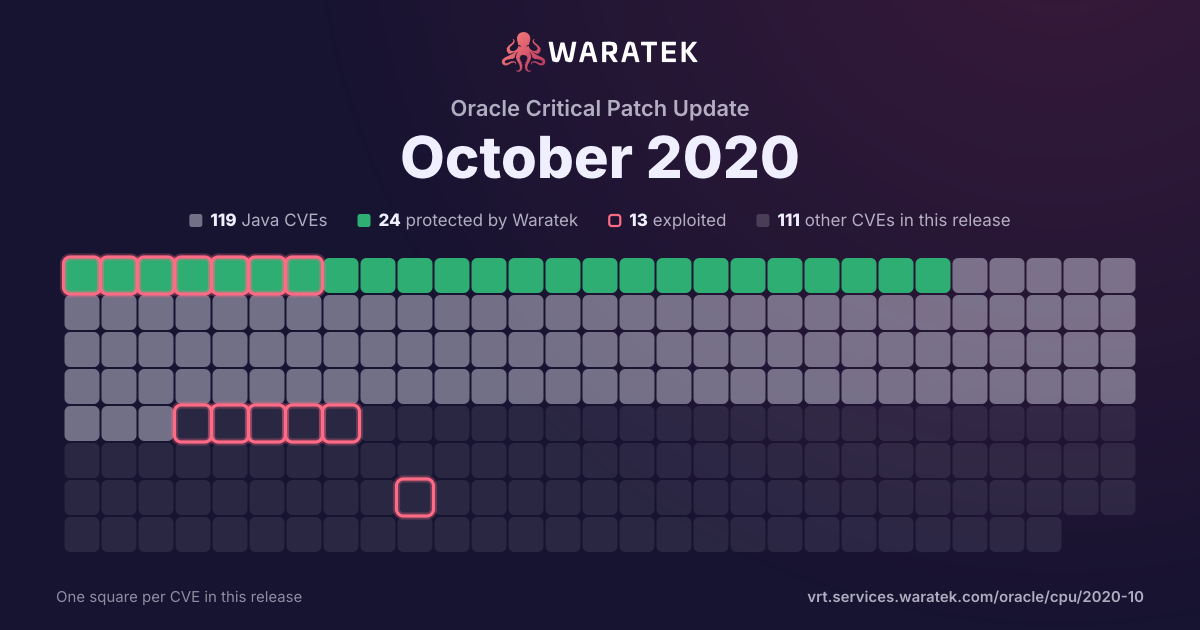
By status
26Protected by Waratek8Mitigation candidate100No exploit published3Outside Waratek scope93Not applicable
13Exploited, marked by the ring
No exploit published. For 78 of them, Oracle's security advisory is the source of public detail.
Protected by Waratek. Waratek RASP can block exploitation of these on systems that have not applied the patch yet.
Overview 5 matches · 2 in Waratek scope · 1 protected · 0 exploited · 0 CISA KEV · 0 public PoC · 0 EPSS ≥ 0.5
5matches
2in Waratek scope40.0%
1protected20.0%
0exploited0.0%
0CISA KEV0.0%
0public PoC0.0%
0EPSS ≥ 0.50.0%
Protected by Waratek
1
20.0%
Rule in development
0
0.0%
Mitigation candidate
0
0.0%
No exploit published
1
20.0%
Outside Waratek scope
0
0.0%
Not applicable
3
60.0%
Withdrawn CVE
0
0.0%
blocked by ARMR today
1
20.0%
partly blocked
0
0.0%
not blocked
4
80.0%
not established
0
0.0%
unrecorded
0
0.0%
Exploited
0
0.0%
Working exploit published
0
0.0%
Proof of concept only
0
0.0%
Forecast only
0
0.0%
No public exploit
5
100.0%
| CVE | Severity | Published▾ | Status | Exploitation | Description |
|---|---|---|---|---|---|
| CVE-2020-15389 | Medium | 2020-06-29 | Not applicable | No public exploit | jp2/opj_decompress.c in OpenJPEG through 2.3.1 has a use-after-free that can be triggered if there is a mix of valid and invalid files in a directory operated on by the decompressor. Triggering a double-free may also be possible. This is related to calling opj_image_destroy twice. |
| CVE-2020-14195 | High | 2020-06-16 | Protected by Waratek | No public exploit | FasterXML jackson-databind 2.x before 2.9.10.5 mishandles the interaction between serialization gadgets and typing, related to org.jsecurity.realm.jndi.JndiRealmFactory (aka org.jsecurity). |
| CVE-2020-10878 | High | 2020-06-05 | Not applicable | No public exploit | Perl before 5.30.3 has an integer overflow related to mishandling of a "PL_regkind[OP(n)] == NOTHING" situation. A crafted regular expression could lead to malformed bytecode with a possibility of instruction injection. |
| CVE-2020-3235 | High | 2020-06-03 | Not applicable | No public exploit | A vulnerability in the Simple Network Management Protocol (SNMP) subsystem of Cisco IOS Software and Cisco IOS XE Software on Catalyst 4500 Series Switches could allow an authenticated, remote attacker to cause a denial of service (DoS) condition. The vulnerability is due to insufficient input validation when the software processes specific SNMP object identifiers. An attacker could exploit this vulnerability by sending a crafted SNMP packet to an affected device. A successful exploit could allow the attacker to cause the affected device to reload, resulting in a DoS condition. Note: To exploit this vulnerability by using SNMPv2c or earlier, the attacker must know the SNMP read-only community string for an affected system. To exploit this vulnerability by using SNMPv3, the attacker must know the user credentials for the affected system. |
| CVE-2020-11080 | High | 2020-06-03 | No exploit published | No public exploit | In nghttp2 before version 1.41.0, the overly large HTTP/2 SETTINGS frame payload causes denial of service. The proof of concept attack involves a malicious client constructing a SETTINGS frame with a length of 14,400 bytes (2400 individual settings entries) over and over again. The attack causes the CPU to spike at 100%. nghttp2 v1.41.0 fixes this vulnerability. There is a workaround to this vulnerability. Implement nghttp2_on_frame_recv_callback callback, and if received frame is SETTINGS frame and the number of settings entries are large (e.g., > 32), then drop the connection. |