
Oracle Critical Patch Update October 2020
Released October 2020 · Oracle's advisory ↗ · ← Critical Patch Update, July 2020 · Critical Patch Update, January 2021 →
230 CVEs in this release, one square each
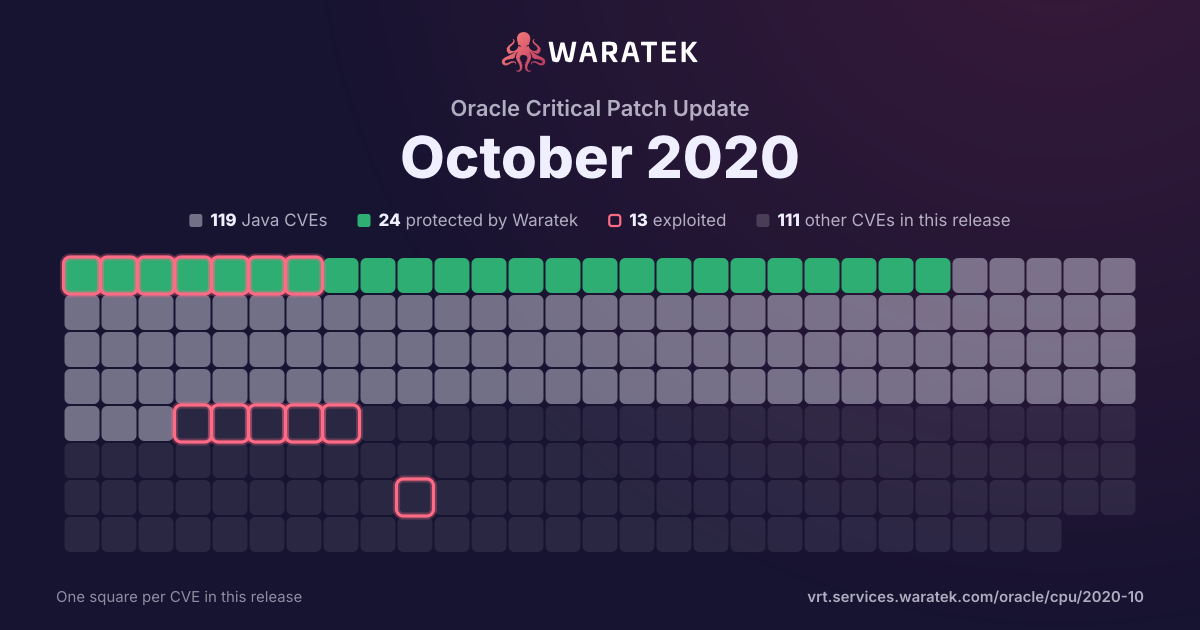
By status
26Protected by Waratek8Mitigation candidate100No exploit published3Outside Waratek scope93Not applicable
13Exploited, marked by the ring
No exploit published. For 78 of them, Oracle's security advisory is the source of public detail.
Protected by Waratek. Waratek RASP can block exploitation of these on systems that have not applied the patch yet.
Overview 10 matches · 7 in Waratek scope · 3 protected · 0 exploited · 0 CISA KEV · 1 public PoC · 1 EPSS ≥ 0.5
10matches
7in Waratek scope70.0%
3protected30.0%
0exploited0.0%
0CISA KEV0.0%
1public PoC10.0%
1EPSS ≥ 0.510.0%
Protected by Waratek
3
30.0%
Rule in development
0
0.0%
Mitigation candidate
0
0.0%
No exploit published
4
40.0%
Outside Waratek scope
0
0.0%
Not applicable
3
30.0%
Withdrawn CVE
0
0.0%
blocked by ARMR today
3
30.0%
partly blocked
0
0.0%
not blocked
7
70.0%
not established
0
0.0%
unrecorded
0
0.0%
Exploited
0
0.0%
Working exploit published
1
10.0%
Proof of concept only
0
0.0%
Forecast only
0
0.0%
No public exploit
9
90.0%
| CVE | Severity | Published▾ | Status | Exploitation | Description |
|---|---|---|---|---|---|
| CVE-2020-13631 | Medium | 2020-05-27 | Not applicable | No public exploit | SQLite before 3.32.0 allows a virtual table to be renamed to the name of one of its shadow tables, related to alter.c and build.c. |
| CVE-2020-9484 | High | 2020-05-20 | Protected by Waratek | Working exploit published | When using Apache Tomcat versions 10.0.0-M1 to 10.0.0-M4, 9.0.0.M1 to 9.0.34, 8.5.0 to 8.5.54 and 7.0.0 to 7.0.103 if a) an attacker is able to control the contents and name of a file on the server; and b) the server is configured to use the PersistenceManager with a FileStore; and c) the PersistenceManager is configured with sessionAttributeValueClassNameFilter="null" (the default unless a SecurityManager is used) or a sufficiently lax filter to allow the attacker provided object to be deserialized; and d) the attacker knows the relative file path from the storage location used by FileStore to the file the attacker has control over; then, using a specifically crafted request, the attacker will be able to trigger remote code execution via deserialization of the file under their control. Note that all of conditions a) to d) must be true for the attack to succeed. |
| CVE-2020-9410 | High | 2020-05-20 | No exploit published | No public exploit | The report generator component of TIBCO Software Inc.'s TIBCO JasperReports Library, TIBCO JasperReports Library for ActiveMatrix BPM, TIBCO JasperReports Server, TIBCO JasperReports Server for AWS Marketplace, and TIBCO JasperReports Server for ActiveMatrix BPM contains a vulnerability that theoretically allows an attacker to exploit HTML injection to gain full control of a web interface containing the output of the report generator component with the privileges of any user that views the affected report(s). The attacker can theoretically exploit this vulnerability when other users view a maliciously generated report, where those reports use Fusion Charts and a data source with contents controlled by the attacker. Affected releases are TIBCO Software Inc.'s TIBCO JasperReports Library: versions 7.1.1 and below, versions 7.2.0 and 7.2.1, version 7.3.0, version 7.5.0, TIBCO JasperReports Library for ActiveMatrix BPM: versions 7.1.1 and below, TIBCO JasperReports Server: versions 7.1.1 and below, version 7.2.0, version 7.5.0, TIBCO JasperReports Server for AWS Marketplace: versions 7.5.0 and below, and TIBCO JasperReports Server for ActiveMatrix BPM: versions 7.1.1 and below. |
| CVE-2019-11048 | Medium | 2020-05-20 | Not applicable | No public exploit | In PHP versions 7.2.x below 7.2.31, 7.3.x below 7.3.18 and 7.4.x below 7.4.6, when HTTP file uploads are allowed, supplying overly long filenames or field names could lead PHP engine to try to allocate oversized memory storage, hit the memory limit and stop processing the request, without cleaning up temporary files created by upload request. This potentially could lead to accumulation of uncleaned temporary files exhausting the disk space on the target server. |
| CVE-2020-10722 | Medium | 2020-05-19 | Not applicable | No public exploit | A vulnerability was found in DPDK versions 18.05 and above. A missing check for an integer overflow in vhost_user_set_log_base() could result in a smaller memory map than requested, possibly allowing memory corruption. |
| CVE-2020-5408 | Medium | 2020-05-14 | No exploit published | No public exploit | Spring Security versions 5.3.x prior to 5.3.2, 5.2.x prior to 5.2.4, 5.1.x prior to 5.1.10, 5.0.x prior to 5.0.16 and 4.2.x prior to 4.2.16 use a fixed null initialization vector with CBC Mode in the implementation of the queryable text encryptor. A malicious user with access to the data that has been encrypted using such an encryptor may be able to derive the unencrypted values using a dictionary attack. |
| CVE-2020-1945 | Medium | 2020-05-14 | No exploit published | No public exploit | Apache Ant 1.1 to 1.9.14 and 1.10.0 to 1.10.7 uses the default temporary directory identified by the Java system property java.io.tmpdir for several tasks and may thus leak sensitive information. The fixcrlf and replaceregexp tasks also copy files from the temporary directory back into the build tree allowing an attacker to inject modified source files into the build process. |
| CVE-2020-1941 | Medium | 2020-05-14 | No exploit published | No public exploit | In Apache ActiveMQ 5.0.0 to 5.15.11, the webconsole admin GUI is open to XSS, in the view that lists the contents of a queue. |
| CVE-2020-11973 | Critical | 2020-05-14 | Protected by Waratek | No public exploit | Apache Camel Netty enables Java deserialization by default. Apache Camel 2.22.x, 2.23.x, 2.24.x, 2.25.0, 3.0.0 up to 3.1.0 are affected. 2.x users should upgrade to 2.25.1, 3.x users should upgrade to 3.2.0. |
| CVE-2020-10683 | Critical | 2020-05-01 | Protected by Waratek | No public exploit | dom4j before 2.0.3 and 2.1.x before 2.1.3 allows external DTDs and External Entities by default, which might enable XXE attacks. However, there is popular external documentation from OWASP showing how to enable the safe, non-default behavior in any application that uses dom4j. |