
Oracle Critical Patch Update October 2020
Released October 2020 · Oracle's advisory ↗ · ← Critical Patch Update, July 2020 · Critical Patch Update, January 2021 →
230 CVEs in this release, one square each
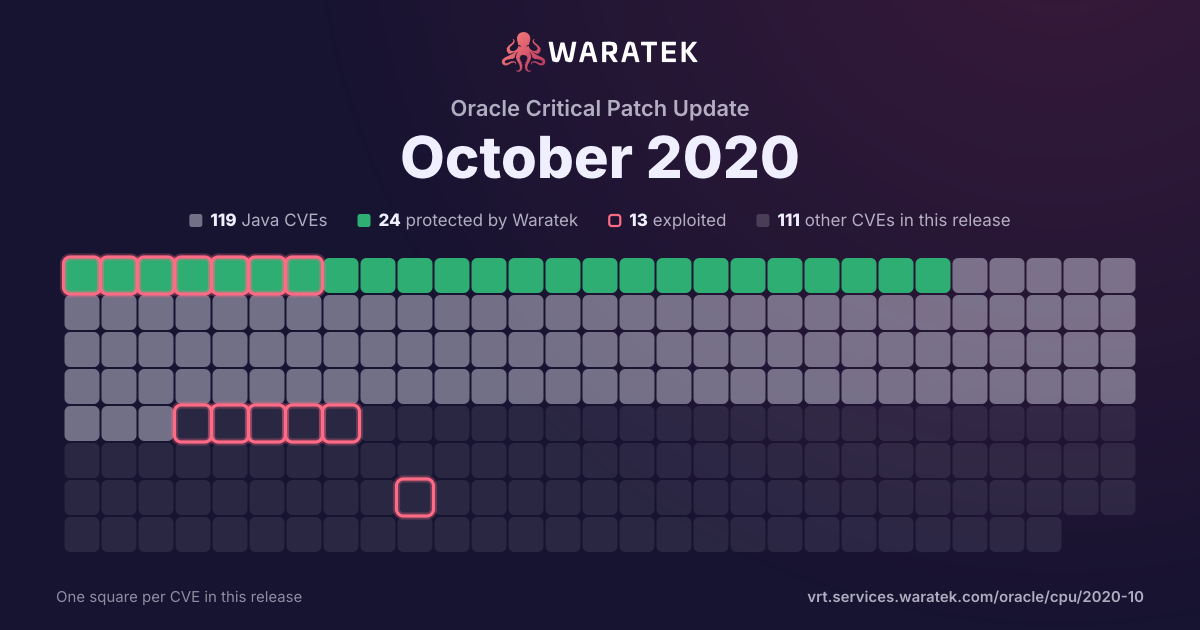
By status
26Protected by Waratek8Mitigation candidate100No exploit published3Outside Waratek scope93Not applicable
13Exploited, marked by the ring
No exploit published. For 78 of them, Oracle's security advisory is the source of public detail.
Protected by Waratek. Waratek RASP can block exploitation of these on systems that have not applied the patch yet.
Overview 22 matches · 14 in Waratek scope · 4 protected · 2 exploited · 1 CISA KEV · 4 public PoC · 4 EPSS ≥ 0.5
22matches
14in Waratek scope63.6%
4protected18.2%
2exploited9.1%
1CISA KEV4.5%
4public PoC18.2%
4EPSS ≥ 0.518.2%
Protected by Waratek
4
18.2%
Rule in development
0
0.0%
Mitigation candidate
2
9.1%
No exploit published
8
36.4%
Outside Waratek scope
1
4.5%
Not applicable
7
31.8%
Withdrawn CVE
0
0.0%
blocked by ARMR today
4
18.2%
partly blocked
0
0.0%
not blocked
18
81.8%
not established
0
0.0%
unrecorded
0
0.0%
split by
peak 10 / month
Apr 207
Mitigation candidate2
No exploit published3
Outside Waratek scope1
Not applicable1
High1
Medium5
Low1
not blocked7
Exploited2
Proof of concept only1
No public exploit4
May 2010
Protected by Waratek3
No exploit published4
Not applicable3
Critical2
High2
Medium6
blocked by ARMR today3
not blocked7
Working exploit published1
No public exploit9
Jun 205
Protected by Waratek1
No exploit published1
Not applicable3
High4
Medium1
blocked by ARMR today1
not blocked4
No public exploit5
Apr 20May 20Jun 20
| CVE | Severity | Published▾ | Status | Exploitation | Description |
|---|---|---|---|---|---|
| CVE-2020-15389 | Medium | 2020-06-29 | Not applicable | No public exploit | jp2/opj_decompress.c in OpenJPEG through 2.3.1 has a use-after-free that can be triggered if there is a mix of valid and invalid files in a directory operated on by the decompressor. Triggering a double-free may also be possible. This is related to calling opj_image_destroy twice. |
| CVE-2020-14195 | High | 2020-06-16 | Protected by Waratek | No public exploit | FasterXML jackson-databind 2.x before 2.9.10.5 mishandles the interaction between serialization gadgets and typing, related to org.jsecurity.realm.jndi.JndiRealmFactory (aka org.jsecurity). |
| CVE-2020-10878 | High | 2020-06-05 | Not applicable | No public exploit | Perl before 5.30.3 has an integer overflow related to mishandling of a "PL_regkind[OP(n)] == NOTHING" situation. A crafted regular expression could lead to malformed bytecode with a possibility of instruction injection. |
| CVE-2020-3235 | High | 2020-06-03 | Not applicable | No public exploit | A vulnerability in the Simple Network Management Protocol (SNMP) subsystem of Cisco IOS Software and Cisco IOS XE Software on Catalyst 4500 Series Switches could allow an authenticated, remote attacker to cause a denial of service (DoS) condition. The vulnerability is due to insufficient input validation when the software processes specific SNMP object identifiers. An attacker could exploit this vulnerability by sending a crafted SNMP packet to an affected device. A successful exploit could allow the attacker to cause the affected device to reload, resulting in a DoS condition. Note: To exploit this vulnerability by using SNMPv2c or earlier, the attacker must know the SNMP read-only community string for an affected system. To exploit this vulnerability by using SNMPv3, the attacker must know the user credentials for the affected system. |
| CVE-2020-11080 | High | 2020-06-03 | No exploit published | No public exploit | In nghttp2 before version 1.41.0, the overly large HTTP/2 SETTINGS frame payload causes denial of service. The proof of concept attack involves a malicious client constructing a SETTINGS frame with a length of 14,400 bytes (2400 individual settings entries) over and over again. The attack causes the CPU to spike at 100%. nghttp2 v1.41.0 fixes this vulnerability. There is a workaround to this vulnerability. Implement nghttp2_on_frame_recv_callback callback, and if received frame is SETTINGS frame and the number of settings entries are large (e.g., > 32), then drop the connection. |
| CVE-2020-13631 | Medium | 2020-05-27 | Not applicable | No public exploit | SQLite before 3.32.0 allows a virtual table to be renamed to the name of one of its shadow tables, related to alter.c and build.c. |
| CVE-2020-9484 | High | 2020-05-20 | Protected by Waratek | Working exploit published | When using Apache Tomcat versions 10.0.0-M1 to 10.0.0-M4, 9.0.0.M1 to 9.0.34, 8.5.0 to 8.5.54 and 7.0.0 to 7.0.103 if a) an attacker is able to control the contents and name of a file on the server; and b) the server is configured to use the PersistenceManager with a FileStore; and c) the PersistenceManager is configured with sessionAttributeValueClassNameFilter="null" (the default unless a SecurityManager is used) or a sufficiently lax filter to allow the attacker provided object to be deserialized; and d) the attacker knows the relative file path from the storage location used by FileStore to the file the attacker has control over; then, using a specifically crafted request, the attacker will be able to trigger remote code execution via deserialization of the file under their control. Note that all of conditions a) to d) must be true for the attack to succeed. |
| CVE-2020-9410 | High | 2020-05-20 | No exploit published | No public exploit | The report generator component of TIBCO Software Inc.'s TIBCO JasperReports Library, TIBCO JasperReports Library for ActiveMatrix BPM, TIBCO JasperReports Server, TIBCO JasperReports Server for AWS Marketplace, and TIBCO JasperReports Server for ActiveMatrix BPM contains a vulnerability that theoretically allows an attacker to exploit HTML injection to gain full control of a web interface containing the output of the report generator component with the privileges of any user that views the affected report(s). The attacker can theoretically exploit this vulnerability when other users view a maliciously generated report, where those reports use Fusion Charts and a data source with contents controlled by the attacker. Affected releases are TIBCO Software Inc.'s TIBCO JasperReports Library: versions 7.1.1 and below, versions 7.2.0 and 7.2.1, version 7.3.0, version 7.5.0, TIBCO JasperReports Library for ActiveMatrix BPM: versions 7.1.1 and below, TIBCO JasperReports Server: versions 7.1.1 and below, version 7.2.0, version 7.5.0, TIBCO JasperReports Server for AWS Marketplace: versions 7.5.0 and below, and TIBCO JasperReports Server for ActiveMatrix BPM: versions 7.1.1 and below. |
| CVE-2019-11048 | Medium | 2020-05-20 | Not applicable | No public exploit | In PHP versions 7.2.x below 7.2.31, 7.3.x below 7.3.18 and 7.4.x below 7.4.6, when HTTP file uploads are allowed, supplying overly long filenames or field names could lead PHP engine to try to allocate oversized memory storage, hit the memory limit and stop processing the request, without cleaning up temporary files created by upload request. This potentially could lead to accumulation of uncleaned temporary files exhausting the disk space on the target server. |
| CVE-2020-10722 | Medium | 2020-05-19 | Not applicable | No public exploit | A vulnerability was found in DPDK versions 18.05 and above. A missing check for an integer overflow in vhost_user_set_log_base() could result in a smaller memory map than requested, possibly allowing memory corruption. |
| CVE-2020-5408 | Medium | 2020-05-14 | No exploit published | No public exploit | Spring Security versions 5.3.x prior to 5.3.2, 5.2.x prior to 5.2.4, 5.1.x prior to 5.1.10, 5.0.x prior to 5.0.16 and 4.2.x prior to 4.2.16 use a fixed null initialization vector with CBC Mode in the implementation of the queryable text encryptor. A malicious user with access to the data that has been encrypted using such an encryptor may be able to derive the unencrypted values using a dictionary attack. |
| CVE-2020-1945 | Medium | 2020-05-14 | No exploit published | No public exploit | Apache Ant 1.1 to 1.9.14 and 1.10.0 to 1.10.7 uses the default temporary directory identified by the Java system property java.io.tmpdir for several tasks and may thus leak sensitive information. The fixcrlf and replaceregexp tasks also copy files from the temporary directory back into the build tree allowing an attacker to inject modified source files into the build process. |
| CVE-2020-1941 | Medium | 2020-05-14 | No exploit published | No public exploit | In Apache ActiveMQ 5.0.0 to 5.15.11, the webconsole admin GUI is open to XSS, in the view that lists the contents of a queue. |
| CVE-2020-11973 | Critical | 2020-05-14 | Protected by Waratek | No public exploit | Apache Camel Netty enables Java deserialization by default. Apache Camel 2.22.x, 2.23.x, 2.24.x, 2.25.0, 3.0.0 up to 3.1.0 are affected. 2.x users should upgrade to 2.25.1, 3.x users should upgrade to 3.2.0. |
| CVE-2020-10683 | Critical | 2020-05-01 | Protected by Waratek | No public exploit | dom4j before 2.0.3 and 2.1.x before 2.1.3 allows external DTDs and External Entities by default, which might enable XXE attacks. However, there is popular external documentation from OWASP showing how to enable the safe, non-default behavior in any application that uses dom4j. |
| CVE-2020-11023 | Medium | 2020-04-29 | Mitigation candidate | Exploited | In jQuery versions greater than or equal to 1.0.3 and before 3.5.0, passing HTML containing <option> elements from untrusted sources - even after sanitizing it - to one of jQuery's DOM manipulation methods (i.e. .html(), .append(), and others) may execute untrusted code. This problem is patched in jQuery 3.5.0. |
| CVE-2020-11022 | Medium | 2020-04-29 | Mitigation candidate | Exploited | In jQuery starting with 1.12.0 and before 3.5.0, passing HTML from untrusted sources - even after sanitizing it - to one of jQuery's DOM manipulation methods (i.e. .html(), .append(), and others) may execute untrusted code. This problem is patched in jQuery 3.5.0. |
| CVE-2020-9489 | Medium | 2020-04-27 | No exploit published | No public exploit | A carefully crafted or corrupt file may trigger a System.exit in Tika's OneNote Parser. Crafted or corrupted files can also cause out of memory errors and/or infinite loops in Tika's ICNSParser, MP3Parser, MP4Parser, SAS7BDATParser, OneNoteParser and ImageParser. Apache Tika users should upgrade to 1.24.1 or later. The vulnerabilities in the MP4Parser were partially fixed by upgrading the com.googlecode:isoparser:1.1.22 dependency to org.tallison:isoparser:1.9.41.2. For unrelated security reasons, we upgraded org.apache.cxf to 3.3.6 as part of the 1.24.1 release. |
| CVE-2020-9488 | Low | 2020-04-27 | No exploit published | No public exploit | Improper validation of certificate with host mismatch in Apache Log4j SMTP appender. This could allow an SMTPS connection to be intercepted by a man-in-the-middle attack which could leak any log messages sent through that appender. Fixed in Apache Log4j 2.12.3 and 2.13.1 |
| CVE-2020-1967 | High | 2020-04-21 | Not applicable | Proof of concept only | Server or client applications that call the SSL_check_chain() function during or after a TLS 1.3 handshake may crash due to a NULL pointer dereference as a result of incorrect handling of the "signature_algorithms_cert" TLS extension. The crash occurs if an invalid or unrecognised signature algorithm is received from the peer. This could be exploited by a malicious peer in a Denial of Service attack. OpenSSL version 1.1.1d, 1.1.1e, and 1.1.1f are affected by this issue. This issue did not affect OpenSSL versions prior to 1.1.1d. Fixed in OpenSSL 1.1.1g (Affected 1.1.1d-1.1.1f). |
| CVE-2020-1730 | Medium | 2020-04-13 | Outside Waratek scope | No public exploit | A flaw was found in libssh versions before 0.8.9 and before 0.9.4 in the way it handled AES-CTR (or DES ciphers if enabled) ciphers. The server or client could crash when the connection hasn't been fully initialized and the system tries to cleanup the ciphers when closing the connection. The biggest threat from this vulnerability is system availability. |
| CVE-2020-1954 | Medium | 2020-04-01 | No exploit published | No public exploit | Apache CXF has the ability to integrate with JMX by registering an InstrumentationManager extension with the CXF bus. If the ‘createMBServerConnectorFactory‘ property of the default InstrumentationManagerImpl is not disabled, then it is vulnerable to a man-in-the-middle (MITM) style attack. An attacker on the same host can connect to the registry and rebind the entry to another server, thus acting as a proxy to the original. They are then able to gain access to all of the information that is sent and received over JMX. |