
Oracle Critical Patch Update October 2020
Released October 2020 · Oracle's advisory ↗ · ← Critical Patch Update, July 2020 · Critical Patch Update, January 2021 →
230 CVEs in this release, one square each
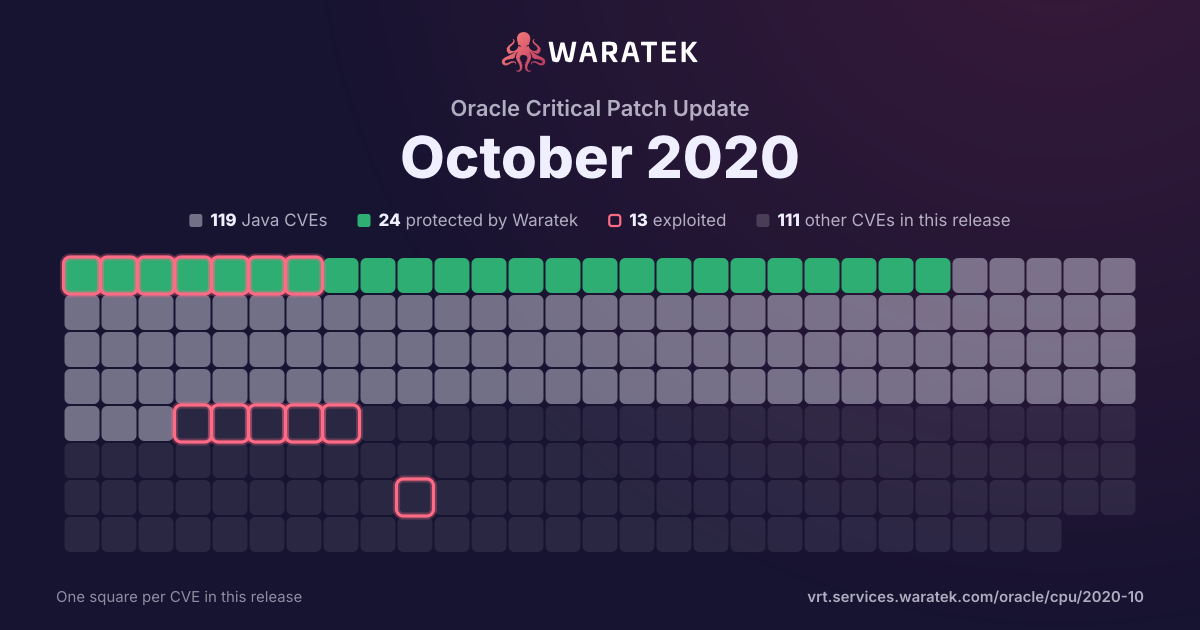
By status
26Protected by Waratek8Mitigation candidate100No exploit published3Outside Waratek scope93Not applicable
13Exploited, marked by the ring
No exploit published. For 78 of them, Oracle's security advisory is the source of public detail.
Protected by Waratek. Waratek RASP can block exploitation of these on systems that have not applied the patch yet.
Overview 7 matches · 5 in Waratek scope · 0 protected · 2 exploited · 1 CISA KEV · 3 public PoC · 3 EPSS ≥ 0.5
7matches
5in Waratek scope71.4%
0protected0.0%
2exploited28.6%
1CISA KEV14.3%
3public PoC42.9%
3EPSS ≥ 0.542.9%
Protected by Waratek
0
0.0%
Rule in development
0
0.0%
Mitigation candidate
2
28.6%
No exploit published
3
42.9%
Outside Waratek scope
1
14.3%
Not applicable
1
14.3%
Withdrawn CVE
0
0.0%
blocked by ARMR today
0
0.0%
partly blocked
0
0.0%
not blocked
7
100.0%
not established
0
0.0%
unrecorded
0
0.0%
Exploited
2
28.6%
Working exploit published
0
0.0%
Proof of concept only
1
14.3%
Forecast only
0
0.0%
No public exploit
4
57.1%
| CVE | Severity | Published▾ | Status | Exploitation | Description |
|---|---|---|---|---|---|
| CVE-2020-11023 | Medium | 2020-04-29 | Mitigation candidate | Exploited | In jQuery versions greater than or equal to 1.0.3 and before 3.5.0, passing HTML containing <option> elements from untrusted sources - even after sanitizing it - to one of jQuery's DOM manipulation methods (i.e. .html(), .append(), and others) may execute untrusted code. This problem is patched in jQuery 3.5.0. |
| CVE-2020-11022 | Medium | 2020-04-29 | Mitigation candidate | Exploited | In jQuery starting with 1.12.0 and before 3.5.0, passing HTML from untrusted sources - even after sanitizing it - to one of jQuery's DOM manipulation methods (i.e. .html(), .append(), and others) may execute untrusted code. This problem is patched in jQuery 3.5.0. |
| CVE-2020-9489 | Medium | 2020-04-27 | No exploit published | No public exploit | A carefully crafted or corrupt file may trigger a System.exit in Tika's OneNote Parser. Crafted or corrupted files can also cause out of memory errors and/or infinite loops in Tika's ICNSParser, MP3Parser, MP4Parser, SAS7BDATParser, OneNoteParser and ImageParser. Apache Tika users should upgrade to 1.24.1 or later. The vulnerabilities in the MP4Parser were partially fixed by upgrading the com.googlecode:isoparser:1.1.22 dependency to org.tallison:isoparser:1.9.41.2. For unrelated security reasons, we upgraded org.apache.cxf to 3.3.6 as part of the 1.24.1 release. |
| CVE-2020-9488 | Low | 2020-04-27 | No exploit published | No public exploit | Improper validation of certificate with host mismatch in Apache Log4j SMTP appender. This could allow an SMTPS connection to be intercepted by a man-in-the-middle attack which could leak any log messages sent through that appender. Fixed in Apache Log4j 2.12.3 and 2.13.1 |
| CVE-2020-1967 | High | 2020-04-21 | Not applicable | Proof of concept only | Server or client applications that call the SSL_check_chain() function during or after a TLS 1.3 handshake may crash due to a NULL pointer dereference as a result of incorrect handling of the "signature_algorithms_cert" TLS extension. The crash occurs if an invalid or unrecognised signature algorithm is received from the peer. This could be exploited by a malicious peer in a Denial of Service attack. OpenSSL version 1.1.1d, 1.1.1e, and 1.1.1f are affected by this issue. This issue did not affect OpenSSL versions prior to 1.1.1d. Fixed in OpenSSL 1.1.1g (Affected 1.1.1d-1.1.1f). |
| CVE-2020-1730 | Medium | 2020-04-13 | Outside Waratek scope | No public exploit | A flaw was found in libssh versions before 0.8.9 and before 0.9.4 in the way it handled AES-CTR (or DES ciphers if enabled) ciphers. The server or client could crash when the connection hasn't been fully initialized and the system tries to cleanup the ciphers when closing the connection. The biggest threat from this vulnerability is system availability. |
| CVE-2020-1954 | Medium | 2020-04-01 | No exploit published | No public exploit | Apache CXF has the ability to integrate with JMX by registering an InstrumentationManager extension with the CXF bus. If the ‘createMBServerConnectorFactory‘ property of the default InstrumentationManagerImpl is not disabled, then it is vulnerable to a man-in-the-middle (MITM) style attack. An attacker on the same host can connect to the registry and rebind the entry to another server, thus acting as a proxy to the original. They are then able to gain access to all of the information that is sent and received over JMX. |