
Oracle Critical Patch Update October 2020
Released October 2020 · Oracle's advisory ↗ · ← Critical Patch Update, July 2020 · Critical Patch Update, January 2021 →
230 CVEs in this release, one square each
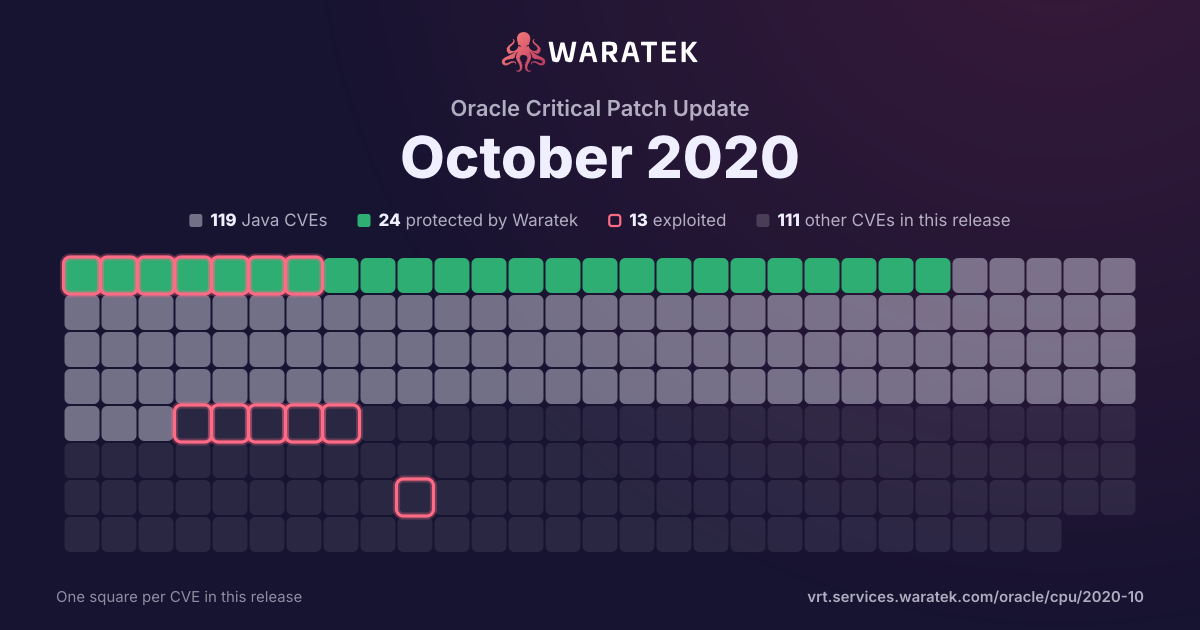
By status
26Protected by Waratek8Mitigation candidate100No exploit published3Outside Waratek scope93Not applicable
13Exploited, marked by the ring
No exploit published. For 78 of them, Oracle's security advisory is the source of public detail.
Protected by Waratek. Waratek RASP can block exploitation of these on systems that have not applied the patch yet.
Overview 4 matches · 2 in Waratek scope · 0 protected · 1 exploited · 0 CISA KEV · 0 public PoC · 1 EPSS ≥ 0.5
4matches
2in Waratek scope50.0%
0protected0.0%
1exploited25.0%
0CISA KEV0.0%
0public PoC0.0%
1EPSS ≥ 0.525.0%
Protected by Waratek
0
0.0%
Rule in development
0
0.0%
Mitigation candidate
1
25.0%
No exploit published
1
25.0%
Outside Waratek scope
0
0.0%
Not applicable
2
50.0%
Withdrawn CVE
0
0.0%
blocked by ARMR today
0
0.0%
partly blocked
0
0.0%
not blocked
3
75.0%
not established
1
25.0%
unrecorded
0
0.0%
Exploited
1
25.0%
Working exploit published
0
0.0%
Proof of concept only
0
0.0%
Forecast only
0
0.0%
No public exploit
3
75.0%
| CVE | Severity | Published▾ | Status | Exploitation | Description |
|---|---|---|---|---|---|
| CVE-2019-10097 | High | 2019-09-26 | Mitigation candidate | Exploited | In Apache HTTP Server 2.4.32-2.4.39, when mod_remoteip was configured to use a trusted intermediary proxy server using the "PROXY" protocol, a specially crafted PROXY header could trigger a stack buffer overflow or NULL pointer deference. This vulnerability could only be triggered by a trusted proxy and not by untrusted HTTP clients. |
| CVE-2019-3740 | Medium | 2019-09-18 | No exploit published | No public exploit | RSA BSAFE Crypto-J versions prior to 6.2.5 are vulnerable to an Information Exposure Through Timing Discrepancy vulnerabilities during DSA key generation. A malicious remote attacker could potentially exploit those vulnerabilities to recover DSA keys. |
| CVE-2019-5482 | Critical | 2019-09-16 | Not applicable | No public exploit | Heap buffer overflow in the TFTP protocol handler in cURL 7.19.4 to 7.65.3. |
| CVE-2019-1547 | Medium | 2019-09-10 | Not applicable | No public exploit | Normally in OpenSSL EC groups always have a co-factor present and this is used in side channel resistant code paths. However, in some cases, it is possible to construct a group using explicit parameters (instead of using a named curve). In those cases it is possible that such a group does not have the cofactor present. This can occur even where all the parameters match a known named curve. If such a curve is used then OpenSSL falls back to non-side channel resistant code paths which may result in full key recovery during an ECDSA signature operation. In order to be vulnerable an attacker would have to have the ability to time the creation of a large number of signatures where explicit parameters with no co-factor present are in use by an application using libcrypto. For the avoidance of doubt libssl is not vulnerable because explicit parameters are never used. Fixed in OpenSSL 1.1.1d (Affected 1.1.1-1.1.1c). Fixed in OpenSSL 1.1.0l (Affected 1.1.0-1.1.0k). Fixed in OpenSSL 1.0.2t (Affected 1.0.2-1.0.2s). |