
Oracle Critical Patch Update October 2020
Released October 2020 · Oracle's advisory ↗ · ← Critical Patch Update, July 2020 · Critical Patch Update, January 2021 →
230 CVEs in this release, one square each
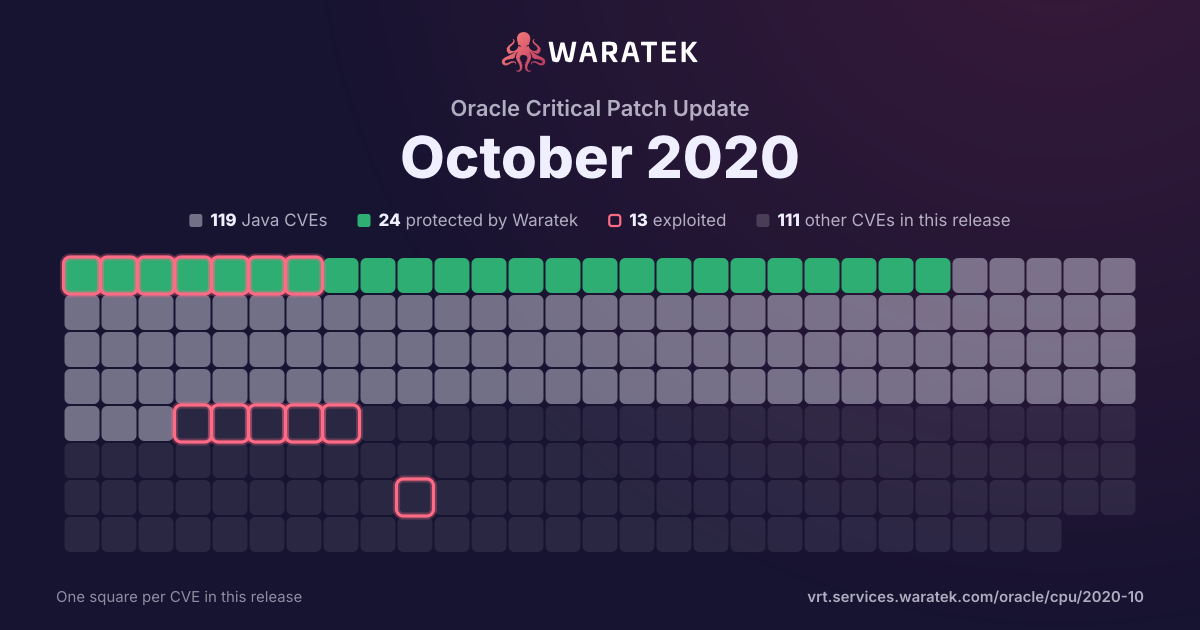
By status
26Protected by Waratek8Mitigation candidate100No exploit published3Outside Waratek scope93Not applicable
13Exploited, marked by the ring
No exploit published. For 78 of them, Oracle's security advisory is the source of public detail.
Protected by Waratek. Waratek RASP can block exploitation of these on systems that have not applied the patch yet.
Overview 78 matches · 0 protected · 1 exploited · 0 CISA KEV · 2 public PoC · 2 EPSS ≥ 0.5
Protected by Waratek
0
0.0%
Rule in development
0
0.0%
Mitigation candidate
2
2.6%
No exploit published
76
97.4%
blocked by ARMR today
0
0.0%
partly blocked
0
0.0%
not blocked
78
100.0%
not established
0
0.0%
unrecorded
0
0.0%
Exploited
1
1.3%
Working exploit published
1
1.3%
Proof of concept only
0
0.0%
Forecast only
0
0.0%
No public exploit
76
97.4%
split by
peak 74 / month
Jun 201
No exploit published1
High1
not blocked1
No public exploit1
Jul 202
Mitigation candidate1
No exploit published1
Critical1
High1
not blocked2
Working exploit published1
No public exploit1
Aug 201
Mitigation candidate1
Critical1
not blocked1
Exploited1
Sep 200
Oct 2074
No exploit published74
Critical5
High27
Medium35
Low7
not blocked74
No public exploit74
Jun 20Jul 20Aug 20Sep 20Oct 20
| CVE | Severity | Published▾ | Status | Exploitation | Description |
|---|---|---|---|---|---|
| CVE-2020-14897 | Medium | 2020-10-21 | No exploit published | No public exploit | Vulnerability in the Oracle FLEXCUBE Direct Banking product of Oracle Financial Services Applications (component: Pre Login). Supported versions that are affected are 12.0.1, 12.0.2 and 12.0.3. Easily exploitable vulnerability allows unauthenticated attacker with network access via HTTP to compromise Oracle FLEXCUBE Direct Banking. Successful attacks require human interaction from a person other than the attacker. Successful attacks of this vulnerability can result in unauthorized access to critical data or complete access to all Oracle FLEXCUBE Direct Banking accessible data. CVSS 3.1 Base Score 6.5 (Confidentiality impacts). CVSS Vector: (CVSS:3.1/AV:N/AC:L/PR:N/UI:R/S:U/C:H/I:N/A:N). |
| CVE-2020-14896 | Medium | 2020-10-21 | No exploit published | No public exploit | Vulnerability in the Oracle Banking Payments product of Oracle Financial Services Applications (component: Core). Supported versions that are affected are 14.1.0-14.4.0. Easily exploitable vulnerability allows low privileged attacker with network access via HTTP to compromise Oracle Banking Payments. Successful attacks of this vulnerability can result in unauthorized access to critical data or complete access to all Oracle Banking Payments accessible data. CVSS 3.1 Base Score 6.5 (Confidentiality impacts). CVSS Vector: (CVSS:3.1/AV:N/AC:L/PR:L/UI:N/S:U/C:H/I:N/A:N). |
| CVE-2020-14895 | Medium | 2020-10-21 | No exploit published | No public exploit | Vulnerability in the Oracle Utilities Framework product of Oracle Utilities Applications (component: System Wide). Supported versions that are affected are 2.2.0.0.0, 4.2.0.2.0, 4.2.0.3.0, 4.3.0.1.0 - 4.3.0.6.0, 4.4.0.0.0 and 4.4.0.2.0. Easily exploitable vulnerability allows low privileged attacker with network access via HTTP to compromise Oracle Utilities Framework. Successful attacks of this vulnerability can result in unauthorized update, insert or delete access to some of Oracle Utilities Framework accessible data as well as unauthorized read access to a subset of Oracle Utilities Framework accessible data. CVSS 3.1 Base Score 5.4 (Confidentiality and Integrity impacts). CVSS Vector: (CVSS:3.1/AV:N/AC:L/PR:L/UI:N/S:U/C:L/I:L/A:N). |
| CVE-2020-14894 | Medium | 2020-10-21 | No exploit published | No public exploit | Vulnerability in the Oracle Banking Corporate Lending product of Oracle Financial Services Applications (component: Core). Supported versions that are affected are 12.3.0 and 14.0.0-14.4.0. Easily exploitable vulnerability allows low privileged attacker with network access via HTTP to compromise Oracle Banking Corporate Lending. Successful attacks of this vulnerability can result in unauthorized access to critical data or complete access to all Oracle Banking Corporate Lending accessible data. CVSS 3.1 Base Score 6.5 (Confidentiality impacts). CVSS Vector: (CVSS:3.1/AV:N/AC:L/PR:L/UI:N/S:U/C:H/I:N/A:N). |
| CVE-2020-14890 | Medium | 2020-10-21 | No exploit published | No public exploit | Vulnerability in the Oracle FLEXCUBE Direct Banking product of Oracle Financial Services Applications (component: Pre Login). Supported versions that are affected are 12.0.1, 12.0.2 and 12.0.3. Easily exploitable vulnerability allows unauthenticated attacker with network access via HTTP to compromise Oracle FLEXCUBE Direct Banking. Successful attacks require human interaction from a person other than the attacker. Successful attacks of this vulnerability can result in unauthorized access to critical data or complete access to all Oracle FLEXCUBE Direct Banking accessible data. CVSS 3.1 Base Score 6.5 (Confidentiality impacts). CVSS Vector: (CVSS:3.1/AV:N/AC:L/PR:N/UI:R/S:U/C:H/I:N/A:N). |
| CVE-2020-14887 | Medium | 2020-10-21 | No exploit published | No public exploit | Vulnerability in the Oracle FLEXCUBE Universal Banking product of Oracle Financial Services Applications (component: Infrastructure). Supported versions that are affected are 12.3.0 and 14.0.0-14.4.0. Easily exploitable vulnerability allows low privileged attacker with network access via HTTP to compromise Oracle FLEXCUBE Universal Banking. Successful attacks of this vulnerability can result in unauthorized access to critical data or complete access to all Oracle FLEXCUBE Universal Banking accessible data. CVSS 3.1 Base Score 6.5 (Confidentiality impacts). CVSS Vector: (CVSS:3.1/AV:N/AC:L/PR:L/UI:N/S:U/C:H/I:N/A:N). |
| CVE-2020-14880 | High | 2020-10-21 | No exploit published | No public exploit | Vulnerability in the BI Publisher product of Oracle Fusion Middleware (component: E-Business Suite - XDO). Supported versions that are affected are 5.5.0.0.0, 11.1.1.9.0, 12.2.1.3.0 and 12.2.1.4.0. Easily exploitable vulnerability allows low privileged attacker with network access via HTTP to compromise BI Publisher. While the vulnerability is in BI Publisher, attacks may significantly impact additional products. Successful attacks of this vulnerability can result in unauthorized access to critical data or complete access to all BI Publisher accessible data as well as unauthorized update, insert or delete access to some of BI Publisher accessible data. CVSS 3.1 Base Score 8.5 (Confidentiality and Integrity impacts). CVSS Vector: (CVSS:3.1/AV:N/AC:L/PR:L/UI:N/S:C/C:H/I:L/A:N). |
| CVE-2020-14879 | High | 2020-10-21 | No exploit published | No public exploit | Vulnerability in the BI Publisher product of Oracle Fusion Middleware (component: E-Business Suite - XDO). Supported versions that are affected are 5.5.0.0.0, 11.1.1.9.0, 12.2.1.3.0 and 12.2.1.4.0. Easily exploitable vulnerability allows low privileged attacker with network access via HTTP to compromise BI Publisher. While the vulnerability is in BI Publisher, attacks may significantly impact additional products. Successful attacks of this vulnerability can result in unauthorized access to critical data or complete access to all BI Publisher accessible data as well as unauthorized update, insert or delete access to some of BI Publisher accessible data. CVSS 3.1 Base Score 8.5 (Confidentiality and Integrity impacts). CVSS Vector: (CVSS:3.1/AV:N/AC:L/PR:L/UI:N/S:C/C:H/I:L/A:N). |
| CVE-2020-14877 | Medium | 2020-10-21 | No exploit published | No public exploit | Vulnerability in the Oracle Hospitality OPERA 5 Property Services product of Oracle Hospitality Applications (component: Logging). Supported versions that are affected are 5.5 and 5.6. Easily exploitable vulnerability allows high privileged attacker with network access via HTTP to compromise Oracle Hospitality OPERA 5 Property Services. Successful attacks of this vulnerability can result in unauthorized creation, deletion or modification access to critical data or all Oracle Hospitality OPERA 5 Property Services accessible data as well as unauthorized access to critical data or complete access to all Oracle Hospitality OPERA 5 Property Services accessible data. CVSS 3.1 Base Score 6.5 (Confidentiality and Integrity impacts). CVSS Vector: (CVSS:3.1/AV:N/AC:L/PR:H/UI:N/S:U/C:H/I:H/A:N). |
| CVE-2020-14876 | Critical | 2020-10-21 | No exploit published | No public exploit | Vulnerability in the Oracle Trade Management product of Oracle E-Business Suite (component: User Interface). Supported versions that are affected are 12.1.1 - 12.1.3 and 12.2.3 - 12.2.10. Easily exploitable vulnerability allows unauthenticated attacker with network access via HTTP to compromise Oracle Trade Management. Successful attacks of this vulnerability can result in unauthorized creation, deletion or modification access to critical data or all Oracle Trade Management accessible data as well as unauthorized access to critical data or complete access to all Oracle Trade Management accessible data. CVSS 3.1 Base Score 9.1 (Confidentiality and Integrity impacts). CVSS Vector: (CVSS:3.1/AV:N/AC:L/PR:N/UI:N/S:U/C:H/I:H/A:N). |
| CVE-2020-14875 | Critical | 2020-10-21 | No exploit published | No public exploit | Vulnerability in the Oracle Marketing product of Oracle E-Business Suite (component: Marketing Administration). Supported versions that are affected are 12.1.1 - 12.1.3 and 12.2.3 - 12.2.10. Easily exploitable vulnerability allows unauthenticated attacker with network access via HTTP to compromise Oracle Marketing. Successful attacks of this vulnerability can result in unauthorized creation, deletion or modification access to critical data or all Oracle Marketing accessible data as well as unauthorized access to critical data or complete access to all Oracle Marketing accessible data. CVSS 3.1 Base Score 9.1 (Confidentiality and Integrity impacts). CVSS Vector: (CVSS:3.1/AV:N/AC:L/PR:N/UI:N/S:U/C:H/I:H/A:N). |
| CVE-2020-14865 | High | 2020-10-21 | No exploit published | No public exploit | Vulnerability in the PeopleSoft Enterprise SCM eSupplier Connection product of Oracle PeopleSoft (component: eSupplier Connection). The supported version that is affected is 9.2. Easily exploitable vulnerability allows low privileged attacker with network access via HTTP to compromise PeopleSoft Enterprise SCM eSupplier Connection. Successful attacks of this vulnerability can result in unauthorized creation, deletion or modification access to critical data or all PeopleSoft Enterprise SCM eSupplier Connection accessible data as well as unauthorized access to critical data or complete access to all PeopleSoft Enterprise SCM eSupplier Connection accessible data. CVSS 3.1 Base Score 8.1 (Confidentiality and Integrity impacts). CVSS Vector: (CVSS:3.1/AV:N/AC:L/PR:L/UI:N/S:U/C:H/I:H/A:N). |
| CVE-2020-14863 | High | 2020-10-21 | No exploit published | No public exploit | Vulnerability in the Oracle One-to-One Fulfillment product of Oracle E-Business Suite (component: Print Server). Supported versions that are affected are 12.1.1 - 12.1.3. Easily exploitable vulnerability allows unauthenticated attacker with network access via HTTP to compromise Oracle One-to-One Fulfillment. Successful attacks require human interaction from a person other than the attacker and while the vulnerability is in Oracle One-to-One Fulfillment, attacks may significantly impact additional products. Successful attacks of this vulnerability can result in unauthorized access to critical data or complete access to all Oracle One-to-One Fulfillment accessible data as well as unauthorized update, insert or delete access to some of Oracle One-to-One Fulfillment accessible data. CVSS 3.1 Base Score 8.2 (Confidentiality and Integrity impacts). CVSS Vector: (CVSS:3.1/AV:N/AC:L/PR:N/UI:R/S:C/C:H/I:L/A:N). |
| CVE-2020-14862 | High | 2020-10-21 | No exploit published | No public exploit | Vulnerability in the Oracle Universal Work Queue product of Oracle E-Business Suite (component: Internal Operations). Supported versions that are affected are 12.2.3 - 12.2.9. Easily exploitable vulnerability allows low privileged attacker with network access via HTTP to compromise Oracle Universal Work Queue. Successful attacks of this vulnerability can result in takeover of Oracle Universal Work Queue. CVSS 3.1 Base Score 8.8 (Confidentiality, Integrity and Availability impacts). CVSS Vector: (CVSS:3.1/AV:N/AC:L/PR:L/UI:N/S:U/C:H/I:H/A:H). |
| CVE-2020-14858 | Medium | 2020-10-21 | No exploit published | No public exploit | Vulnerability in the Oracle Hospitality OPERA 5 Property Services product of Oracle Hospitality Applications (component: Logging). Supported versions that are affected are 5.5 and 5.6. Easily exploitable vulnerability allows high privileged attacker with network access via HTTP to compromise Oracle Hospitality OPERA 5 Property Services. Successful attacks require human interaction from a person other than the attacker. Successful attacks of this vulnerability can result in takeover of Oracle Hospitality OPERA 5 Property Services. CVSS 3.1 Base Score 6.8 (Confidentiality, Integrity and Availability impacts). CVSS Vector: (CVSS:3.1/AV:N/AC:L/PR:H/UI:R/S:U/C:H/I:H/A:H). |
| CVE-2020-14857 | High | 2020-10-21 | No exploit published | No public exploit | Vulnerability in the Oracle Trade Management product of Oracle E-Business Suite (component: User Interface). Supported versions that are affected are 12.1.1 - 12.1.3 and 12.2.3 - 12.2.10. Easily exploitable vulnerability allows unauthenticated attacker with network access via HTTP to compromise Oracle Trade Management. Successful attacks require human interaction from a person other than the attacker and while the vulnerability is in Oracle Trade Management, attacks may significantly impact additional products. Successful attacks of this vulnerability can result in unauthorized access to critical data or complete access to all Oracle Trade Management accessible data as well as unauthorized update, insert or delete access to some of Oracle Trade Management accessible data. CVSS 3.1 Base Score 8.2 (Confidentiality and Integrity impacts). CVSS Vector: (CVSS:3.1/AV:N/AC:L/PR:N/UI:R/S:C/C:H/I:L/A:N). |
| CVE-2020-14856 | High | 2020-10-21 | No exploit published | No public exploit | Vulnerability in the Oracle Trade Management product of Oracle E-Business Suite (component: User Interface). Supported versions that are affected are 12.1.1 - 12.1.3 and 12.2.3 - 12.2.10. Easily exploitable vulnerability allows unauthenticated attacker with network access via HTTP to compromise Oracle Trade Management. Successful attacks require human interaction from a person other than the attacker and while the vulnerability is in Oracle Trade Management, attacks may significantly impact additional products. Successful attacks of this vulnerability can result in unauthorized access to critical data or complete access to all Oracle Trade Management accessible data as well as unauthorized update, insert or delete access to some of Oracle Trade Management accessible data. CVSS 3.1 Base Score 8.2 (Confidentiality and Integrity impacts). CVSS Vector: (CVSS:3.1/AV:N/AC:L/PR:N/UI:R/S:C/C:H/I:L/A:N). |
| CVE-2020-14855 | Critical | 2020-10-21 | No exploit published | No public exploit | Vulnerability in the Oracle Universal Work Queue product of Oracle E-Business Suite (component: Work Provider Administration). The supported version that is affected is 12.1.3. Easily exploitable vulnerability allows unauthenticated attacker with network access via HTTP to compromise Oracle Universal Work Queue. Successful attacks of this vulnerability can result in takeover of Oracle Universal Work Queue. CVSS 3.1 Base Score 9.8 (Confidentiality, Integrity and Availability impacts). CVSS Vector: (CVSS:3.1/AV:N/AC:L/PR:N/UI:N/S:U/C:H/I:H/A:H). |
| CVE-2020-14854 | Medium | 2020-10-21 | No exploit published | No public exploit | Vulnerability in the Hyperion Infrastructure Technology product of Oracle Hyperion (component: UI and Visualization). The supported version that is affected is 11.1.2.4. Easily exploitable vulnerability allows high privileged attacker with network access via HTTP to compromise Hyperion Infrastructure Technology. Successful attacks require human interaction from a person other than the attacker. Successful attacks of this vulnerability can result in unauthorized creation, deletion or modification access to critical data or all Hyperion Infrastructure Technology accessible data as well as unauthorized access to critical data or complete access to all Hyperion Infrastructure Technology accessible data. CVSS 3.1 Base Score 6.1 (Confidentiality and Integrity impacts). CVSS Vector: (CVSS:3.1/AV:N/AC:L/PR:H/UI:R/S:U/C:H/I:H/A:N). |
| CVE-2020-14851 | High | 2020-10-21 | No exploit published | No public exploit | Vulnerability in the Oracle Trade Management product of Oracle E-Business Suite (component: User Interface). Supported versions that are affected are 12.1.1 - 12.1.3 and 12.2.3 - 12.2.10. Easily exploitable vulnerability allows unauthenticated attacker with network access via HTTP to compromise Oracle Trade Management. Successful attacks require human interaction from a person other than the attacker and while the vulnerability is in Oracle Trade Management, attacks may significantly impact additional products. Successful attacks of this vulnerability can result in unauthorized access to critical data or complete access to all Oracle Trade Management accessible data as well as unauthorized update, insert or delete access to some of Oracle Trade Management accessible data. CVSS 3.1 Base Score 8.2 (Confidentiality and Integrity impacts). CVSS Vector: (CVSS:3.1/AV:N/AC:L/PR:N/UI:R/S:C/C:H/I:L/A:N). |
| CVE-2020-14850 | High | 2020-10-21 | No exploit published | No public exploit | Vulnerability in the Oracle CRM Technical Foundation product of Oracle E-Business Suite (component: Flex Fields). Supported versions that are affected are 12.1.3 and 12.2.3 - 12.2.10. Easily exploitable vulnerability allows unauthenticated attacker with network access via HTTP to compromise Oracle CRM Technical Foundation. Successful attacks require human interaction from a person other than the attacker and while the vulnerability is in Oracle CRM Technical Foundation, attacks may significantly impact additional products. Successful attacks of this vulnerability can result in unauthorized access to critical data or complete access to all Oracle CRM Technical Foundation accessible data as well as unauthorized update, insert or delete access to some of Oracle CRM Technical Foundation accessible data. CVSS 3.1 Base Score 8.2 (Confidentiality and Integrity impacts). CVSS Vector: (CVSS:3.1/AV:N/AC:L/PR:N/UI:R/S:C/C:H/I:L/A:N). |
| CVE-2020-14849 | High | 2020-10-21 | No exploit published | No public exploit | Vulnerability in the Oracle Marketing product of Oracle E-Business Suite (component: Marketing Administration). Supported versions that are affected are 12.1.1 - 12.1.3 and 12.2.3 - 12.2.10. Easily exploitable vulnerability allows unauthenticated attacker with network access via HTTP to compromise Oracle Marketing. Successful attacks require human interaction from a person other than the attacker and while the vulnerability is in Oracle Marketing, attacks may significantly impact additional products. Successful attacks of this vulnerability can result in unauthorized access to critical data or complete access to all Oracle Marketing accessible data as well as unauthorized update, insert or delete access to some of Oracle Marketing accessible data. CVSS 3.1 Base Score 8.2 (Confidentiality and Integrity impacts). CVSS Vector: (CVSS:3.1/AV:N/AC:L/PR:N/UI:R/S:C/C:H/I:L/A:N). |
| CVE-2020-14847 | Low | 2020-10-21 | No exploit published | No public exploit | Vulnerability in the PeopleSoft Enterprise PeopleTools product of Oracle PeopleSoft (component: Query). Supported versions that are affected are 8.56, 8.57 and 8.58. Easily exploitable vulnerability allows high privileged attacker with network access via HTTP to compromise PeopleSoft Enterprise PeopleTools. Successful attacks of this vulnerability can result in unauthorized read access to a subset of PeopleSoft Enterprise PeopleTools accessible data. CVSS 3.1 Base Score 2.7 (Confidentiality impacts). CVSS Vector: (CVSS:3.1/AV:N/AC:L/PR:H/UI:N/S:U/C:L/I:N/A:N). |
| CVE-2020-14843 | High | 2020-10-21 | No exploit published | No public exploit | Vulnerability in the Oracle Business Intelligence Enterprise Edition product of Oracle Fusion Middleware (component: Analytics Actions). Supported versions that are affected are 5.5.0.0.0, 12.2.1.3.0 and 12.2.1.4.0. Easily exploitable vulnerability allows unauthenticated attacker with network access via HTTP to compromise Oracle Business Intelligence Enterprise Edition. Successful attacks require human interaction from a person other than the attacker and while the vulnerability is in Oracle Business Intelligence Enterprise Edition, attacks may significantly impact additional products. Successful attacks of this vulnerability can result in unauthorized update, insert or delete access to some of Oracle Business Intelligence Enterprise Edition accessible data as well as unauthorized read access to a subset of Oracle Business Intelligence Enterprise Edition accessible data and unauthorized ability to cause a partial denial of service (partial DOS) of Oracle Business Intelligence Enterprise Edition. CVSS 3.1 Base Score 7.1 (Confidentiality, Integrity and Availability impacts). CVSS Vector: (CVSS:3.1/AV:N/AC:L/PR:N/UI:R/S:C/C:L/I:L/A:L). |
| CVE-2020-14842 | High | 2020-10-21 | No exploit published | No public exploit | Vulnerability in the BI Publisher product of Oracle Fusion Middleware (component: BI Publisher Security). Supported versions that are affected are 5.5.0.0.0, 11.1.1.9.0, 12.2.1.3.0 and 12.2.1.4.0. Easily exploitable vulnerability allows unauthenticated attacker with network access via HTTP to compromise BI Publisher. Successful attacks require human interaction from a person other than the attacker and while the vulnerability is in BI Publisher, attacks may significantly impact additional products. Successful attacks of this vulnerability can result in unauthorized access to critical data or complete access to all BI Publisher accessible data as well as unauthorized update, insert or delete access to some of BI Publisher accessible data. CVSS 3.1 Base Score 8.2 (Confidentiality and Integrity impacts). CVSS Vector: (CVSS:3.1/AV:N/AC:L/PR:N/UI:R/S:C/C:H/I:L/A:N). |
| CVE-2020-14840 | Medium | 2020-10-21 | No exploit published | No public exploit | Vulnerability in the Oracle Application Object Library product of Oracle E-Business Suite (component: Diagnostics). Supported versions that are affected are 12.1.3 and 12.2.3 - 12.2.10. Easily exploitable vulnerability allows unauthenticated attacker with network access via HTTP to compromise Oracle Application Object Library. Successful attacks require human interaction from a person other than the attacker and while the vulnerability is in Oracle Application Object Library, attacks may significantly impact additional products. Successful attacks of this vulnerability can result in unauthorized update, insert or delete access to some of Oracle Application Object Library accessible data. CVSS 3.1 Base Score 4.7 (Integrity impacts). CVSS Vector: (CVSS:3.1/AV:N/AC:L/PR:N/UI:R/S:C/C:N/I:L/A:N). |
| CVE-2020-14835 | High | 2020-10-21 | No exploit published | No public exploit | Vulnerability in the Oracle Marketing product of Oracle E-Business Suite (component: Marketing Administration). Supported versions that are affected are 12.1.1 - 12.1.3. Easily exploitable vulnerability allows unauthenticated attacker with network access via HTTP to compromise Oracle Marketing. Successful attacks require human interaction from a person other than the attacker and while the vulnerability is in Oracle Marketing, attacks may significantly impact additional products. Successful attacks of this vulnerability can result in unauthorized access to critical data or complete access to all Oracle Marketing accessible data as well as unauthorized update, insert or delete access to some of Oracle Marketing accessible data. CVSS 3.1 Base Score 8.2 (Confidentiality and Integrity impacts). CVSS Vector: (CVSS:3.1/AV:N/AC:L/PR:N/UI:R/S:C/C:H/I:L/A:N). |
| CVE-2020-14834 | High | 2020-10-21 | No exploit published | No public exploit | Vulnerability in the Oracle Trade Management product of Oracle E-Business Suite (component: User Interface). Supported versions that are affected are 12.1.1 - 12.1.3 and 12.2.3 - 12.2.10. Easily exploitable vulnerability allows unauthenticated attacker with network access via HTTP to compromise Oracle Trade Management. Successful attacks require human interaction from a person other than the attacker and while the vulnerability is in Oracle Trade Management, attacks may significantly impact additional products. Successful attacks of this vulnerability can result in unauthorized access to critical data or complete access to all Oracle Trade Management accessible data as well as unauthorized update, insert or delete access to some of Oracle Trade Management accessible data. CVSS 3.1 Base Score 8.2 (Confidentiality and Integrity impacts). CVSS Vector: (CVSS:3.1/AV:N/AC:L/PR:N/UI:R/S:C/C:H/I:L/A:N). |
| CVE-2020-14833 | High | 2020-10-21 | No exploit published | No public exploit | Vulnerability in the Oracle Trade Management product of Oracle E-Business Suite (component: User Interface). Supported versions that are affected are 12.1.1 - 12.1.3 and 12.2.3 - 12.2.10. Easily exploitable vulnerability allows unauthenticated attacker with network access via HTTP to compromise Oracle Trade Management. Successful attacks require human interaction from a person other than the attacker and while the vulnerability is in Oracle Trade Management, attacks may significantly impact additional products. Successful attacks of this vulnerability can result in unauthorized access to critical data or complete access to all Oracle Trade Management accessible data as well as unauthorized update, insert or delete access to some of Oracle Trade Management accessible data. CVSS 3.1 Base Score 8.2 (Confidentiality and Integrity impacts). CVSS Vector: (CVSS:3.1/AV:N/AC:L/PR:N/UI:R/S:C/C:H/I:L/A:N). |
| CVE-2020-14832 | Medium | 2020-10-21 | No exploit published | No public exploit | Vulnerability in the PeopleSoft Enterprise PeopleTools product of Oracle PeopleSoft (component: Integration Broker). Supported versions that are affected are 8.56, 8.57 and 8.58. Easily exploitable vulnerability allows unauthenticated attacker with network access via HTTP to compromise PeopleSoft Enterprise PeopleTools. Successful attacks require human interaction from a person other than the attacker and while the vulnerability is in PeopleSoft Enterprise PeopleTools, attacks may significantly impact additional products. Successful attacks of this vulnerability can result in unauthorized update, insert or delete access to some of PeopleSoft Enterprise PeopleTools accessible data as well as unauthorized read access to a subset of PeopleSoft Enterprise PeopleTools accessible data. CVSS 3.1 Base Score 6.1 (Confidentiality and Integrity impacts). CVSS Vector: (CVSS:3.1/AV:N/AC:L/PR:N/UI:R/S:C/C:L/I:L/A:N). |
| CVE-2020-14831 | High | 2020-10-21 | No exploit published | No public exploit | Vulnerability in the Oracle Marketing product of Oracle E-Business Suite (component: Marketing Administration). Supported versions that are affected are 12.1.1 - 12.1.3 and 12.2.3 - 12.2.10. Easily exploitable vulnerability allows unauthenticated attacker with network access via HTTP to compromise Oracle Marketing. Successful attacks require human interaction from a person other than the attacker and while the vulnerability is in Oracle Marketing, attacks may significantly impact additional products. Successful attacks of this vulnerability can result in unauthorized access to critical data or complete access to all Oracle Marketing accessible data as well as unauthorized update, insert or delete access to some of Oracle Marketing accessible data. CVSS 3.1 Base Score 8.2 (Confidentiality and Integrity impacts). CVSS Vector: (CVSS:3.1/AV:N/AC:L/PR:N/UI:R/S:C/C:H/I:L/A:N). |
| CVE-2020-14826 | Medium | 2020-10-21 | No exploit published | No public exploit | Vulnerability in the Oracle Applications Manager product of Oracle E-Business Suite (component: SQL Extensions). Supported versions that are affected are 12.1.3 and 12.2.3 - 12.2.10. Easily exploitable vulnerability allows unauthenticated attacker with network access via HTTP to compromise Oracle Applications Manager. Successful attacks of this vulnerability can result in unauthorized read access to a subset of Oracle Applications Manager accessible data. CVSS 3.1 Base Score 5.3 (Confidentiality impacts). CVSS Vector: (CVSS:3.1/AV:N/AC:L/PR:N/UI:N/S:U/C:L/I:N/A:N). |
| CVE-2020-14825 | Critical | 2020-10-21 | No exploit published | No public exploit | Vulnerability in the Oracle WebLogic Server product of Oracle Fusion Middleware (component: Core). Supported versions that are affected are 12.2.1.3.0, 12.2.1.4.0 and 14.1.1.0.0. Easily exploitable vulnerability allows unauthenticated attacker with network access via IIOP, T3 to compromise Oracle WebLogic Server. Successful attacks of this vulnerability can result in takeover of Oracle WebLogic Server. CVSS 3.1 Base Score 9.8 (Confidentiality, Integrity and Availability impacts). CVSS Vector: (CVSS:3.1/AV:N/AC:L/PR:N/UI:N/S:U/C:H/I:H/A:H). |
| CVE-2020-14824 | High | 2020-10-21 | No exploit published | No public exploit | Vulnerability in the Oracle Financial Services Analytical Applications Infrastructure product of Oracle Financial Services Applications (component: Infrastructure). Supported versions that are affected are 8.0.6-8.1.0. Easily exploitable vulnerability allows unauthenticated attacker with network access via HTTP to compromise Oracle Financial Services Analytical Applications Infrastructure. While the vulnerability is in Oracle Financial Services Analytical Applications Infrastructure, attacks may significantly impact additional products. Successful attacks of this vulnerability can result in unauthorized ability to cause a hang or frequently repeatable crash (complete DOS) of Oracle Financial Services Analytical Applications Infrastructure. CVSS 3.1 Base Score 8.6 (Availability impacts). CVSS Vector: (CVSS:3.1/AV:N/AC:L/PR:N/UI:N/S:C/C:N/I:N/A:H). |
| CVE-2020-14823 | Medium | 2020-10-21 | No exploit published | No public exploit | Vulnerability in the Oracle CRM Technical Foundation product of Oracle E-Business Suite (component: Preferences). Supported versions that are affected are 12.2.3 - 12.2.10. Easily exploitable vulnerability allows high privileged attacker with network access via HTTP to compromise Oracle CRM Technical Foundation. Successful attacks of this vulnerability can result in unauthorized creation, deletion or modification access to critical data or all Oracle CRM Technical Foundation accessible data as well as unauthorized access to critical data or complete access to all Oracle CRM Technical Foundation accessible data. CVSS 3.1 Base Score 6.5 (Confidentiality and Integrity impacts). CVSS Vector: (CVSS:3.1/AV:N/AC:L/PR:H/UI:N/S:U/C:H/I:H/A:N). |
| CVE-2020-14822 | Medium | 2020-10-21 | No exploit published | No public exploit | Vulnerability in the Oracle Installed Base product of Oracle E-Business Suite (component: APIs). Supported versions that are affected are 12.1.1 - 12.1.3 and 12.2.3 - 12.2.10. Easily exploitable vulnerability allows unauthenticated attacker with network access via HTTP to compromise Oracle Installed Base. Successful attacks require human interaction from a person other than the attacker and while the vulnerability is in Oracle Installed Base, attacks may significantly impact additional products. Successful attacks of this vulnerability can result in unauthorized update, insert or delete access to some of Oracle Installed Base accessible data. CVSS 3.1 Base Score 4.7 (Integrity impacts). CVSS Vector: (CVSS:3.1/AV:N/AC:L/PR:N/UI:R/S:C/C:N/I:L/A:N). |
| CVE-2020-14820 | High | 2020-10-21 | No exploit published | No public exploit | Vulnerability in the Oracle WebLogic Server product of Oracle Fusion Middleware (component: Core). Supported versions that are affected are 10.3.6.0.0, 12.1.3.0.0, 12.2.1.3.0, 12.2.1.4.0 and 14.1.1.0.0. Easily exploitable vulnerability allows unauthenticated attacker with network access via IIOP, T3 to compromise Oracle WebLogic Server. Successful attacks of this vulnerability can result in unauthorized access to critical data or complete access to all Oracle WebLogic Server accessible data. CVSS 3.1 Base Score 7.5 (Confidentiality impacts). CVSS Vector: (CVSS:3.1/AV:N/AC:L/PR:N/UI:N/S:U/C:H/I:N/A:N). |
| CVE-2020-14819 | High | 2020-10-21 | No exploit published | No public exploit | Vulnerability in the Oracle One-to-One Fulfillment product of Oracle E-Business Suite (component: Print Server). The supported version that is affected is 12.1.3. Easily exploitable vulnerability allows unauthenticated attacker with network access via HTTP to compromise Oracle One-to-One Fulfillment. Successful attacks require human interaction from a person other than the attacker and while the vulnerability is in Oracle One-to-One Fulfillment, attacks may significantly impact additional products. Successful attacks of this vulnerability can result in unauthorized access to critical data or complete access to all Oracle One-to-One Fulfillment accessible data as well as unauthorized update, insert or delete access to some of Oracle One-to-One Fulfillment accessible data. CVSS 3.1 Base Score 8.2 (Confidentiality and Integrity impacts). CVSS Vector: (CVSS:3.1/AV:N/AC:L/PR:N/UI:R/S:C/C:H/I:L/A:N). |
| CVE-2020-14817 | High | 2020-10-21 | No exploit published | No public exploit | Vulnerability in the Oracle Marketing product of Oracle E-Business Suite (component: Marketing Administration). Supported versions that are affected are 12.1.1 - 12.1.3 and 12.2.3 - 12.2.10. Easily exploitable vulnerability allows unauthenticated attacker with network access via HTTP to compromise Oracle Marketing. Successful attacks require human interaction from a person other than the attacker and while the vulnerability is in Oracle Marketing, attacks may significantly impact additional products. Successful attacks of this vulnerability can result in unauthorized access to critical data or complete access to all Oracle Marketing accessible data as well as unauthorized update, insert or delete access to some of Oracle Marketing accessible data. CVSS 3.1 Base Score 8.2 (Confidentiality and Integrity impacts). CVSS Vector: (CVSS:3.1/AV:N/AC:L/PR:N/UI:R/S:C/C:H/I:L/A:N). |
| CVE-2020-14816 | High | 2020-10-21 | No exploit published | No public exploit | Vulnerability in the Oracle Marketing product of Oracle E-Business Suite (component: Marketing Administration). Supported versions that are affected are 12.1.1 - 12.1.3 and 12.2.3 - 12.2.10. Easily exploitable vulnerability allows unauthenticated attacker with network access via HTTP to compromise Oracle Marketing. Successful attacks require human interaction from a person other than the attacker and while the vulnerability is in Oracle Marketing, attacks may significantly impact additional products. Successful attacks of this vulnerability can result in unauthorized access to critical data or complete access to all Oracle Marketing accessible data as well as unauthorized update, insert or delete access to some of Oracle Marketing accessible data. CVSS 3.1 Base Score 8.2 (Confidentiality and Integrity impacts). CVSS Vector: (CVSS:3.1/AV:N/AC:L/PR:N/UI:R/S:C/C:H/I:L/A:N). |
| CVE-2020-14815 | High | 2020-10-21 | No exploit published | No public exploit | Vulnerability in the Oracle Business Intelligence Enterprise Edition product of Oracle Fusion Middleware (component: Analytics Actions). Supported versions that are affected are 5.5.0.0.0, 12.2.1.3.0 and 12.2.1.4.0. Easily exploitable vulnerability allows unauthenticated attacker with network access via HTTP to compromise Oracle Business Intelligence Enterprise Edition. Successful attacks require human interaction from a person other than the attacker and while the vulnerability is in Oracle Business Intelligence Enterprise Edition, attacks may significantly impact additional products. Successful attacks of this vulnerability can result in unauthorized access to critical data or complete access to all Oracle Business Intelligence Enterprise Edition accessible data as well as unauthorized update, insert or delete access to some of Oracle Business Intelligence Enterprise Edition accessible data. CVSS 3.1 Base Score 8.2 (Confidentiality and Integrity impacts). CVSS Vector: (CVSS:3.1/AV:N/AC:L/PR:N/UI:R/S:C/C:H/I:L/A:N). |
| CVE-2020-14813 | Medium | 2020-10-21 | No exploit published | No public exploit | Vulnerability in the PeopleSoft Enterprise PeopleTools product of Oracle PeopleSoft (component: PIA Grids). Supported versions that are affected are 8.56, 8.57 and 8.58. Easily exploitable vulnerability allows unauthenticated attacker with network access via HTTP to compromise PeopleSoft Enterprise PeopleTools. Successful attacks require human interaction from a person other than the attacker and while the vulnerability is in PeopleSoft Enterprise PeopleTools, attacks may significantly impact additional products. Successful attacks of this vulnerability can result in unauthorized update, insert or delete access to some of PeopleSoft Enterprise PeopleTools accessible data as well as unauthorized read access to a subset of PeopleSoft Enterprise PeopleTools accessible data. CVSS 3.1 Base Score 6.1 (Confidentiality and Integrity impacts). CVSS Vector: (CVSS:3.1/AV:N/AC:L/PR:N/UI:R/S:C/C:L/I:L/A:N). |
| CVE-2020-14811 | Medium | 2020-10-21 | No exploit published | No public exploit | Vulnerability in the Oracle Applications Manager product of Oracle E-Business Suite (component: AMP EBS Integration). Supported versions that are affected are 12.1.3 and 12.2.3 - 12.2.10. Easily exploitable vulnerability allows unauthenticated attacker with network access via HTTP to compromise Oracle Applications Manager. Successful attacks of this vulnerability can result in unauthorized read access to a subset of Oracle Applications Manager accessible data. CVSS 3.1 Base Score 5.3 (Confidentiality impacts). CVSS Vector: (CVSS:3.1/AV:N/AC:L/PR:N/UI:N/S:U/C:L/I:N/A:N). |
| CVE-2020-14808 | High | 2020-10-21 | No exploit published | No public exploit | Vulnerability in the Oracle Trade Management product of Oracle E-Business Suite (component: User Interface). Supported versions that are affected are 12.1.3 and 12.2.3 - 12.2.10. Easily exploitable vulnerability allows unauthenticated attacker with network access via HTTP to compromise Oracle Trade Management. Successful attacks require human interaction from a person other than the attacker and while the vulnerability is in Oracle Trade Management, attacks may significantly impact additional products. Successful attacks of this vulnerability can result in unauthorized access to critical data or complete access to all Oracle Trade Management accessible data as well as unauthorized update, insert or delete access to some of Oracle Trade Management accessible data. CVSS 3.1 Base Score 8.2 (Confidentiality and Integrity impacts). CVSS Vector: (CVSS:3.1/AV:N/AC:L/PR:N/UI:R/S:C/C:H/I:L/A:N). |
| CVE-2020-14806 | Medium | 2020-10-21 | No exploit published | No public exploit | Vulnerability in the PeopleSoft Enterprise PeopleTools product of Oracle PeopleSoft (component: Query). Supported versions that are affected are 8.56, 8.57 and 8.58. Easily exploitable vulnerability allows unauthenticated attacker with network access via HTTP to compromise PeopleSoft Enterprise PeopleTools. Successful attacks of this vulnerability can result in unauthorized read access to a subset of PeopleSoft Enterprise PeopleTools accessible data. CVSS 3.1 Base Score 5.3 (Confidentiality impacts). CVSS Vector: (CVSS:3.1/AV:N/AC:L/PR:N/UI:N/S:U/C:L/I:N/A:N). |
| CVE-2020-14805 | Critical | 2020-10-21 | No exploit published | No public exploit | Vulnerability in the Oracle E-Business Suite Secure Enterprise Search product of Oracle E-Business Suite (component: Search Integration Engine). Supported versions that are affected are 12.1.3 and 12.2.3 - 12.2.10. Easily exploitable vulnerability allows unauthenticated attacker with network access via HTTP to compromise Oracle E-Business Suite Secure Enterprise Search. Successful attacks of this vulnerability can result in unauthorized creation, deletion or modification access to critical data or all Oracle E-Business Suite Secure Enterprise Search accessible data as well as unauthorized access to critical data or complete access to all Oracle E-Business Suite Secure Enterprise Search accessible data. CVSS 3.1 Base Score 9.1 (Confidentiality and Integrity impacts). CVSS Vector: (CVSS:3.1/AV:N/AC:L/PR:N/UI:N/S:U/C:H/I:H/A:N). |
| CVE-2020-14802 | Medium | 2020-10-21 | No exploit published | No public exploit | Vulnerability in the PeopleSoft Enterprise PeopleTools product of Oracle PeopleSoft (component: PIA Core Technology). Supported versions that are affected are 8.56, 8.57 and 8.58. Easily exploitable vulnerability allows unauthenticated attacker with network access via HTTP to compromise PeopleSoft Enterprise PeopleTools. Successful attacks require human interaction from a person other than the attacker and while the vulnerability is in PeopleSoft Enterprise PeopleTools, attacks may significantly impact additional products. Successful attacks of this vulnerability can result in unauthorized update, insert or delete access to some of PeopleSoft Enterprise PeopleTools accessible data as well as unauthorized read access to a subset of PeopleSoft Enterprise PeopleTools accessible data. CVSS 3.1 Base Score 6.1 (Confidentiality and Integrity impacts). CVSS Vector: (CVSS:3.1/AV:N/AC:L/PR:N/UI:R/S:C/C:L/I:L/A:N). |
| CVE-2020-14801 | Medium | 2020-10-21 | No exploit published | No public exploit | Vulnerability in the PeopleSoft Enterprise PeopleTools product of Oracle PeopleSoft (component: PIA Core Technology). Supported versions that are affected are 8.56, 8.57 and 8.58. Easily exploitable vulnerability allows unauthenticated attacker with network access via HTTP to compromise PeopleSoft Enterprise PeopleTools. Successful attacks require human interaction from a person other than the attacker and while the vulnerability is in PeopleSoft Enterprise PeopleTools, attacks may significantly impact additional products. Successful attacks of this vulnerability can result in unauthorized update, insert or delete access to some of PeopleSoft Enterprise PeopleTools accessible data as well as unauthorized read access to a subset of PeopleSoft Enterprise PeopleTools accessible data. CVSS 3.1 Base Score 6.1 (Confidentiality and Integrity impacts). CVSS Vector: (CVSS:3.1/AV:N/AC:L/PR:N/UI:R/S:C/C:L/I:L/A:N). |
| CVE-2020-14795 | Medium | 2020-10-21 | No exploit published | No public exploit | Vulnerability in the PeopleSoft Enterprise PeopleTools product of Oracle PeopleSoft (component: PIA Core Technology). Supported versions that are affected are 8.57 and 8.58. Easily exploitable vulnerability allows unauthenticated attacker with network access via HTTP to compromise PeopleSoft Enterprise PeopleTools. Successful attacks require human interaction from a person other than the attacker. Successful attacks of this vulnerability can result in unauthorized access to critical data or complete access to all PeopleSoft Enterprise PeopleTools accessible data. CVSS 3.1 Base Score 6.5 (Confidentiality impacts). CVSS Vector: (CVSS:3.1/AV:N/AC:L/PR:N/UI:R/S:U/C:H/I:N/A:N). |
| CVE-2020-14792 | Medium | 2020-10-21 | No exploit published | No public exploit | Vulnerability in the Java SE, Java SE Embedded product of Oracle Java SE (component: Hotspot). Supported versions that are affected are Java SE: 7u271, 8u261, 11.0.8 and 15; Java SE Embedded: 8u261. Difficult to exploit vulnerability allows unauthenticated attacker with network access via multiple protocols to compromise Java SE, Java SE Embedded. Successful attacks require human interaction from a person other than the attacker. Successful attacks of this vulnerability can result in unauthorized update, insert or delete access to some of Java SE, Java SE Embedded accessible data as well as unauthorized read access to a subset of Java SE, Java SE Embedded accessible data. Note: Applies to client and server deployment of Java. This vulnerability can be exploited through sandboxed Java Web Start applications and sandboxed Java applets. It can also be exploited by supplying data to APIs in the specified Component without using sandboxed Java Web Start applications or sandboxed Java applets, such as through a web service. CVSS 3.1 Base Score 4.2 (Confidentiality and Integrity impacts). CVSS Vector: (CVSS:3.1/AV:N/AC:H/PR:N/UI:R/S:U/C:L/I:L/A:N). |
| CVE-2020-14788 | Medium | 2020-10-21 | No exploit published | No public exploit | Vulnerability in the Oracle Communications Diameter Signaling Router (DSR) product of Oracle Communications (component: User Interface). Supported versions that are affected are 8.0.0.0-8.4.0.5. Easily exploitable vulnerability allows unauthenticated attacker with network access via HTTP to compromise Oracle Communications Diameter Signaling Router (DSR). Successful attacks require human interaction from a person other than the attacker and while the vulnerability is in Oracle Communications Diameter Signaling Router (DSR), attacks may significantly impact additional products. Successful attacks of this vulnerability can result in unauthorized update, insert or delete access to some of Oracle Communications Diameter Signaling Router (DSR) accessible data as well as unauthorized read access to a subset of Oracle Communications Diameter Signaling Router (DSR) accessible data. CVSS 3.1 Base Score 6.1 (Confidentiality and Integrity impacts). CVSS Vector: (CVSS:3.1/AV:N/AC:L/PR:N/UI:R/S:C/C:L/I:L/A:N). |
| CVE-2020-14787 | Medium | 2020-10-21 | No exploit published | No public exploit | Vulnerability in the Oracle Communications Diameter Signaling Router (DSR) product of Oracle Communications (component: User Interface). Supported versions that are affected are 8.0.0.0-8.4.0.5. Easily exploitable vulnerability allows low privileged attacker with network access via HTTP to compromise Oracle Communications Diameter Signaling Router (DSR). Successful attacks require human interaction from a person other than the attacker and while the vulnerability is in Oracle Communications Diameter Signaling Router (DSR), attacks may significantly impact additional products. Successful attacks of this vulnerability can result in unauthorized update, insert or delete access to some of Oracle Communications Diameter Signaling Router (DSR) accessible data as well as unauthorized read access to a subset of Oracle Communications Diameter Signaling Router (DSR) accessible data. CVSS 3.1 Base Score 5.4 (Confidentiality and Integrity impacts). CVSS Vector: (CVSS:3.1/AV:N/AC:L/PR:L/UI:R/S:C/C:L/I:L/A:N). |
| CVE-2020-14784 | High | 2020-10-21 | No exploit published | No public exploit | Vulnerability in the Oracle BI Publisher product of Oracle Fusion Middleware (component: Mobile Service). Supported versions that are affected are 11.1.1.9.0, 12.2.1.3.0 and 12.2.1.4.0. Easily exploitable vulnerability allows unauthenticated attacker with network access via HTTP to compromise Oracle BI Publisher. Successful attacks require human interaction from a person other than the attacker and while the vulnerability is in Oracle BI Publisher, attacks may significantly impact additional products. Successful attacks of this vulnerability can result in unauthorized access to critical data or complete access to all Oracle BI Publisher accessible data as well as unauthorized update, insert or delete access to some of Oracle BI Publisher accessible data. CVSS 3.1 Base Score 8.2 (Confidentiality and Integrity impacts). CVSS Vector: (CVSS:3.1/AV:N/AC:L/PR:N/UI:R/S:C/C:H/I:L/A:N). |
| CVE-2020-14782 | Low | 2020-10-21 | No exploit published | No public exploit | Vulnerability in the Java SE, Java SE Embedded product of Oracle Java SE (component: Libraries). Supported versions that are affected are Java SE: 7u271, 8u261, 11.0.8 and 15; Java SE Embedded: 8u261. Difficult to exploit vulnerability allows unauthenticated attacker with network access via multiple protocols to compromise Java SE, Java SE Embedded. Successful attacks of this vulnerability can result in unauthorized update, insert or delete access to some of Java SE, Java SE Embedded accessible data. Note: Applies to client and server deployment of Java. This vulnerability can be exploited through sandboxed Java Web Start applications and sandboxed Java applets. It can also be exploited by supplying data to APIs in the specified Component without using sandboxed Java Web Start applications or sandboxed Java applets, such as through a web service. CVSS 3.1 Base Score 3.7 (Integrity impacts). CVSS Vector: (CVSS:3.1/AV:N/AC:H/PR:N/UI:N/S:U/C:N/I:L/A:N). |
| CVE-2020-14781 | Low | 2020-10-21 | No exploit published | No public exploit | Vulnerability in the Java SE, Java SE Embedded product of Oracle Java SE (component: JNDI). Supported versions that are affected are Java SE: 7u271, 8u261, 11.0.8 and 15; Java SE Embedded: 8u261. Difficult to exploit vulnerability allows unauthenticated attacker with network access via multiple protocols to compromise Java SE, Java SE Embedded. Successful attacks of this vulnerability can result in unauthorized read access to a subset of Java SE, Java SE Embedded accessible data. Note: Applies to client and server deployment of Java. This vulnerability can be exploited through sandboxed Java Web Start applications and sandboxed Java applets. It can also be exploited by supplying data to APIs in the specified Component without using sandboxed Java Web Start applications or sandboxed Java applets, such as through a web service. CVSS 3.1 Base Score 3.7 (Confidentiality impacts). CVSS Vector: (CVSS:3.1/AV:N/AC:H/PR:N/UI:N/S:U/C:L/I:N/A:N). |
| CVE-2020-14780 | High | 2020-10-21 | No exploit published | No public exploit | Vulnerability in the BI Publisher product of Oracle Fusion Middleware (component: BI Publisher Security). Supported versions that are affected are 5.5.0.0.0, 11.1.1.9.0, 12.2.1.3.0 and 12.2.1.4.0. Easily exploitable vulnerability allows unauthenticated attacker with network access via HTTP to compromise BI Publisher. Successful attacks require human interaction from a person other than the attacker. Successful attacks of this vulnerability can result in unauthorized access to critical data or complete access to all BI Publisher accessible data as well as unauthorized update, insert or delete access to some of BI Publisher accessible data. CVSS 3.1 Base Score 7.1 (Confidentiality and Integrity impacts). CVSS Vector: (CVSS:3.1/AV:N/AC:L/PR:N/UI:R/S:U/C:H/I:L/A:N). |
| CVE-2020-14778 | Medium | 2020-10-21 | No exploit published | No public exploit | Vulnerability in the PeopleSoft Enterprise HCM Global Payroll Core product of Oracle PeopleSoft (component: Security). The supported version that is affected is 9.2. Easily exploitable vulnerability allows low privileged attacker with network access via HTTP to compromise PeopleSoft Enterprise HCM Global Payroll Core. Successful attacks of this vulnerability can result in unauthorized update, insert or delete access to some of PeopleSoft Enterprise HCM Global Payroll Core accessible data as well as unauthorized read access to a subset of PeopleSoft Enterprise HCM Global Payroll Core accessible data and unauthorized ability to cause a partial denial of service (partial DOS) of PeopleSoft Enterprise HCM Global Payroll Core. CVSS 3.1 Base Score 6.3 (Confidentiality, Integrity and Availability impacts). CVSS Vector: (CVSS:3.1/AV:N/AC:L/PR:L/UI:N/S:U/C:L/I:L/A:L). |
| CVE-2020-14774 | High | 2020-10-21 | No exploit published | No public exploit | Vulnerability in the Oracle CRM Technical Foundation product of Oracle E-Business Suite (component: Preferences). Supported versions that are affected are 12.1.1 - 12.1.3 and 12.2.3 - 12.2.10. Easily exploitable vulnerability allows unauthenticated attacker with network access via HTTP to compromise Oracle CRM Technical Foundation. Successful attacks of this vulnerability can result in unauthorized ability to cause a hang or frequently repeatable crash (complete DOS) of Oracle CRM Technical Foundation. CVSS 3.1 Base Score 7.5 (Availability impacts). CVSS Vector: (CVSS:3.1/AV:N/AC:L/PR:N/UI:N/S:U/C:N/I:N/A:H). |
| CVE-2020-14772 | Medium | 2020-10-21 | No exploit published | No public exploit | Vulnerability in the Hyperion Lifecycle Management product of Oracle Hyperion (component: Shared Services). The supported version that is affected is 11.1.2.4. Difficult to exploit vulnerability allows high privileged attacker with network access via HTTP to compromise Hyperion Lifecycle Management. Successful attacks require human interaction from a person other than the attacker. Successful attacks of this vulnerability can result in unauthorized creation, deletion or modification access to critical data or all Hyperion Lifecycle Management accessible data. CVSS 3.1 Base Score 4.2 (Integrity impacts). CVSS Vector: (CVSS:3.1/AV:N/AC:H/PR:H/UI:R/S:U/C:N/I:H/A:N). |
| CVE-2020-14770 | Low | 2020-10-21 | No exploit published | No public exploit | Vulnerability in the Hyperion BI+ product of Oracle Hyperion (component: IQR-Foundation service). The supported version that is affected is 11.1.2.4. Difficult to exploit vulnerability allows high privileged attacker with network access via multiple protocols to compromise Hyperion BI+. Successful attacks require human interaction from a person other than the attacker. Successful attacks of this vulnerability can result in unauthorized read access to a subset of Hyperion BI+ accessible data. CVSS 3.1 Base Score 2.0 (Confidentiality impacts). CVSS Vector: (CVSS:3.1/AV:N/AC:H/PR:H/UI:R/S:U/C:L/I:N/A:N). |
| CVE-2020-14768 | Medium | 2020-10-21 | No exploit published | No public exploit | Vulnerability in the Hyperion Analytic Provider Services product of Oracle Hyperion (component: Smart View Provider). The supported version that is affected is 11.1.2.4. Difficult to exploit vulnerability allows low privileged attacker with access to the physical communication segment attached to the hardware where the Hyperion Analytic Provider Services executes to compromise Hyperion Analytic Provider Services. Successful attacks require human interaction from a person other than the attacker. Successful attacks of this vulnerability can result in unauthorized update, insert or delete access to some of Hyperion Analytic Provider Services accessible data as well as unauthorized read access to a subset of Hyperion Analytic Provider Services accessible data and unauthorized ability to cause a partial denial of service (partial DOS) of Hyperion Analytic Provider Services. CVSS 3.1 Base Score 4.3 (Confidentiality, Integrity and Availability impacts). CVSS Vector: (CVSS:3.1/AV:A/AC:H/PR:L/UI:R/S:U/C:L/I:L/A:L). |
| CVE-2020-14767 | Medium | 2020-10-21 | No exploit published | No public exploit | Vulnerability in the Hyperion BI+ product of Oracle Hyperion (component: IQR-Foundation service). The supported version that is affected is 11.1.2.4. Difficult to exploit vulnerability allows high privileged attacker with network access via multiple protocols to compromise Hyperion BI+. Successful attacks require human interaction from a person other than the attacker. Successful attacks of this vulnerability can result in unauthorized access to critical data or complete access to all Hyperion BI+ accessible data. CVSS 3.1 Base Score 4.2 (Confidentiality impacts). CVSS Vector: (CVSS:3.1/AV:N/AC:H/PR:H/UI:R/S:U/C:H/I:N/A:N). |
| CVE-2020-14766 | High | 2020-10-21 | No exploit published | No public exploit | Vulnerability in the Oracle Business Intelligence Enterprise Edition product of Oracle Fusion Middleware (component: Analytics Web Administration). Supported versions that are affected are 5.5.0.0.0, 11.1.1.9.0, 12.2.1.3.0 and 12.2.1.4.0. Easily exploitable vulnerability allows low privileged attacker with network access via HTTP to compromise Oracle Business Intelligence Enterprise Edition. Successful attacks of this vulnerability can result in unauthorized access to critical data or complete access to all Oracle Business Intelligence Enterprise Edition accessible data as well as unauthorized update, insert or delete access to some of Oracle Business Intelligence Enterprise Edition accessible data. CVSS 3.1 Base Score 7.1 (Confidentiality and Integrity impacts). CVSS Vector: (CVSS:3.1/AV:N/AC:L/PR:L/UI:N/S:U/C:H/I:L/A:N). |
| CVE-2020-14764 | Medium | 2020-10-21 | No exploit published | No public exploit | Vulnerability in the Hyperion Planning product of Oracle Hyperion (component: Application Development Framework). The supported version that is affected is 11.1.2.4. Difficult to exploit vulnerability allows high privileged attacker with network access via HTTP to compromise Hyperion Planning. Successful attacks require human interaction from a person other than the attacker. Successful attacks of this vulnerability can result in unauthorized creation, deletion or modification access to critical data or all Hyperion Planning accessible data. CVSS 3.1 Base Score 4.2 (Integrity impacts). CVSS Vector: (CVSS:3.1/AV:N/AC:H/PR:H/UI:R/S:U/C:N/I:H/A:N). |
| CVE-2020-14761 | Medium | 2020-10-21 | No exploit published | No public exploit | Vulnerability in the Oracle Applications Manager product of Oracle E-Business Suite (component: Oracle Diagnostics Interfaces). Supported versions that are affected are 12.1.3 and 12.2.3 - 12.2.7. Easily exploitable vulnerability allows unauthenticated attacker with network access via HTTP to compromise Oracle Applications Manager. Successful attacks of this vulnerability can result in unauthorized update, insert or delete access to some of Oracle Applications Manager accessible data as well as unauthorized read access to a subset of Oracle Applications Manager accessible data. CVSS 3.1 Base Score 6.5 (Confidentiality and Integrity impacts). CVSS Vector: (CVSS:3.1/AV:N/AC:L/PR:N/UI:N/S:U/C:L/I:L/A:N). |
| CVE-2020-14757 | Medium | 2020-10-21 | No exploit published | No public exploit | Vulnerability in the Oracle WebLogic Server product of Oracle Fusion Middleware (component: Web Services). The supported version that is affected is 12.2.1.3.0. Difficult to exploit vulnerability allows unauthenticated attacker with network access via HTTP to compromise Oracle WebLogic Server. Successful attacks require human interaction from a person other than the attacker. Successful attacks of this vulnerability can result in unauthorized creation, deletion or modification access to critical data or all Oracle WebLogic Server accessible data as well as unauthorized access to critical data or complete access to all Oracle WebLogic Server accessible data. CVSS 3.1 Base Score 6.8 (Confidentiality and Integrity impacts). CVSS Vector: (CVSS:3.1/AV:N/AC:H/PR:N/UI:R/S:U/C:H/I:H/A:N). |
| CVE-2020-14753 | Medium | 2020-10-21 | No exploit published | No public exploit | Vulnerability in the Oracle Hospitality Reporting and Analytics product of Oracle Food and Beverage Applications (component: Installation). The supported version that is affected is 9.1.0. Easily exploitable vulnerability allows low privileged attacker with logon to the infrastructure where Oracle Hospitality Reporting and Analytics executes to compromise Oracle Hospitality Reporting and Analytics. Successful attacks require human interaction from a person other than the attacker and while the vulnerability is in Oracle Hospitality Reporting and Analytics, attacks may significantly impact additional products. Successful attacks of this vulnerability can result in unauthorized access to critical data or complete access to all Oracle Hospitality Reporting and Analytics accessible data. CVSS 3.1 Base Score 5.9 (Confidentiality impacts). CVSS Vector: (CVSS:3.1/AV:L/AC:L/PR:L/UI:R/S:C/C:H/I:N/A:N). |
| CVE-2020-14752 | Medium | 2020-10-21 | No exploit published | No public exploit | Vulnerability in the Hyperion Lifecycle Management product of Oracle Hyperion (component: Shared Services). The supported version that is affected is 11.1.2.4. Difficult to exploit vulnerability allows high privileged attacker with network access via HTTP to compromise Hyperion Lifecycle Management. Successful attacks require human interaction from a person other than the attacker. Successful attacks of this vulnerability can result in unauthorized creation, deletion or modification access to critical data or all Hyperion Lifecycle Management accessible data. CVSS 3.1 Base Score 4.2 (Integrity impacts). CVSS Vector: (CVSS:3.1/AV:N/AC:H/PR:H/UI:R/S:U/C:N/I:H/A:N). |
| CVE-2020-14746 | Medium | 2020-10-21 | No exploit published | No public exploit | Vulnerability in the Oracle Applications Framework product of Oracle E-Business Suite (component: Popup windows). Supported versions that are affected are 12.1.3 and 12.2.3 - 12.2.10. Easily exploitable vulnerability allows unauthenticated attacker with network access via HTTP to compromise Oracle Applications Framework. Successful attacks require human interaction from a person other than the attacker and while the vulnerability is in Oracle Applications Framework, attacks may significantly impact additional products. Successful attacks of this vulnerability can result in unauthorized update, insert or delete access to some of Oracle Applications Framework accessible data. CVSS 3.1 Base Score 4.7 (Integrity impacts). CVSS Vector: (CVSS:3.1/AV:N/AC:L/PR:N/UI:R/S:C/C:N/I:L/A:N). |
| CVE-2020-14745 | Medium | 2020-10-21 | No exploit published | No public exploit | Vulnerability in the Oracle REST Data Services product of Oracle REST Data Services (component: General). Supported versions that are affected are 11.2.0.4, 12.1.0.2, 12.2.0.1, 18c and 19c; Standalone ORDS: prior to 20.2.1. Easily exploitable vulnerability allows low privileged attacker with network access via HTTP to compromise Oracle REST Data Services. Successful attacks of this vulnerability can result in unauthorized read access to a subset of Oracle REST Data Services accessible data. CVSS 3.1 Base Score 4.3 (Confidentiality impacts). CVSS Vector: (CVSS:3.1/AV:N/AC:L/PR:L/UI:N/S:U/C:L/I:N/A:N). |
| CVE-2020-14744 | Medium | 2020-10-21 | No exploit published | No public exploit | Vulnerability in the Oracle REST Data Services product of Oracle REST Data Services (component: General). Supported versions that are affected are 11.2.0.4, 12.1.0.2, 12.2.0.1, 18c and 19c; Standalone ORDS: prior to 20.2.1. Easily exploitable vulnerability allows low privileged attacker with network access via HTTP to compromise Oracle REST Data Services. Successful attacks of this vulnerability can result in unauthorized access to critical data or complete access to all Oracle REST Data Services accessible data. CVSS 3.1 Base Score 6.5 (Confidentiality impacts). CVSS Vector: (CVSS:3.1/AV:N/AC:L/PR:L/UI:N/S:U/C:H/I:N/A:N). |
| CVE-2020-14740 | Low | 2020-10-21 | No exploit published | No public exploit | Vulnerability in the SQL Developer Install component of Oracle Database Server. Supported versions that are affected are 11.2.0.4, 12.1.0.2, 12.2.0.1 and 18c. Easily exploitable vulnerability allows low privileged attacker having Client Computer User Account privilege with logon to the infrastructure where SQL Developer Install executes to compromise SQL Developer Install. Successful attacks require human interaction from a person other than the attacker. Successful attacks of this vulnerability can result in unauthorized read access to a subset of SQL Developer Install accessible data. CVSS 3.1 Base Score 2.8 (Confidentiality impacts). CVSS Vector: (CVSS:3.1/AV:L/AC:L/PR:L/UI:R/S:U/C:L/I:N/A:N). |
| CVE-2020-14732 | Low | 2020-10-21 | No exploit published | No public exploit | Vulnerability in the Oracle Retail Customer Management and Segmentation Foundation product of Oracle Retail Applications (component: Promotions). The supported version that is affected is 19.0. Difficult to exploit vulnerability allows low privileged attacker with network access via HTTP to compromise Oracle Retail Customer Management and Segmentation Foundation. Successful attacks of this vulnerability can result in unauthorized read access to a subset of Oracle Retail Customer Management and Segmentation Foundation accessible data. CVSS 3.1 Base Score 3.1 (Confidentiality impacts). CVSS Vector: (CVSS:3.1/AV:N/AC:H/PR:L/UI:N/S:U/C:L/I:N/A:N). |
| CVE-2020-14731 | Low | 2020-10-21 | No exploit published | No public exploit | Vulnerability in the Oracle Retail Customer Management and Segmentation Foundation product of Oracle Retail Applications (component: Segment). Supported versions that are affected are 18.0 and 19.0. Difficult to exploit vulnerability allows low privileged attacker with network access via HTTP to compromise Oracle Retail Customer Management and Segmentation Foundation. Successful attacks of this vulnerability can result in unauthorized read access to a subset of Oracle Retail Customer Management and Segmentation Foundation accessible data. CVSS 3.1 Base Score 3.1 (Confidentiality impacts). CVSS Vector: (CVSS:3.1/AV:N/AC:H/PR:L/UI:N/S:U/C:L/I:N/A:N). |
| CVE-2020-11984 | Critical | 2020-08-07 | Mitigation candidate | Exploited | Apache HTTP server 2.4.32 to 2.4.44 mod_proxy_uwsgi info disclosure and possible RCE |
| CVE-2020-13935 | High | 2020-07-14 | Mitigation candidate | Working exploit published | The payload length in a WebSocket frame was not correctly validated in Apache Tomcat 10.0.0-M1 to 10.0.0-M6, 9.0.0.M1 to 9.0.36, 8.5.0 to 8.5.56 and 7.0.27 to 7.0.104. Invalid payload lengths could trigger an infinite loop. Multiple requests with invalid payload lengths could lead to a denial of service. |
| CVE-2019-17638 | Critical | 2020-07-09 | No exploit published | No public exploit | In Eclipse Jetty, versions 9.4.27.v20200227 to 9.4.29.v20200521, in case of too large response headers, Jetty throws an exception to produce an HTTP 431 error. When this happens, the ByteBuffer containing the HTTP response headers is released back to the ByteBufferPool twice. Because of this double release, two threads can acquire the same ByteBuffer from the pool and while thread1 is about to use the ByteBuffer to write response1 data, thread2 fills the ByteBuffer with other data. Thread1 then proceeds to write the buffer that now contains different data. This results in client1, which issued request1 seeing data from another request or response which could contain sensitive data belonging to client2 (HTTP session ids, authentication credentials, etc.). If the Jetty version cannot be upgraded, the vulnerability can be significantly reduced by configuring a responseHeaderSize significantly larger than the requestHeaderSize (12KB responseHeaderSize and 8KB requestHeaderSize). |
| CVE-2020-11080 | High | 2020-06-03 | No exploit published | No public exploit | In nghttp2 before version 1.41.0, the overly large HTTP/2 SETTINGS frame payload causes denial of service. The proof of concept attack involves a malicious client constructing a SETTINGS frame with a length of 14,400 bytes (2400 individual settings entries) over and over again. The attack causes the CPU to spike at 100%. nghttp2 v1.41.0 fixes this vulnerability. There is a workaround to this vulnerability. Implement nghttp2_on_frame_recv_callback callback, and if received frame is SETTINGS frame and the number of settings entries are large (e.g., > 32), then drop the connection. |