
Oracle Critical Patch Update October 2020
Released October 2020 · Oracle's advisory ↗ · ← Critical Patch Update, July 2020 · Critical Patch Update, January 2021 →
230 CVEs in this release, one square each
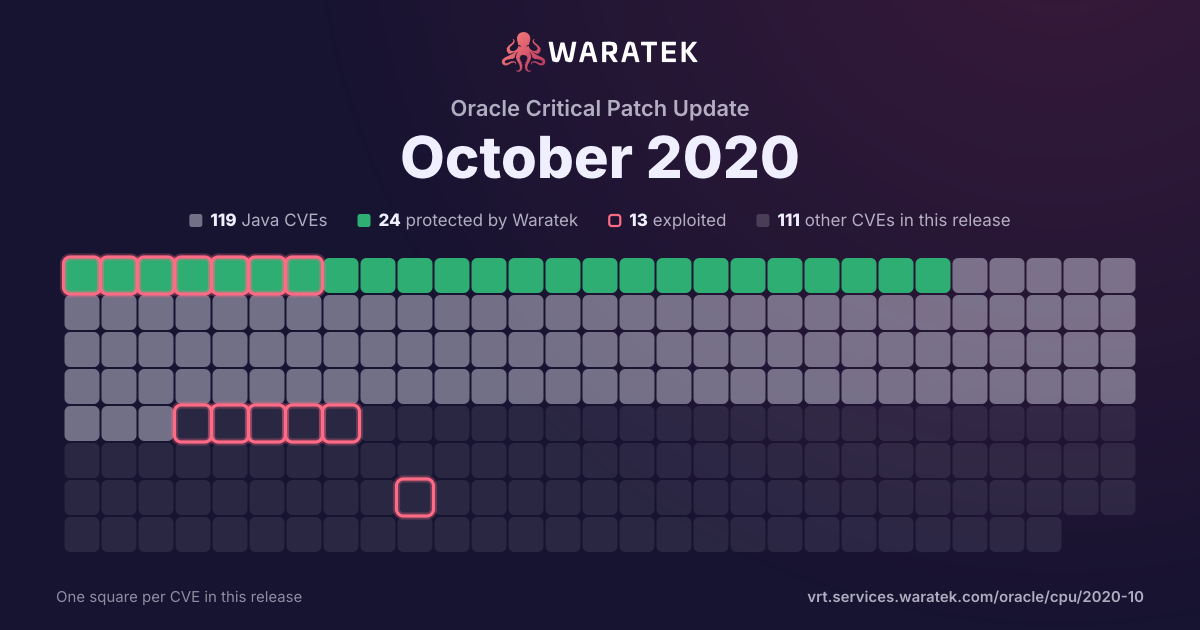
By status
24Protected by Waratek2Mitigation candidate93No exploit published64Outside Waratek scope47Not applicable
13Exploited, marked by the ring
No exploit published. For 75 of them, Oracle's security advisory is the source of public detail.
Protected by Waratek. Waratek RASP can block exploitation of these on systems that have not applied the patch yet.
Overview 206 matches · 95 in Waratek scope · 0 protected · 6 exploited · 2 CISA KEV · 9 public PoC · 11 EPSS ≥ 0.5
206matches
95in Waratek scope46.1%
0protected0.0%
6exploited2.9%
2CISA KEV1.0%
9public PoC4.4%
11EPSS ≥ 0.55.3%
Protected by Waratek
0
0.0%
Rule in development
0
0.0%
Mitigation candidate
2
1.0%
No exploit published
93
45.1%
Outside Waratek scope
64
31.1%
Not applicable
47
22.8%
Withdrawn CVE
0
0.0%
blocked by ARMR today
0
0.0%
partly blocked
0
0.0%
not blocked
206
100.0%
not established
0
0.0%
unrecorded
0
0.0%
split by
peak 152 / quarter
Q4 161
Outside Waratek scope1
Critical1
not blocked1
No public exploit1
Q1 170
Q2 170
Q3 171
Not applicable1
Critical1
not blocked1
No public exploit1
Q4 170
Q1 180
Q2 182
No exploit published2
Critical1
High1
not blocked2
No public exploit2
Q3 182
Outside Waratek scope1
Not applicable1
Critical1
Medium1
not blocked2
No public exploit2
Q4 180
Q1 190
Q2 196
No exploit published3
Outside Waratek scope1
Not applicable2
Critical1
High2
Medium3
not blocked6
Exploited1
Proof of concept only1
Forecast only1
No public exploit3
Q3 199
No exploit published2
Outside Waratek scope5
Not applicable2
Critical3
High4
Medium2
not blocked9
Exploited1
No public exploit8
Q4 196
No exploit published6
Critical4
High1
Medium1
not blocked6
No public exploit6
Q1 205
Mitigation candidate1
No exploit published2
Outside Waratek scope2
Critical2
High1
Medium2
not blocked5
Proof of concept only1
No public exploit4
Q2 2018
No exploit published5
Outside Waratek scope8
Not applicable5
High5
Medium12
Low1
not blocked18
Exploited2
Proof of concept only1
No public exploit15
Q3 204
Mitigation candidate1
No exploit published1
Outside Waratek scope1
Not applicable1
Critical2
High2
not blocked4
Exploited1
Working exploit published1
No public exploit2
Q4 20152
No exploit published72
Outside Waratek scope45
Not applicable35
Critical6
High33
Medium96
Low17
not blocked152
Exploited1
No public exploit151
Q4 16Q2 17Q4 17Q2 18Q4 18Q2 19Q4 19Q2 20Q4 20
| CVE | Severity | Published▾ | Status | Exploitation | Description |
|---|---|---|---|---|---|
| CVE-2018-11058 | Critical | 2018-09-14 | Outside Waratek scope | No public exploit | RSA BSAFE Micro Edition Suite, versions prior to 4.0.11 (in 4.0.x) and prior to 4.1.6 (in 4.1.x), and RSA BSAFE Crypto-C Micro Edition, version prior to 4.0.5.3 (in 4.0.x) contain a Buffer Over-Read vulnerability when parsing ASN.1 data. A remote attacker could use maliciously constructed ASN.1 data that would result in such issue. |
| CVE-2018-3693 | Medium | 2018-07-10 | Not applicable | No public exploit | Systems with microprocessors utilizing speculative execution and branch prediction may allow unauthorized disclosure of information to an attacker with local user access via a speculative buffer overflow and side-channel analysis. |
| CVE-2017-7658 | Critical | 2018-06-26 | No exploit published | No public exploit | In Eclipse Jetty Server, versions 9.2.x and older, 9.3.x (all non HTTP/1.x configurations), and 9.4.x (all HTTP/1.x configurations), when presented with two content-lengths headers, Jetty ignored the second. When presented with a content-length and a chunked encoding header, the content-length was ignored (as per RFC 2616). If an intermediary decided on the shorter length, but still passed on the longer body, then body content could be interpreted by Jetty as a pipelined request. If the intermediary was imposing authorization, the fake pipelined request would bypass that authorization. |
| CVE-2018-2765 | High | 2018-04-19 | No exploit published | No public exploit | Vulnerability in the Oracle Security Service component of Oracle Fusion Middleware (subcomponent: Oracle SSL API). Supported versions that are affected are 11.1.1.9.0, 12.1.3.0.0, 12.2.1.2.0 and 12.2.1.3.0. Easily exploitable vulnerability allows unauthenticated attacker with network access via HTTPS to compromise Oracle Security Service. Successful attacks of this vulnerability can result in unauthorized access to critical data or complete access to all Oracle Security Service accessible data. CVSS 3.0 Base Score 7.5 (Confidentiality impacts). CVSS Vector: (CVSS:3.0/AV:N/AC:L/PR:N/UI:N/S:U/C:H/I:N/A:N). |
| CVE-2017-9800 | Critical | 2017-08-11 | Not applicable | No public exploit | A maliciously constructed svn+ssh:// URL would cause Subversion clients before 1.8.19, 1.9.x before 1.9.7, and 1.10.0.x through 1.10.0-alpha3 to run an arbitrary shell command. Such a URL could be generated by a malicious server, by a malicious user committing to a honest server (to attack another user of that server's repositories), or by a proxy server. The vulnerability affects all clients, including those that use file://, http://, and plain (untunneled) svn://. |
| CVE-2015-1832 | Critical | 2016-10-03 | Outside Waratek scope | No public exploit | XML external entity (XXE) vulnerability in the SqlXmlUtil code in Apache Derby before 10.12.1.1, when a Java Security Manager is not in place, allows context-dependent attackers to read arbitrary files or cause a denial of service (resource consumption) via vectors involving XmlVTI and the XML datatype. |