
Oracle Critical Patch Update October 2020
Released October 2020 · Oracle's advisory ↗ · ← Critical Patch Update, July 2020 · Critical Patch Update, January 2021 →
230 CVEs in this release, one square each
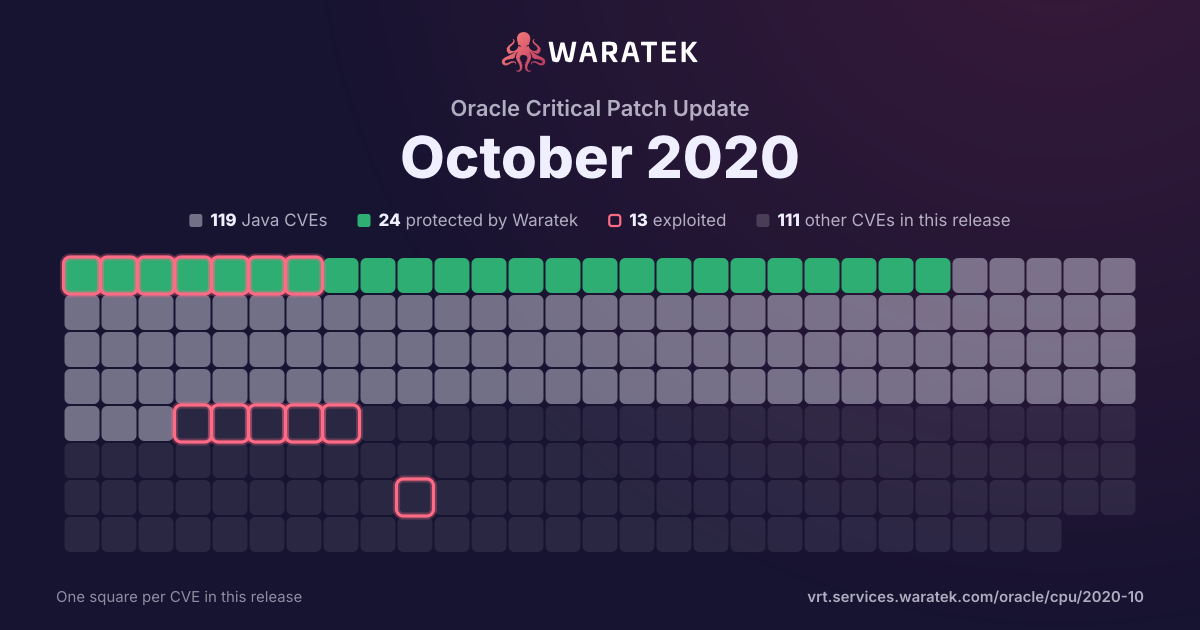
By status
24Protected by Waratek2Mitigation candidate93No exploit published64Outside Waratek scope47Not applicable
13Exploited, marked by the ring
No exploit published. For 75 of them, Oracle's security advisory is the source of public detail.
Protected by Waratek. Waratek RASP can block exploitation of these on systems that have not applied the patch yet.
Overview 6 matches · 0 in Waratek scope · 0 protected · 2 CISA KEV · 5 public PoC
Protected by Waratek
0
0.0%
Rule in development
0
0.0%
Mitigation candidate
0
0.0%
No exploit published
0
0.0%
Outside Waratek scope
5
83.3%
Not applicable
1
16.7%
Withdrawn CVE
0
0.0%
blocked by ARMR today
0
0.0%
partly blocked
0
0.0%
not blocked
6
100.0%
not established
0
0.0%
unrecorded
0
0.0%
Exploited
6
100.0%
Working exploit published
0
0.0%
Proof of concept only
0
0.0%
Forecast only
0
0.0%
No public exploit
0
0.0%
split by
peak 2 / quarter
Q2 191
Outside Waratek scope1
Medium1
not blocked1
Exploited1
Q3 191
Outside Waratek scope1
High1
not blocked1
Exploited1
Q4 190
Q1 200
Q2 202
Outside Waratek scope2
Medium2
not blocked2
Exploited2
Q3 201
Outside Waratek scope1
Critical1
not blocked1
Exploited1
Q4 201
Not applicable1
Critical1
not blocked1
Exploited1
Q2 19Q3 19Q4 19Q1 20Q2 20Q3 20Q4 20
| CVE | Severity | Published▾ | Status | Exploitation | Description |
|---|---|---|---|---|---|
| CVE-2020-14871 | Critical | 2020-10-21 | Not applicable | Exploited | Vulnerability in the Oracle Solaris product of Oracle Systems (component: Pluggable authentication module). Supported versions that are affected are 10 and 11. Easily exploitable vulnerability allows unauthenticated attacker with network access via multiple protocols to compromise Oracle Solaris. While the vulnerability is in Oracle Solaris, attacks may significantly impact additional products. Successful attacks of this vulnerability can result in takeover of Oracle Solaris. Note: This CVE is not exploitable for Solaris 11.1 and later releases, and ZFSSA 8.7 and later releases, thus the CVSS Base Score is 0.0. CVSS 3.1 Base Score 10.0 (Confidentiality, Integrity and Availability impacts). CVSS Vector: (CVSS:3.1/AV:N/AC:L/PR:N/UI:N/S:C/C:H/I:H/A:H). |
| CVE-2020-11984 | Critical | 2020-08-07 | Outside Waratek scope | Exploited | Apache HTTP server 2.4.32 to 2.4.44 mod_proxy_uwsgi info disclosure and possible RCE |
| CVE-2020-11023 | Medium | 2020-04-29 | Outside Waratek scope | Exploited | In jQuery versions greater than or equal to 1.0.3 and before 3.5.0, passing HTML containing <option> elements from untrusted sources - even after sanitizing it - to one of jQuery's DOM manipulation methods (i.e. .html(), .append(), and others) may execute untrusted code. This problem is patched in jQuery 3.5.0. |
| CVE-2020-11022 | Medium | 2020-04-29 | Outside Waratek scope | Exploited | In jQuery starting with 1.12.0 and before 3.5.0, passing HTML from untrusted sources - even after sanitizing it - to one of jQuery's DOM manipulation methods (i.e. .html(), .append(), and others) may execute untrusted code. This problem is patched in jQuery 3.5.0. |
| CVE-2019-10097 | High | 2019-09-26 | Outside Waratek scope | Exploited | In Apache HTTP Server 2.4.32-2.4.39, when mod_remoteip was configured to use a trusted intermediary proxy server using the "PROXY" protocol, a specially crafted PROXY header could trigger a stack buffer overflow or NULL pointer deference. This vulnerability could only be triggered by a trusted proxy and not by untrusted HTTP clients. |
| CVE-2019-11358 | Medium | 2019-04-20 | Outside Waratek scope | Exploited | jQuery before 3.4.0, as used in Drupal, Backdrop CMS, and other products, mishandles jQuery.extend(true, {}, ...) because of Object.prototype pollution. If an unsanitized source object contained an enumerable __proto__ property, it could extend the native Object.prototype. |